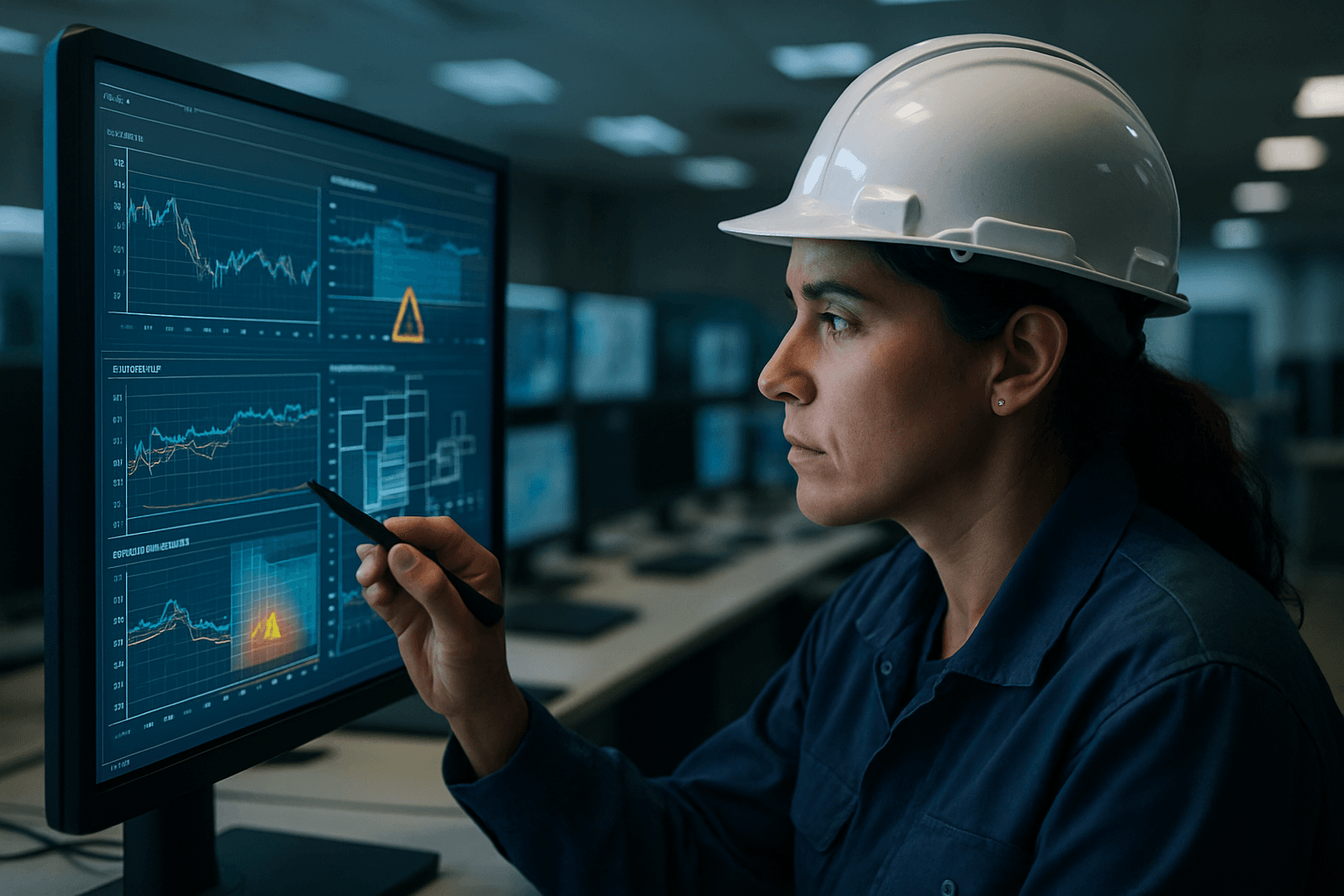
In the complex world of industrial refrigeration and HVAC, the efficiency of a condenser is paramount. These critical components are the workhorses of cooling systems, responsible for rejecting heat and ensuring the smooth operation of everything from large-scale food processing plants to commercial air conditioning units. However, hidden inefficiencies and impending failures often go unnoticed until they lead to costly downtime, increased energy consumption, or even catastrophic system breakdowns. The good news? A new era of predictive maintenance, powered by deep learning, is emerging to safeguard these vital systems, transforming raw performance data into actionable insights for enhanced energy efficiency and operational longevity.
The Critical Role of Condensers in Industrial Systems
Condensers are fundamental heat exchangers in various thermal systems, including refrigeration units, steam turbine systems, and HVAC installations. Their primary function is to convert a working fluid from its vapor phase to its liquid phase by rejecting heat to a cooling medium, such as air or water.
In industrial refrigeration, condensers are essential for maintaining effective heat exchange throughout the refrigeration cycle, rejecting heat from the compressed refrigerant. In HVAC systems, the condenser, often recognized as the outdoor unit, plays a pivotal role in humidity control and maintaining desired indoor temperatures by releasing absorbed heat to the outside atmosphere. The efficiency of these devices directly impacts overall energy consumption and operational costs. High-efficiency condensers enable the refrigerant to turn into liquid more quickly and effectively, leading to reduced energy consumption and operating costs. Conversely, issues like dirt, dust, or debris on the condenser’s outer surface can negatively affect heat transfer and reduce system efficiency. Uncleaned condenser tubes can cause compressors to overheat, leading to heat and energy loss, and even compressor failures, which are major expenses in HVAC system operations.
Traditional Anomaly Detection: Strengths and Limitations
Historically, detecting anomalies in industrial systems, including condenser performance, has relied on a combination of rule-based systems, statistical methods, and manual inspections.
Rule-Based Systems and Threshold Alarms
Conventional HVAC systems often utilize rule-based controls that activate actions based on predetermined thresholds (e.g., activating cooling if temperature exceeds a certain limit). While straightforward to implement, these systems struggle to adapt to dynamic environmental fluctuations, non-linear system behavior, or to optimize for multiple goals simultaneously, such as comfort, cost, and efficiency. They can also be fooled by issues that aren’t immediately apparent, such as condenser tubes that appear clean but are internally fouled.
Statistical Methods for Baseline Monitoring
Statistical approaches establish normal operating ranges based on historical data distributions. Methods like moving averages can detect gradual shifts in process parameters, while exponential smoothing identifies trends in noisy industrial data. Techniques such as Principal Component Analysis (PCA) have also been used for fault detection and diagnosis in chillers. These methods are more sophisticated than simple thresholding but may still miss subtle, complex anomalies that don’t fall neatly outside statistical bounds or involve intricate correlations between multiple sensor readings.
Manual Inspections and Their Challenges
Regular maintenance and manual inspections are critical for improving the performance and extending the lifespan of cooling systems. Periodic cleaning and checks ensure efficient operation and prevent malfunctions caused by accumulated dirt or debris. However, manual inspections are often reactive, time-consuming, and prone to human error, making it difficult to detect incipient faults before they escalate. They also incur significant maintenance budgets, with a substantial portion often wasted on unnecessary interventions, while still missing a high percentage of developing failures between scheduled inspections.
The Dawn of Deep Learning in Anomaly Detection
Deep learning, a subset of machine learning, is revolutionizing industrial anomaly detection by enabling systems to learn complex patterns from raw sensor data automatically. Unlike traditional methods, deep learning models can uncover subtle deviations from normal operating behavior that might indicate emerging problems, even when simple thresholds aren’t violated.
Why Deep Learning for Condenser Data?
Condenser performance data, characterized by continuous streams of measurements like temperature, pressure, energy consumption, and airflow, constitutes time-series data. This type of data often exhibits complex temporal dependencies and non-linear relationships that traditional methods struggle to capture. Deep learning models, particularly recurrent neural networks (RNNs) and their variants, are uniquely suited for processing sequential data.
Deep learning facilitates real-time decision-making, ongoing learning, and accurate control by comprehending complex relationships between various operational variables. This capability is crucial for identifying anomalous system behavior, suboptimal energy consumption, or wear in components, aligning with the goals of Industrial Internet of Things (IIoT) and Industry 4.0 initiatives.
Key Deep Learning Models for Time Series Anomaly Detection
Several deep learning architectures have proven effective for anomaly detection in time-series data:
Long Short-Term Memory (LSTM) Networks
LSTMs are a type of Recurrent Neural Network (RNN) specifically designed to model temporal sequences and long-range dependencies more accurately than regular RNNs. Their memory cells and gating mechanisms allow them to store temporal states and learn complex time dependencies, making them highly effective for reconstructing normal sequences and detecting deviations.
Autoencoders
An autoencoder is a neural network designed to copy its input to its output, with an internal hidden layer that encodes the input into a compressed representation. By training the network to minimize the difference between the input and output (reconstruction error), it learns efficient encodings of the data. For anomaly detection, an autoencoder is trained on normal, anomaly-free data. When new data is fed into the trained autoencoder, a high reconstruction error indicates a pattern the model hasn’t seen before, flagging it as a potential anomaly.
LSTM Autoencoders
Combining LSTMs with autoencoders creates a powerful model for time-series anomaly detection. An LSTM autoencoder uses LSTM layers to learn representations of temporal input sequences. It consists of an encoder LSTM that compresses the input sequence into a low-dimensional latent representation and a decoder LSTM that attempts to reconstruct the original sequence. The model learns to reproduce normal patterns effectively but struggles to reconstruct sequences that deviate from the norm, such as anomalies. High reconstruction error then signals an anomaly. This approach is particularly powerful as it doesn’t require labeled training data for anomalies and adapts to complex sequential patterns.
Other Advanced Architectures
Beyond LSTMs and autoencoders, other deep learning models are being explored for time-series anomaly detection in industrial contexts:
- Variational Autoencoders (VAEs): These generative models can learn complex data distributions and are used for anomaly detection by identifying data points that fall outside the learned normal distribution.
- Generative Adversarial Networks (GANs): GANs can also learn the distribution of normal data and detect anomalies as inputs that the generator struggles to produce or the discriminator identifies as fake.
- Transformer Models: Increasingly, transformer-based models are achieving state-of-the-art results for various time-series anomaly detection tasks, outperforming LSTM autoencoders in some refrigeration system applications.
- Gated Recurrent Unit (GRU) Networks: Similar to LSTMs, GRUs are also effective in processing sequential data and have shown high accuracy in fault identification in HVAC systems.
Benefits of Deep Learning for Condenser Anomaly Detection
The application of deep learning to condenser performance data yields significant advantages for industrial refrigeration and HVAC:
Enhanced Predictive Maintenance
Deep learning enables condition-based interventions rather than relying on fixed schedules or post-failure responses. By analyzing sensor streams against baseline performance models, machine learning algorithms can detect subtle degradation patterns, allowing for early detection of equipment failures. This proactive approach can lead to a substantial reduction in unplanned failures and extended equipment life. For example, predicting a compressor failure weeks in advance can prevent costly emergency repairs and unexpected downtime.
Improved Energy Efficiency
Faulty system states in industrial refrigeration systems lead to inefficient operating conditions and increased energy consumption. Deep learning models can optimize HVAC energy efficiency, leading to 20-40% energy savings through predictive and adaptive control. By identifying anomalies that signal inefficiencies, such as dirty coils or refrigerant leaks, deep learning ensures that systems operate closer to their optimal performance, reducing energy waste and carbon emissions.
Reduced Operational Costs
By preventing major breakdowns and optimizing maintenance schedules, deep learning significantly lowers overall operational and maintenance costs. Predictive maintenance reduces unnecessary interventions (compared to time-based preventive maintenance) and minimizes costly unplanned downtime.
Real-time Monitoring and Diagnostics
IoT sensors continuously monitor parameters like vibration, temperature, pressure, current draw, refrigerant levels, and airflow, generating thousands of data points per minute. Deep learning models can process this real-time data to identify issues as they develop, providing immediate insights and enabling timely corrective actions.
Challenges and Future Directions
While the promise of deep learning for condenser anomaly detection is significant, several challenges must be addressed for widespread adoption:
Data Quality and Availability
High-quality, clean, and well-labeled data is crucial for training effective deep learning models. Industrial data can suffer from noisiness, strong outliers, and differences in feature ranges. A lack of labeled anomaly data often necessitates the use of unsupervised or semi-supervised learning techniques. Data preprocessing steps, including cleaning, normalization, and validation, are essential.
Model Complexity and Interpretability
Deep learning models, particularly deep neural networks, can be complex “black boxes,” making it challenging to understand why a particular anomaly was detected. This lack of interpretability can hinder trust and adoption by maintenance personnel. Research into Explainable AI (XAI) methods is critical to provide enhanced transparency and trustworthiness of predictive outcomes.
Computational Requirements and Deployment
Implementing real-time anomaly detection systems with deep learning models can be computationally intensive, requiring robust data pipelines and significant processing power. Deploying these models in edge computing environments or integrating them into existing industrial control systems requires careful consideration.
Generalization and Adaptability
Models trained on data from one specific chiller or condenser system may not generalize well to others due to variations in design, operating conditions, and sensor configurations. Developing robust models that can adapt to evolving operational patterns and different equipment types is an ongoing challenge.
Conclusion
The integration of deep learning for anomaly detection in condenser performance data marks a pivotal advancement in industrial refrigeration and HVAC. By moving beyond traditional reactive or rule-based maintenance strategies, deep learning offers a proactive, intelligent approach to monitoring and optimizing these critical systems. Models like LSTM autoencoders can identify subtle inefficiencies and impending failures with remarkable accuracy, leading to significant gains in energy efficiency, substantial reductions in operational costs, and prolonged equipment lifespan. As the Industrial Internet of Things (IIoT) continues to expand, overcoming challenges related to data quality, model interpretability, and deployment will pave the way for a future where intelligent, self-optimizing cooling systems are the norm, contributing to both economic advantages and environmental sustainability.