
Chemical Processing
Design of Experiments
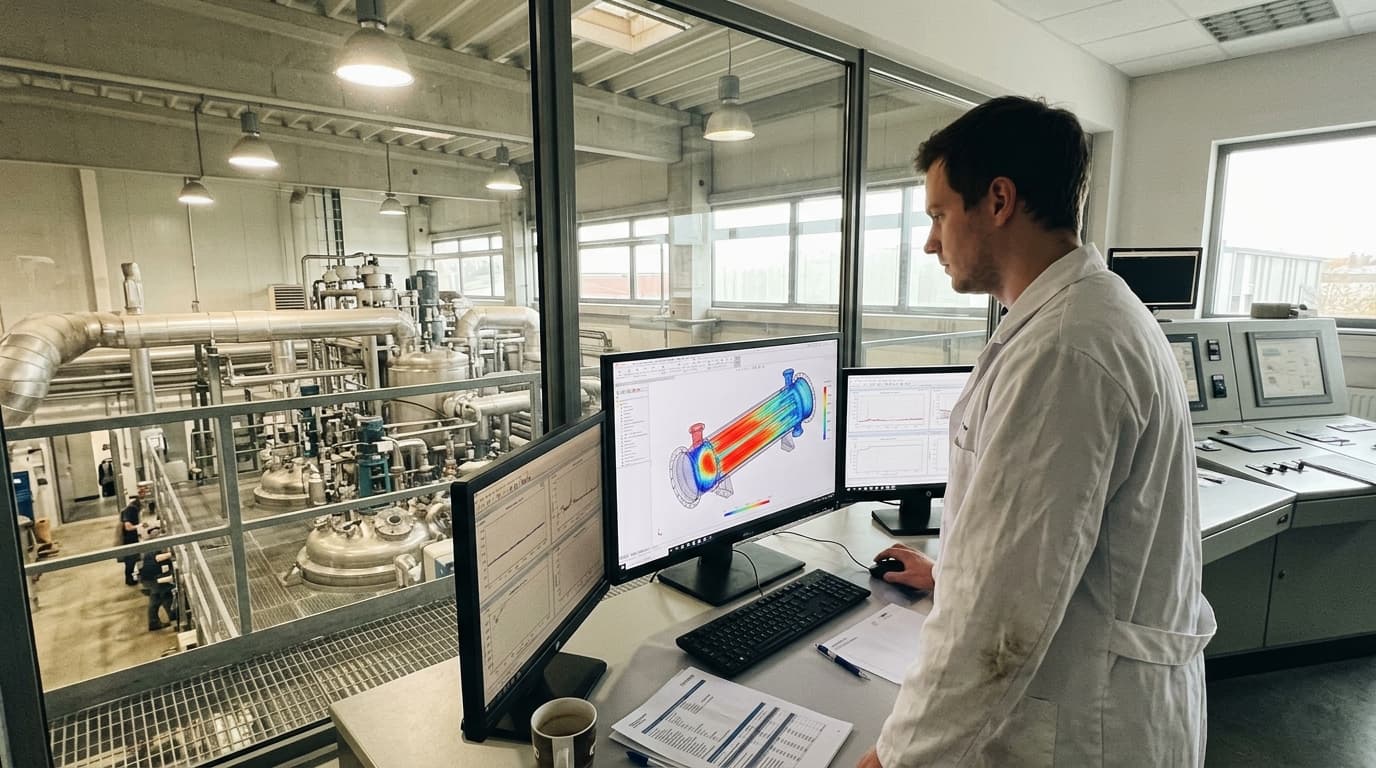
Chemical processes involve complex multi-variable interactions where DOE delivers 15–30% yield improvements. Our engineers systematically optimise reaction conditions, catalyst performance, and distillation parameters through statistically rigorous experimental design.
DOE Challenges
in Chemical Processing
Reaction complexity, catalyst interactions, and safety constraints drive chemical processing DOE needs.
Reaction Yield Maximisation
Temperature, pressure, residence time, and catalyst loading all influence reaction yield and selectivity. DOE identifies the optimal combination while respecting safety and equipment constraints.
Catalyst Performance Tuning
Catalyst activity, selectivity, and lifecycle depend on operating conditions. DOE determines the factor settings that maximise catalyst utilisation and minimise deactivation rates.
Distillation Column Factors
Reflux ratio, feed location, tray design, and operating pressure interact to determine separation efficiency. DOE optimises column performance while minimising energy consumption.
Scale-Up Validation
Laboratory-optimised conditions must be validated at pilot and production scale. DOE identifies which factors are scale-sensitive and establishes robust operating windows for scale-up.
Our 8-Step
DOE Framework
A systematic 8-step DOE methodology for chemical process optimisation and yield improvement.
Planning
Define clear objectives, success criteria, and measurable KPIs that align the experiment with your broader engineering and business goals.
Identify all relevant factors and their operational levels, establish measurement system reliability through Gauge R&R studies, and define statistical control boundaries. A robust plan ensures resources are allocated efficiently and that every test run produces actionable data.
Screening
Run targeted preliminary experiments to separate the critical few factors from the trivial many, drastically reducing experimental scope.
Leverage Fractional Factorial, Plackett-Burman, or Definitive Screening Designs to evaluate dozens of potential variables in a fraction of the runs a full factorial would require. The deliverable is a ranked Pareto chart of factor significance, enabling your team to focus on the variables that truly drive performance.
Modelling
Construct a rigorous mathematical model that quantifies how significant factors and their interactions drive your response variable.
Apply Full Factorial or Response Surface designs to capture main effects, two-way interactions, and curvature. The resulting model is validated with ANOVA, residual diagnostics, and R-squared metrics to ensure it reliably predicts system behaviour across the design space.
Optimisation
Fine-tune factor settings using response surface methodology to pinpoint the operating conditions that maximise yield, quality, or efficiency.
Deploy Central Composite or Box-Behnken Designs to map the response surface and locate global optima, even in the presence of complex factor interactions. Multi-objective optimisation techniques such as desirability functions are applied when balancing competing performance targets.
Verification
Execute confirmation runs under the predicted optimal conditions to validate that the model accurately reflects real-world process behaviour.
Compare observed responses against model predictions using confidence and prediction intervals to assess agreement. If deviations exceed acceptable thresholds, the model and optimisation parameters are iteratively refined until robust, repeatable performance is confirmed.
Execution
Carry out each experimental run according to the randomised design matrix, maintaining strict control over environmental conditions and procedural consistency.
All relevant process parameters, environmental readings, and response measurements are recorded in structured data logs with full traceability. Randomisation and blocking strategies are enforced to guard against systematic bias, ensuring the collected dataset is statistically sound.
Analysis
Apply statistical analysis — including ANOVA, effect plots, and contour maps — to extract meaningful patterns, interactions, and correlations from the experimental data.
Beyond classical statistics, advanced predictive models are built using neural networks (SANN), machine learning algorithms, and AI-driven pattern recognition. These complementary techniques uncover non-linear relationships that traditional regression may miss, delivering deeper process understanding.
Utilisation
Translate experimental insights into concrete process improvements, updated specifications, and operational best practices that drive measurable business value.
A comprehensive report documenting the experimental design, statistical findings, and recommended operating windows is delivered to all stakeholders. Knowledge is embedded into SOPs, control plans, and continuous improvement frameworks to ensure long-term retention and replication across projects.
What You
Receive
Comprehensive DOE deliverables for chemical process optimisation and scale-up.
Screening Design Report
Identification of statistically significant factors using fractional factorial or definitive screening designs.
Interaction Analysis
Two-factor and higher-order interaction effects with statistical significance testing and practical importance assessment.
Response Surface Model
Central composite or Box-Behnken design results with contour plots for yield, selectivity, and purity responses.
Multi-Response Optimisation
Simultaneous optimisation of competing responses (yield vs selectivity vs purity) using desirability functions.
Scale-Up Assessment
Factor sensitivity analysis with scale-dependent parameter identification and recommended pilot-scale verification experiments.
Process Robustness Study
Transmission of variation analysis showing process sensitivity to factor fluctuations with recommended control limits.
Proven Results in
Chemical Processing
Based on DOE projects across batch and continuous chemical processes.
Related Products
& Services
Complementary equipment and engineering services for your process.










Chemical Processing
DOE FAQ
Common questions about Design of Experiments in chemical processing.
Yes. We adapt DOE methodology for continuous processes using steady-state experimental designs, split-plot designs for hard-to-change factors, and appropriate randomisation strategies to account for process dynamics.
Safety limits are incorporated as hard constraints in the experimental design. We use constrained designs that respect operating envelopes and include risk assessment review before any experimental plan is executed.
We use screening designs (Plackett-Burman, Definitive Screening) to efficiently identify the vital few factors from many candidates, typically reducing 10-15 suspected factors to 3-5 key variables for detailed optimisation.
Yes. Multi-response optimisation using desirability functions handles competing objectives like maximising yield while minimising impurity formation and energy consumption. Each response can be weighted by business importance.
Ready to
Optimise?
Our chemical engineering DOE specialists deliver systematic process optimisation for yield improvement and cost reduction.
- Systematic multi-variable optimisation
- Chemical Processing-specific DOE methodology
- AI & ML-powered predictive modelling