
Power Generation
Heat & Mass Balance
Power plants — from gas turbines to biomass and waste-to-energy facilities — require precise heat and mass balances to optimise boiler efficiency, turbine cycle performance, and cooling systems. Our H&MB analyses model the complete thermodynamic cycle, identify efficiency losses, and deliver actionable improvements to push thermal efficiency beyond 92%.
H&MB Challenges
in Power Generation
Boiler efficiency, turbine cycle analysis, and cooling water modelling demand rigorous thermodynamic accounting.
Boiler Efficiency Balances
Accurate boiler energy balances quantify combustion efficiency, radiation losses, blowdown losses, and flue gas heat content — essential for identifying efficiency improvement opportunities.
Turbine Cycle Analysis
Steam and gas turbine cycles involve multiple pressure levels, extraction points, and reheat stages. Precise enthalpy balances at every stage determine actual vs design cycle efficiency.
Cooling Water System Modelling
Condenser heat rejection and cooling tower performance depend on accurate mass and energy balances accounting for evaporation, drift, blowdown, and ambient conditions.
Multi-Fuel Operations
Plants burning multiple fuels (gas, coal, biomass, waste) require fuel-specific combustion calculations with varying heating values, moisture content, and ash composition.
Our 11-Step
Methodology
A systematic approach refined for power generation thermodynamics.
Initial Meeting with Customer
Engage with the customer in a structured kick-off session to thoroughly understand process requirements, operating constraints, and performance targets.
We define the full project scope, success criteria, and key deliverables while mapping stakeholder expectations. This early alignment ensures that engineering efforts remain focused on the outcomes that matter most to your operation.
Data Gathering
Collect comprehensive plant data including piping and instrumentation diagrams, equipment datasheets, laboratory analyses, and historical operating logs.
We systematically catalogue temperature, pressure, flow rate, composition, and thermophysical property data for every process stream. Missing or uncertain data points are flagged early so that targeted measurements or conservative design assumptions can be applied before modelling begins.
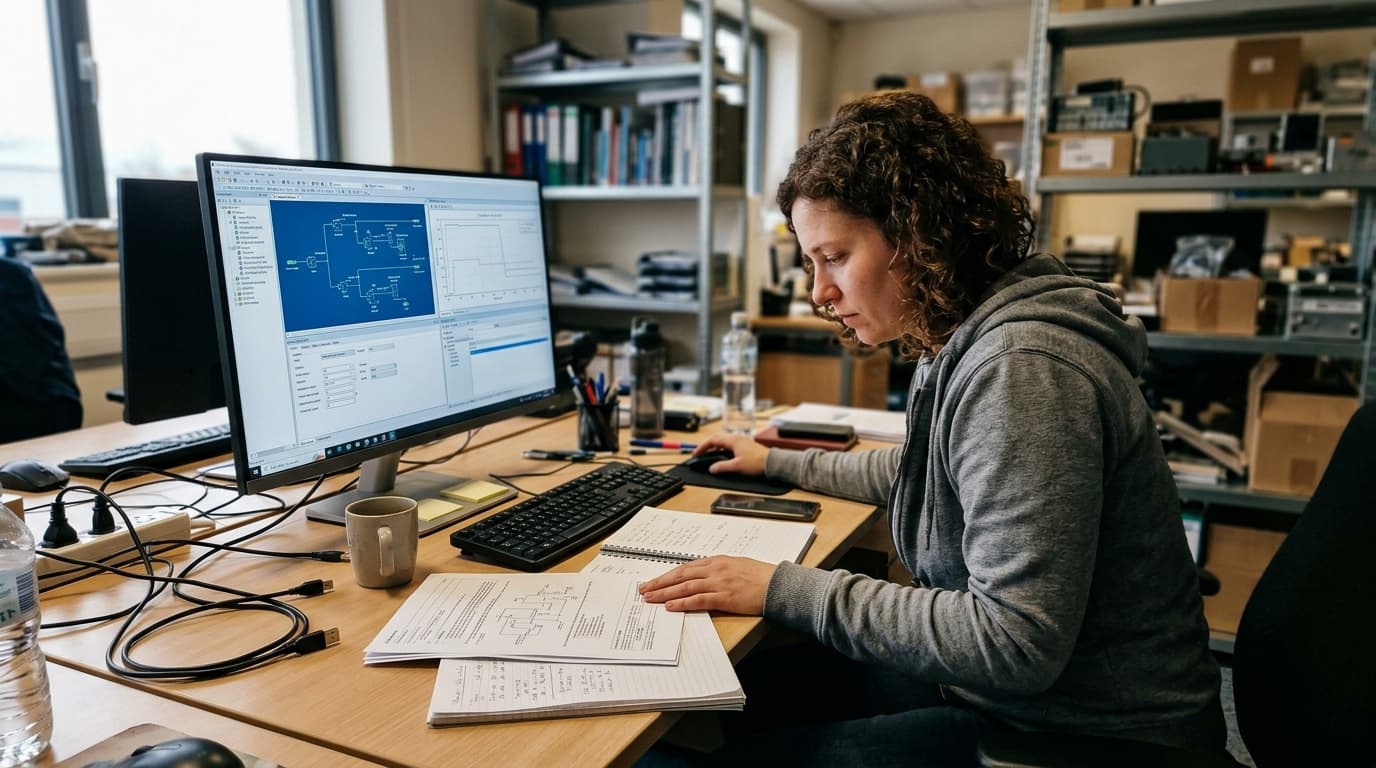
Process Simulation
Utilise industry-standard simulation platforms such as Aspen Plus, HYSYS, or DWSIM to build rigorous steady-state and dynamic models of the process.
Appropriate thermodynamic packages and equation-of-state models are selected to accurately capture phase behaviour and reaction kinetics. The simulation fidelity is directly tied to the quality of input data, and our engineers validate each sub-model against known benchmarks before integrating the full flowsheet.
Data Analysis
Analyse simulation outputs to quantify heat duties, mass transfer rates, energy consumption profiles, and utility demands across every unit operation.
Our engineers perform sensitivity analyses and pinch-point evaluations to expose thermodynamic bottlenecks, excess energy losses, and capacity constraints. The results are benchmarked against industry norms so that improvement opportunities are grounded in measurable performance gaps.
Report & Presentation
Compile findings into a structured technical report with simulation outcomes, heat-recovery opportunities, and prioritised optimisation recommendations.
The report is presented in a collaborative review session where our engineers walk through key findings, risk areas, and cost-benefit trade-offs. Actionable next steps and a preliminary implementation roadmap are agreed upon with the customer before proceeding to detailed design.
Process Flow Diagram (PFD)
Develop a comprehensive Process Flow Diagram capturing all major equipment items, interconnecting streams, control loops, and key operating conditions.
The PFD serves as the single-source-of-truth blueprint from which all heat and mass balance calculations are derived. Stream tables annotated with temperatures, pressures, enthalpies, and flow rates are embedded directly into the diagram, ensuring full traceability between the visual representation and the underlying engineering data.
Mass Balance Calculations
Apply species-level and overall mass balance equations to every unit operation, rigorously accounting for reactions, phase changes, and recycle loops.
Balances are resolved across liquid, gas, and solid phases, with particular attention to trace components that may accumulate in recycles or affect product purity. Closure tolerances are defined per stream, and any discrepancies are systematically reconciled before proceeding to energy calculations.
Energy Balance Calculations
Perform rigorous enthalpy-based energy balances to quantify heating, cooling, and work duties for every unit operation in the flowsheet.
Applying the first law of thermodynamics, we account for sensible heat, latent heat of phase transitions, heats of reaction, and mechanical work inputs. The resulting duty profiles feed directly into utility sizing, heat-exchanger specification, and pinch analysis for maximum energy recovery.
Iteration & Optimisation
Iteratively converge the coupled mass and energy balance equations, then apply parametric optimisation to maximise throughput, yield, or energy efficiency.
Process variables such as reflux ratios, heat-integration networks, recycle split fractions, and equipment capacities are systematically varied to identify the optimal configuration. Each iteration is evaluated against economic and operability constraints to ensure the solution is both technically sound and commercially viable.
Simulation & Validation
Cross-validate the finalised balance calculations against independent simulation runs, plant data, or pilot-scale measurements to confirm accuracy and robustness.
Turndown, upset, and seasonal operating scenarios are modelled to verify that the design performs reliably across its full operating envelope. This proactive validation identifies potential issues — such as fouling, flooding, or thermal stress — before capital is committed, significantly reducing project risk and rework costs.
Reporting & Documentation
Prepare the definitive heat and mass balance package comprising fully documented calculations, assumption registers, stream tables, and equipment duty summaries.
The deliverable set includes an executive summary for decision-makers alongside detailed appendices suitable for FEED or detailed design handover. Recommendations for energy-saving measures, capacity upgrades, and operational improvements are clearly prioritised by impact and implementation effort.
What You
Receive
Actionable performance engineering deliverables for power plant operations.
Boiler Performance Report
Complete combustion and heat balance for the boiler including efficiency calculation per BS EN 12952/12953 or ASME PTC 4 methodology.
Turbine Cycle Analysis
Stage-by-stage turbine analysis with steam tables, extraction flows, and isentropic efficiency calculations for the complete cycle.
Water/Steam Cycle Balance
Full mass and energy balance for the water/steam cycle including feedwater heaters, deaerator, attemperators, and blowdown.
Cooling System Model
Cooling tower or condenser heat balance with evaporation/drift losses, blowdown calculations, and seasonal performance predictions.
Fuel Analysis & Combustion
Detailed fuel analysis, stoichiometric combustion calculations, excess air optimisation, and flue gas composition prediction.
Efficiency Improvement Plan
Prioritised modifications to improve plant heat rate and thermal efficiency with capital cost estimates and payback periods.
Proven Results in
Power Generation
Based on H&MB studies across gas-fired, coal, biomass, and waste-to-energy power plants.
Related Products
& Services
Complementary equipment and engineering services for your process.





Power Generation
H&MB FAQ
Common questions from power plant operators about our heat and mass balance service.
We can apply either EN 12952/12953 (input-output and heat loss methods) or ASME PTC 4 depending on your requirements and jurisdiction. Both approaches provide comprehensive efficiency breakdowns with individual loss quantification.
Yes. We model the complete CCGT cycle including gas turbine, HRSG (multi-pressure), steam turbine, and condenser. The integrated model identifies pinch points, supplementary firing potential, and part-load performance.
We perform sensitivity analysis across your expected fuel quality range, modelling combustion and performance at multiple fuel compositions. This identifies the operating envelope and ensures equipment is sized for the worst-case scenario.
Yes. Our models include ambient temperature, humidity, and pressure corrections for gas turbine performance, cooling tower capacity, and condenser vacuum — allowing seasonal performance prediction and capacity planning.
Ready to
Optimise?
Our power generation engineers deliver precision H&MB analyses that maximise thermal efficiency and reduce operating costs.
- Comprehensive energy & material flow analysis
- Power Generation-specific process simulation
- Detailed cost-benefit analysis & documentation