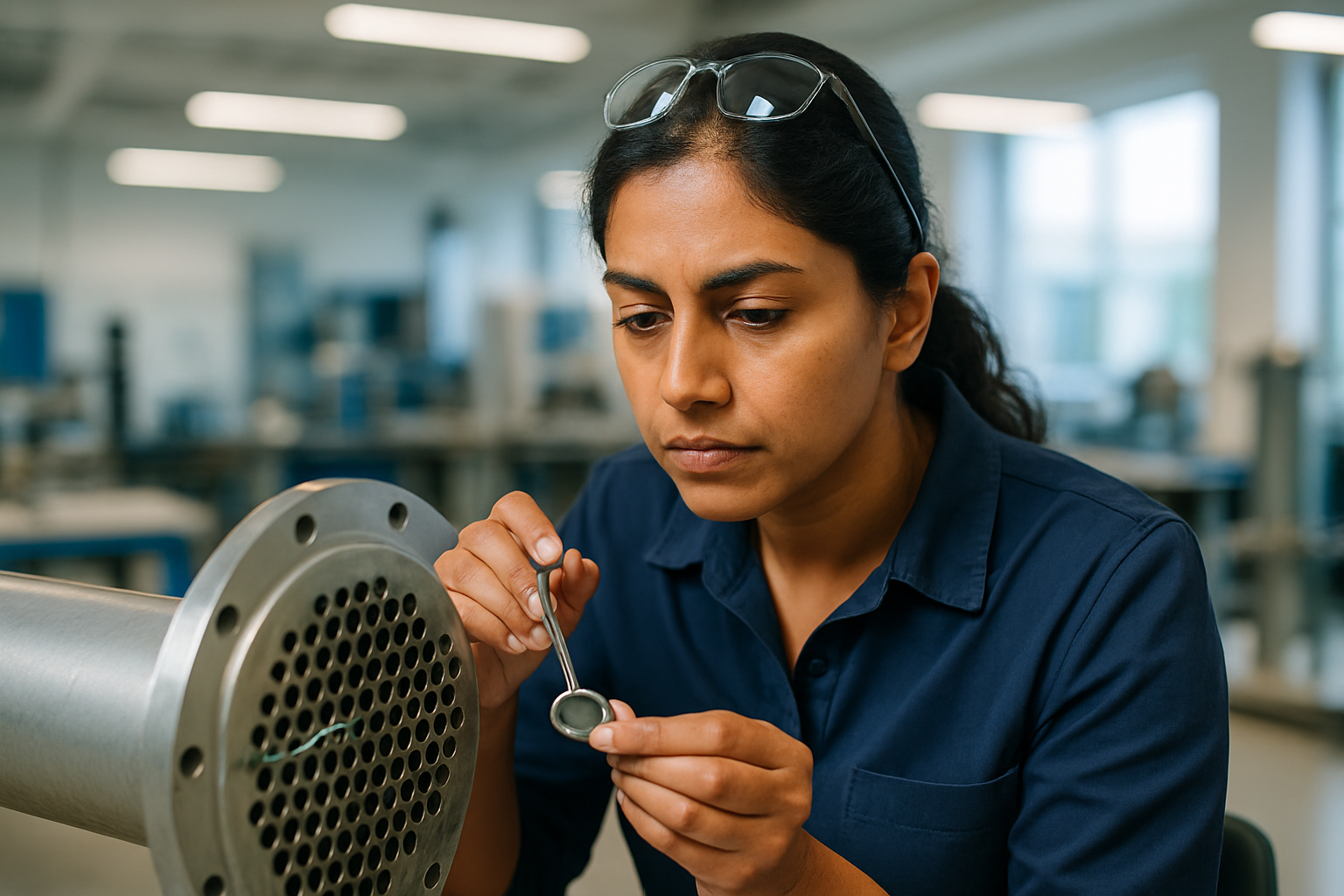
Shell and tube heat exchangers are the workhorses of industrial processes, facilitating crucial heat transfer across a vast array of temperatures, pressures, and flow rates in sectors like chemical processing, oil and gas, and power generation. However, optimizing their performance is a continuous pursuit, driven by the need for greater energy efficiency, reduced operational costs, and a smaller environmental footprint. A key strategy in achieving these goals lies in the innovative application of surface modifications to enhance heat transfer and mitigate common operational challenges.
The Imperative for Heat Transfer Enhancement
The core function of a heat exchanger is to transfer heat (Q) between two fluids, governed by the equation Q = U * A * ΔT, where U is the overall heat transfer coefficient, A is the heat transfer surface area, and ΔT is the temperature driving force. To increase heat duty or reduce the required surface area for a given duty, engineers can either increase the surface area or improve the overall heat transfer coefficient (OHTC).
Traditional shell and tube heat exchangers typically utilize plain tubes. While robust, these designs often present opportunities for significant improvements in thermal performance. By implementing enhancement techniques, industries can realize several benefits:
- Compactness: Smaller and lighter heat exchangers, reducing capital and installation costs, as well as plot space.
- Improved Efficiency: Higher heat transfer rates, leading to lower energy consumption and operational costs.
- Reliability & Maintenance: Reduced fouling, leading to longer operational periods and easier maintenance.
- Debottlenecking: Enhanced existing heat exchangers to meet increased process demands without requiring a larger footprint.
Diverse Strategies for Surface Modification
Surface modifications in shell and tube heat exchangers generally aim to increase the effective heat transfer surface area, promote turbulence, or inhibit fouling. These passive enhancement techniques typically do not require external power, offering a cost-effective solution.
Increasing Heat Transfer Surface Area
One of the most straightforward methods to boost heat transfer is to increase the available surface area. While simply making the heat exchanger larger is an option, it often comes with drawbacks such as higher cost, decreased OHTC, and potential fouling issues due to lower velocities. A more efficient approach is the use of extended surfaces.
- Finned Tubes: These are the most common technique for increasing surface area without significantly enlarging the heat exchanger’s overall size. Fins can be applied externally (low-fin tubes, particularly effective on the shell side for gas processes) or internally (internal ribs) to enhance heat transfer on either the shell or tube side, depending on the controlling thermal resistance.
Enhancing Heat Transfer Coefficient through Turbulence
The heat transfer coefficient is strongly influenced by fluid velocity and turbulence in single-phase flows. Modifying tube surfaces can disrupt the boundary layer and promote mixing, thereby increasing the heat transfer rate.
- Advanced Tube Geometries: Tubes can be designed with features such as corrugated or dimpled surfaces. These geometries induce secondary flows and turbulence, leading to higher heat transfer coefficients. Studies have shown that dimple profiles can significantly improve cooling effects.
- Tube Inserts (Turbulators): Devices like twisted tapes, wire mesh, spring-like wire inserts, or wire matrix inserts can be placed inside tubes. These inserts promote turbulence and mixing, especially effective with high-viscosity fluids in laminar flow regimes. Improvements in heat transfer film coefficients can be as high as five times, with wire matrix inserts potentially offering a 10x increase in laminar flow.
- Internal Ribs: These structures within the tubes create swirl flow, increasing the tube-side heat transfer coefficient and offering a small increase in surface area.
Fouling Mitigation through Surface Coatings and Textures
Fouling, the accumulation of unwanted deposits on heat exchanger surfaces, severely impedes heat transfer efficiency and increases pressure drop. Surface modifications can play a crucial role in reducing foulant adhesion.
- Anti-Fouling Coatings: Applying specialized coatings can create surfaces with low surface energy, making them less prone to foulant adhesion and buildup. Hydrophobic coatings, for example, have been shown to constantly remove condensed water droplets, preventing them from creating thermal resistance and increasing condensation heat transfer efficiency by over 5% in some cases.
- Material Selection: While not strictly a surface modification in the sense of texture, selecting materials with higher resistance to corrosion can prevent corrosion-induced fouling, which forms low thermal conductivity oxide layers.
- Surface Texturing for Phase Change: For boiling services, specially designed surfaces with a large number of nucleation sites or fin-like structures can significantly increase the heat transfer coefficient by improving nucleate boiling. Microscale cavities, dents, and nanometer-scale textures can control bubble formation, prevent film formation, and promote evaporation, improving both heat transfer coefficient and critical heat flux.
Challenges and Considerations in Implementation
Despite the clear advantages, implementing surface modifications comes with its own set of challenges.
- Pressure Drop: Many heat transfer enhancement techniques, particularly those promoting turbulence, also lead to an increase in pressure drop across the heat exchanger. This requires careful consideration of pumping power and operational costs.
- Cost and Manufacturing Complexity: The initial capital cost of enhanced tubes or coatings can be higher than plain tubes. The manufacturing processes for intricate surface geometries or specialized coatings can also add complexity and cost.
- Mechanical Reliability and Adhesion: Any enhancement technique must maintain equivalent or better mechanical reliability than plain tubes. Coatings, in particular, must demonstrate long-term adhesion to the substrate, especially when exposed to harsh process fluids and high temperatures, as failure can lead to deteriorating performance.
- Scalability: While promising results are often achieved in laboratory settings for advanced surface textures, scaling these up to industrial applications can be challenging.
The Future of Enhanced Heat Exchangers
The field of heat transfer enhancement is continuously evolving, driven by advancements in materials science and manufacturing.
- Additive Manufacturing: 3D printing technologies enable the creation of highly intricate flow path designs and surface textures that were previously impossible to achieve. This allows for optimized heat transfer and minimized pressure drops.
- Nanofluids and Phase-Change Materials: While not strictly surface modifications, these advanced fluids, when combined with optimized surfaces, can further boost thermal conductivity and energy storage capabilities. Nanofluids, suspensions of nanoparticles in base fluids, have demonstrated significant potential in enhancing convective heat transfer coefficients, with some studies showing 10% to 30% improvement.
- Smart Heat Exchangers and AI-Driven Design: The integration of sensors and AI can lead to real-time monitoring of performance metrics (temperature, pressure, flow rate), enabling predictive maintenance and optimized operation. AI can also be used to design and optimize heat exchanger characteristics for specific applications, considering a holistic approach to thermal-hydraulic performance.
- Hybrid Systems: The future will likely see hybrid approaches, combining multiple technologies such as surface modifications, advanced materials, and smart control systems for maximum efficiency and sustainability.
Conclusion
Surface modifications offer a powerful pathway to significantly enhance the performance of shell and tube heat exchangers. By strategically increasing surface area, promoting turbulence, and mitigating fouling through techniques like finned tubes, advanced tube geometries, inserts, and specialized coatings, industries can achieve more compact, efficient, and reliable heat transfer systems. While challenges related to pressure drop, cost, and manufacturing complexity remain, ongoing research and the emergence of advanced technologies like additive manufacturing and AI-driven design promise a future where shell and tube heat exchangers operate at unprecedented levels of efficiency, contributing to greater sustainability and profitability in industrial processes.