In the competitive world of industrial manufacturing, optimizing energy efficiency is no longer just a goal—it’s a strategic imperative. As factories strive towards net-zero manufacturing strategies and more robust energy management, a subtle yet significant threat often undermines these efforts: thermal bridges. These invisible pathways for heat transfer can lead to substantial energy loss, compromised product quality, and increased operational costs. Understanding, identifying, and mitigating thermal bridges is therefore crucial for any industrial facility aiming for genuine sustainability and peak performance.
What are Thermal Bridges and Why Do They Matter in Factories?
A thermal bridge, also known as a cold bridge, is an area within a building’s construction that allows heat to transfer more readily than the surrounding insulated materials. This typically occurs where there’s a break in insulation, reduced insulation, or where materials with higher thermal conductivity penetrate the insulation layer. In essence, they create “shortcuts” for heat to bypass the intended thermal barrier of a building’s envelope.
For industrial manufacturing plants, the impact of thermal bridges is particularly acute due to several factors:
- Significant Temperature Control Requirements: Many industrial processes, such as pharmaceutical manufacturing, food processing, and electronics production, demand precise temperature maintenance within specific zones. Thermal bridges create localized hot or cold spots, directly compromising product quality and equipment performance.
- High Energy Consumption: Factories often consume immense quantities of energy for heating, cooling, and ventilation. Thermal bridges force HVAC systems to work harder, consuming additional energy to maintain desired conditions, leading to higher heating and cooling costs.
- Risk of Condensation and Mould: When warm, moist indoor air meets cold surfaces created by thermal bridges, condensation can form. This moisture can lead to mould growth, material degradation, and structural damage, posing health risks to occupants and increasing maintenance costs.
- Compliance with Evolving Standards: Modern building codes and energy performance standards, such as IECC and ASHRAE 90.1, are increasingly addressing thermal bridging, making their mitigation a necessity for compliance.
Thermal bridges can account for a significant portion of a building’s heat loss, with some research suggesting they can be responsible for up to 30% of a dwelling’s heat loss, and can significantly reduce the effective R-value of a wall. In some cases, structural steel penetrating the building envelope can conduct thermal energy up to 400 times faster than properly insulated wall sections.
Common Locations of Thermal Bridges in Industrial Construction
Thermal bridges can manifest in various areas of a factory, often at junctions or penetrations where insulation continuity is compromised. Common locations include:
- Structural Connections: Steel beams penetrating exterior walls, column-to-foundation connections, and roof-to-wall interfaces are significant sources.
- Envelope Penetrations: Piping, electrical conduits, and equipment connections that breach the building envelope without proper thermal breaks create substantial heat transfer pathways.
- Cladding Systems: Metal panel attachment systems, window frames, and curtain wall connections often bypass insulation layers, creating continuous thermal paths.
- Junctions and Corners: Wall-to-floor junctions, roof joists, slab edges, and corners of outside walls are prone to thermal bridging.
- Discontinuities in Insulation: Areas with missing, compressed, or incorrectly installed insulation can act as thermal bridges.
Advanced Methods for Detecting Thermal Bridges
Identifying thermal bridges accurately is the crucial first step in addressing them. While visual inspections can offer initial clues, advanced diagnostic tools provide the precision needed for effective mitigation.
Infrared Thermography (Thermal Imaging)
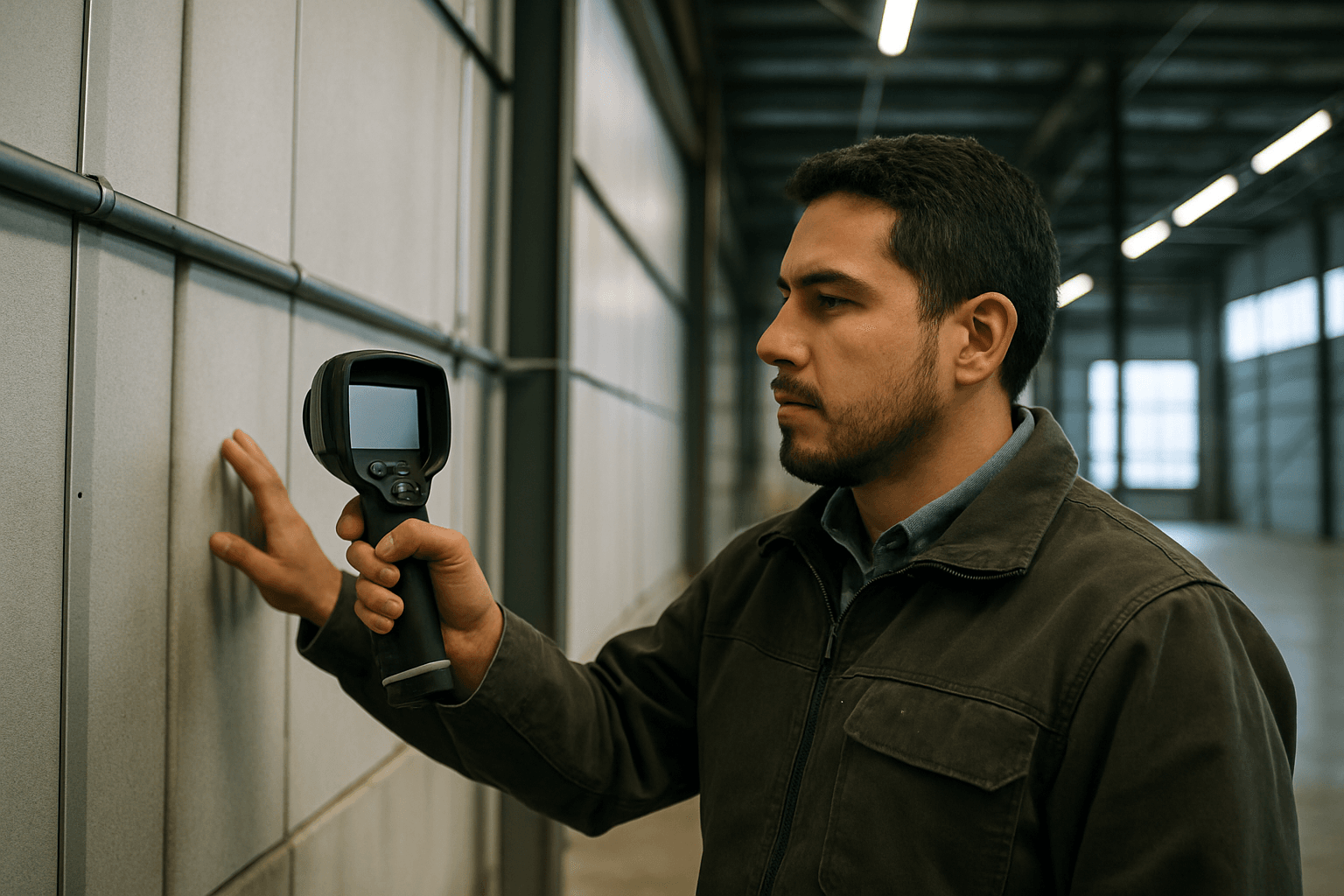
Infrared thermography is a non-invasive, contactless method that uses heat-sensitive cameras to measure and visualize surface temperatures. Areas of heat loss (or gain) appear in contrasting colors on a thermal image, allowing certified thermographers to pinpoint inefficiencies that are invisible to the naked eye.
- How it works: Thermal cameras detect infrared radiation emitted by objects, creating thermograms that visually represent temperature differences with color coding. Hot spots on exterior images indicate heat escaping, while cold spots on interior images can point to thermal bridges.
- Optimal Conditions: Thermal imaging works best when there’s a significant temperature difference between the inside and outside of the building, making colder months or early mornings ideal. HVAC systems should be turned off shortly before the scan to ensure accurate results.
- Applications in Factories: Thermography is invaluable for inspecting the building envelope (walls, roof, windows, doors), HVAC and ductwork systems for air leaks and insulation deficiencies, and even mechanical and electrical systems for overheating components.
- Beyond Visuals: While powerful, interpreting thermal images requires expertise. A blue spot on a wall indicating energy loss could have multiple causes (e.g., ventilation, moisture, missing insulation, cracks), necessitating further investigation. Combining thermography with other techniques provides a more comprehensive understanding.
Blower Door Testing and Air Leakage Analysis
While thermography excels at detecting temperature differences, blower door testing is critical for quantifying and locating air leakage, which is often intertwined with thermal bridging. An air blower door test involves mounting a powerful fan in an exterior doorway to either pressurize or depressurize the building.
- How it works: By creating a pressure difference, the test measures the amount of air moving into or out of the building through unsealed cracks and openings. This helps determine the building’s airtightness and the total cubic air leakage.
- Combined Approach: Blower door testing is often used in conjunction with infrared thermography. While the building is under pressure, infrared cameras can meticulously pinpoint the exact locations of building enclosure flaws and air leaks. Smoke machines can also be used to visually demonstrate air flow at compromised seals.
- Benefits: This method provides critical data for assessing energy efficiency, meeting stringent building codes, and identifying opportunities for targeted air sealing improvements. It helps differentiate between heat loss due to conduction (thermal bridging) and convection (air leakage).
Digital Modelling and Simulation Software
For a proactive approach and a deeper understanding of thermal performance, advanced digital modeling software plays a vital role.
- Predictive Analysis: Software packages like THERM and WUFI can analyze heat transfer through building assemblies and predict thermal behavior in a structure. These tools can reveal more about a building’s thermal bridging than on-site tools alone, allowing engineers to quantify thermal bridge impacts before construction.
- Finite Element Analysis (FEA): FEA is a sophisticated modeling technique used to pinpoint thermal and moisture-related risks, especially critical for complex junctions and non-standard constructions.
- Net-Zero Strategies: Energy modeling software is essential for identifying and assessing the impact of thermal bridges, guiding design or retrofitting processes to reduce their effects, and ensuring compliance with net-zero energy standards. This allows for the calculation of linear thermal transmittance (Ψ-value), which quantifies additional heat loss due to thermal anomalies.
Other Diagnostic Tools
- Contact-based Thermocouples: These provide in-depth data and track temperature changes over time for specific points, but are limited to individual locations.
- Laser Thermometers: Also known as non-contact thermometers, these infer temperature from a portion of the thermal radiation emitted by an object, offering quick spot measurements.
- Artificial Neural Networks (ANNs): Emerging research is exploring deep learning approaches to automate the detection of thermal bridges from comprehensive thermal image datasets, improving efficiency and reducing reliance on subjective judgment.
The Imperative of Addressing Thermal Bridges for Net-Zero Manufacturing
Detecting thermal bridges is a fundamental step towards achieving energy efficiency, cost reduction, and sustainability in industrial manufacturing. Unaddressed thermal bridges can negate the benefits of other energy-saving measures, leading to higher energy bills, reduced comfort, and risks of condensation and mould.
By leveraging a combination of infrared thermography, blower door testing, and advanced digital modeling, factory owners and energy managers can accurately identify these hidden energy drains. This comprehensive understanding then paves the way for effective mitigation strategies, such as integrating structural thermal breaks, implementing continuous insulation, and optimizing material selection. Embracing these advanced detection methods is not just about compliance; it’s about building more resilient, efficient, and truly sustainable factory constructions for the future.