Indoor Solar Cells Hit 38% Efficiency Milestone
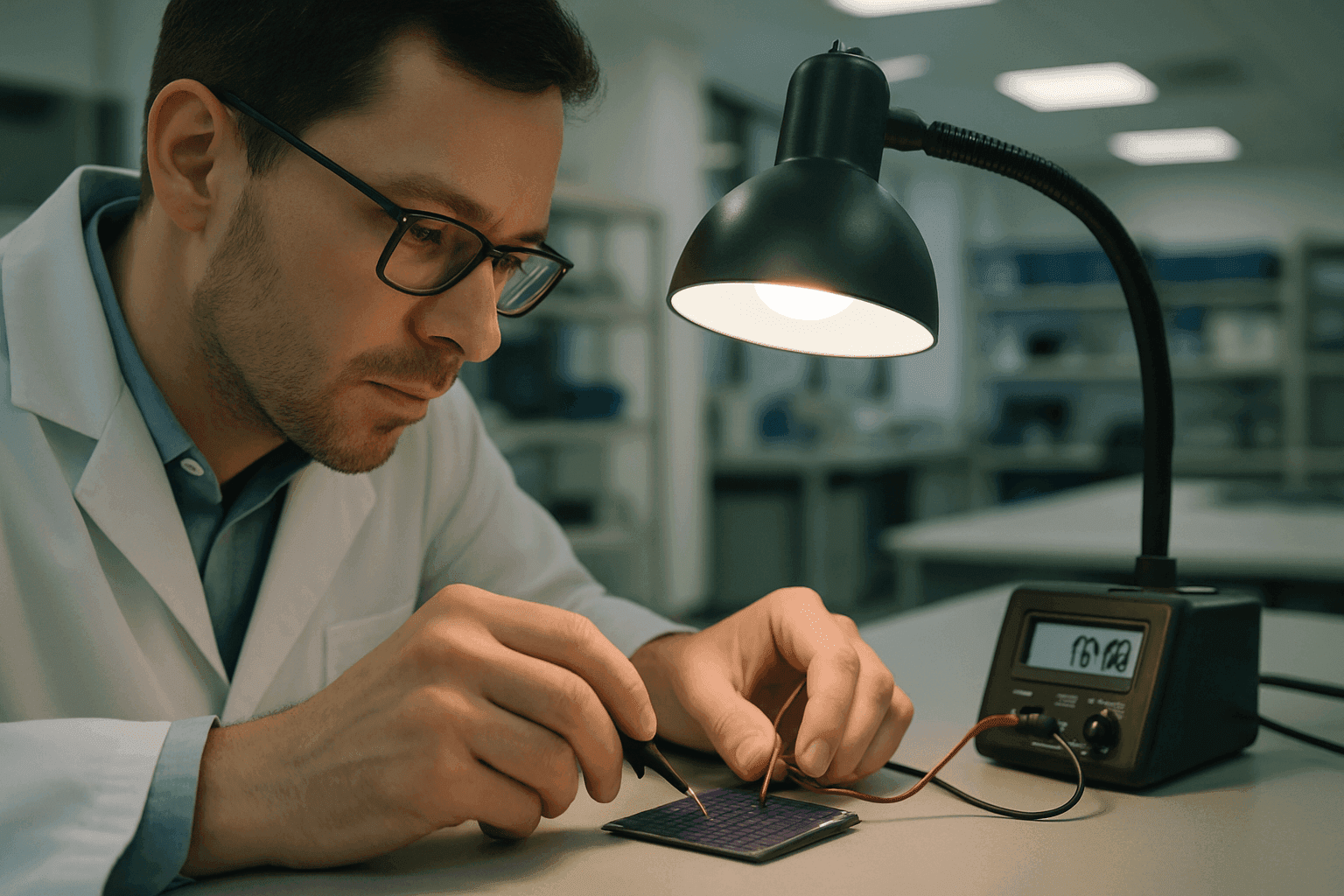
Solar cells have long been associated with harnessing the sun's energy outdoors, but recent advancements are bringing this technology inside. Breakthroughs in materials and designs are enabling solar cells to efficiently convert indoor light into electricity, opening up new possibilities for powering small devices and reducing reliance on batteries. Recent research highlights significant progress in this field, with some solar cells achieving efficiencies as high as 38% under low indoor light conditions.
The Rise of Indoor Photovoltaics
Indoor photovoltaics (IPV), also known as indoor solar panels, leverage conventional photovoltaic technology but instead of sunlight, they use energy from artificial light sources. These light sources include light-emitting diodes (LEDs), compact fluorescent lamps (CFLs), and halogen lamps. IPVs are tested using indoor light simulators, often solar simulators with a modified spectrum to mimic indoor light sources.
The growing demand for self-powered microelectronic indoor devices, such as sensors, smart meters, wearable devices, and actuators, is driving the development of IPV technology. These devices automate daily activities through the Internet of Things (IoT), making IPV an essential element of their functionality.
To evaluate these cells, researchers measure their performance under specific indoor lux levels. The indoor power conversion efficiency (ηindoor) of a photovoltaic cell is calculated using the following equation:
ηindoor=PinPmax=PinVoc⋅Isc⋅FFwhere:
- Pmax is the maximum electrical power output,
- Pin is the total incident optical power from the indoor light source,
- Voc is the open-circuit voltage,
- Isc is the short-circuit current,
- FF is the fill factor of the photovoltaic cell.
Key Benefits of Indoor Solar Cells
- Sustainability: Reduces the need for disposable batteries, promoting a more circular product lifecycle.
- Convenience: Provides continuous power for devices, eliminating the need for frequent charging or battery replacements.
- Versatility: Can be integrated into various devices, including IoT sensors, wearable fitness monitors, home security sensors, and low-power electronics.
- Efficiency: Emerging materials and designs are significantly increasing the power conversion efficiency of indoor solar cells.
Applications of Indoor Solar Cells
Indoor solar cells have a wide range of practical applications, including:
- Internet of Things (IoT) Devices: Powering sensors, smart home devices, and other connected hardware, reducing the need for manual battery replacement and enabling self-sustaining operation.
- Wearable Electronics: Integration into wearable fitness monitors, smartwatches, and other mobile form factors, providing continuous power and minimising charging downtime.
- Low-Power Consumer Electronics: Powering devices like remote controls, wireless keyboards, calculators, and other desktop accessories, lowering reliance on disposable alkaline batteries.
- Smart Buildings: Integration into building management systems, powering localised sensors and controls for lighting, HVAC, and security systems.
- Aerospace and Transportation: Utilising lightweight and flexible solar cells in specialised cabins and vehicle interiors, improving localised energy efficiency without adding substantial weight.
Standardisation of Indoor Testing
To ensure consistency across these applications, the IEC introduced specific guidelines in 2023, designated as IEC TS 62607-7-2:2023, for evaluating photovoltaics under indoor light. These standards detail the testing process and light source calibration, considering both device and light source dependencies. The standards include calibrated light sources for standard fluorescent lights and cool LEDs, with a colour temperature of 5000 K and illuminance levels of 1000 lx, 200 lx, and 50 lx.
Innovative Materials and Designs
Several innovative approaches are contributing to the improved efficiency of indoor solar cells. These include the use of perovskite materials, organic semiconductors, and transition metal dichalcogenides (TMDs).
Perovskite Solar Cells
Perovskite compounds, often realised and synthesised in laboratories, are proving to be more effective at converting light into electricity compared to traditional materials like silicon. These materials excel at absorbing visible light and efficiently converting it into energy. An Australian-Korean research team working with Macquarie University has developed a perovskite solar cell that achieves high power conversion efficiencies in low-light indoor environments. This technology incorporates two innovative components:
- Perovskite Material: Instead of silicon, perovskite is used to generate electricity.
- Aluminium Layer: An aluminium layer reduces energy leaks, further enhancing efficiency.
These perovskite solar modules have demonstrated power densities three to five times greater than commercially available photovoltaic cells for indoor use. In well-lit indoor environments, they have achieved power conversion efficiencies of up to 33.5% and a power density of 107.3 µW/cm² (microwatts per square centimetre).
Organic Photovoltaics (OPV)
OPVs utilise semiconducting polymers to convert light into electricity. These materials offer a sustainable, eco-friendly, lightweight, and flexible alternative to traditional silicon-based cells. Recent advancements have pushed OPV efficiency close to 20% on a small-cell level, making them competitive with conventional PV technologies. Researchers are also exploring high bandgap organic semiconductors to further enhance energy conversion under indoor lighting conditions.
As part of this commercial transition, the Swedish manufacturer Epishine has developed a patented lamination process that ensures high performance in indoor solar cells, even under low-light conditions. By printing half half the solar cell on each substrate, drying the films, and then laminating them together, the risk of conductive materials filling voids in the semiconducting active layer is eliminated. This process maintains high conversion efficiency and enhances the overall reliability of indoor organic solar cells.
Transition Metal Dichalcogenides (TMDs)
Researchers at Stanford University have explored the potential of TMD solar cells for indoor energy harvesting. TMDs, such as WSe2 and MoS2, are two-dimensional materials with exceptional semiconducting properties and high optical absorption coefficients. These materials are suitable for producing semi-transparent and flexible solar cells, making them ideal for applications in aerospace, architecture, transportation, and wearable electronics.
Studies suggest that TMD solar cells can achieve power conversion efficiencies of up to 36.5% under indoor lighting. With improved material quality and optimised designs, TMD solar cells could outperform commercial indoor photovoltaic technologies, offering a reliable energy solution for the expanding IoT ecosystem.
Other Materials and Technologies
- Gallium Indium Phosphide (GaInP): This material has demonstrated high efficiency under indoor light, converting nearly 40% of light energy into electricity. However, its performance under sunlight is less impressive due to its large band gap.
- Dye-Sensitised Solar Cells (DSSCs): DSSCs are already available for indoor applications due to their high efficiency under low-intensity light.
- Quantum Dot Solar Cells (QDSCs): These cells can be engineered to absorb different wavelengths of light, offering greater potential than silicon. Recent research shows QDSCs achieving 19.1% efficiency in lab environments.
Exeger and Powerfoyle: Redefining Indoor Power Conversion Efficiency
A major commercial breakthrough in indoor energy harvesting is Powerfoyle™, a light-charging technology developed by the Swedish deep-tech company Exeger. Powerfoyle transforms any kind of light—both natural outdoor sunlight and artificial indoor light—into clean electrical power.
Unlike traditional rigid silicon panels, Powerfoyle is a flexible, durable, and highly customisable light-harvesting material based on dye-sensitised solar cell (DSSC) principles.
Optimising Power Conversion Efficiency Under Ambient Light
For traditional solar cells, power conversion efficiency is typically measured under standard outdoor test conditions (AM1.5G, 1000 W/m²). However, standard silicon PV cells perform poorly under indoor illumination because their bandgap is not optimised for the low-intensity, narrow-spectrum light emitted by modern LEDs and fluorescent bulbs.
Exeger’s Powerfoyle technology addresses this by redesigning the photoactive layer at the molecular level:
- Spectral Matching: Powerfoyle’s light-absorbing dyes are engineered to align precisely with the visible light spectrum of indoor light sources (typically 400 nm to 700 nm wavelength). This spectral alignment ensures a high indoor power conversion efficiency that traditional silicon cannot match in dim environments.
- Angular Insensitivity: Traditional PV modules suffer from severe efficiency drops when light strikes at oblique angles. Powerfoyle features a highly textured, nanostructured electrode that captures light from any incident angle, making it highly effective for wearable devices and consumer electronics that are constantly moving.
- Seamless Product Integration: Powerfoyle can be integrated into products without compromising their design aesthetics. It can mimic various textures, such as leather, brushed steel, or carbon fibre, allowing designers to build self-powering capabilities directly into headphones, remote controls, smart helmets, and IoT sensors.
By maintaining high power conversion efficiency in low-lux environments (from 50 to 500 lux), Exeger allows consumer electronics—such as wireless headphones developed in partnership with Adidas and Urbanista—to operate continuously without ever needing to be plugged into a wall outlet.
Challenges and Future Directions
Despite the significant progress, several challenges remain in the development of indoor solar cells:
- Material Quality: Improving the quality of materials like perovskites and TMDs is crucial for achieving higher efficiencies and long-term stability.
- Cost Reduction: Lowering the production costs of advanced materials and manufacturing processes is essential for widespread adoption.
- Durability and Stability: Enhancing the durability and stability of indoor solar cells is necessary to ensure reliable performance over extended periods.
- Optimisation for Specific Light Sources: Tailoring solar cells to specific indoor light sources, such as LEDs or fluorescent lamps, can further improve their efficiency.
The future of indoor solar cells looks promising, with ongoing research focused on addressing these challenges and unlocking the full potential of this technology. As materials and designs continue to advance, indoor solar cells are poised to play a significant role in powering our devices and reducing overall environmental impact.
Conclusion: The Path Forward for Indoor Photovoltaics
Breakthroughs in solar cell technology enable highly efficient indoor energy harvesting. With efficiencies reaching 38% in low indoor light, these advancements represent a significant shift in how we power small-scale electronics and reduce our dependence on single-use batteries. As research continues and new materials emerge, indoor solar cells are set to become a standard feature in modern electronics, fostering a highly efficient and self-sustaining device ecosystem.
