OPC UA Energy Monitoring Integration via IEC 62541
Using X.509 certificates and IEC 62541 to securely cut plant energy costs by 15-25%.
OPC UA energy monitoring integration is a standardised industrial communications methodology that utilises the IEC 62541 standard series to securely extract, model, and transmit utility and process energy data from physical plant assets to high-level analytics platforms.
In highly regulated environments such as pharmaceutical and chemical manufacturing, bridging operational technology (OT) with enterprise information technology (IT) presents massive integration challenges. Automation engineers and SCADA systems integrators must capture granular energy data without altering validated PLC runtime logic or compromising plant cybersecurity. Implementing OPC Unified Architecture (OPC UA), internationally standardised under the IEC 62541 series, provides a robust, platform-independent, and cryptographically secure framework to achieve these goals. By employing standardised information models, facilities can establish a vendor-neutral single source of truth that drives energy reduction programmes while maintaining absolute regulatory compliance.
Technical Foundations of OPC UA Energy Monitoring Integration via IEC 62541

Modern industrial energy management relies on the continuous ingestion of high-resolution telemetry from a wide array of field instruments, variable speed drives, and programmable logic controllers (PLCs). Historically, fieldbus protocols such as Modbus RTU, Modbus TCP, and PROFIBUS DP dominated the factory floor. However, these legacy protocols carry significant technical limitations: they lack semantic data descriptions, transmit data in unencrypted cleartext, and rely on hardware-specific or operating-system-dependent middleware.
The IEC 62541 standard series defines the architecture of OPC UA, replacing legacy COM/DCOM-dependent "Classic OPC" with a modern, platform-neutral communication layer. OPC UA operates natively across diverse operating systems, including Windows, Linux, and embedded real-time operating systems (RTOS), allowing direct execution on edge gateways, smart sensors, and modern PLC processors.
Defining the IEC 62541 Standard Series
The IEC 62541 standard series is divided into multiple parts, each addressing a specific layer of the communication and semantic architecture:
- IEC 62541-3 (Address Space Model): Defines the rules for representing objects, variables, methods, and relationships within an OPC UA server.
- IEC 62541-4:2025 (Services): Establishes the abstract services used to interact with the address space, such as Read, Write, Browse, and Subscribe.
- IEC 62541-5:2026 (Information Model): Specifies the standardised, base-level nodes, types, and references that constitute an empty server's address space.
- IEC 62541-6 (Mappings): Outlines how abstract services and data structures are serialised and mapped onto physical network transports, such as the high-performance binary TCP protocol (
opc.tcp://). - IEC 62541-13:2025 (Aggregates): Details the information model associated with aggregated values, enabling structured retrieval of historical energy trends over designated timeframes.
The Core Shift from Raw Telemetry to Semantic Metadata
Traditional protocols transmit energy data as raw, unformatted register values. For instance, a Modbus energy meter might represent total active power consumption as an unsigned 32-bit integer in register 40001. A supervisory system reading this register must be manually programmed with external configuration files to understand that the value represents active power, that its unit of measure is kilowatts (kW), and that the scaling factor is 0.1.
OPC UA eliminates this manual mapping by integrating semantic metadata directly into the communications protocol. In an IEC 62541-compliant address space, an energy variable is represented as a complex Node with associated Properties. These properties include engineering units (e.g., kWh, m³, °C), measurement ranges, data quality status, and precise, synchronised timestamps. This semantic structure permits high-level cloud analytics platforms to discover, interpret, and ingest energy streams automatically, without any manual tag scaling or data translation.

Omni Vision delivers turnkey utility metering, CO2 tracking, and AI-powered production KPI intelligence — giving you real-time dashboards and actionable insights across your entire facility.
Information Modelling and the OPC 34100 Companion Specification
While the core IEC 62541 standard defines how to model data, specific industry verticals require standardised representations of domain-specific concepts. The OPC Foundation, in collaboration with groups like the VDMA, addresses this through OPC UA Companion Specifications. For energy data integration, the governing specification is OPC 34100 (historically published as VDMA 34100:2025-03), which defines the standard information model for Energy Consumption Management (ECM).
Semantic Data Structuring with OPC 34100
OPC 34100 establishes a standardised object structure for representing energy-related variables and machine states. This information model defines standardised ObjectTypes, VariableTypes, and DataTypes that describe how energy consumption data must be exposed by production machinery and utility plant components.
| Node Type | OPC 34100 Definition | Application in Utility Metering |
|---|---|---|
| EnergyMeasurement | Standardised structure for active, reactive, and apparent energy variables. | Tracks total electricity consumption in kWh and active power in kW. |
| EnergyProfile | Characterises energy consumption patterns across specific machine states. | Maps energy usage during startup, idle, production, and shutdown phases. |
| Power Standby Management | Object model for executing and monitoring low-power states. | Identifies opportunities for operators or building-management systems to trigger standby modes during non-production windows. |
| Accuracy Class | Metadata property indicating the precision of the physical instrument. | Confirms meter compliance with standards like IEC 61557-12. |
By using OPC 34100, a plant with machines from Siemens, Beckhoff, and Rockwell can present a perfectly uniform address space to an energy analytics client. The client does not need to handle three different proprietary vendor profiles; it queries a single, standardised OPC UA interface.
Eliminating PLC Logic Modifications
A primary technical barrier to implementing energy monitoring in established manufacturing environments is the risk associated with modifying running PLC code. In regulated pharmaceutical and chemical plants, modifying a controller’s functional block diagram or ladder logic requires a comprehensive management-of-change (MOC) cycle, extensive engineering testing, and system re-validation.
OPC UA information models bypass this issue by utilising external mapping layers inside the PLC’s communication processor or an adjacent OPC UA server gateway. Instead of altering the core execution block of the PLC, engineers map existing memory addresses (such as global DB variables or I/O image tables) directly to the OPC 34100 schema in the server configuration. The PLC runtime logic remains physically untouched, while the outside world gains access to clean, standardised energy metadata.
OT-to-IT Security: X.509 Certificates and GMP Compliance

In regulated manufacturing environments, bridging operational technology with enterprise IT or cloud databases introduces severe cybersecurity and compliance risks. Pharmaceutical production facilities must comply with strict Good Manufacturing Practice (GMP) regulations, including FDA 21 CFR Part 11 in the United States and EU GMP Annex 11 in Europe. These frameworks demand complete data integrity, precise audit trails, and robust access controls.
Legacy protocols like Modbus TCP possess zero security mechanisms; they do not require authentication, and anyone on the network can read or write to register values. OPC UA, by contrast, was designed from its inception to enforce a secure-by-default communication model.
Cryptographic Authentication and Encryption
Under IEC 62541-2:2026 (OPC UA Security Model), security is integrated directly into the transport layer and the application layer. Rather than relying on simple passwords or network isolation, OPC UA utilises public key infrastructure (PKI) with asymmetric cryptography:
- X.509 Certificate Exchange: When an OPC UA client connects to a server, the application components exchange X.509 digital certificates. Connection is refused unless both parties trust each other’s certificates. This trust relationship is managed via local certificate trust lists or automated Certificate Authorities (CAs).
- Symmetric Encryption: Once mutual trust is established, the client and server negotiate a secure symmetric communication channel. Standardised security profiles, such as
Aes128_Sha256_RsaOaeporBasic256Sha256, dictate the use of high-strength cryptographic algorithms to encrypt the payload and sign messages. This prevents eavesdropping and man-in-the-middle attacks. - Granular User Roles: IEC 62541-5:2026 defines standard role-based user authentication models. This allows administrators to grant specific permissions to users or external applications, ensuring that only authorised clients can access critical energy registers or execute methods.
Read-Only Architectures and GAMP 5 Compliance
Under the GAMP 5 (Good Automated Manufacturing Practice) framework, which classifies configurable monitoring and analytics platforms as Category 4 (configured software), energy tracking platforms must prove they cannot interfere with validated manufacturing processes. The most effective method to achieve this is the deployment of a physical or logical read-only architecture.
In an optimised deployment, the on-site edge gateway acts strictly as an OPC UA client connecting to the plant’s local OPC UA servers. The connection profile configured on the PLC or SCADA OPC UA server is explicitly restricted to read-only access. This logical restriction is enforced via the secure channel protocol, ensuring that even if the edge gateway or cloud-facing interface is compromised, no write commands can ever traverse back to the physical PLCs. Because there is zero-write access to plant control systems, the operational validation status of critical process systems—such as sterile HVAC loops, autoclaves, and reaction vessels—remains fully intact, removing the requirement for expensive software re-validation.

Track energy consumption, emissions, and process parameters with seamless PLC/SCADA integration via Modbus, OPC-UA, and MQTT protocols.
Reconciling ISO 50001 and UK Decarbonisation Frameworks
The United Kingdom has committed to legal targets for industrial decarbonisation, aiming to reduce greenhouse gas emissions by 81 per cent by 2035 compared to 1990 levels, on the path to Net Zero. For energy-intensive manufacturers in the UK, complying with regulatory reporting frameworks like the Streamlined Energy and Carbon Reporting (SECR) regulations and the Energy Savings Opportunity Scheme (ESOS) is a mandatory operational requirement.
A structured Energy Management System (EnMS) certified to ISO 50001:2018 provides the organisational framework to meet these mandates. However, the success of an ISO 50001 EnMS is entirely dependent on the quality and auditability of the underlying data.
A Single Source of Truth for Energy Management Systems
To satisfy ISO 50001:2018 audit requirements, plants must establish accurate Energy Baselines (EnBs) and track Energy Performance Indicators (EnPIs). Collecting this data manually via weekly spreadsheet entries is highly error-prone, violates basic data integrity protocols, and lacks the resolution required to identify waste.
OPC UA acts as a vendor-neutral single source of truth across the facility. By standardising data streams from different utility infrastructures, it allows the simultaneous ingestion of six core utility vectors:
- Electricity: Real-time active power, voltage imbalance, and power factor.
- Gas: Volumetric flow rates corrected for temperature and pressure.
- Water: Process cooling water and pure water volumes.
- Steam: Mass flow, temperature, and pressure tracking to monitor boiler efficiency.
- Compressed Air: Dynamic pressure drops and compressor energy consumption.
- Oil: Thermal oil loop flow rates and fuel oil supply monitoring.
This high-resolution, time-stamped data enables engineers to correlate exact energy surges with specific process phases or production batches.
Streamlining SECR and ESOS Audit Readiness
Under SECR and ESOS, UK enterprises must provide detailed calculations of their annual Scope 1 (direct combustion of fuels) and Scope 2 (purchased electricity) carbon dioxide equivalent (CO₂e) emissions. The precision of these reports relies on the ability to demonstrate an unbroken, tamper-proof audit trail from the physical utility meter to the final carbon statement.
Through OPC UA integration, every captured energy point is automatically associated with a cryptographic, timestamped record. This automated, continuous data pipeline replaces manual reporting with high-integrity, automated reporting sheets. When external auditors review SECR or ESOS submissions, they can trace any aggregated monthly emission figure back to the exact millisecond-level PLC variable logs, ensuring perfect regulatory compliance and eliminating the threat of compliance fines.
Architecture of an Integrated Energy Intelligence Platform

Implementing an end-to-end industrial energy management strategy requires a clear data architecture that safely transitions data from local control networks to cloud-based predictive analytics. This architecture spans the standard ISA-95 hierarchical model, linking physical shop-floor machinery with enterprise-level dashboards.
The Omni Vision Energy Intelligence Platform uses this structural model. It integrates secure, physical on-site hardware with cloud-based artificial intelligence engines (utilising EPSA's analytical framework) to deliver deep energy insights without altering core plant automation loops.
Connecting Level 2 PLCs with Level 4 Cloud Intelligence
At the physical layer (Level 1 and 2), utility meters and sensor nodes are wired directly into existing plant PLCs or distributed I/O blocks. The local PLC acts as the primary data consolidator, hosting an IEC 62541-compliant OPC UA server.
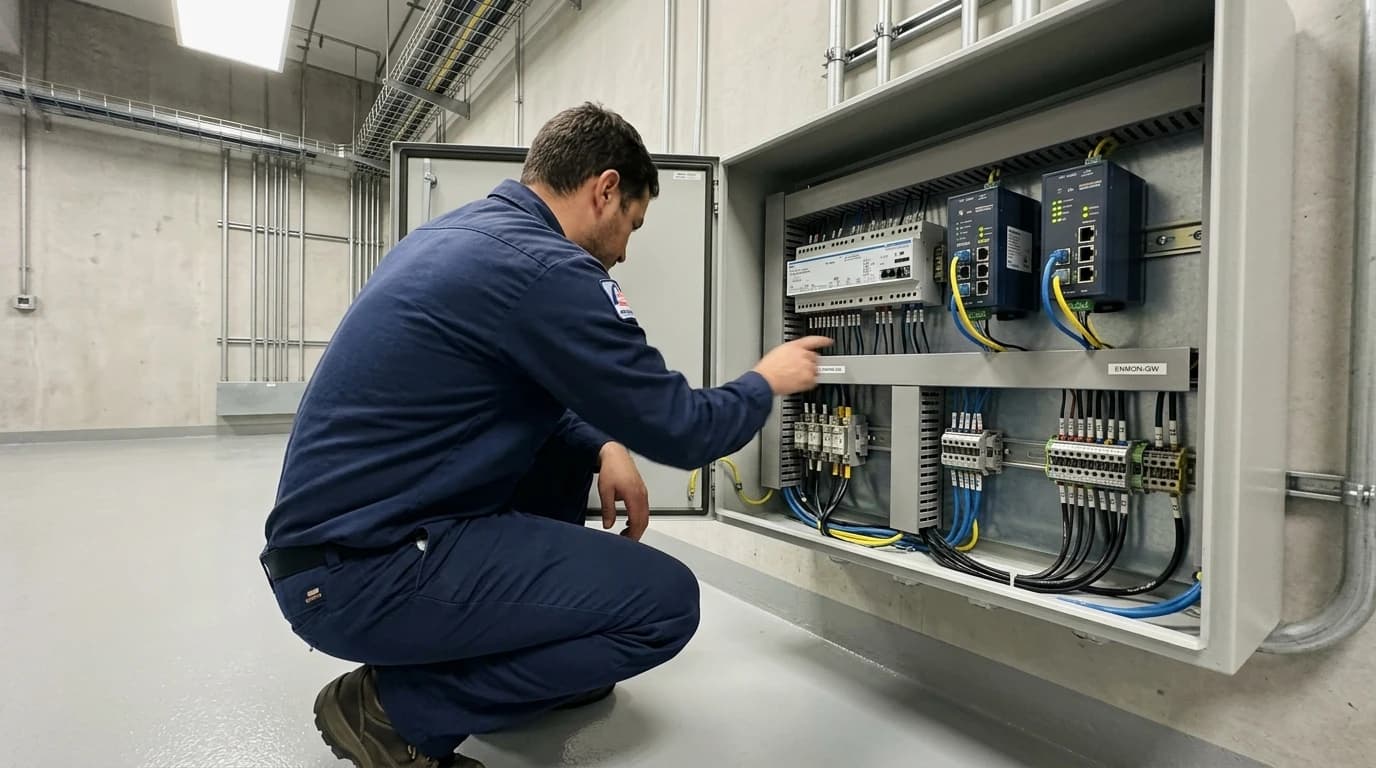
At the edge interface, an industrial EnerTherm Edge Gateway is deployed. Running as a secure OPC UA client, the gateway queries the local OPC UA server’s address space using the read-only, encrypted protocol specified under IEC 62541-6. The gateway packages this semantic energy data and pushes it one-way to the cloud via secure HTTPS over a standard outgoing TLS connection.
AI-Driven Cloud Analytics and Anomaly Detection
Once the standardised, time-stamped data arrives in the EPSA cloud environment, the analytics engine applies machine learning algorithms to model the baseline energy behaviour of the facility. Rather than using simple threshold alerts, which often trigger false alarms during normal process shifts, the platform uses multi-variable regression models to predict energy consumption based on current production outputs.
The platform dynamically calculates key performance indicators (KPIs) such as energy consumption per batch or energy cost per tonne of chemical product. It provides 24/7 anomaly detection across all six core utility streams, immediately flagging deviations such as compressed air leaks, boiler scaling, or HVAC over-ventilation.
ROI-Driven Deployments and Practical Factory Optimisation
For plant managers and financial officers, implementing advanced IoT architectures must be justified by clear, quantifiable financial returns. Standard industrial deployments of the Omni Vision platform consistently demonstrate that integrating OPC UA energy monitoring delivers rapid, measurable efficiency improvements.
Achieving 15 to 25 per cent Energy Savings
By providing high-resolution visibility into operational utility consumption, manufacturing facilities consistently achieve 15 to 25 per cent energy cost reductions. These savings are driven by several highly targeted technical interventions:
- HVAC Dynamic Schedule Optimisation: In pharmaceutical cleanrooms, heating, ventilation, and air conditioning (HVAC) systems frequently consume upwards of 70 per cent of total site electricity due to strict air change requirements. The platform identifies non-production periods and empty shifts, allowing operators to safely adjust air change rates during non-operational hours without violating GMP pressure baselines.
- Peak Demand Shaving: Process industries can schedule high-energy operations, such as thermal drying or boiler blowdowns, away from peak tariff hours.
- Proactive Maintenance and Thermal Recovery: Identifying steam trap failures, compressed air leaks, and degraded heat exchanger coefficients before they lead to complete equipment failure or massive energy waste.
These efficiency improvements typically translate to a sub-12-month return on investment (ROI), making energy efficiency projects highly competitive for capital expenditure allocation.
Standardised 8 to 16-Week Deployment Model
Deploying enterprise-wide industrial IoT integration can easily stall due to custom programming requirements and integration friction. By utilising the standardised semantic models defined in IEC 62541 and OPC 34100, the deployment process is highly predictable and structured:
- Weeks 1 to 4 (Audit and Instrumentation): Engineers audit existing plant networks, identify legacy meters, and specify where additional physical sub-metering is needed.
- Weeks 5 to 8 (OPC UA Mapping and Gateway Installation): Existing PLCs are configured to expose energy registers via OPC UA. The industrial edge gateway is physically installed and established as a secure, read-only client.
- Weeks 9 to 12 (Cloud Connection and Calibration): One-way TLS communication is established between the edge gateway and the cloud environment. The AI engine begins processing incoming utility streams, establishing initial baselines.
- Weeks 13 to 16 (Dashboard Commissioning and Training): Site-specific energy dashboards are delivered, custom production-linked KPIs are calibrated, and facility teams are trained to act on the anomaly detection reports.
Transitioning a plant from manual, retrospective spreadsheet tracking to dynamic, cloud-based analytics represents a significant technical leap. Leveraging the standardised, secure, and semantic capabilities of OPC UA via IEC 62541 ensures that this transition is accomplished safely, reliably, and in complete alignment with both UK industrial decarbonisation goals and global regulatory standards.
This article reflects the independent analysis and editorial opinion of EnerTherm Engineering. Product names, trademarks, and brands mentioned belong to their respective owners. EnerTherm Engineering is not affiliated with, endorsed by, or a licensee of any third-party software or product mentioned unless explicitly stated.

Simulation Engineer — EnerTherm Engineering
Rajesh Sekar is a Simulation Engineer at EnerTherm Engineering, specialising in computational fluid dynamics (CFD), finite element analysis (FEA), and thermal process simulation. He holds a degree from Cranfield University and brings extensive experience in simulation-based product development from the automotive, aerospace, and energy sectors.
