TPRO Baking Oven Digital Twin Simulator
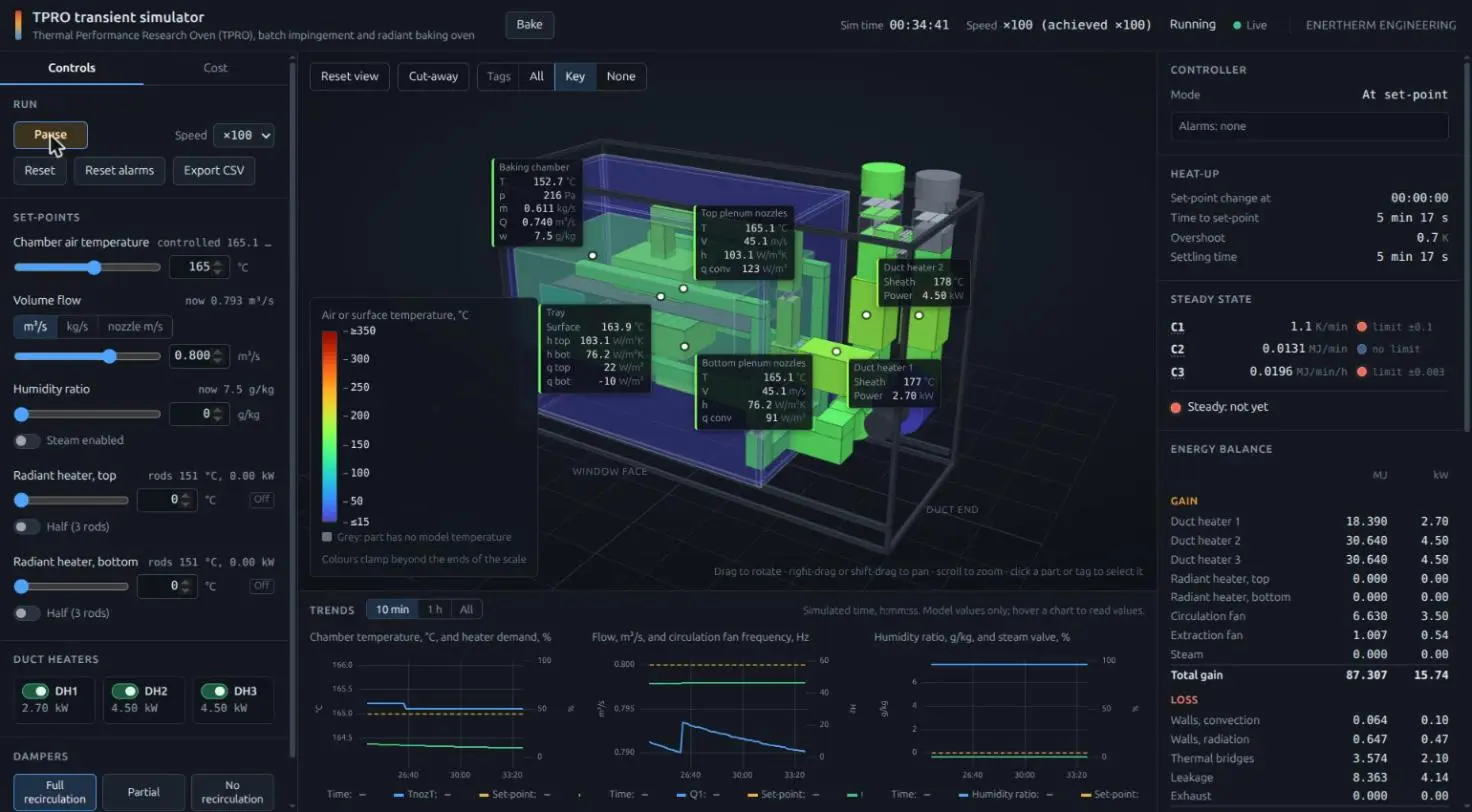
The rebuilt TPRO simulator closes its energy and mass balance at every step, with a worst energy-closure error of 0.08% across the validation cases. It brings a research oven developed to investigate baking heat transfer into a live engineering environment where settings, heat flows and bake outcomes can be assessed together.
From research rig to digital twin
More than twenty years ago, the Thermal Performance Research Oven, or TPRO, was built by APV Baker to investigate heat transfer in baking beyond the limits of industrial ovens. The electrically heated batch rig reproduces, within a chamber about one metre long, the zone-by-zone conditions of a travelling tunnel oven of 100 to 300 m.
The rig is 4.0 m long, 2.8 m high and 1.6 m wide, and weighs about 2.5 tonnes. It uses three duct heaters rated at 130 kW in total, six radiant heaters rated at 5.7 kW in total, a circulation fan, a second fan on inverters and nine dampers. Hot air impinges on the product through top and bottom nozzle plates, while radiant heaters above and below the band add direct radiation.
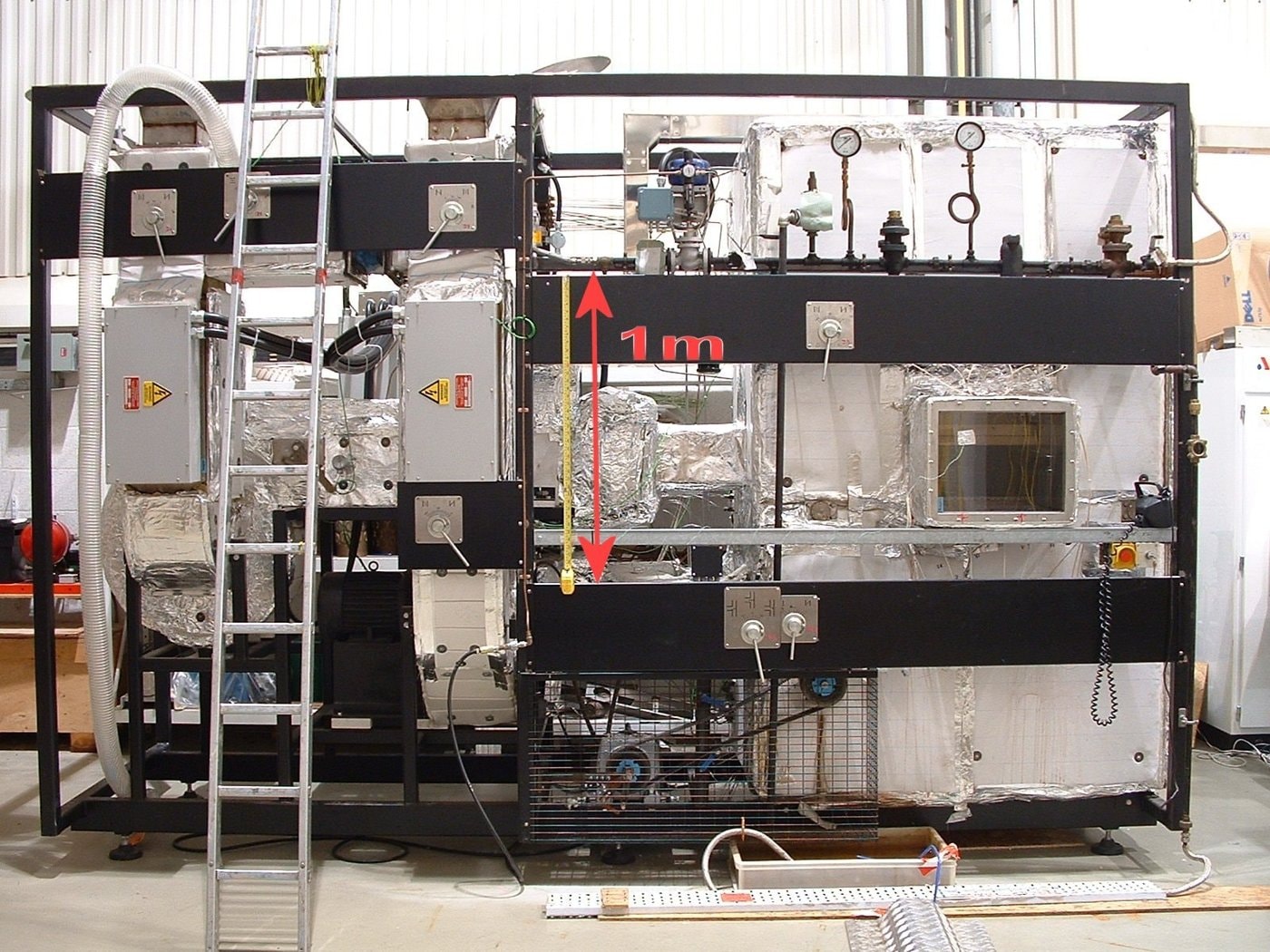
Its instrumentation included 52 temperature points, 8 pressure points and a humidity sensor, with a real-time energy balance computed in the controller. The rig remains at Baker Perkins, now Coperion.
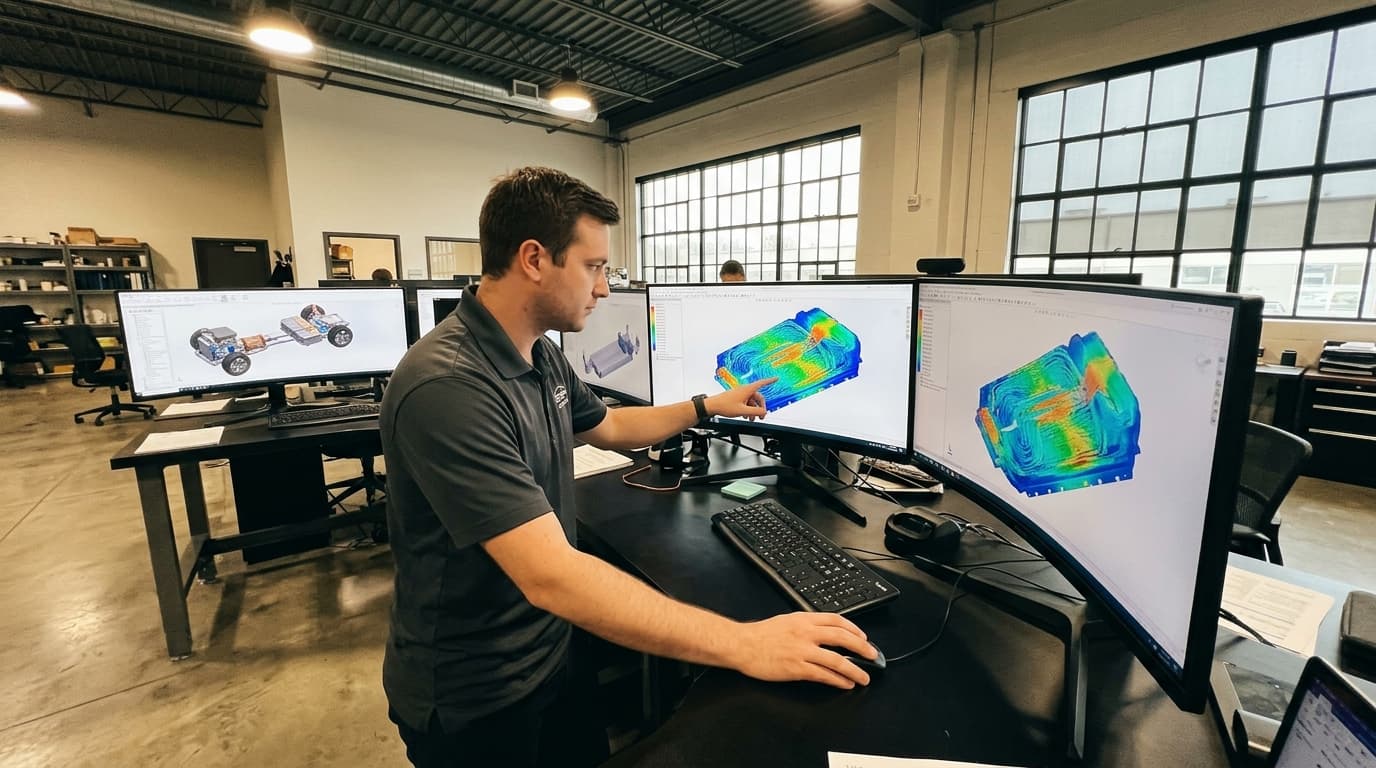
Detailed thermal analysis using CFD and FEA to predict temperature distributions, heat transfer rates, and thermal stresses before you build or modify equipment.
The research question behind the model
APV Baker and Cranfield University began their joint project in 1996. The work examined the limits of effective heat transfer that could shorten a bake while keeping product quality acceptable. The PhD research programme covered the rig design and commissioning, heater and air-circuit design, control, non-food tests and food trials.
A design of experiments on Madeira cake considered 8 oven factors and 10 product responses. It identified a bake-time reduction of up to 16% against the benchmark, with the other product responses held within acceptable values, and the result was confirmed experimentally.
The research also proposed a baking comfort zone. This describes the balance of conduction, convection, radiation and evaporation at the product surface during a bake. The engineering aim is straightforward: apply each heat flux at the appropriate time so that bake time and energy use fall without taking the product outside its quality tolerances.
A transient Fortran 90 model was written in 2000, but each run took 10 to 30 hours. In 2003, the heat-flux-map concept was presented at the ASME International Mechanical Engineering Congress. At that time, the heat fluxes at the product surface could not be measured reliably in real time, so they could not act as a live control reference.
Rebuilding the TPRO as a live simulator
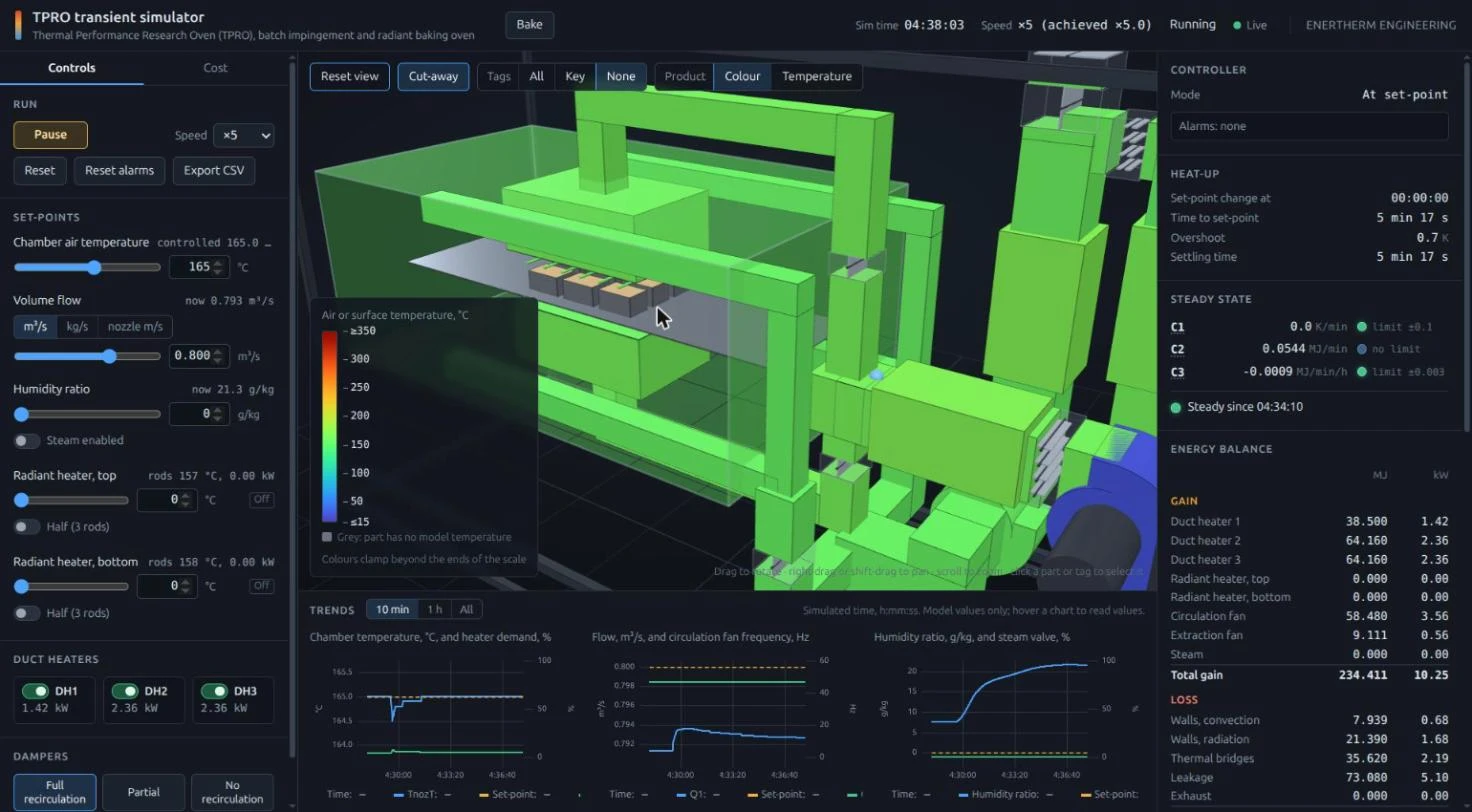
In October 2026, EnerTherm rebuilt the TPRO as a transient simulator in Python with a browser-based 3D view. The model uses the thesis geometry, rig drawings and measured data. It represents every measurement node in the air network, including temperature, pressure, mass flow, volume flow and humidity, alongside fan curves, dampers, leakage paths and moist-air properties.
It also models layered stainless-steel walls and insulation, internal steel, duct-heater elements, radiant rods and reflectors. Closed-loop controls regulate chamber-air temperature, air flow, humidity through steam injection, and the top and bottom radiant heaters. Users can change set-points, dampers and heater settings during a run, then watch the response through live tags and trends.
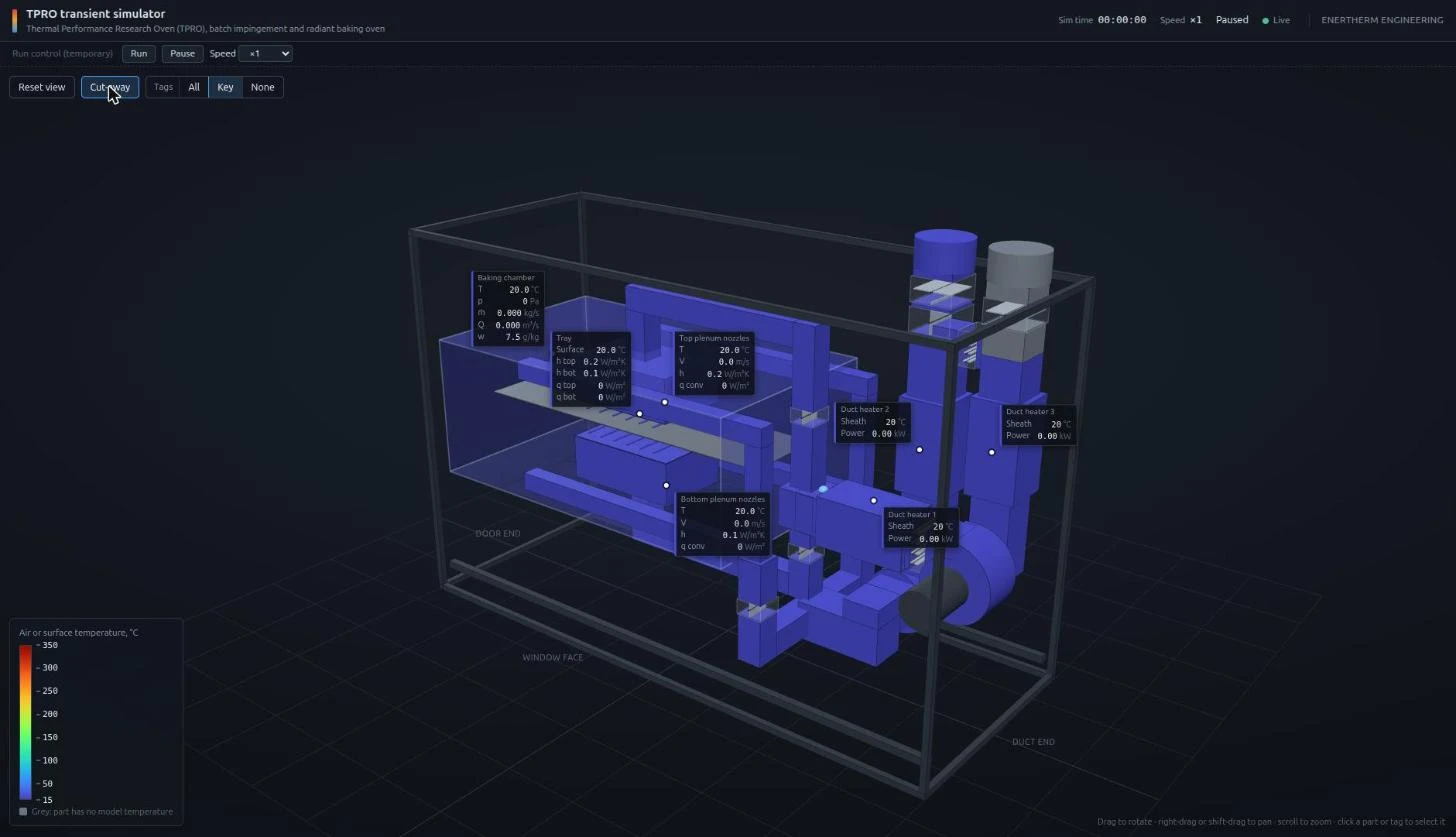
The simulator runs from real time up to x100 and faster on a desktop PC. It calculates impingement convection, direct radiation from the rods, background radiation from plenum surfaces, and conduction from the tin and belt. It also accounts for evaporation, which removes heat from the product.
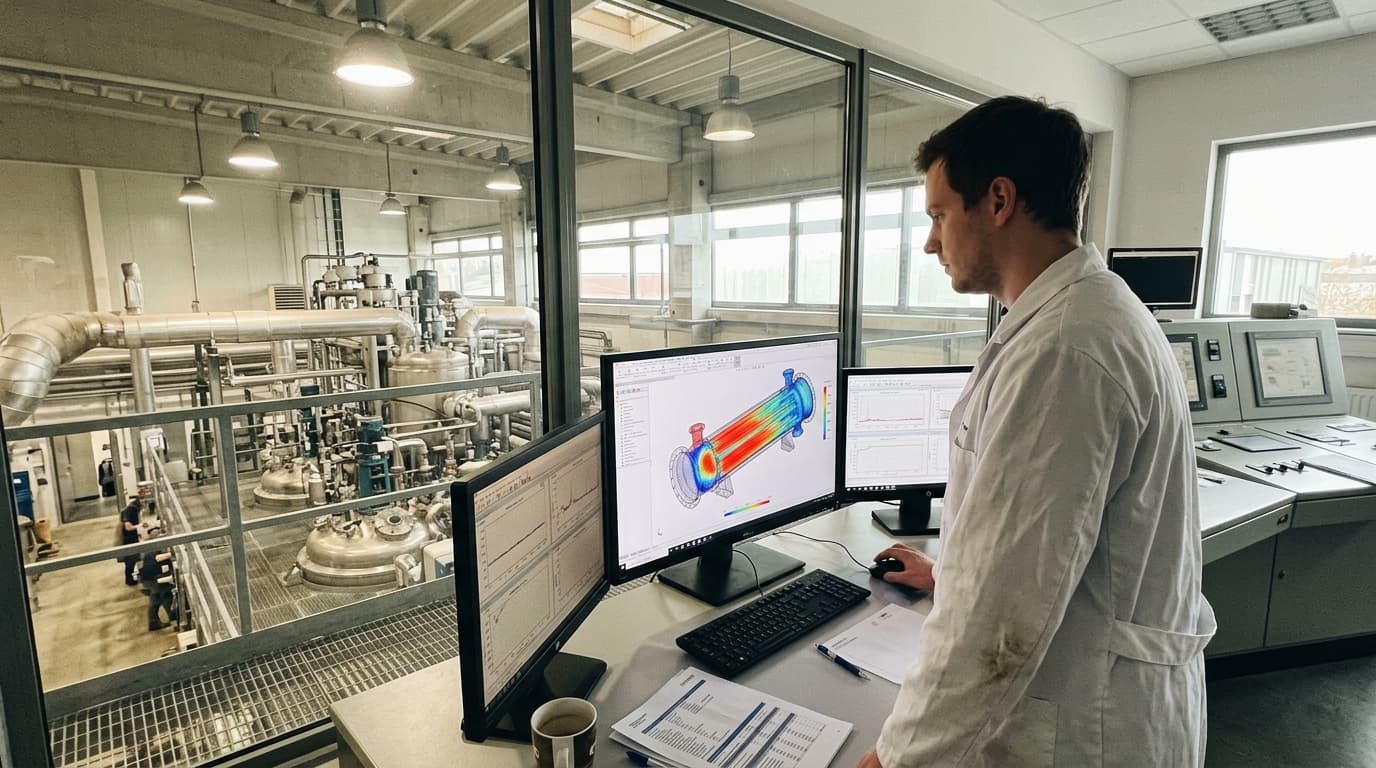
Detailed thermal analysis using CFD and FEA to predict temperature distributions, heat transfer rates, and thermal stresses before you build or modify equipment.
Validation that reports the gaps
A useful simulator must be tested against the plant. The model was calibrated against measured thesis data at 160 °C for fans-only commissioning, steady heating and a warm-up. It was then run without further tuning against held-back tests: steady heating at 200 and 260 °C, eleven heat-up tests and heater-cut tests.
On the calibration cases, all 20 measured quantities were within tolerance, including heater energy input, temperatures, heat-up times and settling times. On held-back cases, 15 of 38 measured quantities were within tolerance. The simulated nozzle air heats and cools faster than the rig, while steady heater power is low at 200 and 260 °C.
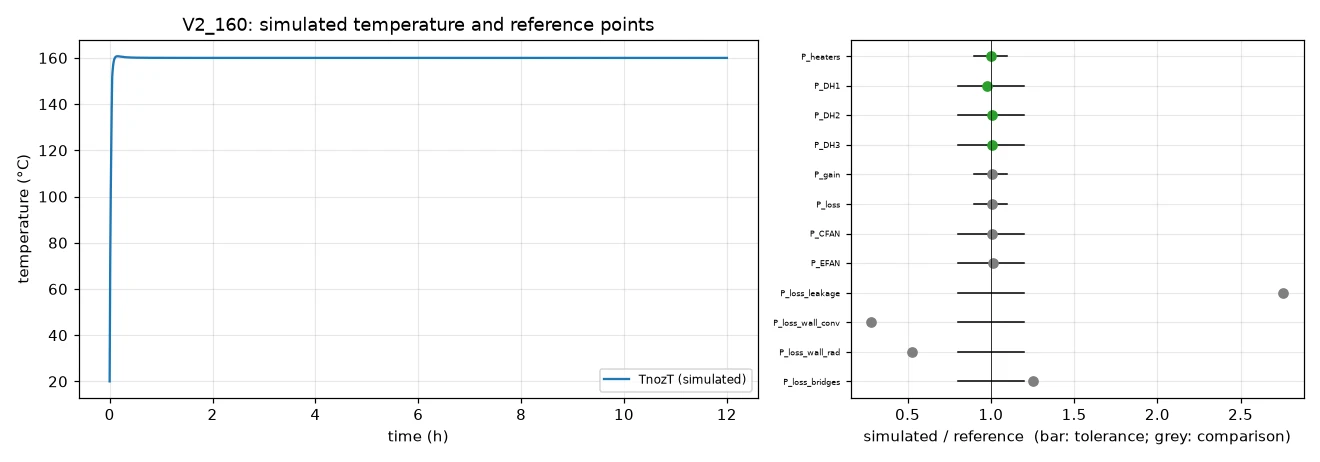
These differences have been reported rather than tuned away. The candidate causes include unmeasured thermal mass in the supply path, such as heater casings, flow grids and nozzle plates, plus a loss split that cannot be determined from a single calibration temperature. The model therefore identifies the plant information still needed for further refinement.
A virtual bake with product and energy outcomes
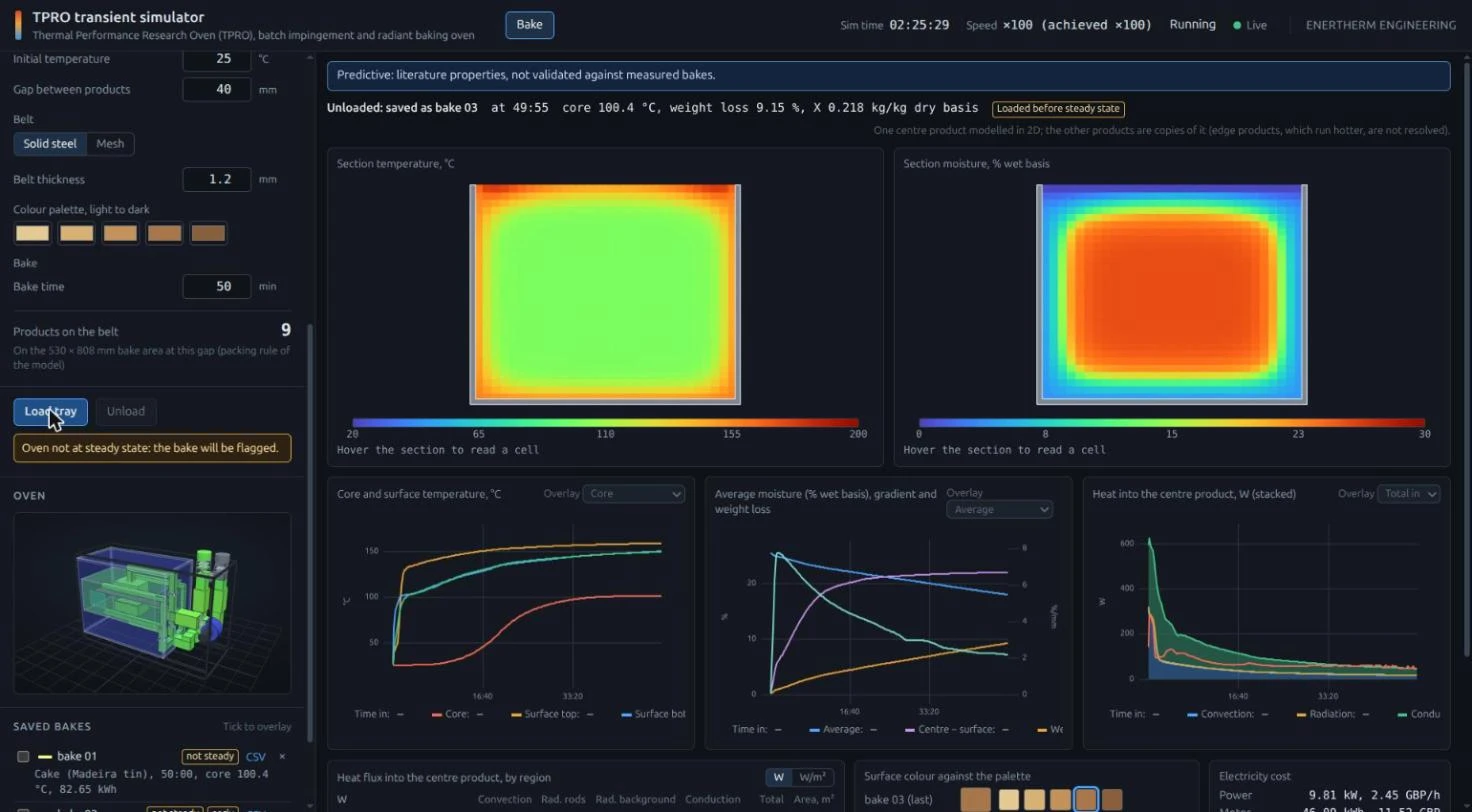
The simulator now includes a product model for a full tray of Madeira cakes, tin bread, baguettes or biscuits on a 0.53 x 0.81 m bake area. One product is resolved as a 2D section with its tin and belt. The other products are copies that apply their heat and moisture load to the oven.
During a bake, the screen reports core and surface temperature, moisture loss and colour. It also tracks water released to the chamber air, the heater duty taken by the product, and the electricity cost of the bake. The product model uses literature properties and remains predictive because no measured bake data is yet available. Its simulated cores currently heat faster than commercial bake times.
Using heat-flux maps to improve bakes
At every time step, the twin calculates heat entering each product face through convection, radiation from rods, radiation from plenum surfaces and conduction from the tin and belt. It shows the evaporation heat loss alongside these inputs. This makes the baking comfort-zone fluxes visible in a way that was not available on the original rig.
Each simulated heating profile can be judged against three linked outcomes: product response, bake time, and energy. Product measures include core temperature, moisture loss and colour against the target. Energy measures include heater and fan kWh and the electricity cost of the bake.
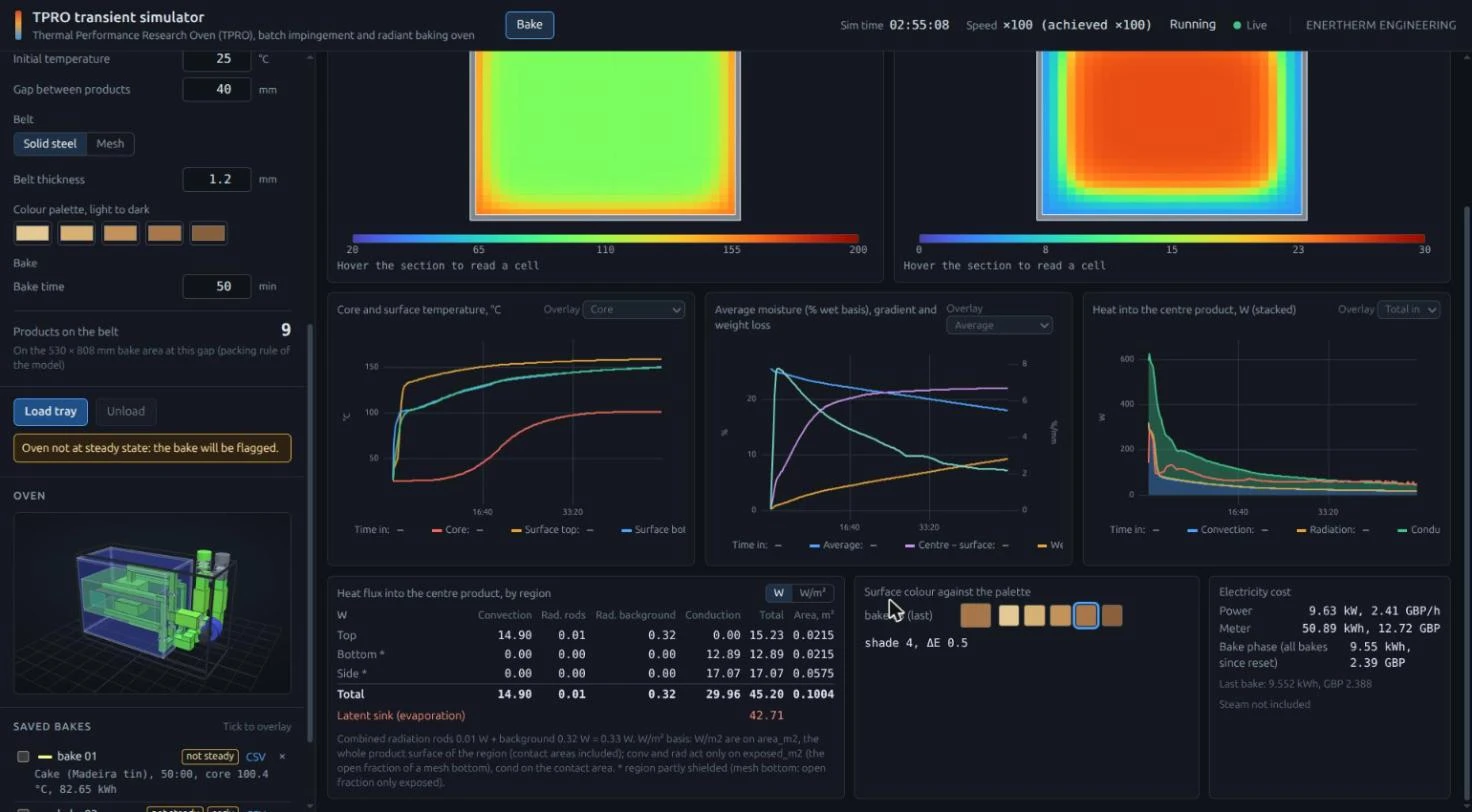
The twin can therefore serve as a test bench for finding settings and flux profiles that meet a product target with less time and energy before a real-oven trial. Once product models are calibrated against measured bakes, those optimised profiles can become the control reference for the Digital Twin Controller in development.
The same method can be applied to an industrial oven, dryer, kiln or furnace. Models built from drawings and site data, then calibrated against measured trends, can support warm-up and set-point studies, product trials, operator training, energy studies and engineering tools built around a client's process.

Managing Director — EnerTherm Engineering
Dr. François Pierrel is Managing Director of EnerTherm Engineering with over two decades of expertise in thermal design, heat transfer, and industrial energy optimisation. He holds a PhD in Heat Transfer from Cranfield University and a Post-Doctorate from Heriot-Watt University.
