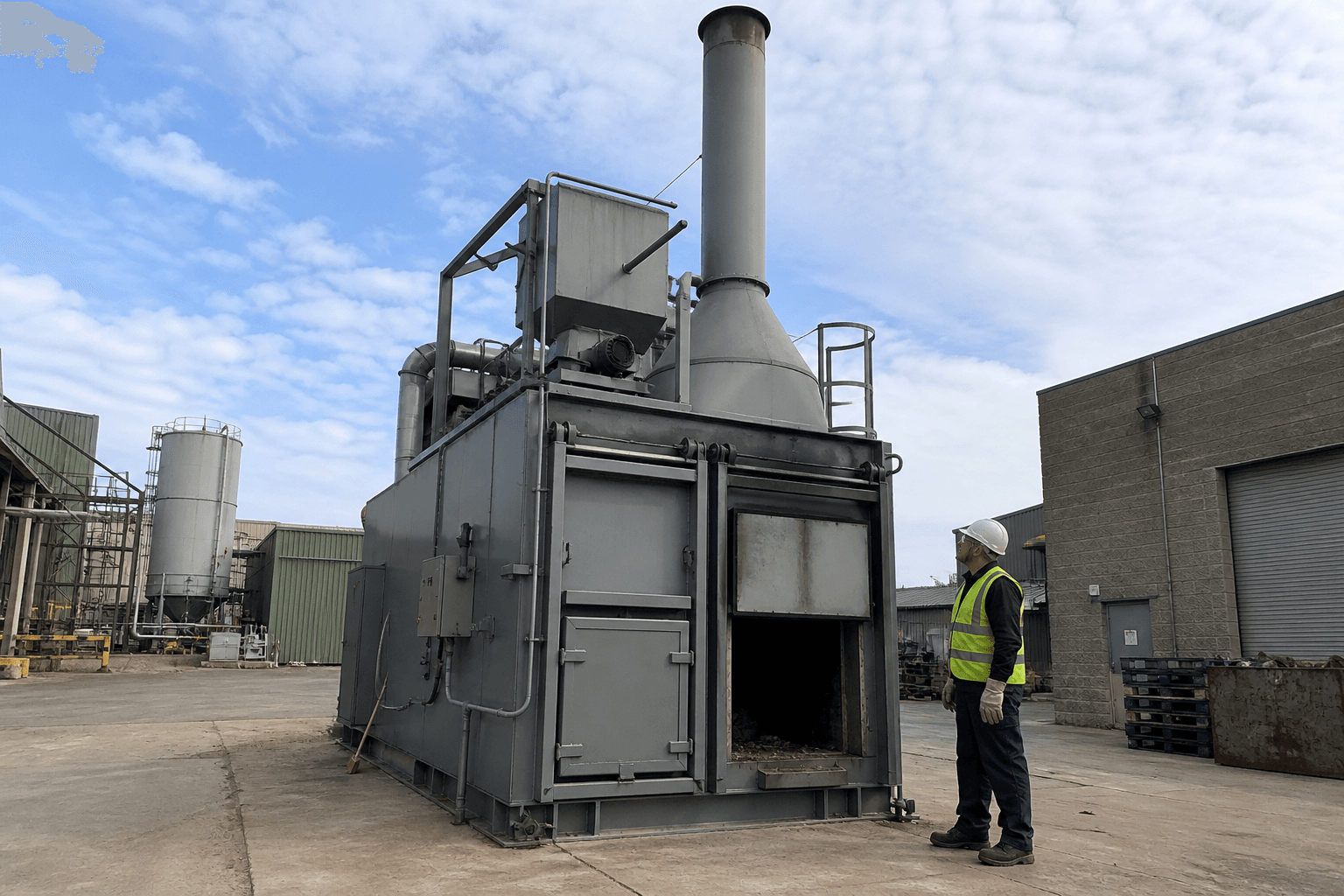
Oily Waste Incinerators
Oily rags, spent absorbent, contaminated wipes, PPE and filter media — absorbed, never free liquid.
Maintenance produces a waste nobody wants to store: oily rags, spent absorbent, contaminated PPE and used filter media. It is hazardous, it is a fire loading in the corner of a workshop, and every drum of it is a consignment note. On-site destruction turns a hazardous accumulation into a routine hour of running.
Four Models,
One Solution
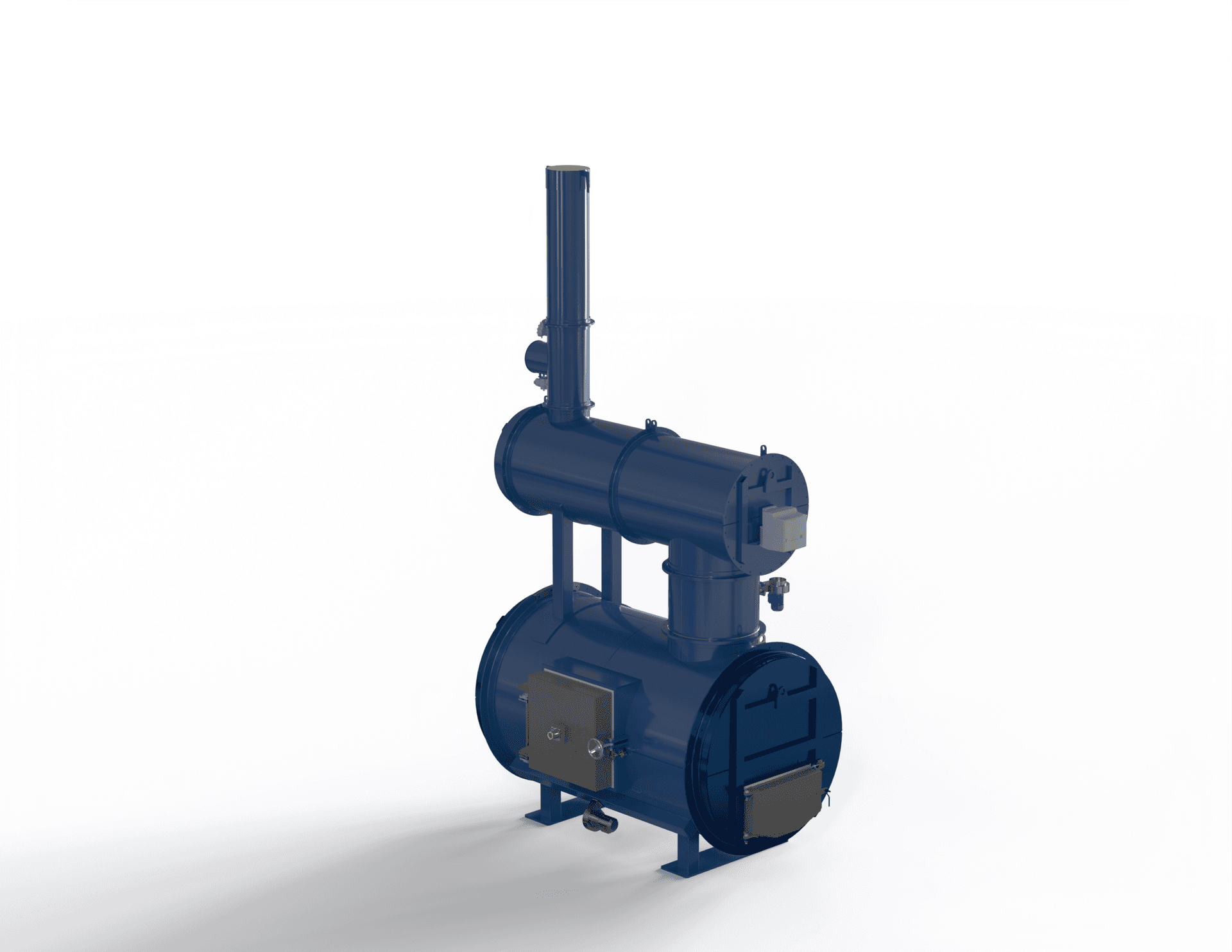
The entry point to the LitBurn range. A 3.3 m³ primary chamber and three burners give continuous 125 kg/h destruction in a footprint that fits a standard yard bay, which makes it the usual choice for a single-site operator replacing skip hire rather than a multi-site waste contract.
The most specified unit in the range. Chamber volume rises to 5.5 m³ for 250 kg/h continuous throughput while the external width grows by only 230 mm over the LBI-125, so sites that outgrow the smallest unit rarely have to rework the slab or the building line.
A 9.6 m³ chamber — nearly double the LBI-250 — for medium-scale industrial waste destruction. At this size most operators pair the unit with heat recovery, because the thermal output during a full shift is large enough to displace a dedicated water heater.
The largest LitBurn: a 16.2 m³ chamber running 500 kg/h continuously. Specified where waste arrives faster than a batch unit can clear it — large manufacturing sites, industrial estates, and operators consolidating several smaller waste contracts onto one machine.
Which Model
Fits Your Volume
Pick a model to see what it clears in a day of oily rags, absorbents & filter media.
A workshop or single plant clearing a tonne or so a week of absorbents and filters alongside its other residual waste.
15 02 02* is hazardous waste
Absorbents, filter materials, wipes and protective clothing contaminated by hazardous substances code as 15 02 02*. Non-hazardously contaminated equivalents are 15 02 03. The classification decides the permit line and the record-keeping, and it is decided by the contaminant.
Absorbed in, never free liquid
The permit and the machine both assume solid waste. Free liquid is a different waste stream with a different destination, and it is separated by the person filling the bin rather than argued about at the charge door.
Recovery ranks above destruction for oil itself
Waste oil has a recovery route and the hierarchy prefers it. What belongs here is the contaminated solid — the rag, the pad, the filter — not the oil that could have been sent for regeneration.
Records survive the movement being removed
Hazardous waste produced and destroyed on the same site still needs to be recorded. Removing the consignment note removes a journey, not the obligation to know what you produced and what happened to it.
Why Burn It
On Site
4 things change on the day this stream stops leaving the site.
The fire loading stops accumulating
Oily rags and saturated absorbent are the classic workshop fire risk, and the quantity held is set by how often a collection comes. Destroying them the day they arise keeps the store at a day's worth rather than a month's.
Hazardous consignments become routine runs
Every drum that leaves is a hazardous waste movement with its paperwork, its carrier and its gate. Destroying the material where it arose removes the movement while leaving the classification and the records intact.
The hydrocarbon is destroyed, not moved
Two-second retention above 850°C destroys the organic fraction. The alternative routes reduce your storage problem by making it someone else's, with your duty of care still attached to it.
Spill response stops being capacity-limited
A bad spill produces more contaminated absorbent in an hour than a normal month. A continuous unit absorbs that as extra running time instead of as an emergency collection at an emergency price.
Dual-chamber unit, continuous duty
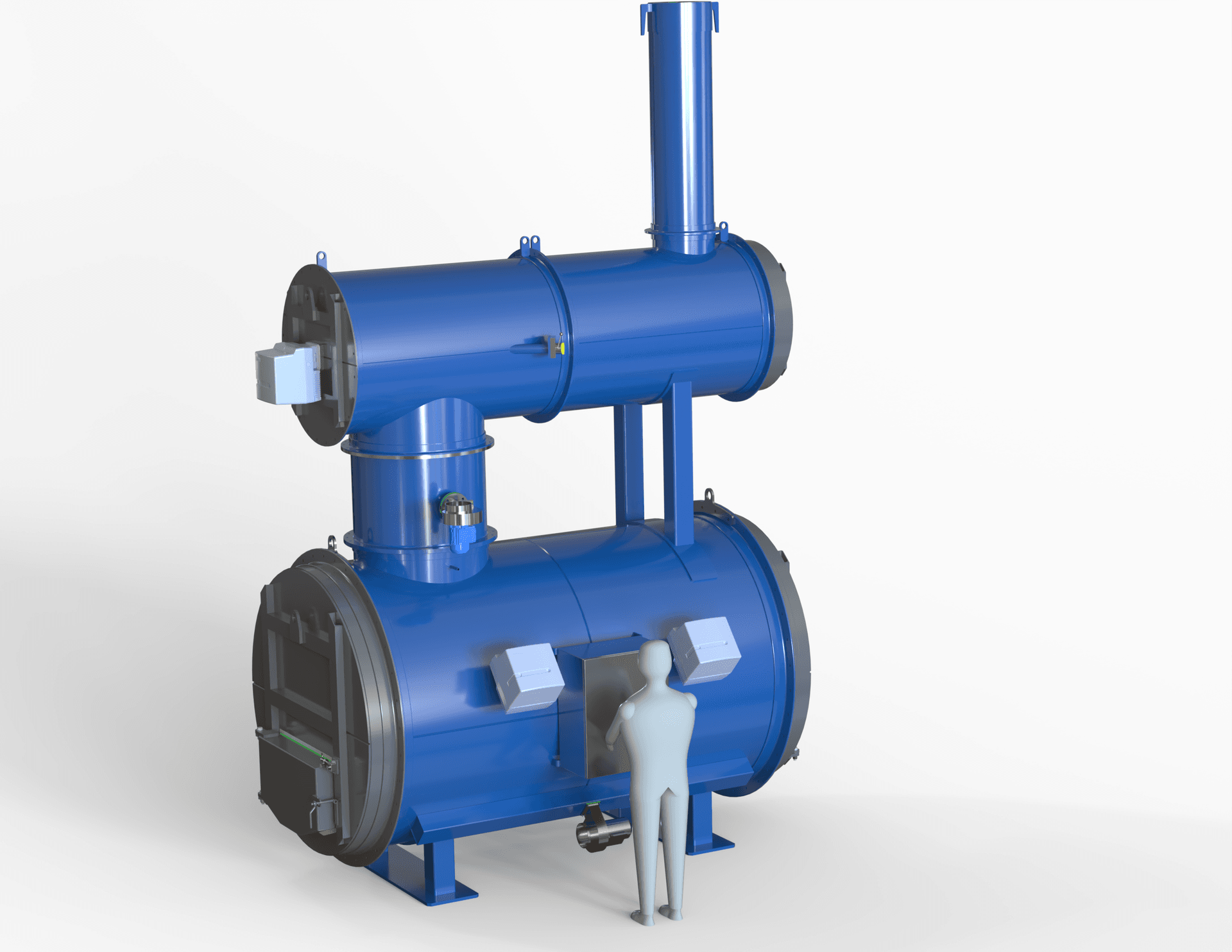
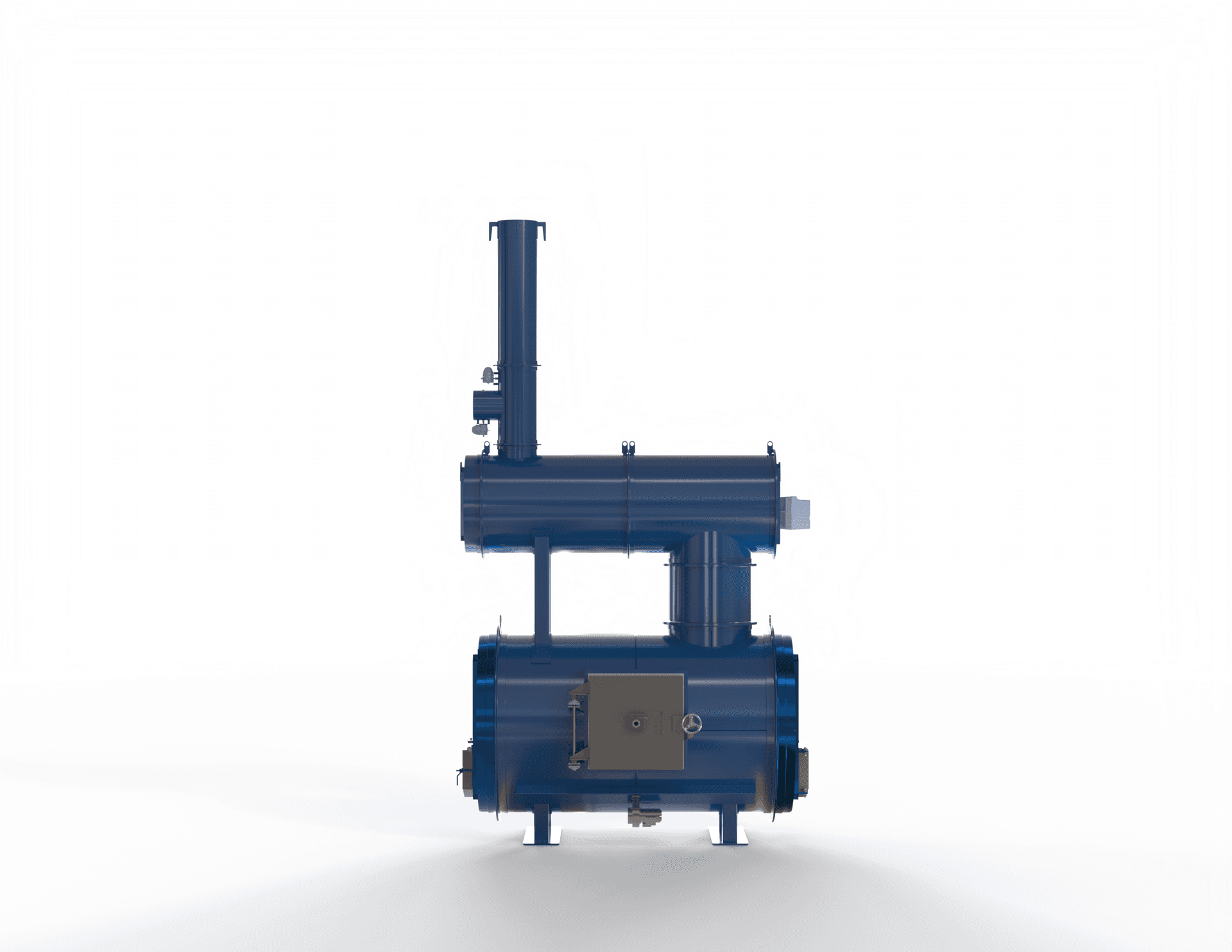
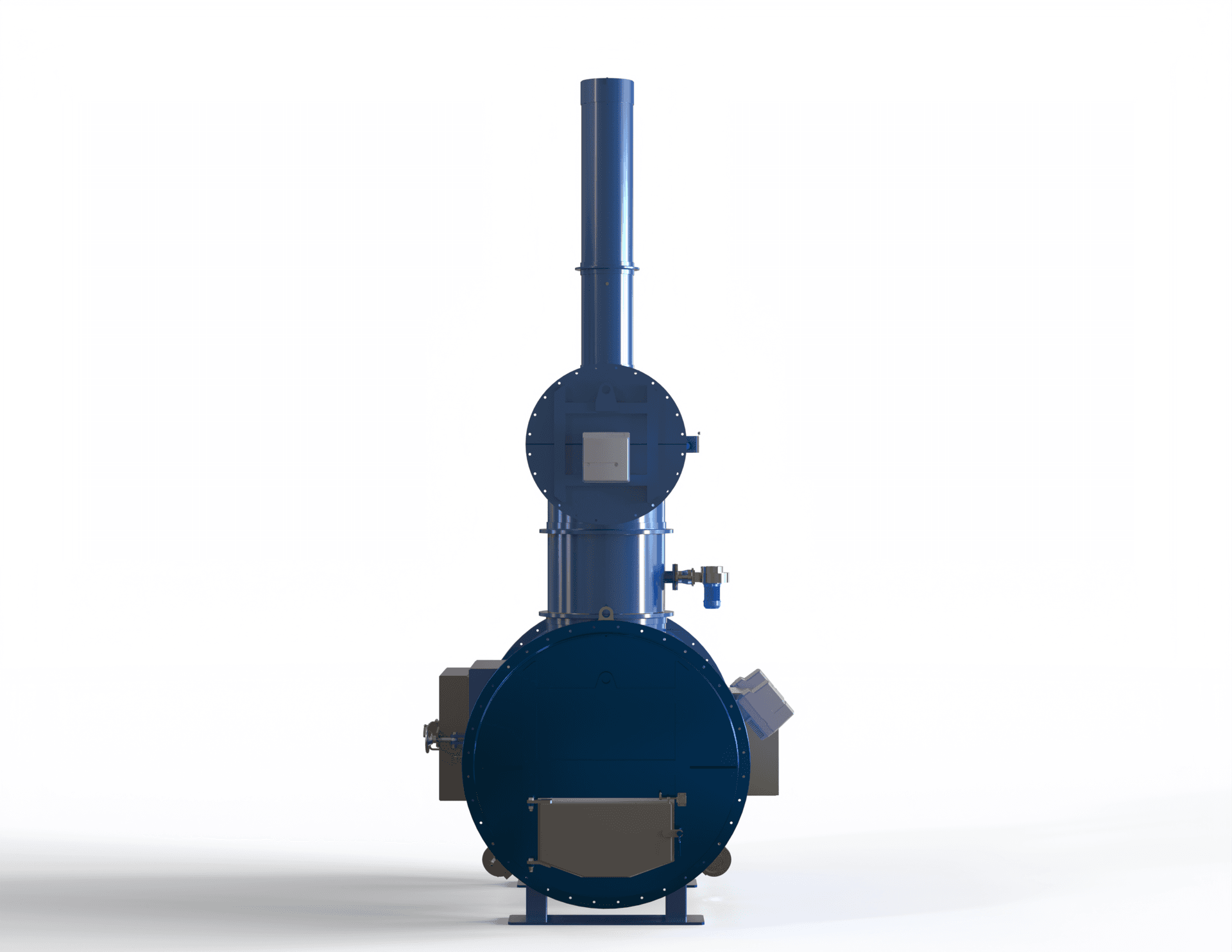
Primary chamber running 850–1,200°C with a secondary holding flue gas above 850°C for two seconds. Rated to run for a shift rather than for a charge, because an industrial stream arrives at the rate the line produces it and a batch machine simply queues it up in the yard.
Front dual-door loading
Charged through a front dual door at floor level, so tote bins, stillages and wheeled skips are fed at the height a forklift or a pump truck already works at. No hoist, no tipping platform, no lifting waste over a top rim.
What Ships
With The Unit
Identical whichever stream it is specified for. The operating procedure changes; the machine does not.
Dual-chamber unit, continuous duty
Primary chamber running 850–1,200°C with a secondary holding flue gas above 850°C for two seconds. Rated to run for a shift rather than for a charge, because an industrial stream arrives at the rate the line produces it and a batch machine simply queues it up in the yard.
Front dual-door loading
Charged through a front dual door at floor level, so tote bins, stillages and wheeled skips are fed at the height a forklift or a pump truck already works at. No hoist, no tipping platform, no lifting waste over a top rim.
IP6X control panel with cycle logging
PLC control with chamber thermocouples, interlocked charge door and a time-stamped temperature record per run. For destruction that has to be evidenced — brand protection, customer-mandated disposal, off-spec write-off — that log is the difference between a certificate and a claim.
Three-burner set and fuel train
Configured for natural gas, LPG, diesel, biofuel or hydrogen. High-calorific streams such as polymer and rubber need less burner input once they are alight, not more — the burners are there to reach and hold the condition, not to do the work the waste is already doing.
Coretex refractory lining
Monolithic castable lining rated for the full range and for sustained running at the top of it. On plastics and solvent-bearing waste the chamber spends real time near the ceiling of that range, which is exactly the duty that eats a cheaper lining.
Stack, dispersion data and commissioning
Stack to the height your site-specific dispersion assessment calls for, the emissions data pack the permit application references, on-site commissioning, a witnessed first run and operator training for the shift staff who will actually run it.
How One Burn Runs,
Start To Finish
One run is one countable event, reconciled against a manifest and evidenced by a time-stamped temperature log.
One Cycle,
Start To Finish
Adds 15 02 02* to the permit and one rule that decides everything at the door: the material is absorbed, not wet. Free liquid in the charge is a rejection, not an adjustment.
Spills are taken up on pads, granules or booms and the used media is bagged or binned where it arose. Whatever is contained here is what the charge will be, so contamination is not spread by moving it twice.
Saturated media that releases liquid is separated out and routed to a licensed liquids destination. This check happens at the store, by the person filling the bin — not at the charge door with a forklift waiting.
Oily waste is fed as part of a mixed charge rather than as a solid block of hydrocarbon. Feeding steadily is what keeps the chamber at condition instead of overshooting it.
Primary combustion with two-second secondary retention above 850°C destroys the retained hydrocarbon, and 1,100°C applies where solvent or chlorinated contamination pushes the charge past 1% halogenated organic content.
Residue is mineral ash with the inert fraction of any filter core or granular carrier. The consignment record for the material stays in the site's hazardous waste file even though the waste never travelled.
What You Can Burn —
And What You Can't
One run takes the whole stream without pre-sorting. What must never enter it is a short, hard list.
Yes: accepted in a run
No pre-sorting between these
- Oily rags, wipes and clothsWorkshop and maintenance rags contaminated with oil, grease or lubricant, bagged at the bench and charged without wringing or washing.
- Spent pad and granular absorbentAbsorbent pads, rolls, socks, booms and granules from spill response and routine drip control, provided they pass the free-liquid check.
- Contaminated PPE and workwearGloves, overalls, boots covers and disposable coveralls contaminated with oil, grease or process chemistry beyond laundering.
- Used filter media and cartridgesOil, air and coolant filter cartridges, bag filters and coalescer elements with retained hydrocarbon; the metal core reports to the ash as inert residue.
- Contaminated packaging and containersDrained containers, liners and packaging that held oil or process chemistry and cannot be cleaned for recycling — drained, never full.
- Workshop sweepings and floor wasteSwept floor waste, dry sweep compound and matting from workshop and plant areas where hydrocarbon contamination is routine.
No: never charged
Not a permit question — these stay out
- Free liquid oil, fuel or coolantDrums of waste oil, fuel and cutting fluid go to a licensed liquids route — often to recovery, which the hierarchy prefers. This class of unit does not inject liquid.
- Saturated media that releases liquidMedia wet enough to drip is a liquid waste carried in a solid. It is separated at the store; the free-liquid check is the whole discipline of this stream.
- Solvent-bearing waste not declared in the permitSolvent contamination changes the codes and often the required temperature. Where a workshop also produces solvent-wetted waste, it goes in the application rather than in the bin.
- Asbestos-contaminated and inert hazardous materialAsbestos, contaminated brake or gasket material and similar mineral hazards do not burn and must not be charged. They have a specialist disposal route and nothing else.
Can you legally burn oily rags, absorbents & filter media on site?
Technically, yes: the chamber destroys almost everything on the accepted list at 850–1,200°C, and capability is rarely the constraint. Legally is a separate question. What your site is allowed to burn is set by your environmental permit from the Environment Agency, SEPA or NIEA and the waste codes written into it. The never-charged list is different again: those materials are out of scope for the unit or governed by a direction, and no permit wording brings them back in. Send us the codes you hold, or the ones you expect to apply for, and we will tell you which of this list they cover before anything is specified.
Send us your waste codesWhat does 1.2 tonnes of oily waste a week take?
Arithmetic on published model figures, not a customer reference. Your numbers go through the same steps.
How This
Was Worked Out
1,200 kg a week against the LBI-125's 125 kg/h is about 10 hours — one shift plus a short second run, leaving 36–60 kg of ash and no hazardous waste movement off the site. This stream rarely justifies a unit by itself. It is usually the fraction that tips a factory already burning production waste into specifying the next size up.
36–60 kg a week
0 movements
None
2.5 t
Send your daily or weekly arisings and we will confirm the model, the run time and the permit route.
Related Products
& Services
Complementary equipment and engineering services for your process.
Sizing and background
- [TOOL]Work out the burn rate for your own arisings
- [TOOL]Size the combustion air and flue gas duty
- [BLOG]Improving manifold airflow evenness by 65%
- [BLOG]Ash management from industrial waste incinerators
- [BLOG]The feasibility of small-scale modular incinerator units
- [BLOG]Precious metal incineration and recovery
- [BLOG]Evaluating flue gas cleaning systems in industrial incinerators
Oily rags, absorbents & filter media Questions
Answered against the published figures for the models specified for this stream, not a generic range sheet.
Oil-contaminated waste is the solid residue of maintenance and spill response: rags and wipes, granular and pad absorbents, contaminated gloves and overalls, spill kit contents, workshop floor sweepings and used filter media. Where the contaminant is a hazardous substance the waste is hazardous too, coding as 15 02 02*; clean or non-hazardously contaminated equivalents sit at 15 02 03. The point of destroying it on site is that the hydrocarbon is destroyed rather than relocated. A drum of oily absorbent leaving in a vehicle is the same oil, in the same quantity, in somebody else's yard, under your duty of care until it reaches a permitted destination. At 850°C with two-second retention the organic fraction is destroyed and what remains is mineral ash and the inert residue of the carrier. The rule that governs this stream is absorption. Absorbent media saturated to the point of releasing liquid is not a charge, it is a liquid waste in a disguise, and a waste incinerator of this class is not a liquid injection plant. Media that passes a simple free-liquid check goes in; a drum of oil does not, and neither does a bin with oil standing in the bottom of it. Filter media is the same argument with an extra step. Cartridge and bag filters, coalescers and workshop filtration all carry retained oil and often a metal core; the media burns, the retained hydrocarbon is destroyed and the core reports to the ash as inert metal.
1,200 kg a week against the LBI-125's 125 kg/h is about 10 hours — one shift plus a short second run, leaving 36–60 kg of ash and no hazardous waste movement off the site. This stream rarely justifies a unit by itself. It is usually the fraction that tips a factory already burning production waste into specifying the next size up.
No. Free liquid oil goes to a licensed liquids route, and the waste hierarchy prefers regeneration or recovery for it anyway. What this stream takes is the contaminated solid — rags, pads, granules, PPE and filter media — with the oil absorbed into it rather than standing in the bin.
By the free-liquid check at the store: media that releases liquid under its own weight is separated out. It is a practical test done by the person filling the bin, and it is the entire discipline of this stream — get it right there and nothing is ever argued about at the charge door.
Drain them first — the recovered oil goes to recovery, which is both cheaper and higher up the hierarchy. What is left is the media and the retained hydrocarbon, which is exactly what the chamber is for. The metal core comes out with the ash as inert residue.
It removes the consignment note for a movement that no longer happens. The classification, the record of what you produced and the duty of care on the residue that does leave are all unchanged. Producing and destroying hazardous waste on one site is a shorter chain, not an exemption.
That is one of the better arguments for a continuous unit. A serious spill produces a month of contaminated absorbent in a shift, and on a collection route that becomes an emergency booking at an emergency price. On site it is extra running hours.
Rarely. A tonne a week is ten hours of running on the smallest LitBurn, and the machine is usually bought for production waste with this fraction added to the same permit. Naming 15 02 02* at application costs nothing; adding it later means a variation.
Ready to
Incinerate?
Send the stream, the volume and the site constraints. We will confirm the model, the permit route, and what the specification has to say to satisfy the regulator.
- The fire loading stops accumulating
- Hazardous consignments become routine runs
- The hydrocarbon is destroyed, not moved
- Spill response stops being capacity-limited