Care Home Waste Incinerators
Care home, hospice, GP and district nursing waste — offensive volume and infectious fraction, split honestly.
Care homes, hospices, GP surgeries and district nursing produce a healthcare stream that is mostly volume and only partly hazardous. Continence pads fill the bins; dressings and insulin sharps make the fraction that has to be incinerated. A group with its own unit stops paying clinical tariffs on the first and stops waiting on a vehicle for the second.
Four Models,
One Solution
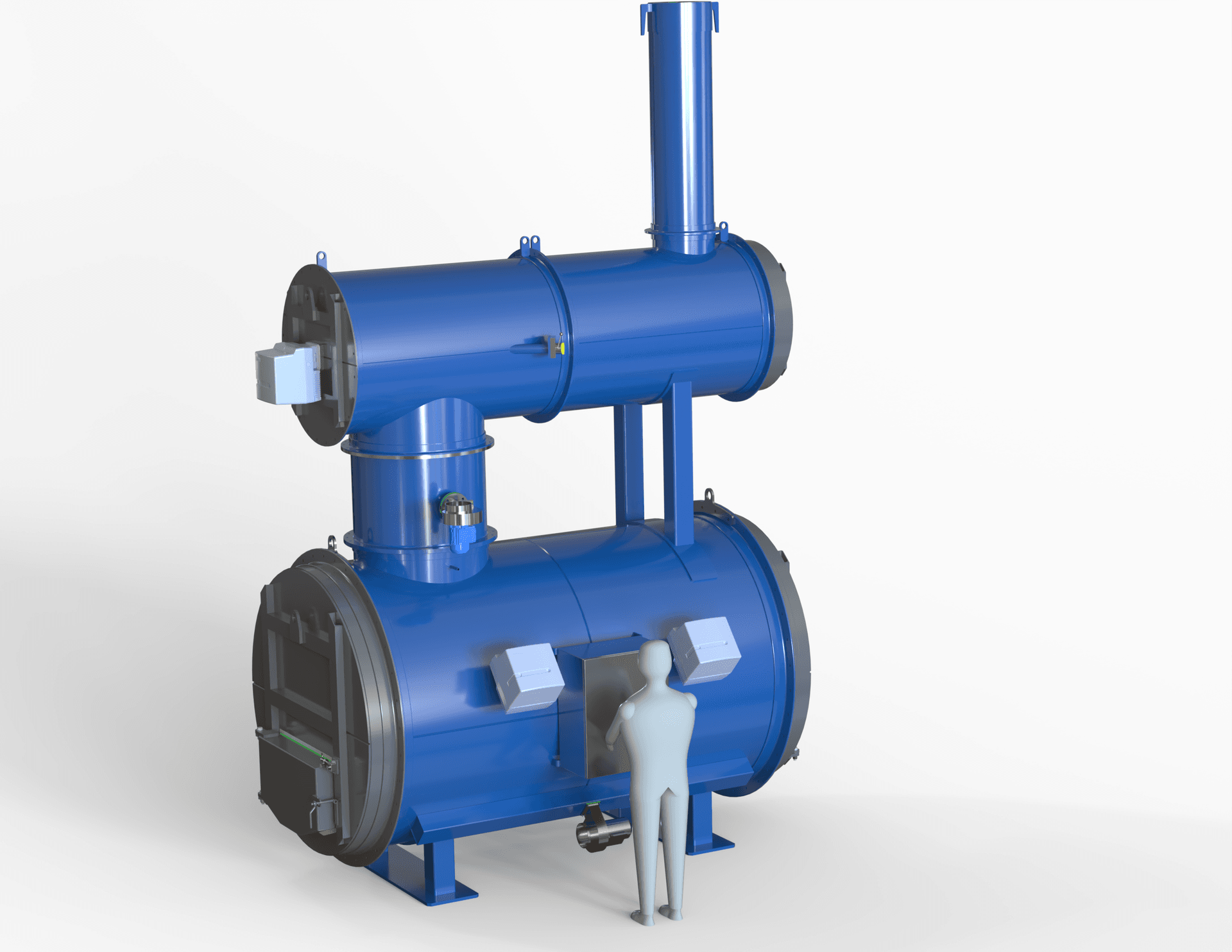
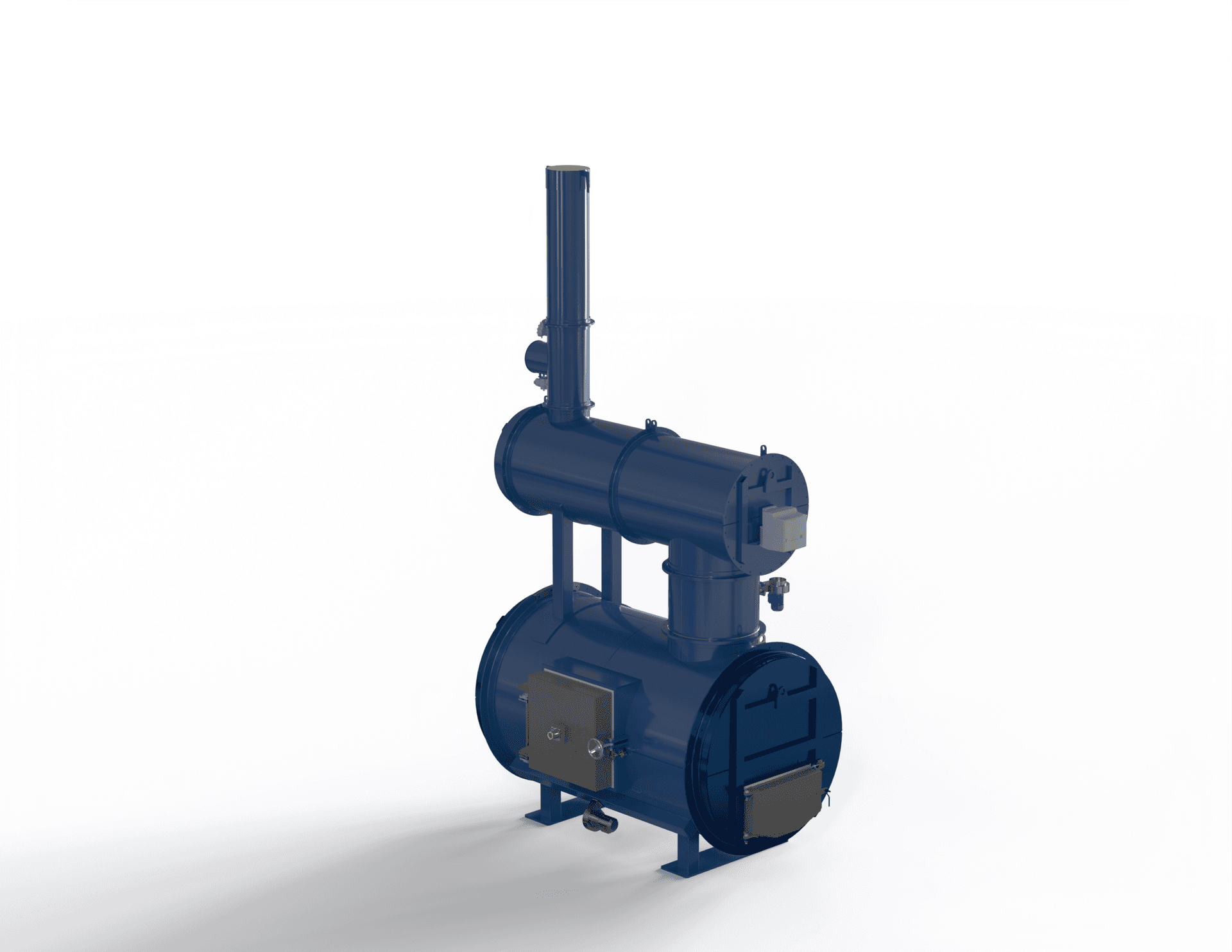
The entry point to the LitBurn range. A 3.3 m³ primary chamber and three burners give continuous 125 kg/h destruction in a footprint that fits a standard yard bay, which makes it the usual choice for a single-site operator replacing skip hire rather than a multi-site waste contract.
The most specified unit in the range. Chamber volume rises to 5.5 m³ for 250 kg/h continuous throughput while the external width grows by only 230 mm over the LBI-125, so sites that outgrow the smallest unit rarely have to rework the slab or the building line.
A 9.6 m³ chamber — nearly double the LBI-250 — for medium-scale industrial waste destruction. At this size most operators pair the unit with heat recovery, because the thermal output during a full shift is large enough to displace a dedicated water heater.
The largest LitBurn: a 16.2 m³ chamber running 500 kg/h continuously. Specified where waste arrives faster than a batch unit can clear it — large manufacturing sites, industrial estates, and operators consolidating several smaller waste contracts onto one machine.
Which Model
Fits Your Volume
Pick a model to see what it clears in a day of care home & community waste.
A twelve-home care group or a hospice with community services: about ten hours a week covers both streams.
18 01 04 and 18 01 03* are different answers
Offensive hygiene waste is 18 01 04 and may lawfully go to landfill or energy from waste; infectious waste is 18 01 03* and may not go to landfill at all. Both should be named at permit application if both will be burned, and the difference should be understood before either is priced.
Segregation is a care-staff duty
The split between tiger-striped, orange, yellow and rigid containers is made in the room by the person providing care. HTM 07-01 applies to a care home as it does to a ward, and a group unit changes the destination rather than the discipline.
Home-to-hub movement is carriage of waste
Collecting from your own homes to your own destruction point requires a registered carrier, the correct documentation and the duty of care, exactly as an external contract would. The saving is the tariff and the schedule, not the paperwork.
Medicines are a separate permit conversation
Trolley returns, part-used medicines and denatured controlled drugs need medicinal codes and, for Schedule 2, an authorised witness. Where a group wants those in scope too, they go in the same application as a distinct line rather than being assumed under the clinical one.
Why Burn It
On Site
4 things change on the day this stream stops leaving the site.
Pad volume is a haulage problem, not a hazard
Continence waste is bulky, heavy and low-risk, and it is the reason collection vehicles come round as often as they do. Reducing it by 95% on site changes the round rather than the risk assessment.
Rural sites are the ones a route drops first
A home at the end of a long round is the pickup that slips when the schedule tightens. A group destruction point turns a dependency on somebody else's route into an internal collection you control.
The infectious fraction stops waiting
Dressings from a resident with a known infection and sharps from the medicines round cannot be held indefinitely in a domestic-scale store. That is the part of the stream where a missed collection turns into a real problem.
Clinical tariffs stop being paid on hygiene waste
Where offensive waste is being collected as clinical waste — which happens far more often than it should — the group is paying the highest tariff on its biggest volume. Segregating properly and destroying on site attacks both ends of that at once.
Dual-chamber unit, 1,100°C capable
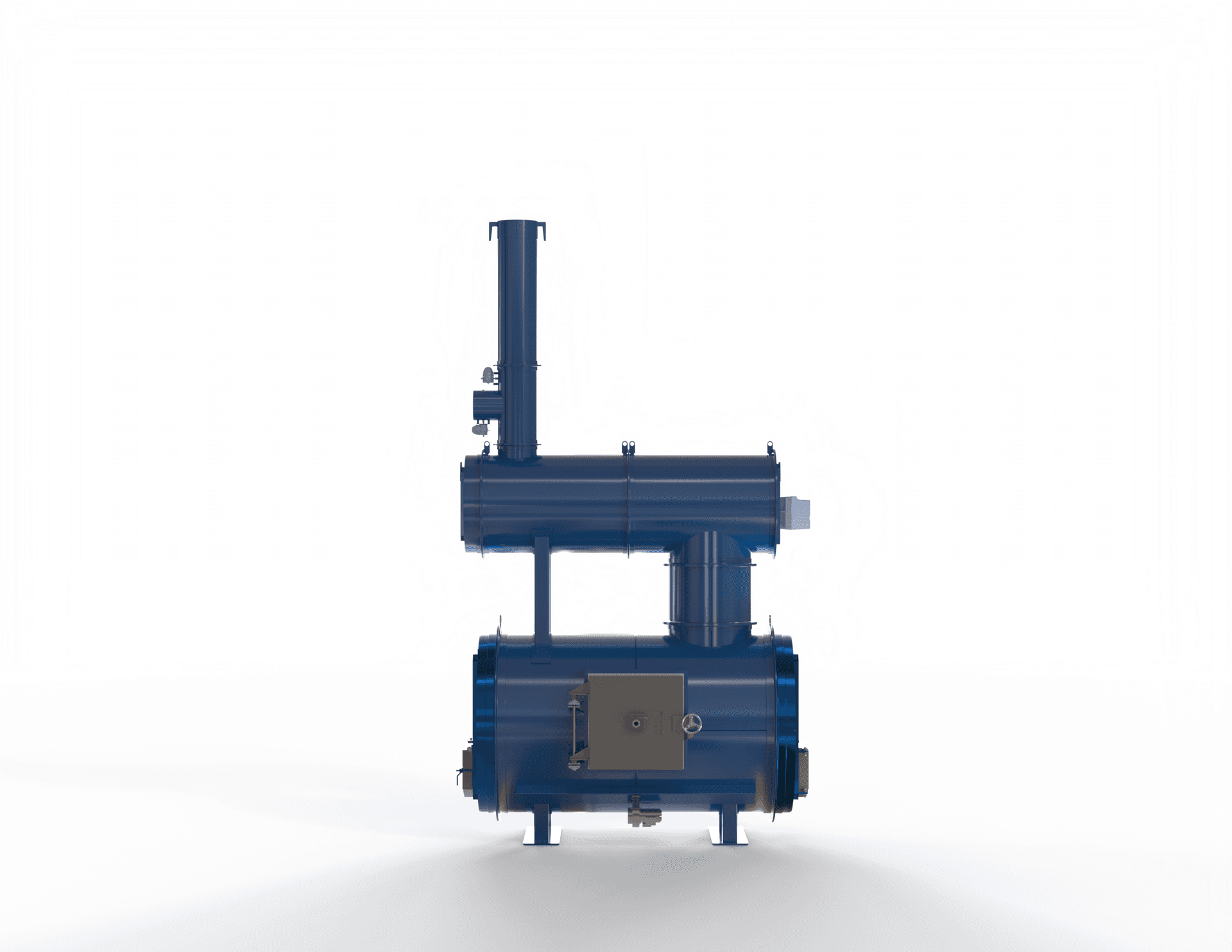
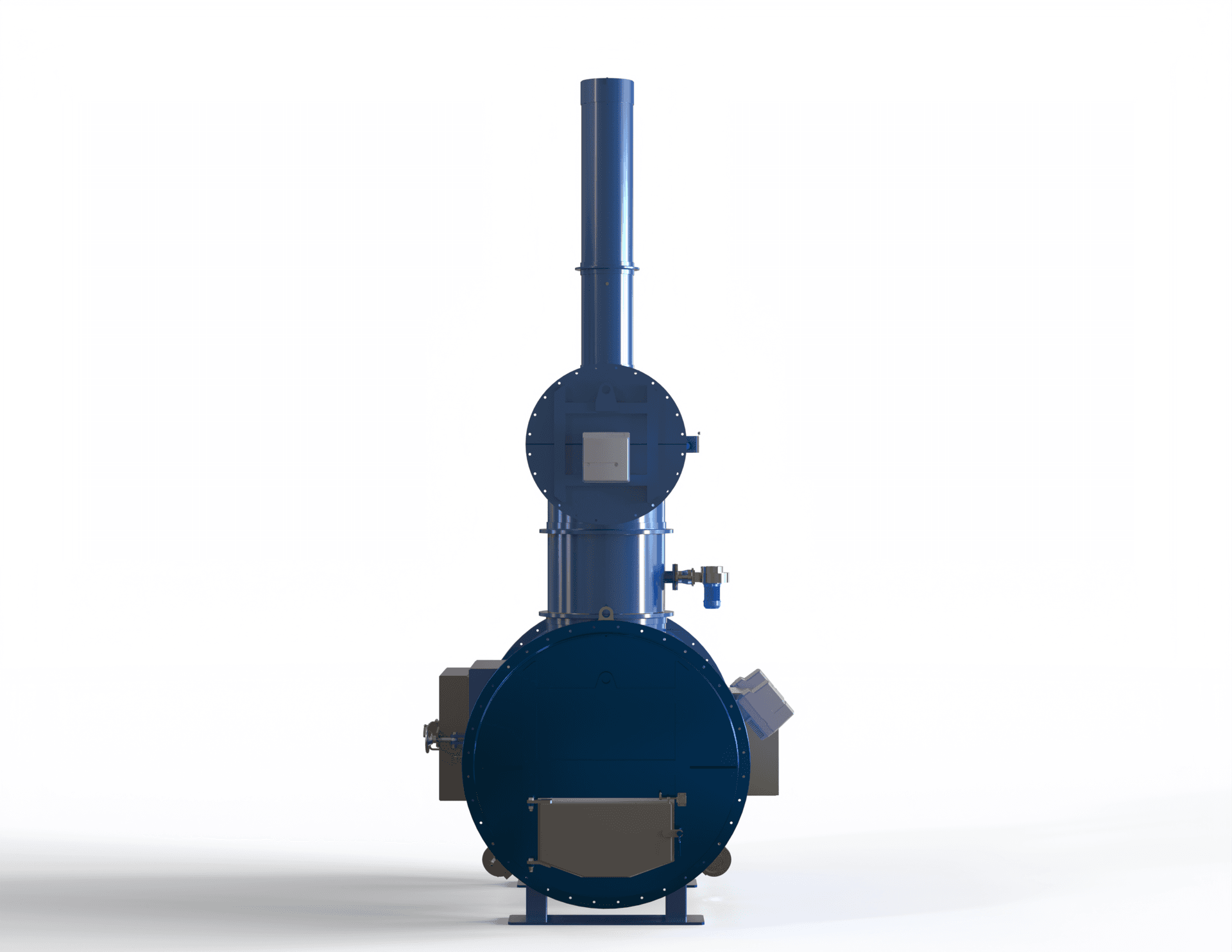
Primary chamber running 850–1,200°C with a secondary chamber holding flue gas above 850°C for two seconds. Clinical charges are PVC-rich — IV bags, giving sets, suction tubing, sterile packaging — so where the stream carries more than 1% halogenated organic content the secondary minimum rises to 1,100°C, and the unit holds it as built rather than as an upgrade.
Front dual-door loading
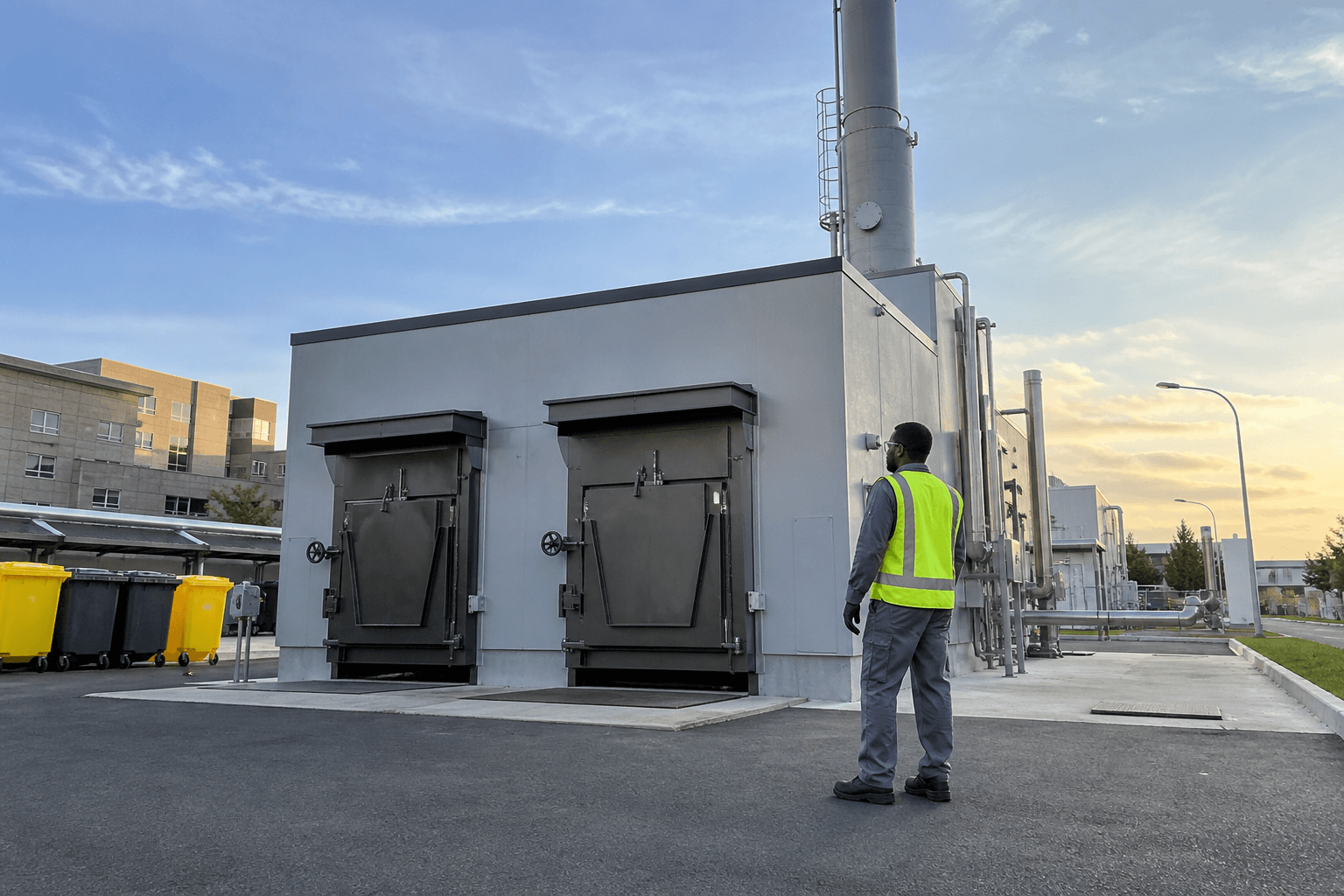
The LBI range is charged through a front dual door at floor level. Wheeled 770-litre clinical carts, rigid-bodied sharps bins and red-lidded anatomical containers go in at the height they arrive at, which is what keeps the last handling step in a clinical waste route a push rather than a lift over a rim.
What Ships
With The Unit
Identical whichever stream it is specified for. The operating procedure changes; the machine does not.
Dual-chamber unit, 1,100°C capable
Primary chamber running 850–1,200°C with a secondary chamber holding flue gas above 850°C for two seconds. Clinical charges are PVC-rich — IV bags, giving sets, suction tubing, sterile packaging — so where the stream carries more than 1% halogenated organic content the secondary minimum rises to 1,100°C, and the unit holds it as built rather than as an upgrade.
Front dual-door loading
The LBI range is charged through a front dual door at floor level. Wheeled 770-litre clinical carts, rigid-bodied sharps bins and red-lidded anatomical containers go in at the height they arrive at, which is what keeps the last handling step in a clinical waste route a push rather than a lift over a rim.
IP6X control panel with cycle logging
PLC control with chamber thermocouples, interlocked charge door and a time-stamped temperature record per run. For clinical waste that record is what turns a claim of destruction into evidence of it — the condition an infection control audit or a permit compliance check asks to see.
Burner set and fuel train
Configured for natural gas, LPG, diesel, biofuel or hydrogen, with three burners across the LBI range. Fuel choice is a site decision; the combustion condition is identical whichever is specified. Wet loads — anatomical waste, suction liners, fluid-heavy dressings — draw more burner time, not a different machine.
Coretex refractory lining
Monolithic castable lining rated for the full temperature range and for sustained running at the top of it. Replaceable in service rather than requiring the shell to be scrapped with it, which matters on a unit running shifts against a daily arisings curve rather than single burns.
Stack, dispersion data and commissioning
Stack supplied to the height your site-specific dispersion assessment calls for — hospital sites usually carry the tightest one on this list, with wards, intakes and neighbours all inside the assessment — plus the emissions data pack the permit application references, on-site commissioning, a witnessed first run and operator training.
How One Burn Runs,
Start To Finish
One run is one countable event, reconciled against a manifest and evidenced by a time-stamped temperature log.
One Cycle,
Start To Finish
Adds 18 01 04 for offensive waste alongside 18 01 03* for the infectious fraction, and a costing question the other children do not have: the offensive stream is a choice, not a legal requirement.
Tiger-striped for offensive hygiene waste, orange for infectious, yellow where medicines are involved, rigid containers for sharps. The split is made by care staff at the room, and everything downstream follows it.
Bagged waste is held in the home's own store and collected onto the group's round to the permitted site, labelled with the home it came from.
Bags and containers go through the front dual door closed. Nothing is opened at the hub to check what a home put in it — that check happens at the home or not at all.
Primary combustion with two-second retention above 850°C in the secondary. Pad waste carries a high moisture content, so a hygiene-heavy run burns below the plate rating and takes longer than the arithmetic suggests.
Residue is 3–5% mineral ash. The run log and the home labels let the group evidence destruction site by site, which is what its own regulator will ask about rather than a tonnage.
What You Can Burn —
And What You Can't
One run takes the whole stream without pre-sorting. What must never enter it is a short, hard list.
Yes: accepted in a run
No pre-sorting between these
- Continence and hygiene wastePads, incontinence products and hygiene waste in tiger-striped bags under 18 01 04 — the volume fraction, and the one that is a cost decision rather than a legal requirement.
- Infectious dressings and wound careDressings, wound packs and swabs from residents or patients with a known infection, bagged orange at the point of care.
- PPE from care and outbreak precautionsGloves, aprons, masks and gowns from personal care and from outbreak precautions, where they carry a real infectious risk rather than being tidied into the wrong bag.
- Insulin and medicines-round sharpsPen needles, insulin sharps, anticoagulant syringes and lancets in sealed rigid containers from the medicines round or the district nursing bag.
- Catheter, stoma and drainage productsDrainage bags, catheter and stoma products from continuing care, bagged at the point of use and charged sealed.
- Hospice and end-of-life care consumablesSingle-use consumables from syringe drivers, pressure care and end-of-life nursing, on the same segregation rules as any other care setting.
No: never charged
Not a permit question — these stay out
- Medicines from the trolley or the returns cupboardExpired and part-used medicines, and denatured controlled drugs, are a medicinal stream with their own codes, their own witness requirement and their own permit lines. They are specified on the pharmaceutical sector.
- Cytotoxic and cytostatic wastePurple-lidded waste from oncology-adjacent community care is hazardous under 18 01 08* and needs its own permitted scope rather than travelling with the home's clinical bags.
- Aerosols, inhalers and pressurised containersSealed vessels under heat. Metered-dose inhalers and aerosols follow their own return route regardless of which bin they were found in.
- Batteries, WEEE and mobility equipmentHoists, beds, monitors and battery-bearing equipment are electrical waste with their own recovery obligations. They are not a waste incineration question at any size.
Can you legally burn care home & community waste on site?
Technically, yes: the chamber destroys almost everything on the accepted list at 850–1,200°C, and capability is rarely the constraint. Legally is a separate question. What your site is allowed to burn is set by your environmental permit from the Environment Agency, SEPA or NIEA and the waste codes written into it. The never-charged list is different again: those materials are out of scope for the unit or governed by a direction, and no permit wording brings them back in. Send us the codes you hold, or the ones you expect to apply for, and we will tell you which of this list they cover before anything is specified.
Send us your waste codesWhat does a 12-home care group need?
Arithmetic on published model figures, not a customer reference. Your numbers go through the same steps.
How This
Was Worked Out
12 homes averaging 100 kg a week = 1,200 kg; against the LBI-125's 125 kg/h that is about 10 hours, or one full shift plus a short second run — allow more where pad waste dominates, because it is wet. Roughly 70% of that weight is offensive waste that is not legally required to be incinerated. Price the run against the landfill and gate-fee alternative before assuming the whole stream belongs in the chamber.
≈10 h a week
≈70% by weight
36–60 kg a week
2.5 t
Send your daily or weekly arisings and we will confirm the model, the run time and the permit route.
Related Products
& Services
Complementary equipment and engineering services for your process.
Sizing and background
- [TOOL]Work out the burn rate for your own arisings
- [TOOL]Size the combustion air and flue gas duty
- [BLOG]Integrating vibration analysis for incinerator predictive maintenance
- [BLOG]Advanced gas cleaning for ultra-low emission incinerators
- [BLOG]Evaluating flue gas cleaning systems in industrial incinerators
Care home & community waste Questions
Answered against the published figures for the models specified for this stream, not a generic range sheet.
Community healthcare waste is what arises outside a hospital: care and nursing homes, hospices, GP surgeries, ambulance stations and district nursing rounds. By weight it is dominated by offensive or hygiene waste — continence pads, incontinence products, non-infectious dressings and PPE — collected in tiger-striped bags under 18 01 04, and it is not required to be incinerated at all. The rest of it is: infectious dressings and PPE from a resident with a known infection, insulin and anticoagulant sharps from the medicines round, wound care from district nursing. That fraction is 18 01 03* and travels the same route as any hospital clinical waste, with the same colour coding and the same collection dependency behind it. Being straight about the split is the whole point of this page. Offensive waste may lawfully go to landfill or energy from waste, so incinerating it is a cost and logistics decision — gate fees, Landfill Tax, vehicle movements to rural sites, and 95% mass reduction against a bulky, low-density load. The infectious fraction is where the legal argument lives, and it is the smaller half. The practical shape is a group: a care operator with a dozen homes, a hospice charity, or a community trust running district nursing from a single base. One permitted unit at a hub takes both streams under one permit, and the offensive volume — which is what makes a rural collection round expensive — stops leaving the group at all.
12 homes averaging 100 kg a week = 1,200 kg; against the LBI-125's 125 kg/h that is about 10 hours, or one full shift plus a short second run — allow more where pad waste dominates, because it is wet. Roughly 70% of that weight is offensive waste that is not legally required to be incinerated. Price the run against the landfill and gate-fee alternative before assuming the whole stream belongs in the chamber.
No. Tiger-striped offensive and hygiene waste — continence pads and the like — may lawfully go to landfill or energy from waste. Burning it is a cost and logistics decision: gate fees, Landfill Tax, vehicle movements and a 95% mass reduction against a bulky load. The infectious fraction is the part with a legal argument behind it.
Usually the smaller part. Pads and hygiene waste dominate by weight, while the genuinely infectious fraction is dressings from a known infection, outbreak PPE and the sharps from the medicines round. Groups that never made that split are typically paying a clinical tariff on the whole lot, which is worth fixing before buying anything.
Only with the medicinal codes named in the permit, and never for Schedule 2 controlled drugs without denaturing and an authorised witness first. That stream is set out on the pharmaceutical sector, including what the witness requirement actually means in practice for a care setting.
No — a home producing around 100 kg a week is under an hour of running. The case is a group: a dozen homes, a hospice with community services, or a trust running district nursing from one base. Consolidation across sites you control is what makes the arithmetic work.
Because it is wet. Continence waste carries a high moisture content, and the burners spend energy evaporating it before combustion proper, so a hygiene-heavy run sits below the plate rating. Allow extra time on a pad-dominated stream rather than sizing straight off the arithmetic.
Yes, for the collection round between your homes and your destruction point. Moving waste between sites you own is still carriage: registered carrier, correct documentation, duty of care throughout. What disappears is the external collection contract and the tariff attached to it.
Ready to
Incinerate?
Send the stream, the volume and the site constraints. We will confirm the model, the permit route, and what the specification has to say to satisfy the regulator.
- Pad volume is a haulage problem, not a hazard
- Rural sites are the ones a route drops first
- The infectious fraction stops waiting
- Clinical tariffs stop being paid on hygiene waste