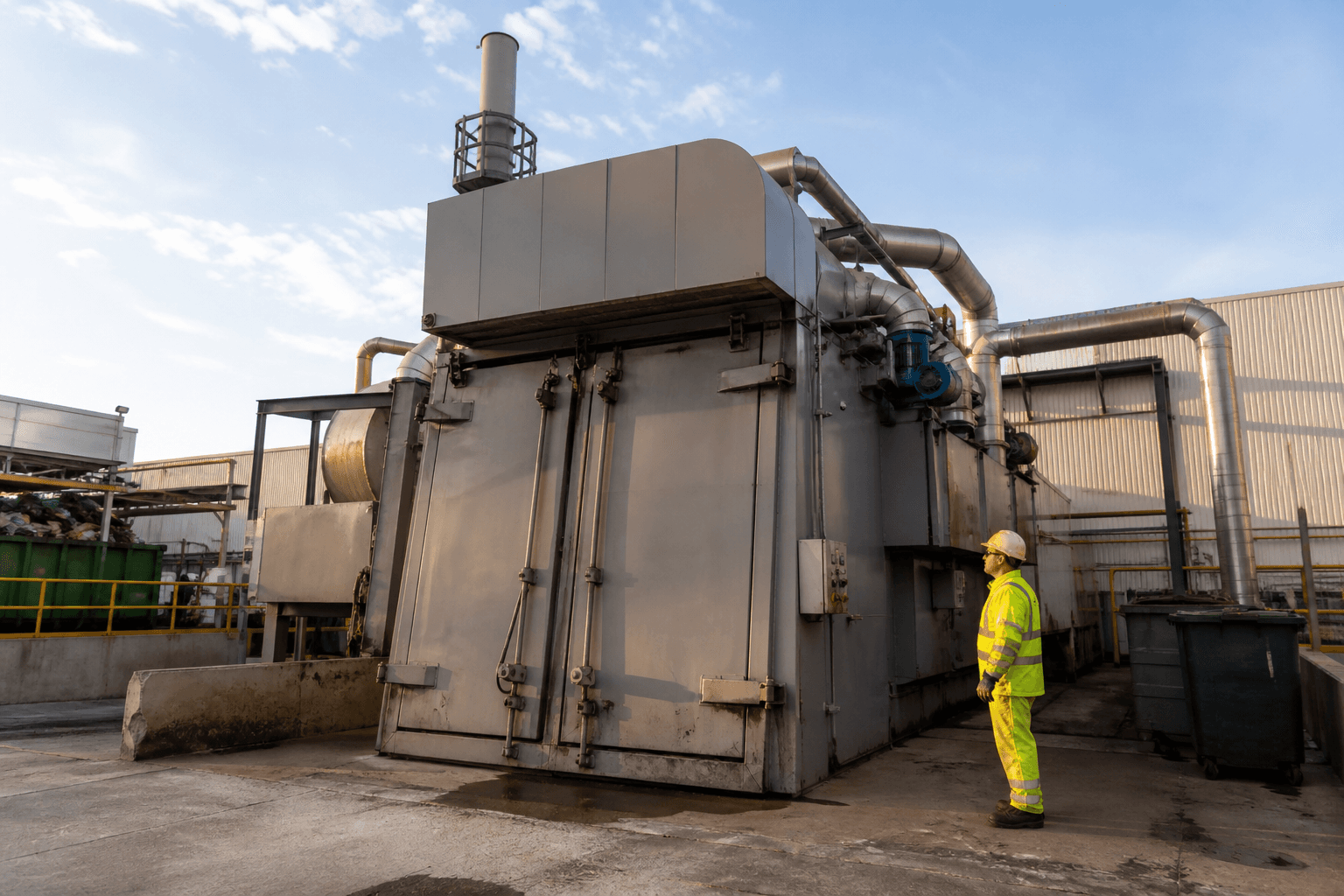
International Catering Waste Incinerators
Category 1 catering waste from aircraft, ships and cross-border transport — destruction is mandatory.
Catering waste from an aircraft or vessel arriving from outside the country is not ordinary refuse. It is Category 1 animal by-product, it carries the biosecurity risk the rules exist for, and it must be destroyed — not composted, not digested, not landfilled. On-site incineration is the shortest route between the aircraft stand and that requirement.
Four Models,
One Solution
The entry point to the LitBurn range. A 3.3 m³ primary chamber and three burners give continuous 125 kg/h destruction in a footprint that fits a standard yard bay, which makes it the usual choice for a single-site operator replacing skip hire rather than a multi-site waste contract.
The most specified unit in the range. Chamber volume rises to 5.5 m³ for 250 kg/h continuous throughput while the external width grows by only 230 mm over the LBI-125, so sites that outgrow the smallest unit rarely have to rework the slab or the building line.
A 9.6 m³ chamber — nearly double the LBI-250 — for medium-scale industrial waste destruction. At this size most operators pair the unit with heat recovery, because the thermal output during a full shift is large enough to displace a dedicated water heater.
The largest LitBurn: a 16.2 m³ chamber running 500 kg/h continuously. Specified where waste arrives faster than a batch unit can clear it — large manufacturing sites, industrial estates, and operators consolidating several smaller waste contracts onto one machine.
Which Model
Fits Your Volume
Pick a model to see what it clears in a day of international catering waste.
A regional airport or small port handling a tonne or so of international catering waste a week.
Category 1 means destruction, not treatment
International catering waste must be destroyed by approved incineration or rendering. Anaerobic digestion, composting, landfill and animal feed are all closed to it. This is the one stream here where incineration is the requirement rather than the option.
APHA approval sits on top of the permit
The plant needs approval under the animal by-products rules as well as an environmental permit for the incineration. Both are in place before the first run, and the approval defines what may be accepted.
Segregation from arrival to charge door
The material is kept apart from ordinary waste in dedicated closed containers throughout. A single tipping error into a general compactor is a biosecurity incident, not a housekeeping one.
Records are part of the approval
Quantity, origin, movement, destruction date and run conditions are recorded to the standard the approval sets. Producing and destroying on one estate shortens the chain; it does not shorten the paperwork.
Why Burn It
On Site
4 things change on the day this stream stops leaving the site.
The disposal route is mandatory, so capacity is the risk
There is no fallback route for Category 1 catering waste. When approved capacity is short or a contractor fails, an operator is holding material it cannot lawfully send anywhere else. On-site capacity removes that exposure entirely.
The biosecurity chain is as short as it can be
Every kilometre this material travels is a kilometre of chain of custody that has to be documented and trusted. Destroying it on the estate reduces the journey to an internal movement under one operator's control.
Segregation stops depending on a third party
The requirement is that international catering waste never mixes with ordinary waste. Fewer handovers means fewer places where a container is tipped into the wrong compactor by someone who did not read the label.
Turnaround is not held up by a collection
Aircraft and vessel turnarounds run to a clock. A destination on the estate means the waste leaves the stand immediately rather than accumulating in a holding area until a specialist vehicle arrives.
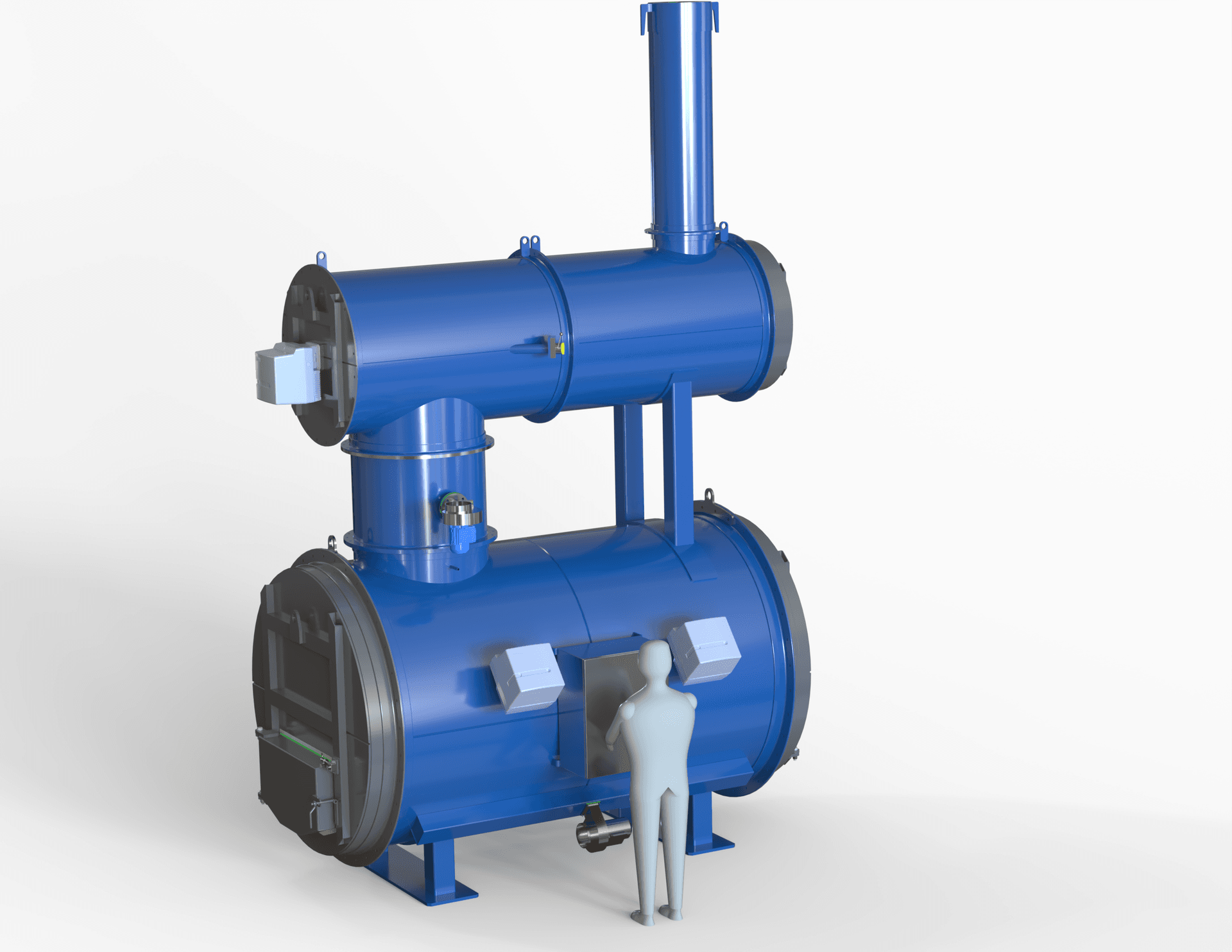
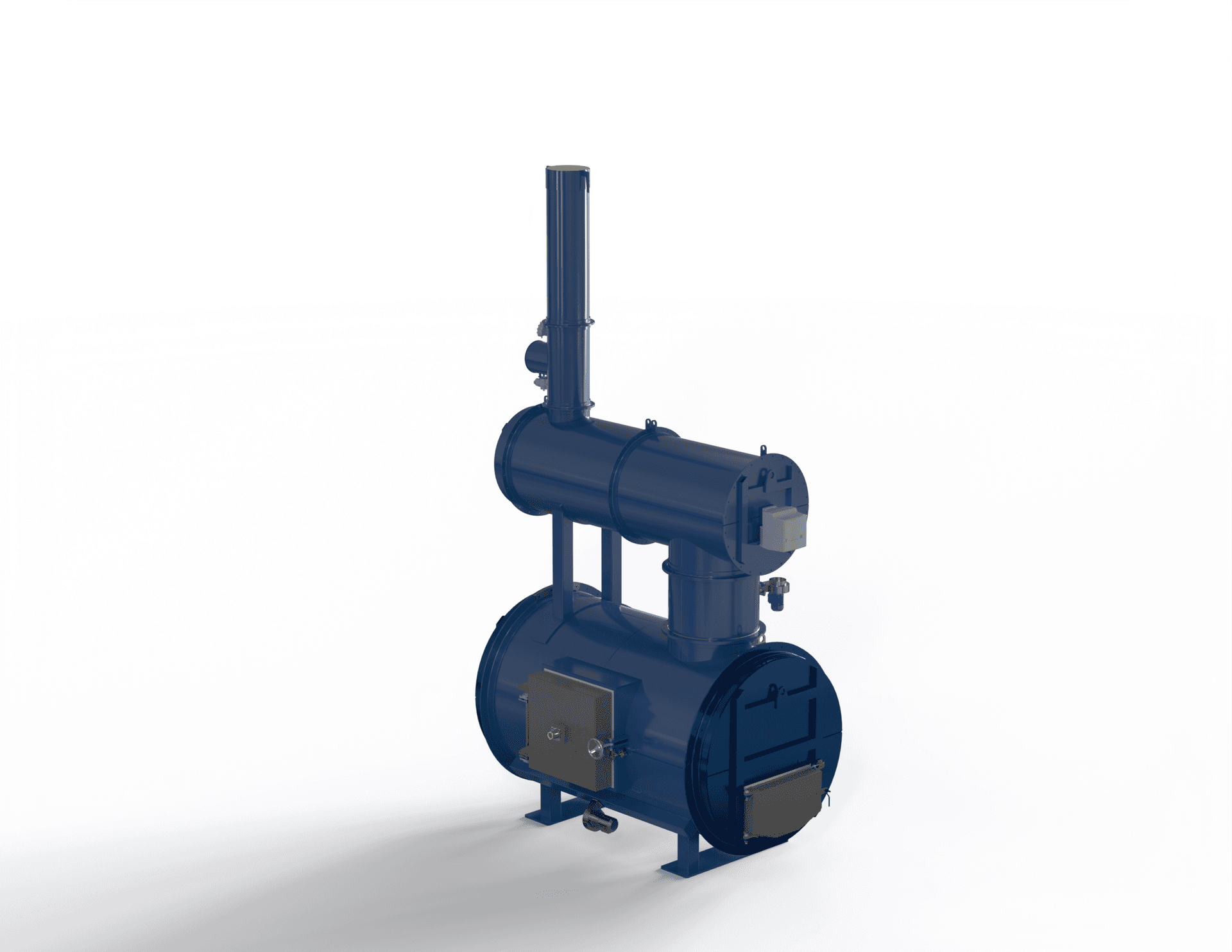
Dual-chamber unit, continuous duty
Primary chamber running 850–1,200°C with a secondary holding flue gas above 850°C for two seconds. Rated to run for a shift, because mixed waste arrives at the rate a site produces it rather than in charges somebody can schedule.
Front dual-door loading
Charged through a front dual door at floor level, so 1,100-litre bins, cages and wheeled containers are fed at the height they are already moved at. No tipping platform, no hoist, no lifting sacks over a rim.
What Ships
With The Unit
Identical whichever stream it is specified for. The operating procedure changes; the machine does not.
Dual-chamber unit, continuous duty
Primary chamber running 850–1,200°C with a secondary holding flue gas above 850°C for two seconds. Rated to run for a shift, because mixed waste arrives at the rate a site produces it rather than in charges somebody can schedule.
Front dual-door loading
Charged through a front dual door at floor level, so 1,100-litre bins, cages and wheeled containers are fed at the height they are already moved at. No tipping platform, no hoist, no lifting sacks over a rim.
IP6X control panel with cycle logging
PLC control with chamber thermocouples, interlocked charge door and a time-stamped temperature record per run. On a residual stream the log is what a permit compliance visit reads, and what a duty-of-care question is answered from.
Three-burner set and fuel train
Configured for natural gas, LPG, diesel, biofuel or hydrogen. Mixed municipal and commercial waste is wetter and more variable than an industrial stream, so burner support matters more here than on a polymer charge.
Coretex refractory lining
Monolithic castable lining rated for the full temperature range, replaceable in service. Mixed waste swings in calorific value between one bin and the next, and the lining is specified for that cycling rather than for a steady feed.
Stack, dispersion data and commissioning
Stack to the height your site-specific dispersion assessment calls for, the emissions data pack the permit application references, on-site commissioning, a witnessed first run and operator training for depot or site staff.
How One Burn Runs,
Start To Finish
One run is one countable event, reconciled against a manifest and evidenced by a time-stamped temperature log.
One Cycle,
Start To Finish
Adds an APHA approval on top of the environmental permit, and a segregation regime that starts at the aircraft door: this material never joins the terminal's ordinary residual stream at any point.
Catering waste is separated at source into dedicated, closed, clearly identified containers. Nothing from an international arrival joins the terminal's ordinary residual stream at any point in its life.
Containers are moved in dedicated equipment under the animal by-product handling requirements, with the movement recorded even where both ends are on the same estate.
Material is charged through the front dual door without being opened, tipped or sorted. The closed container is the control, exactly as it is in the clinical sharps stream.
Primary combustion with flue gas held above 850°C for two seconds in the secondary chamber, at the conditions the approval specifies for Category 1 material.
Quantity, origin, date, run log and ash weight are recorded to the standard the by-products approval requires. The record is the deliverable here every bit as much as the destruction is.
What You Can Burn —
And What You Can't
One run takes the whole stream without pre-sorting. What must never enter it is a short, hard list.
Yes: accepted in a run
No pre-sorting between these
- Aircraft catering waste from international arrivalsGalley waste, uneaten meals, part-used service items and food-contaminated packaging from flights arriving from outside the country.
- Ship and ferry catering wasteGalley and mess waste from vessels arriving from international voyages, landed under the port's by-product arrangements.
- Food-contaminated service ware from those servicesTrays, wrappers, cups and single-use items contaminated with the catering waste — segregated with it rather than separated out.
- Cross-border transport catering wasteCatering waste from international rail and coach operations where the arrangements classify it with the aircraft and vessel streams.
- Seized food products at border pointsPersonal food imports intercepted at the border where the arrangements direct them to approved destruction rather than to another route.
- Quarantine and holding-area food wasteFood material arising in border holding and quarantine areas that falls under the same classification and cannot enter the ordinary stream.
No: never charged
Not a permit question — these stay out
- Domestic catering wasteCatering waste from domestic operations is a different category with separate collection and treatment routes. Mixing the two upgrades the whole load to Category 1 and wastes the approval on ordinary refuse.
- Ordinary terminal and cabin wasteNewspapers, packaging and cabin refuse without food contamination are residual waste. Keeping them out is what keeps the Category 1 stream the size it needs to be.
- Sealed unopened food products for another routeWhere the arrangements permit sealed products to be handled differently, that decision belongs to the authority governing them and not to the waste operation.
- Anything the approval does not nameThe APHA approval defines the categories and quantities the plant may take. Material outside it does not become acceptable because the machine could physically burn it.
Can you legally burn international catering waste on site?
Technically, yes: the chamber destroys almost everything on the accepted list at 850–1,200°C, and capability is rarely the constraint. Legally is a separate question. What your site is allowed to burn is set by your environmental permit from the Environment Agency, SEPA or NIEA and the waste codes written into it, plus APHA approval, because animal by-products are regulated under their own rules. The never-charged list is different again: those materials are out of scope for the unit or governed by a direction, and no permit wording brings them back in. Send us the codes you hold, or the ones you expect to apply for, and we will tell you which of this list they cover before anything is specified.
Send us your waste codesWhat size unit for 5 tonnes of international catering waste a week?
Arithmetic on published model figures, not a customer reference. Your numbers go through the same steps.
How This
Was Worked Out
5,000 kg a week against the LBI-250's 250 kg/h = 20 hours, or two and a half shifts — with no alternative destination available if the unit is not there. Catering waste is wet, so it burns below the plate rating. Allow more time than the arithmetic gives, and size on the busiest week rather than the average — flight and sailing schedules are not smooth.
150–250 kg a week
None — destruction required
APHA + environmental permit
2.9 t
Send your daily or weekly arisings and we will confirm the model, the run time and the permit route.
Related Products
& Services
Complementary equipment and engineering services for your process.
Sizing and background
- [TOOL]Work out the burn rate for your own arisings
- [TOOL]Size the combustion air and flue gas duty
- [BLOG]Validating feasibility for an 8,200 kg/h waste-to-energy incinerator
- [BLOG]Designing modular incinerator systems for waste-to-energy
- [BLOG]Integrating vibration analysis for incinerator predictive maintenance
- [BLOG]Advanced gas cleaning for ultra-low emission incinerators
- [BLOG]Evaluating flue gas cleaning systems in industrial incinerators
International catering waste Questions
Answered against the published figures for the models specified for this stream, not a generic range sheet.
International catering waste is catering waste from means of transport operating internationally — aircraft, ships and, in some arrangements, cross-border rail and road. It is classified as Category 1 animal by-product material because it may contain meat and dairy products from countries with different animal health status, which is precisely the pathway that animal disease controls exist to close. The consequence is that its disposal route is not a choice. Category 1 material must be destroyed by approved incineration or rendering. It may not go to anaerobic digestion, it may not be composted, it may not be landfilled and it may never be fed to animals. That makes this the only stream on the general waste sector where incineration is a legal requirement rather than a commercial decision. Handling is the other half of the requirement. The waste is segregated at the point it leaves the aircraft or vessel, moved in dedicated, closed and identified containers, and kept apart from the terminal's ordinary waste at every stage. A unit on the airside or port estate shortens that chain to the length of an internal road. Both approvals apply. Destroying Category 1 material requires the plant to be approved by APHA under the animal by-products rules, on top of the environmental permit for the incineration itself. Neither substitutes for the other, and both are settled before the first run rather than after it.
5,000 kg a week against the LBI-250's 250 kg/h = 20 hours, or two and a half shifts — with no alternative destination available if the unit is not there. Catering waste is wet, so it burns below the plate rating. Allow more time than the arithmetic gives, and size on the busiest week rather than the average — flight and sailing schedules are not smooth.
Because it is Category 1 animal by-product material. It may contain meat and dairy from countries with different animal health status, and the whole point of the classification is to close that pathway. Approved incineration or rendering are the routes; digestion, composting, landfill and animal feed are all excluded.
Two. An environmental permit for the incineration, and APHA approval of the plant under the animal by-products rules for Category 1 material. The approval defines what may be accepted and the records that must be kept, and neither approval substitutes for the other.
The unit can be permitted for both, but the streams do not share containers or handling. Mixing them upgrades the entire load to Category 1, which wastes approved capacity on waste that had a cheaper lawful route and complicates every record you keep.
The practical answer is as soon as the turnaround allows, held in closed dedicated containers until then. The regulatory answer is set by your approval and your handling arrangements — but the reason operators want a unit on the estate is that holding this material is the part nobody enjoys.
Yes, with more burner support and more time than the plate rating suggests. It is largely water, like anatomical waste, so a run takes longer per kilogram than a dry residual charge. Size on the busiest week and allow margin rather than working from the arithmetic alone.
Where the arrangements direct intercepted personal food imports to approved destruction, an approved unit on the estate is the destination. The categories and quantities it may take are defined by the approval, not by what the chamber could physically accept.
Ready to
Incinerate?
Send the stream, the volume and the site constraints. We will confirm the model, the permit route, and what the specification has to say to satisfy the regulator.
- The disposal route is mandatory, so capacity is the risk
- The biosecurity chain is as short as it can be
- Segregation stops depending on a third party
- Turnaround is not held up by a collection