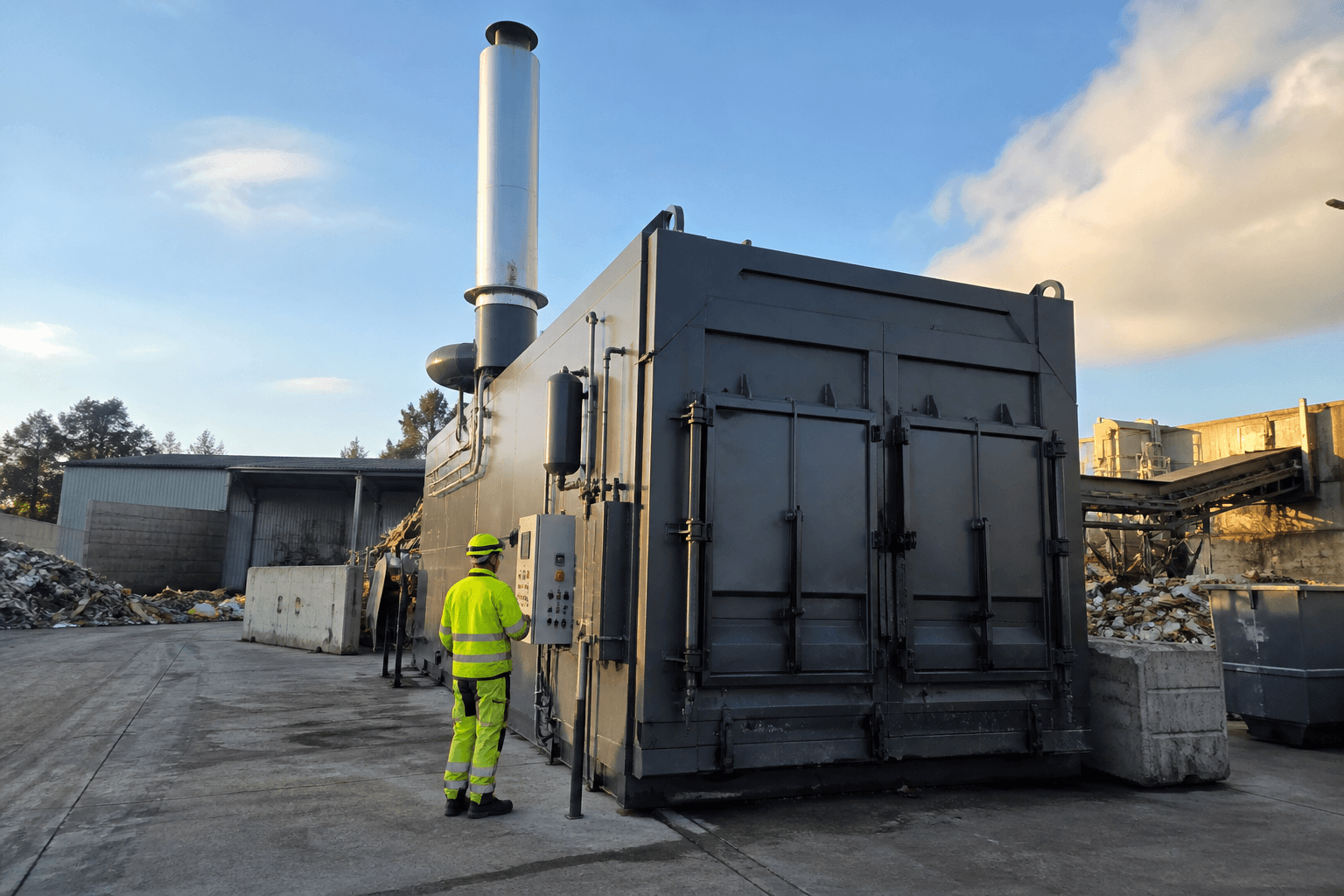
Flood Clearance Waste Incinerators
Silt-contaminated contents, sandbags, flooring and soft furnishings after a flood or storm event.
A flood turns a building's contents into waste overnight, contaminated with silt and whatever the water carried. The clearance is judged in days, not weeks, and it collides with every other affected property in the same district competing for the same skips and the same vehicles.
Four Models,
One Solution
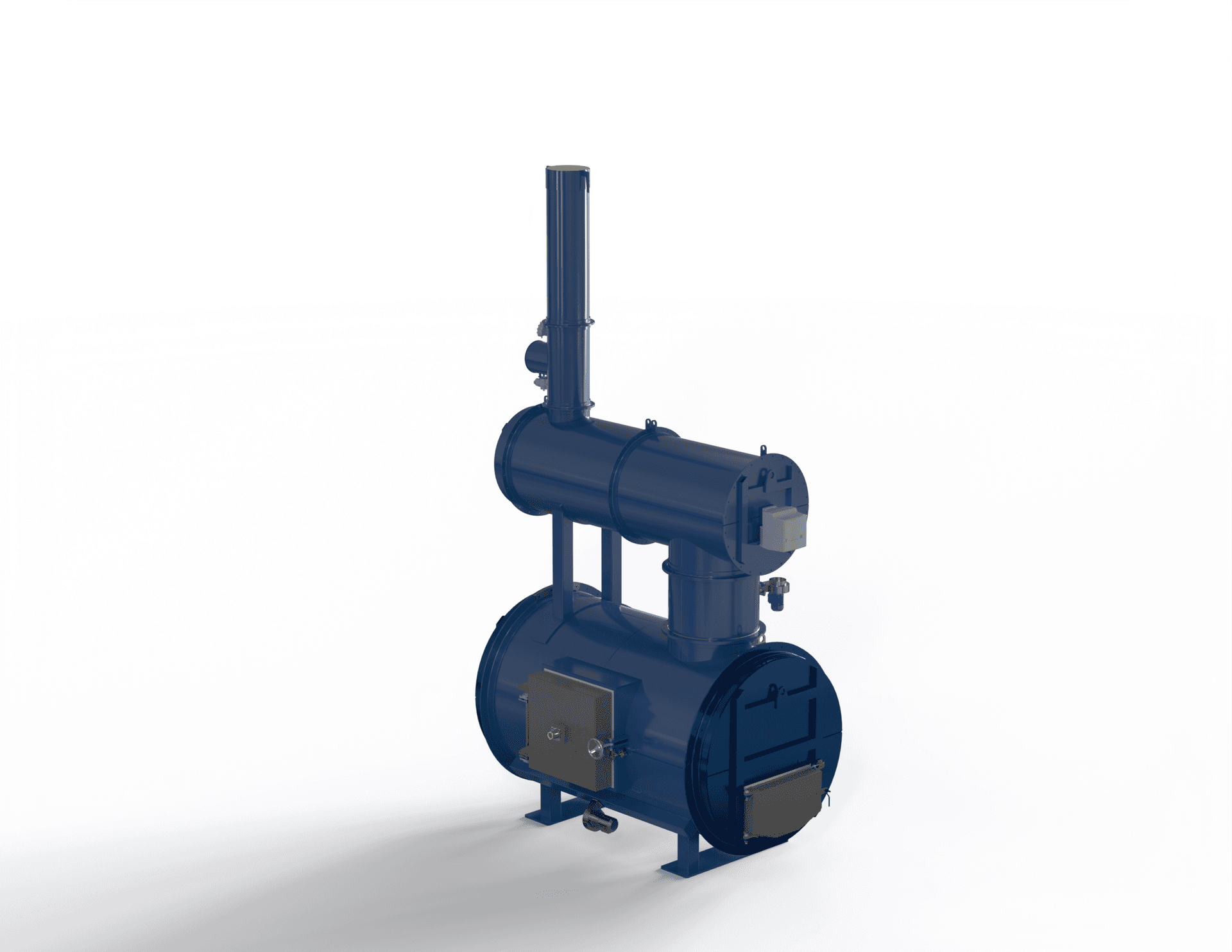
The entry point to the LitBurn range. A 3.3 m³ primary chamber and three burners give continuous 125 kg/h destruction in a footprint that fits a standard yard bay, which makes it the usual choice for a single-site operator replacing skip hire rather than a multi-site waste contract.
The most specified unit in the range. Chamber volume rises to 5.5 m³ for 250 kg/h continuous throughput while the external width grows by only 230 mm over the LBI-125, so sites that outgrow the smallest unit rarely have to rework the slab or the building line.
A 9.6 m³ chamber — nearly double the LBI-250 — for medium-scale industrial waste destruction. At this size most operators pair the unit with heat recovery, because the thermal output during a full shift is large enough to displace a dedicated water heater.
The largest LitBurn: a 16.2 m³ chamber running 500 kg/h continuously. Specified where waste arrives faster than a batch unit can clear it — large manufacturing sites, industrial estates, and operators consolidating several smaller waste contracts onto one machine.
Which Model
Fits Your Volume
Pick a model to see what it clears in a day of flood & storm clearance.
A single site or business holding its own recovery capability, clearing a property's contents over a few shifts.
An emergency does not suspend the permit
The waste codes, the operating condition and the exclusions apply on the worst week exactly as on the quietest. Scope the permit for surge in advance rather than discovering the limits during a response.
POPs-bearing furnishings must be destroyed
Upholstered seating containing persistent organic pollutants cannot be landfilled. Flood clearance produces it in quantity, so the fraction is identified and named at application.
Plasterboard keeps its own route
Gypsum has separate segregation and recovery requirements and is not a fuel. The volume produced during strip-out makes this the exclusion most likely to be quietly ignored under pressure.
Contaminated water is not this unit's problem
Pumped floodwater and washings are liquid waste for a licensed route. What is destroyed here is the solid contaminated material, drained of free water.
Why Burn It
On Site
4 things change on the day this stream stops leaving the site.
Everyone needs a skip in the same week
A district event exhausts local disposal capacity simultaneously. Capacity you already own is the only kind that is not competing with every other affected property.
Waste on the pavement is the visible recovery
Piles outside properties are what residents, members and insurers see. Clearing them quickly changes the perception of the response more than almost anything else in the programme.
Wet contents do not improve with storage
Silt- and sewage-contaminated material held for weeks becomes an odour, vermin and public health issue on top of a disposal one.
Surge capacity is idle capacity the rest of the year
The honest version: a unit bought purely for flood response sits unused. It earns its keep between events on routine clearance, grounds and depot waste, which is how the case is usually made.
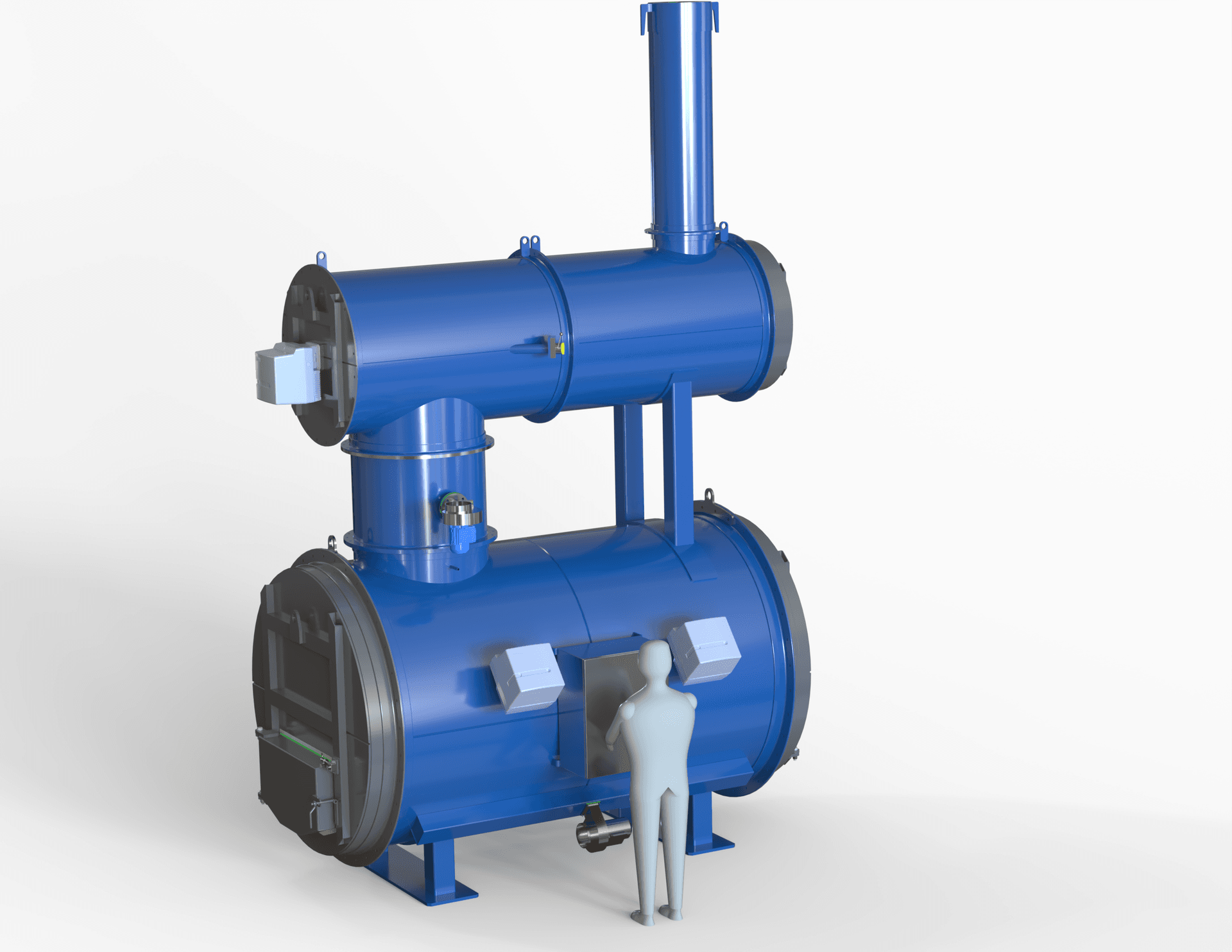
Dual-chamber unit, 1,100°C capable
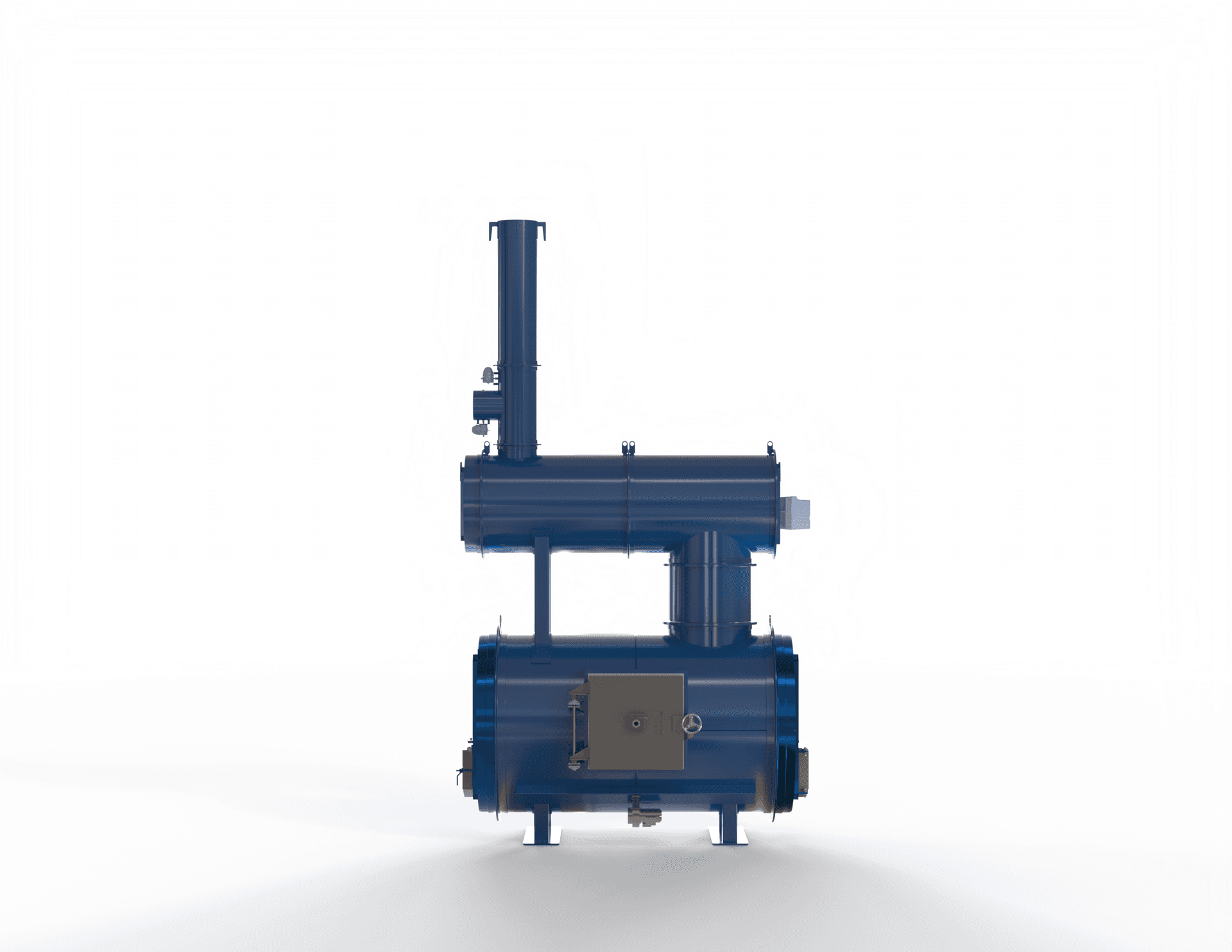
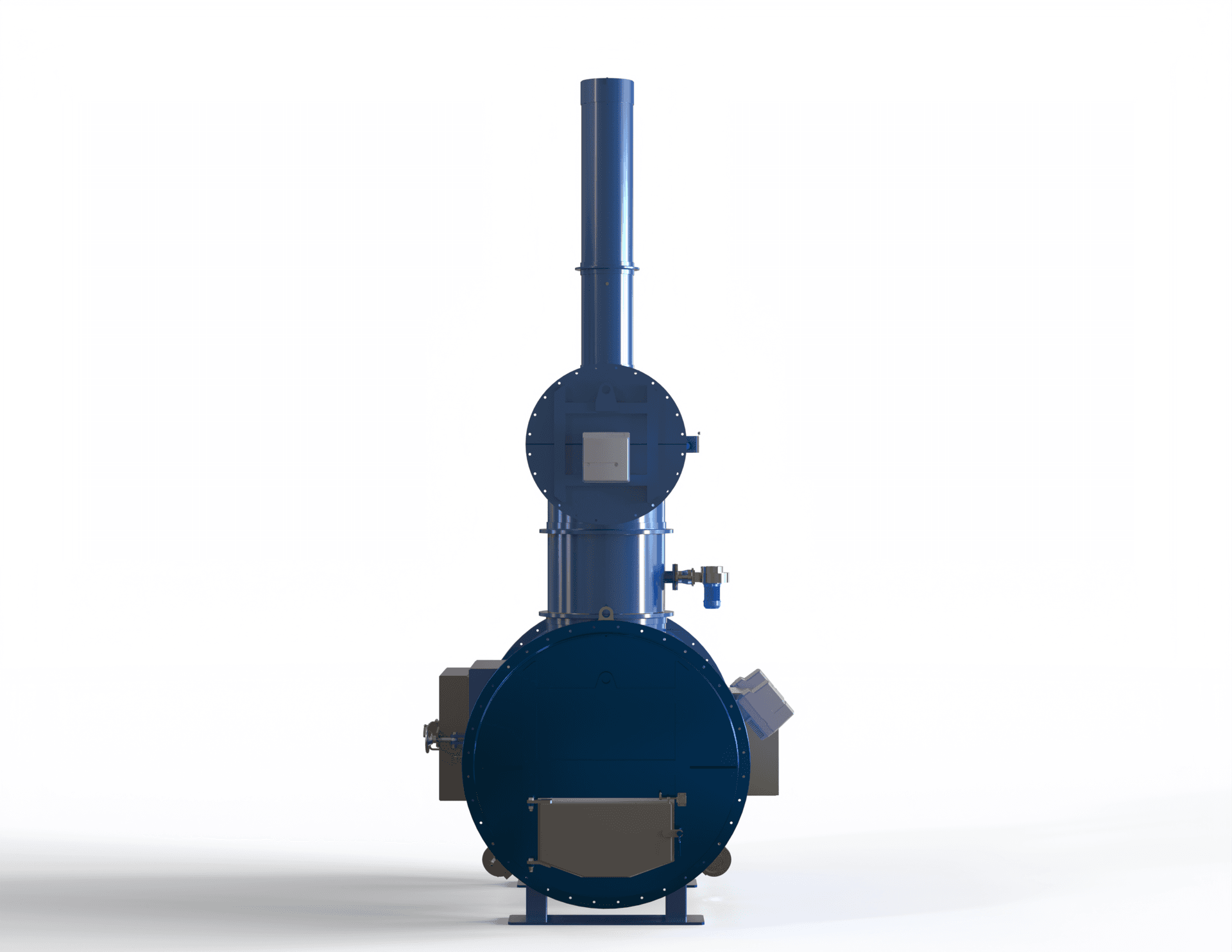
Primary chamber running 850–1,200°C with a secondary holding flue gas above 850°C for two seconds. Environmental waste is the stream most likely to carry halogenated content — chlorinated solvents in contaminated arisings, salt-laden marine debris, POPs-bearing material — so the 1,100°C condition is stated here rather than treated as an exception.
Front dual-door loading
Charged through a front dual door at floor level, so bulk bags, tote bins and wheeled skips go in at the height a site telehandler already works at. Clearance waste arrives in whatever it was collected in, and it is not decanted.
What Ships
With The Unit
Identical whichever stream it is specified for. The operating procedure changes; the machine does not.
Dual-chamber unit, 1,100°C capable
Primary chamber running 850–1,200°C with a secondary holding flue gas above 850°C for two seconds. Environmental waste is the stream most likely to carry halogenated content — chlorinated solvents in contaminated arisings, salt-laden marine debris, POPs-bearing material — so the 1,100°C condition is stated here rather than treated as an exception.
Front dual-door loading
Charged through a front dual door at floor level, so bulk bags, tote bins and wheeled skips go in at the height a site telehandler already works at. Clearance waste arrives in whatever it was collected in, and it is not decanted.
IP6X control panel with cycle logging
PLC control with chamber thermocouples, interlocked charge door and a time-stamped temperature record per run. For hazardous waste produced and destroyed on one site, that log is the evidence behind a consignment record nobody drove anywhere.
Burner set and fuel train
Configured for natural gas, LPG, diesel, biofuel or hydrogen. This stream runs wet and dirty — flood silt, harbour arisings, screenings — so burner support does more work here than on a dry industrial charge.
Coretex refractory lining
Monolithic castable lining rated for the full range and replaceable in service. Environmental loads swing from saturated to solvent-bearing between one bag and the next, and the lining is specified for that cycling rather than for a steady feed.
Stack, dispersion data and commissioning
Stack to the height your site-specific dispersion assessment calls for, the emissions data pack the permit application references, on-site commissioning, a witnessed first run and operator training. Hazardous scope means a bespoke permit rather than standard rules, and the assessment is the long pole.
How One Burn Runs,
Start To Finish
One run is one countable event, reconciled against a manifest and evidenced by a time-stamped temperature log.
One Cycle,
Start To Finish
Adds 20 03 01 and 17 codes for damaged fit-out, and the POPs line for upholstered contents. The defining problem is not the material — it is that a quarter's arisings appear in one week.
Contents and fabric are separated as they come out: recoverable items, WEEE and white goods, plasterboard, and the mixed contaminated residual that is the charge.
Flooded properties yield appliances, batteries, garden chemicals and fuel containers. All are separated before anything reaches the unit.
Saturated carpet, underlay and soft furnishings are drained and stacked to shed free water. A dripping charge burns badly and slowly.
Two-second secondary retention above 850°C, fed steadily. Flood waste is the wettest stream on this site and will run below the plate rating — plan the programme on that, not the arithmetic.
Residue carries silt and mineral content well above the 3–5% figure. The run log documents the clearance for the authority, the insurer or both.
What You Can Burn —
And What You Can't
One run takes the whole stream without pre-sorting. What must never enter it is a short, hard list.
Yes: accepted in a run
No pre-sorting between these
- Carpets, underlay and soft flooringPorous flooring contaminated by floodwater, which cannot be dried and reinstated and has no reuse route.
- Soft furnishings and upholstered contentsSofas, chairs, mattresses and cushions. Upholstered seating is also the POPs fraction requiring destruction rather than landfill.
- Used sandbags and flood defence consumablesDeployed sandbags, contaminated by the water they held back and unusable afterwards, plus single-use barriers and sheeting.
- Damaged fit-out and joineryKitchen and bathroom units, skirtings, doors and timber fit-out stripped out during drying, where contamination rules out recovery.
- Contaminated stock, paper and recordsCommercial stock, files and paper records spoiled by water, destroyed with a run record where confidentiality also applies.
- Strip-out PPE and consumablesSuits, gloves, masks and sheeting used by clearance teams working in contaminated buildings.
No: never charged
Not a permit question — these stay out
- Plasterboard and gypsumA sulphate problem with its own recovery requirements, and never a fuel. Flood clearance produces it in volume and it still goes to its own route.
- White goods, appliances and WEEEElectrical items and their cells carry recovery obligations and are a fire risk in a charge. They are separated at the property.
- Fuel containers, cylinders and garden chemicalsFlooded garages and sheds yield all three. Sealed vessels and unidentified chemistry are handled separately, always.
- Silt, mud and inert material in bulkMineral, does not burn, and fills a chamber for nothing. Scraped silt goes to a soil or inert route rather than into the unit.
Can you legally burn flood & storm clearance on site?
Technically, yes: the chamber destroys almost everything on the accepted list at 850–1,200°C, and capability is rarely the constraint. Legally is a separate question. What your site is allowed to burn is set by your environmental permit from the Environment Agency, SEPA or NIEA and the waste codes written into it. The never-charged list is different again: those materials are out of scope for the unit or governed by a direction, and no permit wording brings them back in. Send us the codes you hold, or the ones you expect to apply for, and we will tell you which of this list they cover before anything is specified.
Send us your waste codesWhat clears 10 tonnes of flood waste in a week?
Arithmetic on published model figures, not a customer reference. Your numbers go through the same steps.
How This
Was Worked Out
10,000 kg against the LBI-500's 500 kg/h is 20 hours on paper; allow closer to 30 in practice, because saturated carpet and furnishings burn well below the plate rating. Size this stream on the event, not the year. The same unit does routine clearance and depot waste for the other fifty-one weeks, which is the only way the arithmetic works.
Separated, not charged
Above 3–5%
16.2 m³
3.8 t
Send your daily or weekly arisings and we will confirm the model, the run time and the permit route.
Related Products
& Services
Complementary equipment and engineering services for your process.


Sizing and background
- [TOOL]Work out the burn rate for your own arisings
- [TOOL]Size the combustion air and flue gas duty
- [BLOG]Ash management from industrial waste incinerators
- [BLOG]Integrating vibration analysis for incinerator predictive maintenance
- [BLOG]Advanced gas cleaning for ultra-low emission incinerators
- [BLOG]Evaluating flue gas cleaning systems in industrial incinerators
Flood & storm clearance Questions
Answered against the published figures for the models specified for this stream, not a generic range sheet.
Flood and storm clearance waste is a building's contents and fabric after water has been through it: soft furnishings, carpets and underlay, flooring, damaged plasterboard and insulation, kitchen units and fit-out, used sandbags, silt-contaminated stock and equipment, and the PPE and consumables used to strip it all out. Floodwater is not clean water. It carries silt, sewage, hydrocarbons and whatever it passed through on the way, so absorbent contents are contaminated rather than merely wet — which is why so little of it is recoverable and why drying it out is rarely the answer for porous material. The defining characteristic is surge. A district-wide event produces months of arisings in a week, at exactly the moment every skip, vehicle and transfer station in the area is oversubscribed. Waste standing outside affected properties is the visible face of a slow recovery, and it is the part residents and insurers complain about first. The materials themselves are ordinary: bulky, wet and mixed, destroying at the standard 850–1,200°C condition. Two fractions need naming — upholstered seating containing POPs, which must be destroyed rather than landfilled, and plasterboard, which does not belong in a chamber and needs its own route even in an emergency.
10,000 kg against the LBI-500's 500 kg/h is 20 hours on paper; allow closer to 30 in practice, because saturated carpet and furnishings burn well below the plate rating. Size this stream on the event, not the year. The same unit does routine clearance and depot waste for the other fifty-one weeks, which is the only way the arithmetic works.
Some can — hard, non-porous items usually. Floodwater carries silt, sewage and hydrocarbons, so porous material is contaminated rather than merely wet, and carpet, underlay, upholstery and insulation do not come back from that. That contaminated porous fraction is what this stream is.
No. Plasterboard, WEEE, cylinders and chemicals are excluded on the worst day exactly as on the best. Pressure is precisely when those exclusions get quietly ignored, which is why they belong in a written procedure agreed before an event.
Substantially. Saturated furnishings and carpet run well below the plate rating because the burners spend energy evaporating water first. Allow around half again on the arithmetic for a flood charge, and drain and stage material before it reaches the door.
Not on the events alone, and we would rather say so. Bought only for flood response it sits idle. The case is made when the same unit handles routine clearance, grounds and depot waste for the rest of the year and the surge capability comes free with it.
In scope, and the run record covers both the disposal and the confidentiality question if there is one. Water-damaged files, stock and paper are destroyed with a time-stamped log rather than going out in an open skip.
The bag does; the sand does not. Used sandbags come out as a mineral residue at close to the sand's weight, so count them as ash rather than as throughput when sizing the run. Emptying them first is worth the labour where volumes are large.
Ready to
Incinerate?
Send the stream, the volume and the site constraints. We will confirm the model, the permit route, and what the specification has to say to satisfy the regulator.
- Everyone needs a skip in the same week
- Waste on the pavement is the visible recovery
- Wet contents do not improve with storage
- Surge capacity is idle capacity the rest of the year