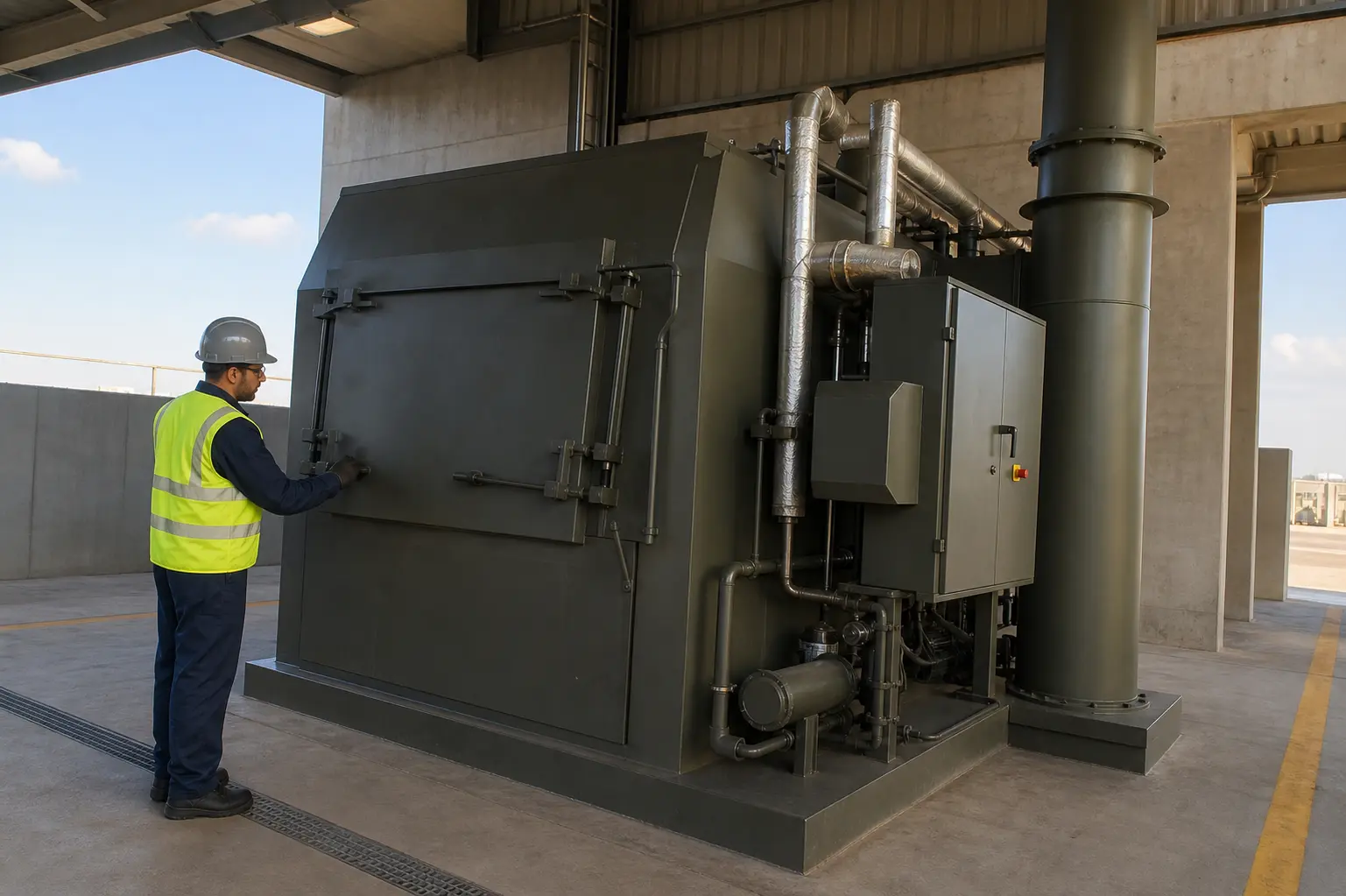
Contaminated Absorbent & Oily Waste Incinerators
Oil-soaked absorbents, spill-kit residues, fuel-contaminated rag and filters cleared on site instead of consigned out.
Vehicle parks, fuel installations and aviation lines generate a stream nobody wants to store: oil-soaked granular absorbent, used spill kits, fuel-contaminated rag, filters and drip trays. It is bulky, it is a fire load, and it needs a hazardous waste consignment every time it leaves. Destroying it on site turns a consignment into a cycle.
Three Models,
One Solution
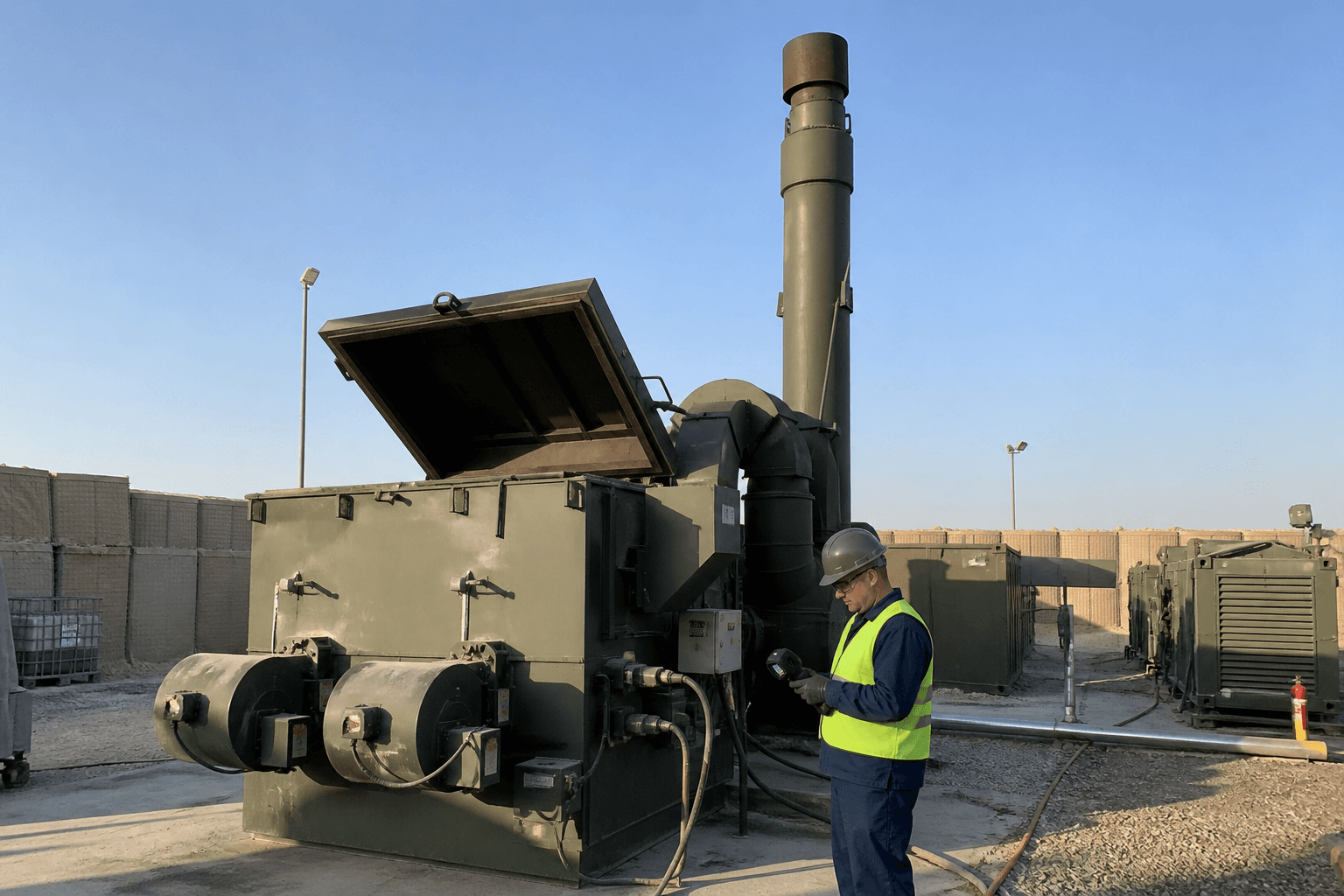
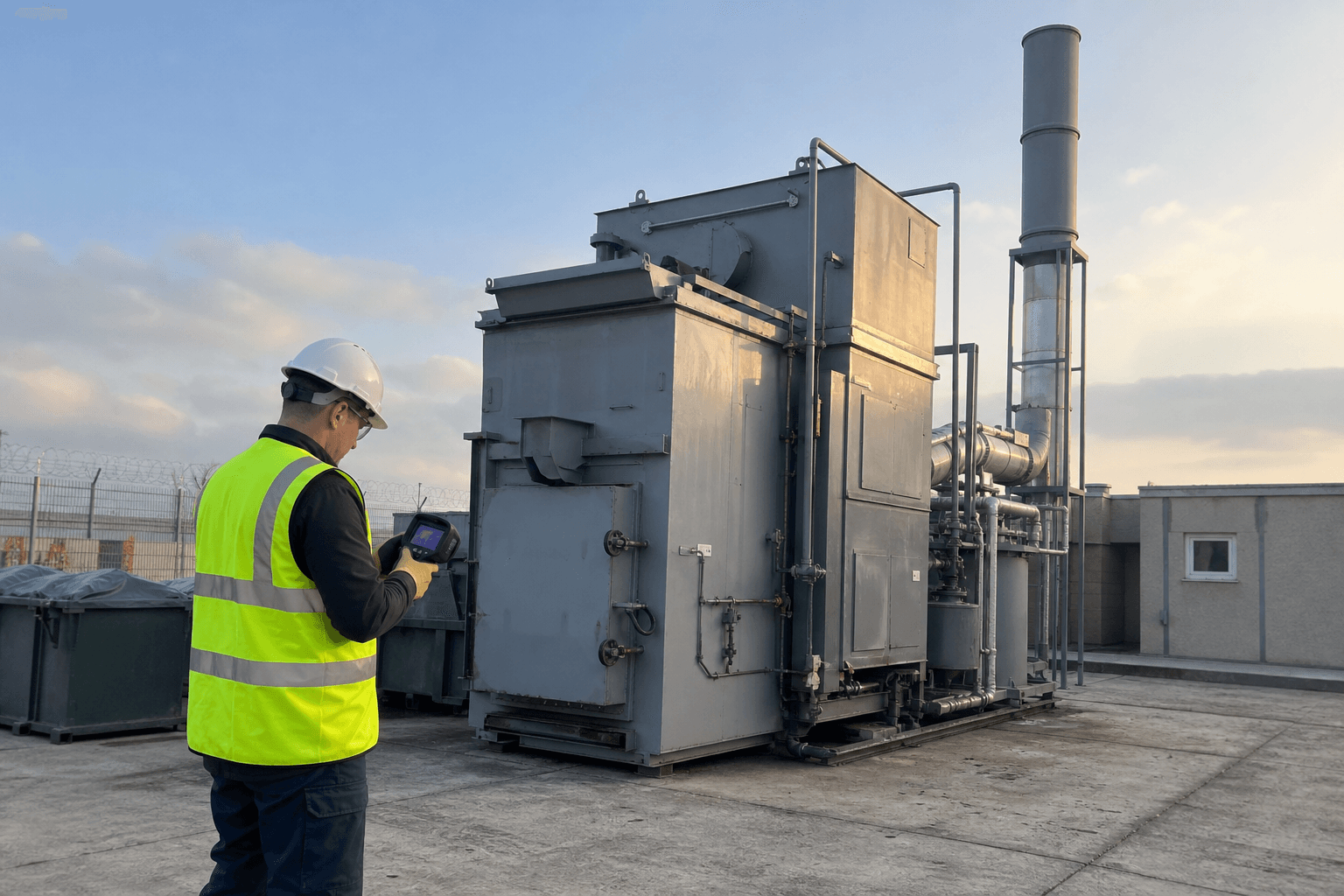
The compact AmoBurn: 150 kg per charge at 1.8 t, light enough to be relocated between sites. Used where destruction has to be witnessed and certified on site rather than handed to a third-party contractor.
250 kg per charge for established base infrastructure. The two-burner arrangement and 1250 mm chamber handle classified document destruction and ammunition-adjacent waste in the same unit.
The largest AmoBurn at 300 kg per charge. Specified where the secure-destruction requirement is continuous enough that a smaller unit would need several cycles a day to keep up.
Which Model
Fits Your Volume
Pick a model to see what it clears in a day of fuel, oil & contaminated absorbents.
A vehicle park's routine spill-kit residues and oil-soaked rag, charged mixed with the drier fraction after a free-liquid check.
Hazardous stream, declared
Fuel- and oil-contaminated waste is hazardous and must be named in the permit application with its waste codes. A permit written for general and packaging waste does not cover the spill kit.
Halogenated content
Some solvents and cutting fluids carry halogenated organics. Above 1% of the stream, the secondary chamber must hold 1,100°C rather than 850°C. Declare the products actually used on site, not a generic list.
Absorbed, never free liquid
This is an operating condition, not a preference. Free liquid is decanted back to the fuel or oil route before the absorbent is charged, and the procedure should say so in writing.
Storage before the charge
Contaminated absorbent awaiting a cycle is still a fire load. On-site destruction shortens the holding period; it does not remove the requirement to store it properly while it waits.
Why Burn It
On Site
4 things change on the day this stream stops leaving the site.
Consignments become cycles
Every movement of hazardous absorbent needs a consignment note and a licensed carrier. On-site destruction replaces an administrative event that depends on someone else's schedule with a cycle that runs on yours.
The fire load stops accumulating
Oil-soaked absorbent stored pending collection is a fire load in a place that was not designed to hold one. Clearing it on a schedule keeps the holding area at a size the risk assessment actually assumed.
Hydrocarbons destroyed, not moved
Landfilling contaminated absorbent relocates the hydrocarbon. Combustion at 850°C held for two seconds destroys the organic fraction and the substrate together, leaving mineral ash.
Spill response is not capacity-limited
A large spill generates more absorbent in a day than the site sees in a quarter. On-site destruction means the response is limited by absorbent stock, not by how much contaminated waste you can store until a carrier can come.
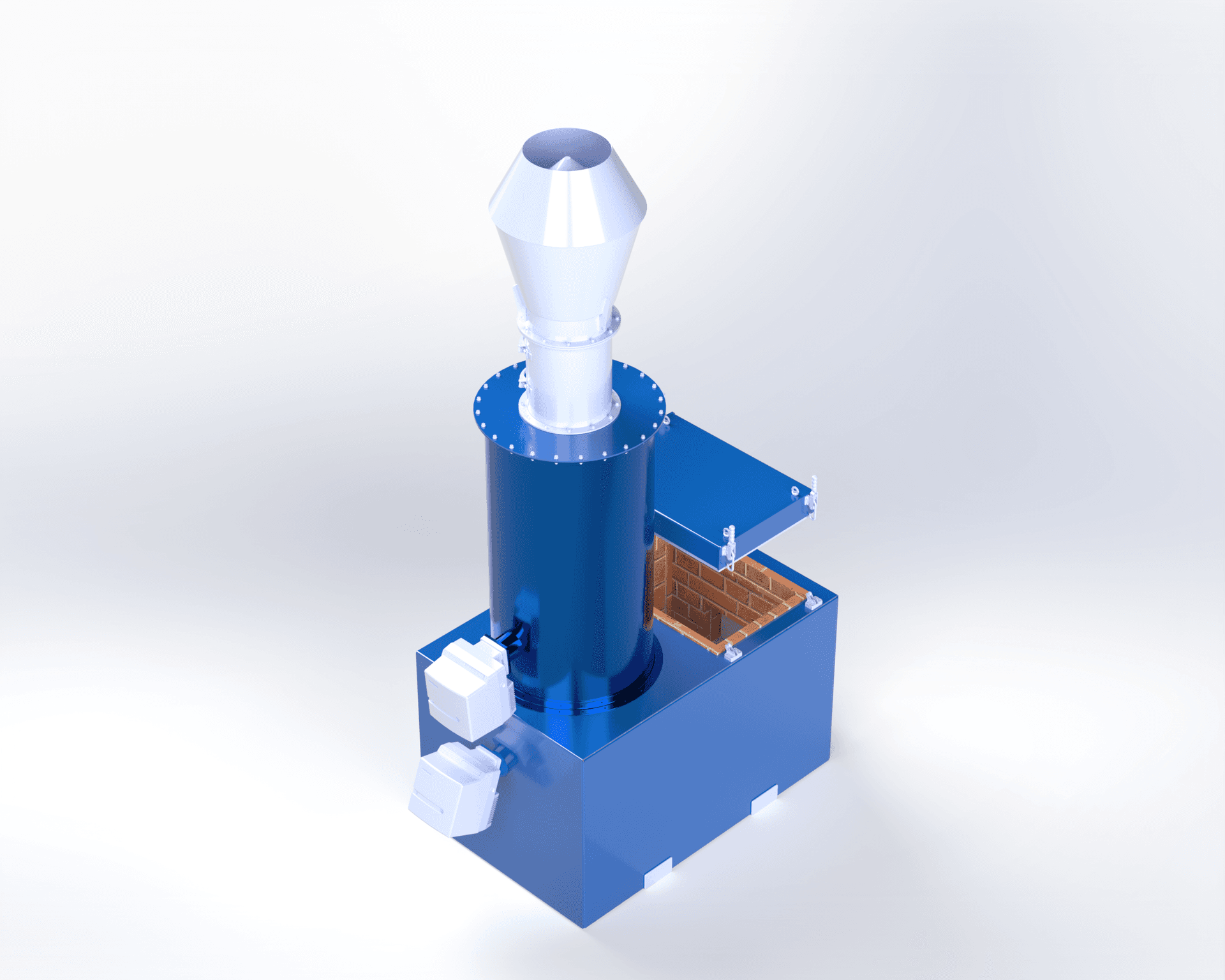
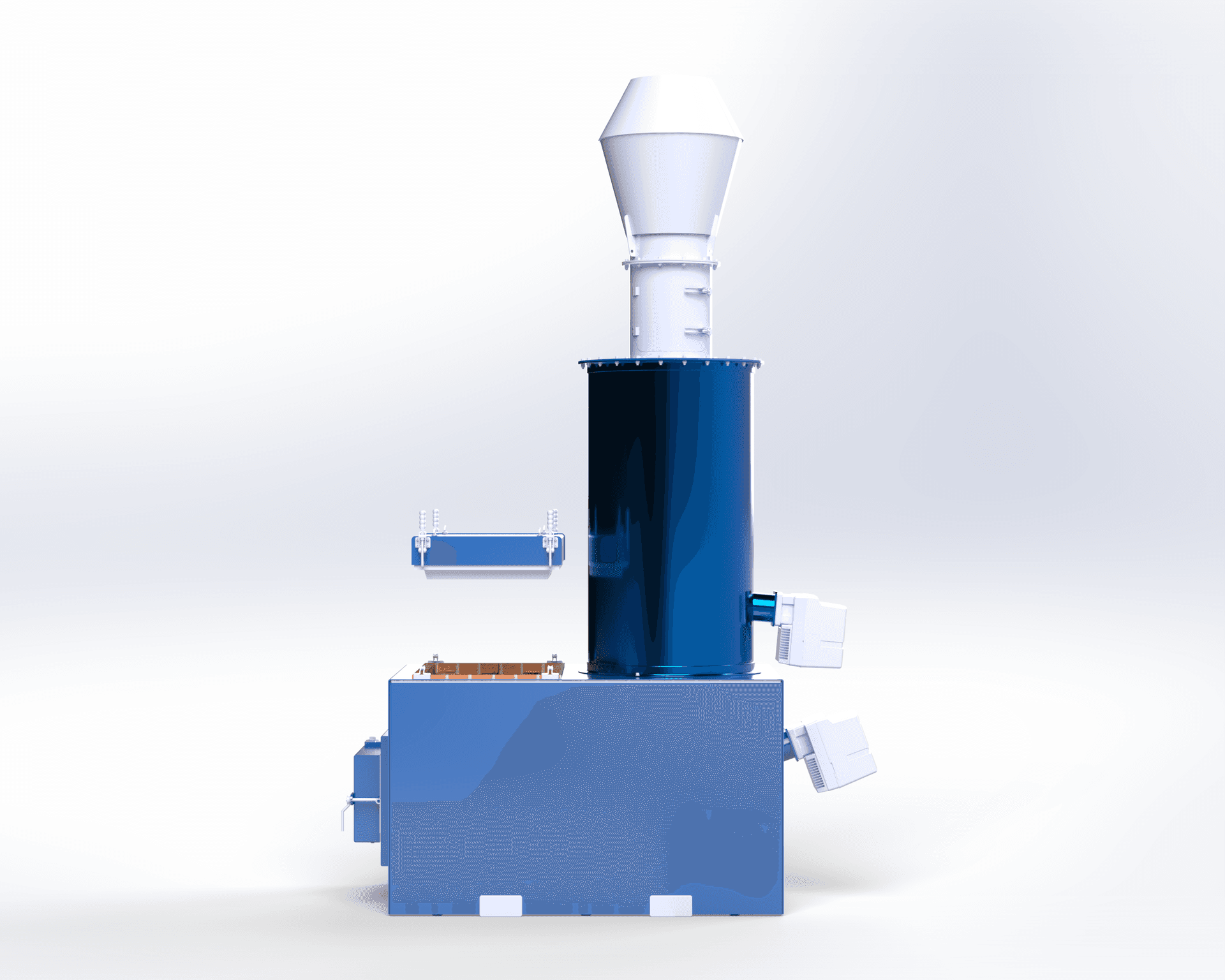
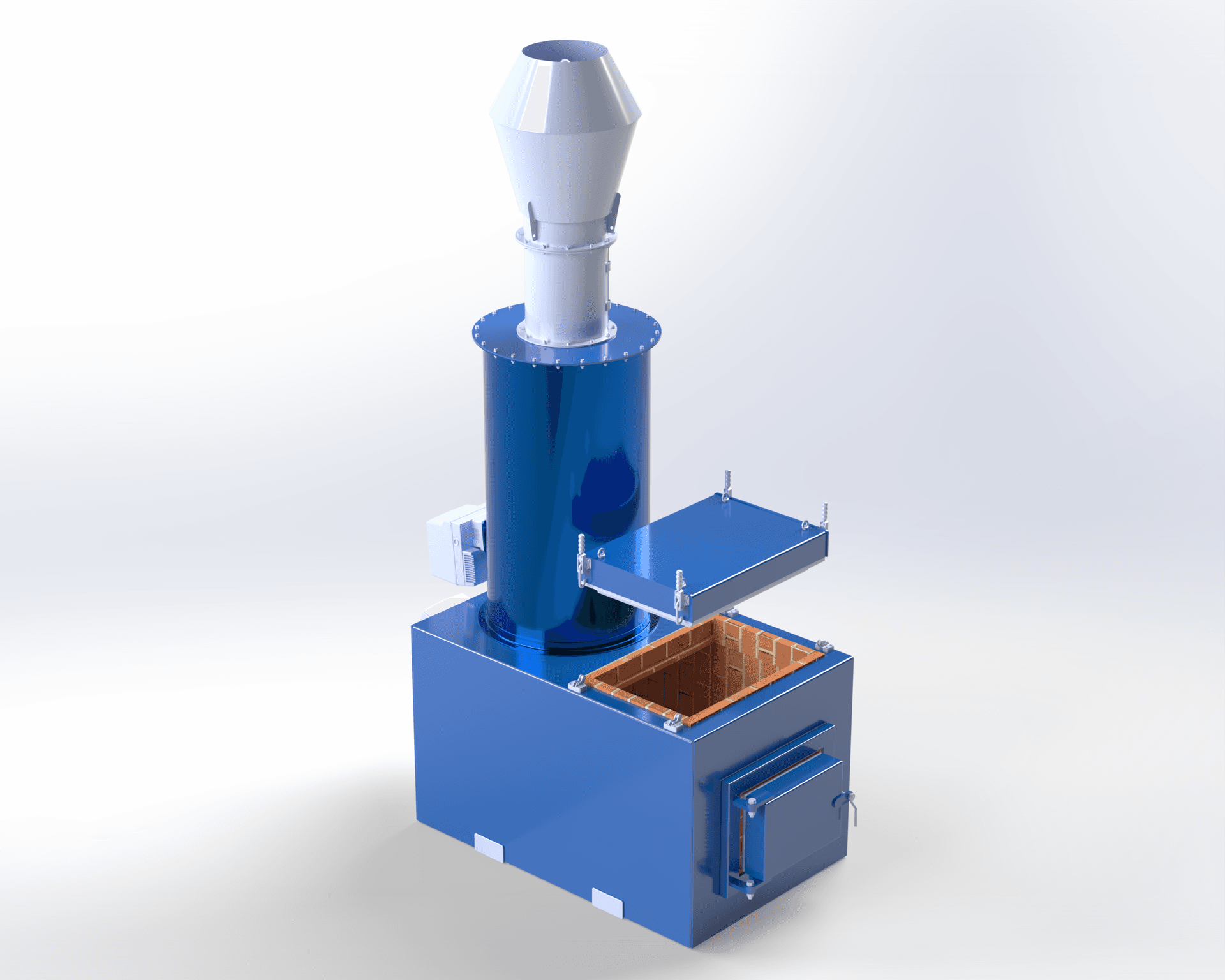
Dual-chamber unit
Primary chamber running 850–1,200°C with a secondary chamber holding flue gas above 850°C for two seconds — the Industrial Emissions Directive condition, met as built rather than as an option.
Burner set and fuel train
Configured for natural gas, LPG, diesel, biofuel or hydrogen. Fuel choice is a site decision; the combustion condition is identical whichever is specified.
What Ships
With The Unit
Identical whichever stream it is specified for. The operating procedure changes; the machine does not.
Dual-chamber unit
Primary chamber running 850–1,200°C with a secondary chamber holding flue gas above 850°C for two seconds — the Industrial Emissions Directive condition, met as built rather than as an option.
Burner set and fuel train
Configured for natural gas, LPG, diesel, biofuel or hydrogen. Fuel choice is a site decision; the combustion condition is identical whichever is specified.
IP6X control panel
PLC control with cycle logging, chamber thermocouples and interlocked charge door. The cycle record is what a destruction register entry is written against.
Coretex refractory lining
Monolithic castable lining rated for the full temperature range, replaceable in service rather than requiring the shell to be scrapped with it.
Stack and dispersion data pack
Stack supplied to the height your site-specific dispersion assessment calls for, with the emissions data the permit application has to reference.
Commissioning and operator training
On-site commissioning, a witnessed first burn, and training for the establishment personnel who will hold the charge-door key.
How One Burn Runs,
Start To Finish
One charge is one countable event. That is what makes a batch unit auditable and a continuous one not.
One Cycle,
Start To Finish
Adds a free-liquid check before charging and hazardous waste codes on the permit. Saturated absorbent is charged mixed with the drier fraction rather than as a load on its own.
Spill response is unchanged: absorb, bag and move to the holding area under the existing procedure. What changes is how long the holding area stays full.
The charge must be absorbed, not saturated. Free liquid in the bag is the one condition that stops the cycle — decant it back to the fuel or oil route and charge the absorbent alone.
Contaminated absorbent burns hot. It is charged mixed with the drier fraction of the stream — packaging, rag, filters — rather than as a single saturated load, which keeps the primary chamber inside its operating band.
Hydrocarbons and substrate are destroyed together. The secondary chamber holds gas above 850°C for two seconds, rising to 1,100°C where halogenated organic content exceeds 1% — declare the solvents you actually use.
Residue is 3–5% mineral ash, plus the metal shell of any filter charged. Both leave under an ordinary transfer note rather than a hazardous consignment.
What You Can Burn —
And What You Can't
One charge takes the whole stream without pre-sorting. What must never enter it is a short, hard list.
Yes: accepted in a charge
No pre-sorting between these
- Spill-kit absorbentsGranular absorbent, pads, booms and socks used on fuel and oil spills. Charge them mixed with the drier fraction — a chamber loaded entirely with saturated granular runs hotter than the operating band intends.
- Fuel- and oil-contaminated ragWipes and rag from the vehicle lines, with the workshop consumables that carry oil or grease.
- Drained oil filtersAccepted once drained. The steel body does not burn — it is inert and separates at ash-out.
- Contaminated disposable PPEGloves, coveralls and disposable clothing from the spill response and the workshop bench, which is where most of this stream's volume actually comes from.
- Drip-tray liners and contaminated packagingLiners, and the contaminated cardboard and fibre packaging that comes off the vehicle lines with them.
No: never charged
Not a permit question — these stay out
- Free liquid fuel, oil or solventThe single hard rule for this stream. A batch chamber is not a liquid injection plant — absorbed only, never poured.
- Waste oil for recoveryRecoverable oil has a value and a route. Burning it as waste is both worse economics and worse practice than sending it for recovery.
- Pressurised containers and aerosolsBrake cleaner and lubricant cans are everywhere on a vehicle line and rupture under heat. Separate at the bin.
- Batteries, including vehicle batteriesThermal runaway and acid residue. WEEE and battery routes, always.
- Tyres and bulk rubberSmoke and residue beyond what the permit will cover for this stream, and a poor use of chamber volume.
Can you legally burn fuel, oil & contaminated absorbents on site?
Technically, yes: the chamber destroys almost everything on the accepted list at 850–1,200°C, and capability is rarely the constraint. Legally is a separate question. What your site is allowed to burn is set by your environmental permit from the Environment Agency, SEPA or NIEA and the waste codes written into it. The never-charged list is different again: those materials are out of scope for the unit or governed by a direction, and no permit wording brings them back in. Send us the codes you hold, or the ones you expect to apply for, and we will tell you which of this list they cover before anything is specified.
Send us your waste codesHow many charges for 450 kg of spill absorbent?
Arithmetic on published model figures, not a customer reference. Your numbers go through the same steps.
How This
Was Worked Out
450 kg of used absorbent ÷ 250 kg per charge = 2 AMBI-250 charges, each mixed with the drier fraction. Ash is 14–23 kg at 3–5%, leaving on an ordinary transfer note rather than a hazardous consignment. Charge saturated absorbent mixed with the drier fraction; a chamber loaded entirely with soaked granular runs hotter than the operating band intends.
0
Cleared within days, not weeks
14–23 kg total
Ordinary transfer note
Send your daily or weekly arisings and we will confirm the model, the charge count and the permit route.
Related Products
& Services
Complementary equipment and engineering services for your process.

Sizing and background
- [TOOL]Work out the burn rate for your own arisings
- [TOOL]Size the combustion air and flue gas duty
- [BLOG]Fuel-to-air ratio in ammunition incinerators
- [BLOG]NOx reduction in ammunition incinerators
- [BLOG]Advanced process control for ammunition incinerators
- [BLOG]Integrating vibration analysis for incinerator predictive maintenance
- [BLOG]Advanced gas cleaning for ultra-low emission incinerators
Fuel, oil & contaminated absorbents Questions
Answered against the published figures for the models specified for this stream, not a generic range sheet.
Contaminated absorbent waste is the material used to capture a spill and everything that gets soaked in the process: granular absorbent, pads and booms, rag, disposable PPE, oil filters, drip trays and the packaging around them. On a defence site it comes from vehicle lines, generator installations, fuel points and aviation maintenance, and it arrives unpredictably — a large spill produces in an afternoon what routine maintenance produces in a quarter. It is classified hazardous once it holds fuel or oil, which is what makes it awkward. Storage has a fire-loading limit and a duration limit, movement needs a consignment note and a licensed carrier, and the interval between the spill and the collection is exactly the period the site is holding a hazard it did not plan for. Thermal destruction resolves the organic fraction rather than transferring it. At 850–1,200°C with a two-second secondary-chamber retention, hydrocarbons on the absorbent are destroyed along with the substrate carrying them. Where the stream includes halogenated content above 1% — some solvents and cutting fluids do — the secondary chamber holds 1,100°C instead. One constraint governs the whole stream: absorbed, not free. Liquid fuel or oil in bulk does not go into a batch chamber under any circumstances. What goes in is the absorbent with the liquid held in it, charged in reasonable proportion rather than saturated, and declared in the permit as the hazardous stream it is.
450 kg of used absorbent ÷ 250 kg per charge = 2 AMBI-250 charges, each mixed with the drier fraction. Ash is 14–23 kg at 3–5%, leaving on an ordinary transfer note rather than a hazardous consignment. Charge saturated absorbent mixed with the drier fraction; a chamber loaded entirely with soaked granular runs hotter than the operating band intends.
Not as free liquid, no. These are batch chambers, not liquid injection plant: oil and fuel go in absorbed onto granular absorbent, pads or rag, never poured. Recoverable waste oil should go for recovery anyway — it has a value and a route, and burning it is worse on both counts.
It does when it leaves the site. Destroying it on site removes the movement, so the consignment is replaced by a cycle and the residue leaves as ordinary ash under a transfer note. The stream still has to be named as hazardous in the environmental permit.
Mixed rather than loaded alone. Saturated absorbent burns hot enough to push the primary chamber above its operating band if it makes up the whole charge, so it is charged with the drier fraction of the stream — packaging, rag and filters — in proportion.
Drained filters, yes. The metal shell survives the burn and is recovered from the ash as inert scrap; the media and the residual oil in it are destroyed. Do not charge undrained filters, and never charge a filter housing still holding free oil.
The standard 850°C two-second secondary-chamber condition covers hydrocarbon-contaminated absorbent. Where the stream includes halogenated solvents or cutting fluids above 1%, the requirement rises to 1,100°C — the units hold it, but the permit application has to declare the products in use.
One charge per working day is the planning unit, so 450 kg of bagged absorbent is two cycles on an AMBI-250 — days rather than the weeks a carrier collection typically takes. The practical benefit is that the holding area stops being a standing fire load between the spill and the collection.
Ready to
Incinerate?
Send the stream, the volume and the site constraints. We will confirm the model, the permit route, and what the specification has to say to satisfy the regulator.
- Consignments become cycles
- The fire load stops accumulating
- Hydrocarbons destroyed, not moved
- Spill response is not capacity-limited