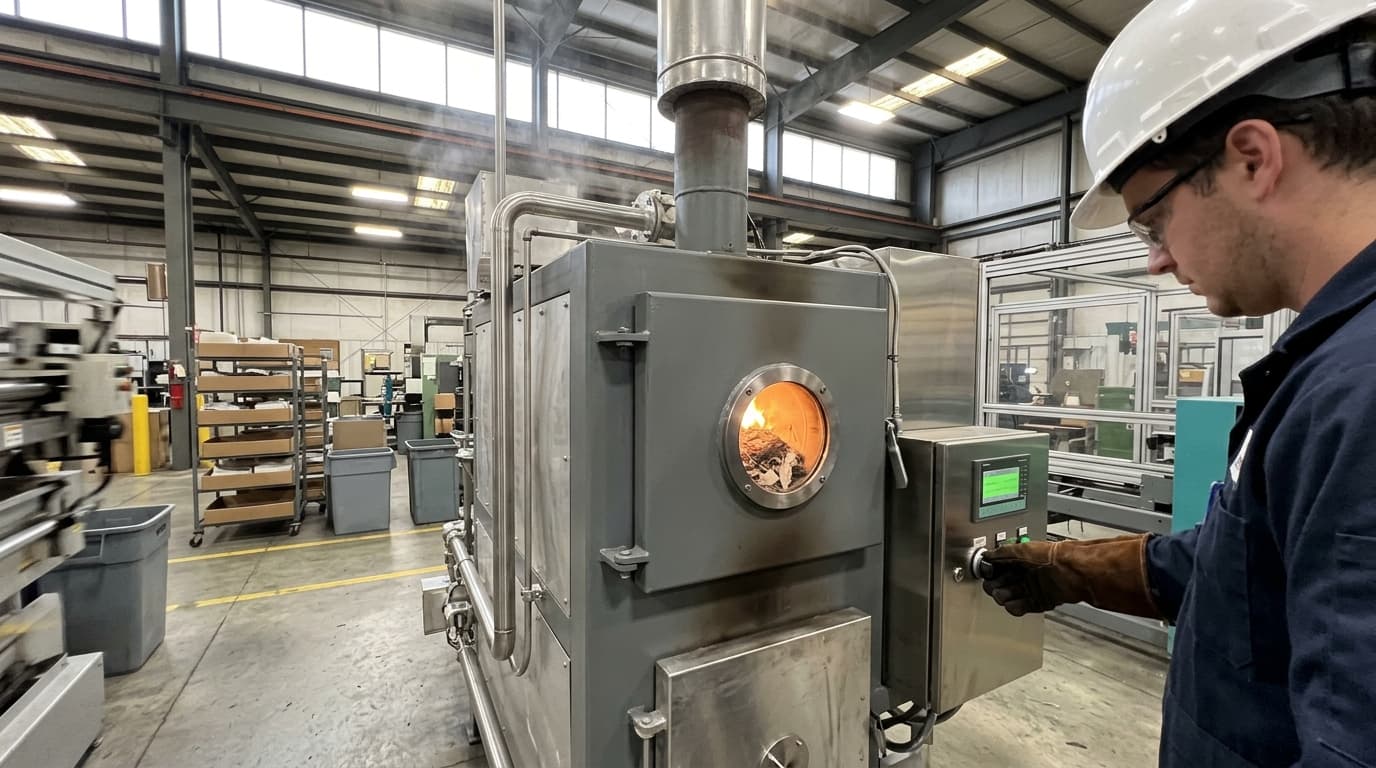
Manufacturing Waste Incinerators
6 industrial waste streams on one permitted LitBurn.
A factory's residual waste is the fraction nobody will recycle: contaminated, laminated, branded, off-spec or simply mixed beyond separation. It leaves in skips, at standard-rate Landfill Tax, on somebody else's schedule. LitBurn units destroy it at the rate the line produces it — but only the part that genuinely has no recovery route, because the waste hierarchy is a duty and not a preference.
Four Models,
One Solution
The entry point to the LitBurn range. A 3.3 m³ primary chamber and three burners give continuous 125 kg/h destruction in a footprint that fits a standard yard bay, which makes it the usual choice for a single-site operator replacing skip hire rather than a multi-site waste contract.
The most specified unit in the range. Chamber volume rises to 5.5 m³ for 250 kg/h continuous throughput while the external width grows by only 230 mm over the LBI-125, so sites that outgrow the smallest unit rarely have to rework the slab or the building line.
A 9.6 m³ chamber — nearly double the LBI-250 — for medium-scale industrial waste destruction. At this size most operators pair the unit with heat recovery, because the thermal output during a full shift is large enough to displace a dedicated water heater.
The largest LitBurn: a 16.2 m³ chamber running 500 kg/h continuously. Specified where waste arrives faster than a batch unit can clear it — large manufacturing sites, industrial estates, and operators consolidating several smaller waste contracts onto one machine.
6 Streams,
One Machine
All 6 destroy at the same condition, so one permitted LitBurn covers the lot. What changes is the procedure and the waste codes.
Every line makes material it cannot sell: failed QC, off-spec batches, start-up and changeover waste, damaged finished goods. It is worthless, it is often branded, and until it is destroyed it is stock on a system and a liability in a yard. A LitBurn clears it at the rate the line makes it.
Production rejects & off-spec product in fullAdds 16 03 off-spec codes — and the hazardous 16 03 05* line where the chemistry is — plus a write-off reconciliation, so the run record matches what left the stock system.
The waste hierarchy comes before the permit
You must take reasonable measures to apply the hierarchy — prevention, reuse, recycling, other recovery, then disposal — and declare it on waste transfer documentation. A unit that burns recoverable clean scrap is a compliance problem wearing a permit. Specify it for the residual fraction and keep the evidence of what was diverted.
The permit names the codes, chapter by chapter
Industrial waste spans several EWC chapters: 07 and 16 03 for off-spec product, 12 for shaping and surface-treatment residues, 15 01 for packaging, 15 02 02* for hazardous absorbents and wipes, 08 01 for paint and coatings, 04 02 for textiles. Every stream you intend to burn is named at application; a permit is not written for a category.
1,100°C where halogenated content exceeds 1%
PVC, PTFE, chlorinated rubbers and some coating systems push a charge past the 1% halogenated organic threshold, which raises the secondary-chamber minimum from 850°C to 1,100°C. Declare it against the streams that carry it rather than treating the higher condition as an exception you invoke later.
Hazardous fractions keep their paperwork
Oil-contaminated absorbents, solvent-bearing coating waste and hazardous off-spec chemistry are hazardous waste. Producing and destroying them on the same site removes the road movement and the third-party gate, not the classification, the record-keeping or the duty of care on the residue that leaves.
What Ships
With The Unit
Identical whichever stream it is specified for. The operating procedure changes; the machine does not.
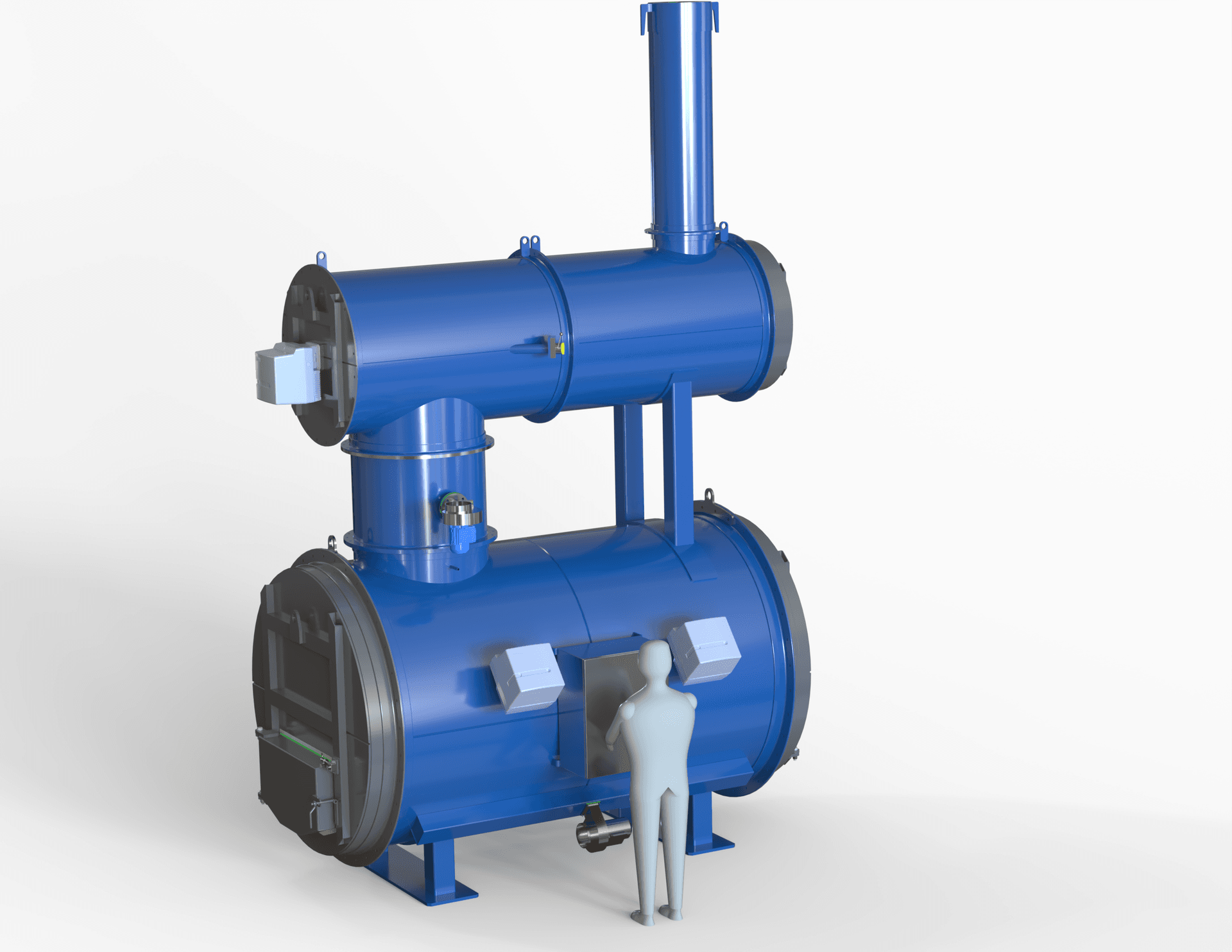
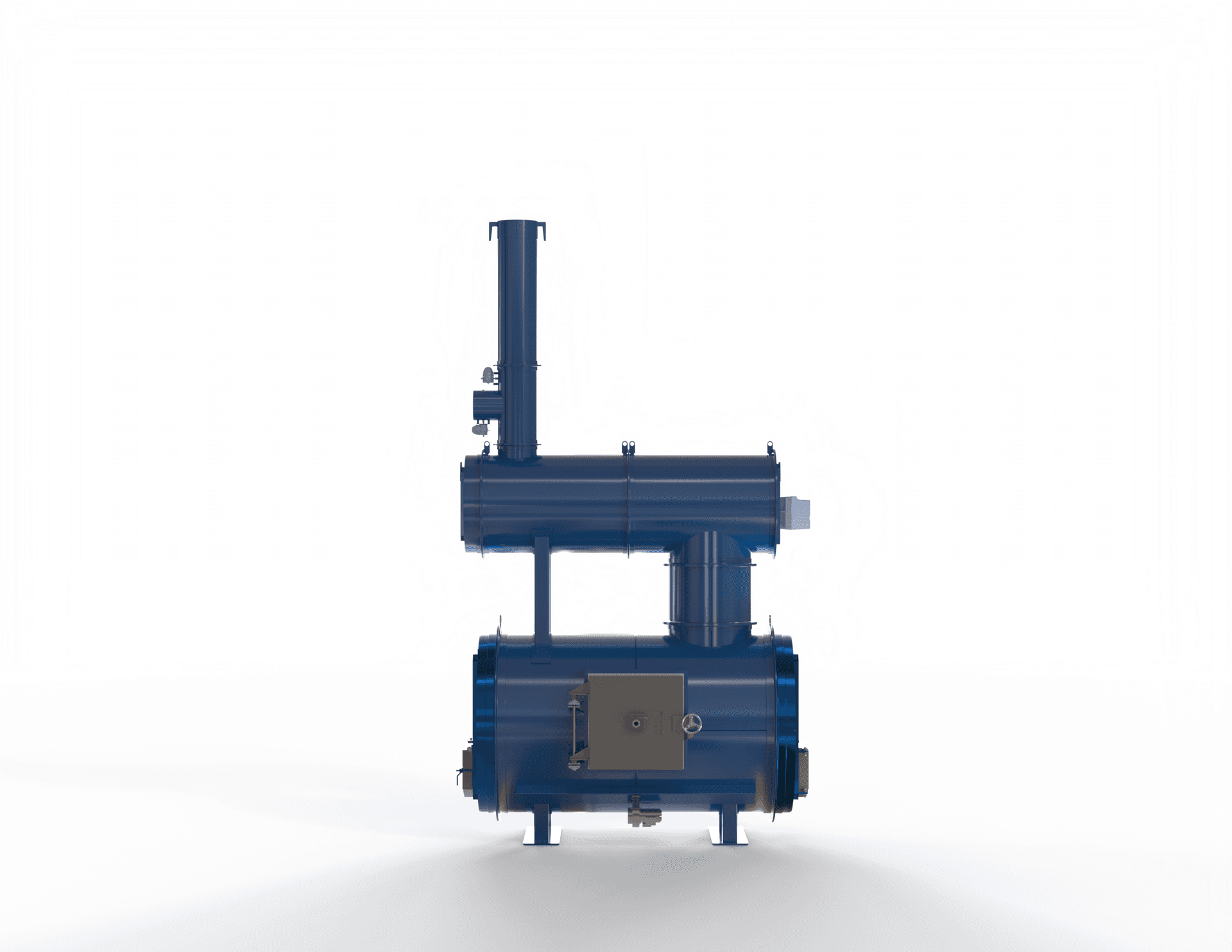
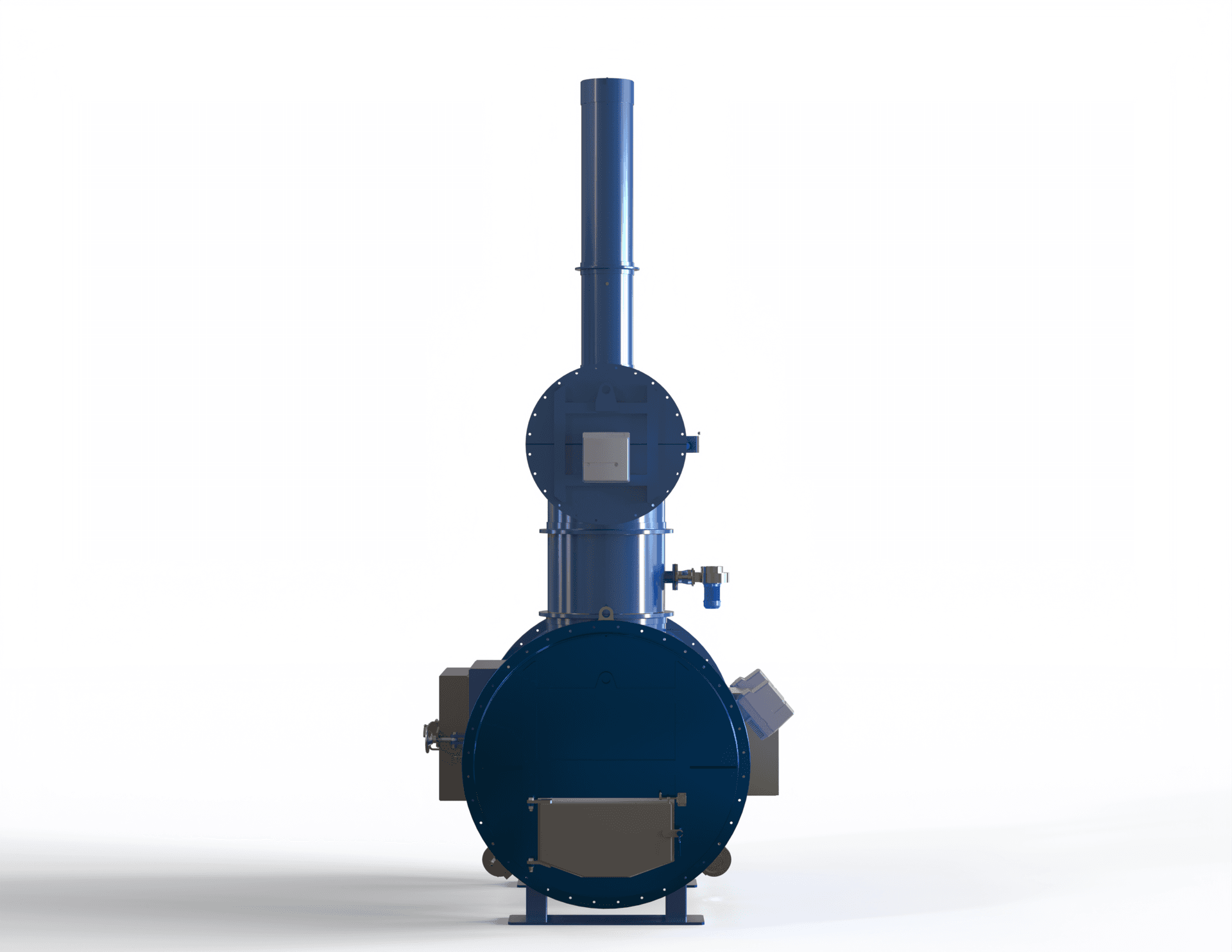
Dual-chamber unit, continuous duty
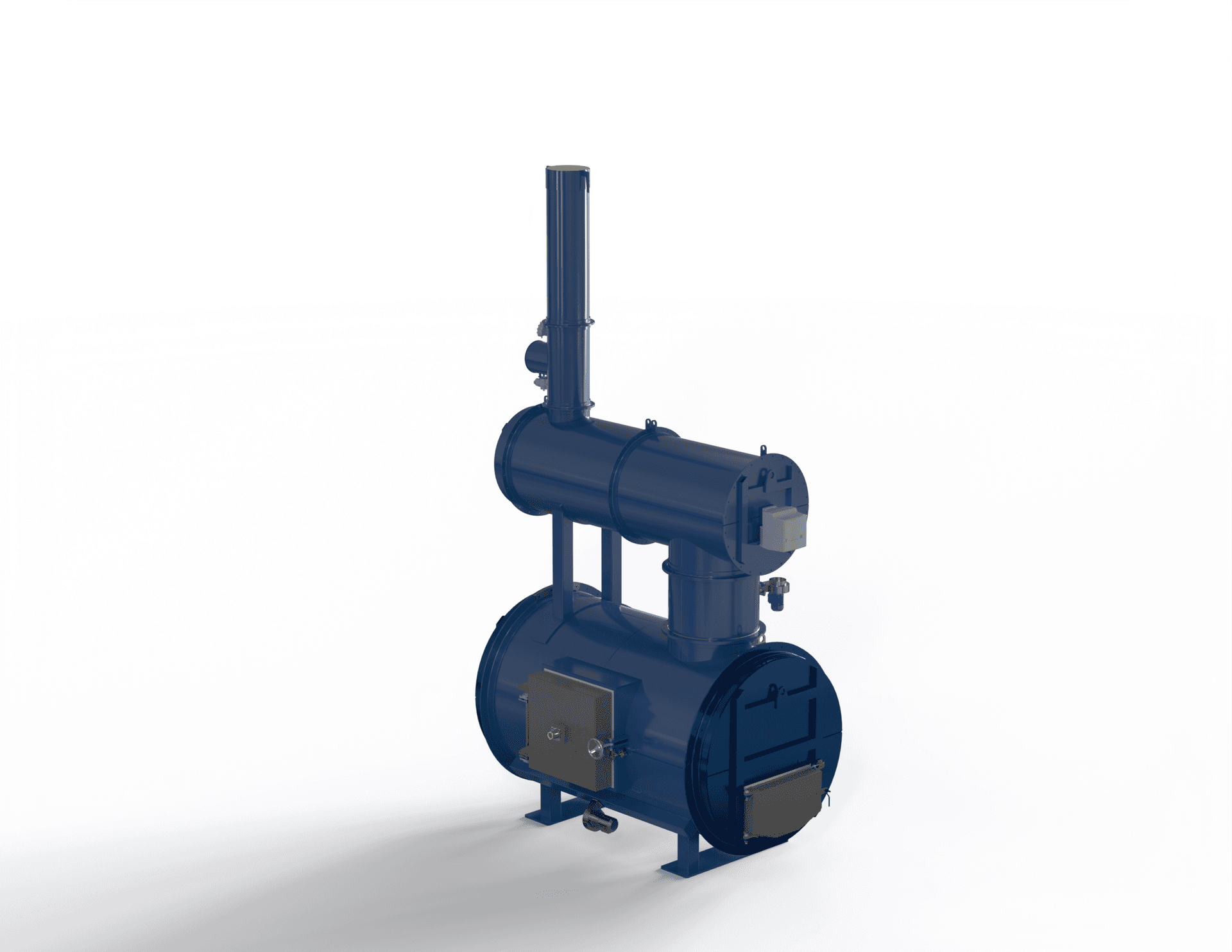
Primary chamber running 850–1,200°C with a secondary holding flue gas above 850°C for two seconds. Rated to run for a shift rather than for a charge, because an industrial stream arrives at the rate the line produces it and a batch machine simply queues it up in the yard.
Front dual-door loading
Charged through a front dual door at floor level, so tote bins, stillages and wheeled skips are fed at the height a forklift or a pump truck already works at. No hoist, no tipping platform, no lifting waste over a top rim.
IP6X control panel with cycle logging
PLC control with chamber thermocouples, interlocked charge door and a time-stamped temperature record per run. For destruction that has to be evidenced — brand protection, customer-mandated disposal, off-spec write-off — that log is the difference between a certificate and a claim.
Three-burner set and fuel train
Configured for natural gas, LPG, diesel, biofuel or hydrogen. High-calorific streams such as polymer and rubber need less burner input once they are alight, not more — the burners are there to reach and hold the condition, not to do the work the waste is already doing.
Coretex refractory lining
Monolithic castable lining rated for the full range and for sustained running at the top of it. On plastics and solvent-bearing waste the chamber spends real time near the ceiling of that range, which is exactly the duty that eats a cheaper lining.
Stack, dispersion data and commissioning
Stack to the height your site-specific dispersion assessment calls for, the emissions data pack the permit application references, on-site commissioning, a witnessed first run and operator training for the shift staff who will actually run it.
How One Burn Runs,
Start To Finish
One run is one countable event, reconciled against a manifest and evidenced by a time-stamped temperature log.
The Same Cycle,
Whichever Stream
Every industrial stream runs the cycle below. What differs between them is the procedure at the charge door and what the permit has to name — not the machine and not the combustion condition.
Reuse, then recycling, then recovery, then disposal. Clean single-polymer scrap, dry cardboard and uncontaminated metal have routes and should take them. What belongs in the chamber is what those routes will not take — contaminated, mixed, laminated, branded or off-spec material.
Hazardous fractions are separated where they arise: solvent-bearing, oil-contaminated and coating waste each carry their own codes and their own consignment paperwork. The sorting decision belongs to the person who watched the material come off the machine.
The unit is brought to temperature — 30 minutes from cold — and fed through the front dual door while running, from the bins and stillages the line fills. Feed rate is steady rather than dumped: a high-calorific charge tipped in whole spikes the chamber instead of raising its output.
Primary at 850–1,200°C, secondary holding gas above 850°C for two seconds, or 1,100°C where the stream carries more than 1% halogenated organic content. PVC, PTFE and chlorinated coatings are the industrial materials that cross that line.
Residue comes out at 3–5% of input mass: mineral ash plus the inert fraction of any glass fibre, filler or metal. The run log and the weights close the record — for a write-off, a customer-mandated destruction or simply the site's own waste return.
What You Can Burn —
And What You Can't
Every stream has its own accepted list and its own exclusions. They sit on the 6 stream pages, not here.
Can you legally burn industrial waste on site?
Technically, yes: the chamber destroys almost everything these streams produce at 850–1,200°C, and capability is rarely the constraint. What your site is allowed to burn is set by your environmental permit from the Environment Agency, SEPA or NIEA and the waste codes written into it. Open the stream you are dealing with for its accepted list and the materials that never go in whatever the permit says — or send us the codes you hold and we will tell you what they cover.
Send us your waste codesOne Machine,
All 6 Streams
What changes between streams is the operating procedure and the waste codes on the permit. The machine does not change.
Same Condition,
Every Stream
All 6 streams destroy at the same condition: 850–1,200°C in the primary chamber with flue gas held above 850°C for two seconds in the secondary. That is why one permitted LitBurn covers the lot rather than needing a machine each. What differs is the procedure at the charge door and what the permit has to name.
These are continuous-duty units, so throughput is a function of operating hours rather than cycles. Where a site runs several of these streams through one unit, size on the combined arisings rather than on whichever stream prompted the enquiry.
Hours = arisings ÷ burn rate. Ash = 3–5% of what went in. Check the chamber volume as well as the rate: bulky loads fill the box first, dense ones reach the rating first.
Send your combined arisings across the streams you run and we will confirm the model, the run time and the permit route.
Related Products
& Services
Complementary equipment and engineering services for your process.
Sizing and background
- [TOOL]Work out the burn rate for your own arisings
- [TOOL]Size the combustion air and flue gas duty
- [BLOG]Improving manifold airflow evenness by 65%
- [BLOG]Ash management from industrial waste incinerators
- [BLOG]The feasibility of small-scale modular incinerator units
- [BLOG]Precious metal incineration and recovery
- [BLOG]Evaluating flue gas cleaning systems in industrial incinerators
Industrial Questions
Answered against the published figures for the LitBurn range, not a generic sheet.
A manufacturing waste incinerator is a dual-chamber unit specified for the residual output of a factory — production rejects and off-spec batches, oil-contaminated absorbents and filter media, polymer and rubber off-cuts, textile and fibre waste, and paint, coating and solvent-contaminated solids. It is not a recycling substitute and should never be sold as one. That distinction is the first thing to settle. The waste hierarchy requires reuse and recycling to be considered before recovery or disposal, so clean single-polymer scrap, dry cardboard and uncontaminated metal belong in a recovery route, not in a chamber. What justifies a unit is the fraction those routes reject: contaminated, mixed, laminated, confidential or condemned material that would otherwise go to landfill or to an energy-from-waste gate at a price per tonne that rises every year. The combustion condition is the Industrial Emissions Directive one — 850°C to 1,200°C in the primary chamber, flue gas above 850°C for two seconds in the secondary, rising to 1,100°C where the waste carries more than 1% halogenated organic content. Industrial streams reach that threshold through PVC, PTFE, chlorinated rubbers and some coating systems, so the declared condition should follow the material rather than the sales sheet. The LitBurn LBI range covers 125, 250, 375 and 500 kg/h as continuous-duty units, front-loaded at floor level from the bins and stillages the line already fills. Six industrial streams are specified separately below because each has a different reason it cannot be recycled, a different waste code and a different exclusion list. The machine does not change. The permit line and the procedure do.
No, and doing it is a compliance failure rather than a commercial choice. The waste hierarchy requires reuse and recycling to be considered first, and it is declared on your transfer documentation. The honest case for a unit is the residual fraction — contaminated, mixed, laminated, branded or off-spec material that recyclers will not take — and that fraction is usually large enough on its own.
Three things: the gate fee and standard-rate Landfill Tax on roughly 95% of the mass, the vehicle movements that carry it, and the schedule dependency that decides how much yard space you give to full skips. What it costs is fuel, an operator's time and a permit, which is why the arithmetic works at tonnages rather than at kilogrammes.
Yes, and that is normally the point. Production rejects, absorbents, polymer trim, textile waste and coating residues all destroy at the same condition, so a single permitted LitBurn covers them provided every stream is named with its codes at application. The exclusions are what have to stay separate: bulk liquids, aerosols, batteries, WEEE and tyres.
Size on hours, not on charges. Divide weekly residual arisings by the burn rate and match it against the shifts you are willing to run: a single site clearing a few tonnes a week lands on the LBI-125 or LBI-250, a large plant or multi-building group on the LBI-375 or LBI-500. Then check chamber volume against your bin count, because industrial waste is bulky.
Not if it is fed rather than dumped. Polymer, rubber and solvent-bearing material carry a lot of energy, and tipping a full stillage in at once spikes the chamber instead of raising throughput. Steady feeding is the operating discipline for these streams, and the Coretex lining is specified for sustained running at the top of the range because that is where they sit.
At the larger sizes it usually is. A unit running a full shift on high-calorific industrial waste produces enough thermal output to be worth capturing for process or space heating — most operators specifying an LBI-375 or LBI-500 look at it. It is a site engineering question rather than a change to the incinerator specification.
It depends on what went in. Residue from ordinary production waste is mineral ash leaving under a transfer note. Where the permitted scope included hazardous streams — solvent-bearing coating waste, oil-contaminated absorbents — the residue classification follows from that and should be agreed with the regulator at application rather than discovered at the weighbridge.
Bulk liquid solvent and oil, aerosols and pressurised vessels, batteries, WEEE, tyres, asbestos, and anything radioactive. Each has its own route and none of them is improved by a chamber. Free liquid is the one that catches sites out most often: absorbed onto media it is a normal charge, in a drum it is not.
Ready to
Incinerate?
Send the stream, the volume and the site constraints. We will confirm the model, the permit route, and what the specification has to say to satisfy the regulator.
- The waste hierarchy comes before the permit
- The permit names the codes, chapter by chapter
- 1,100°C where halogenated content exceeds 1%
- Hazardous fractions keep their paperwork