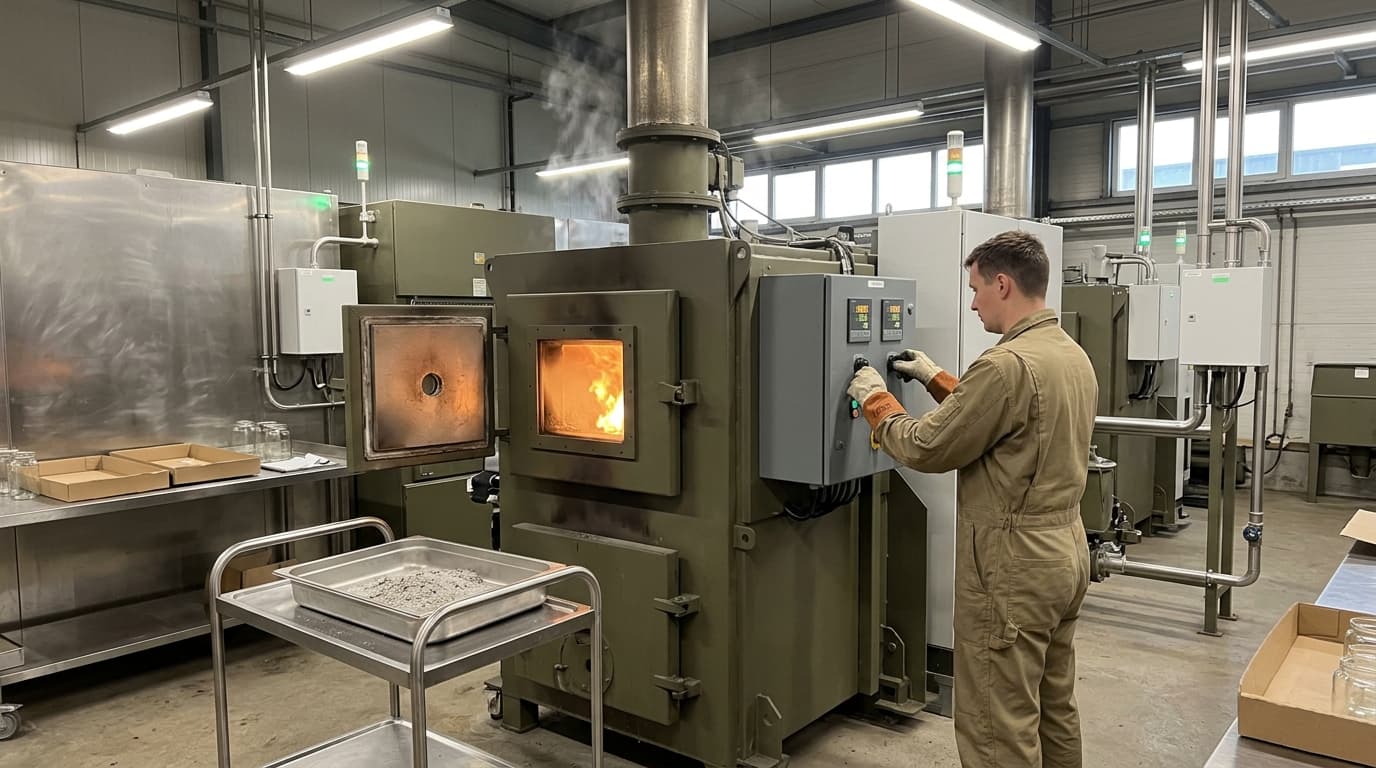
Military & Defence Incinerators
6 defence waste streams on one permitted AmoBurn.
Defence sites generate waste that cannot leave the perimeter. Protectively marked paper, expended ammunition packaging, field medical waste and camp refuse all carry a reason — security, legal, or logistical — why handing them to a commercial waste contractor is the wrong answer. AmoBurn units destroy them where they arise, under supervision, with a burn that can be witnessed and recorded.
Three Models,
One Solution
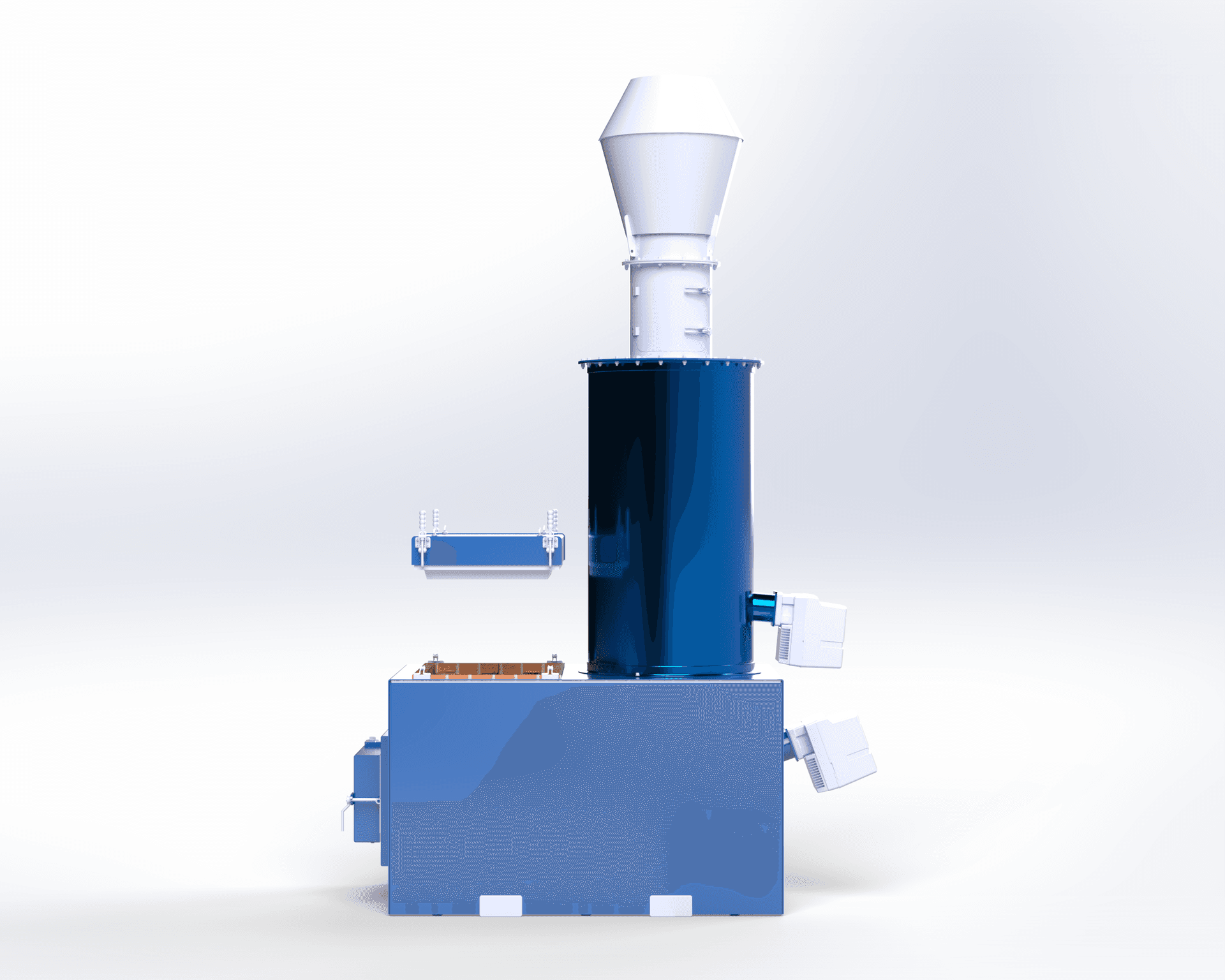
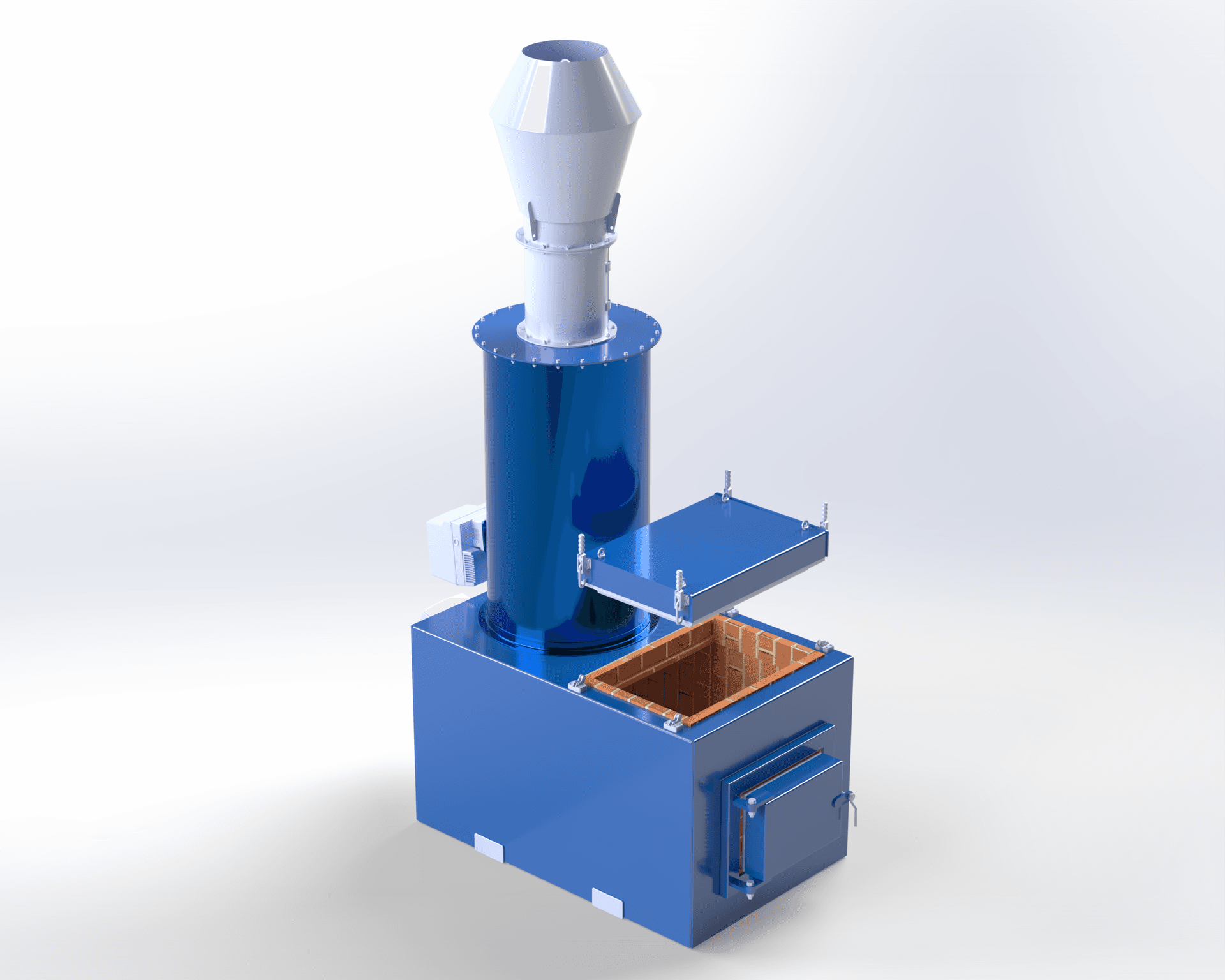
The compact AmoBurn: 150 kg per charge at 1.8 t, light enough to be relocated between sites. Used where destruction has to be witnessed and certified on site rather than handed to a third-party contractor.
250 kg per charge for established base infrastructure. The two-burner arrangement and 1250 mm chamber handle classified document destruction and ammunition-adjacent waste in the same unit.
The largest AmoBurn at 300 kg per charge. Specified where the secure-destruction requirement is continuous enough that a smaller unit would need several cycles a day to keep up.
6 Streams,
One Machine
All 6 destroy at the same condition, so one permitted AmoBurn covers the lot. What changes is the procedure and the waste codes.
Ranges and armouries generate a steady stream of material that is contaminated by association: fibre packaging, propellant-fouled wipes, expended links and cases, and range sweepings that no commercial contractor will accept without a declaration nobody wants to sign. AmoBurn units destroy that stream on site, in supervised batch cycles, and hand back inert metal and 3–5% mineral ash.
Ammunition & ordnance waste in fullAdds the establishment's own certification that the charge is free of energetic material, and a metal-recovery step at ash-out. Permit declares halogenated content where solvents are in the stream.
Crown status is not an exemption
Burning waste on a defence establishment requires an environmental permit from the Environment Agency in England and Wales, SEPA in Scotland or NIEA in Northern Ireland. The application needs the same technical data pack as any commercial operator, and temporary and training sites are not exempt either.
Every stream named, with its codes
A permit written for general waste does not silently cover the aid post or the spill kit. Clinical waste, sharps, pathological waste and hazardous absorbents each need naming with their waste codes at application, which is why the six streams are specified separately rather than as one list.
850°C, two seconds — 1,100°C where halogenated
The Industrial Emissions Directive condition is met as built. Where a stream carries more than 1% halogenated organic content — some solvents, laminated passes, coated textile — the secondary-chamber minimum rises to 1,100°C. The units hold it; the application has to declare it.
Nothing energetic, ever
These are waste incinerators, not demolition or burning-ground equipment. Live ammunition, initiators, pyrotechnics, bulk propellant and any suspected UXO go to specialist EOD disposal. Every charge is certified free of energetic material by the establishment before it is loaded.
What Ships
With The Unit
Identical whichever stream it is specified for. The operating procedure changes; the machine does not.
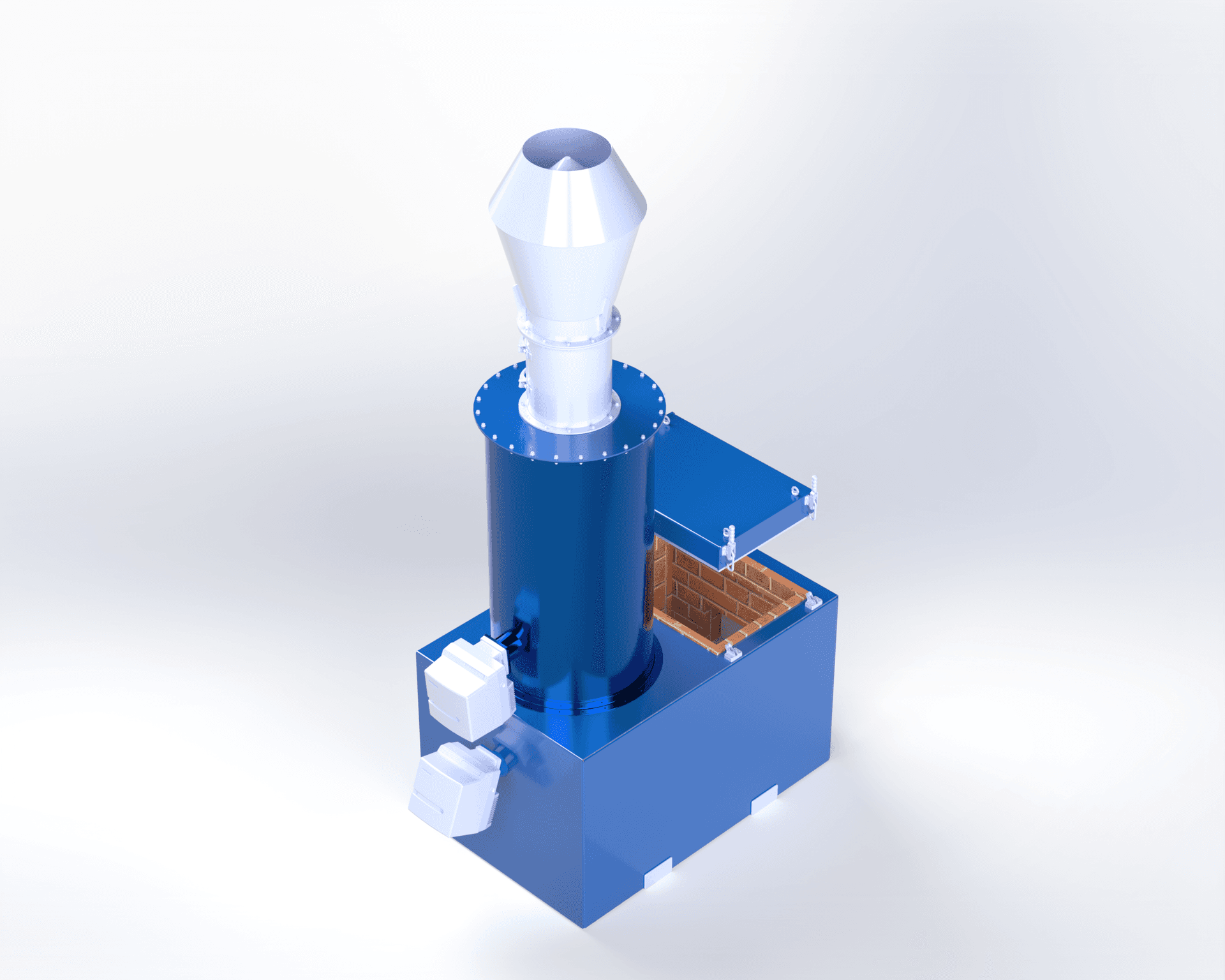
Dual-chamber unit
Primary chamber running 850–1,200°C with a secondary chamber holding flue gas above 850°C for two seconds — the Industrial Emissions Directive condition, met as built rather than as an option.
Burner set and fuel train
Configured for natural gas, LPG, diesel, biofuel or hydrogen. Fuel choice is a site decision; the combustion condition is identical whichever is specified.
IP6X control panel
PLC control with cycle logging, chamber thermocouples and interlocked charge door. The cycle record is what a destruction register entry is written against.
Coretex refractory lining
Monolithic castable lining rated for the full temperature range, replaceable in service rather than requiring the shell to be scrapped with it.
Stack and dispersion data pack
Stack supplied to the height your site-specific dispersion assessment calls for, with the emissions data the permit application has to reference.
Commissioning and operator training
On-site commissioning, a witnessed first burn, and training for the establishment personnel who will hold the charge-door key.
How One Burn Runs,
Start To Finish
One charge is one countable event. That is what makes a batch unit auditable and a continuous one not.
The Same Cycle,
Whichever Stream
Every defence stream runs the cycle below. What differs between them is the procedure at the charge door and what the permit has to name — not the machine and not the combustion condition.
The unit is top-loaded from the secure store or holding area, the load recorded, and the charge door closed and interlocked. Nothing can be added once the cycle starts, which is what makes one charge equal one register entry.
The primary chamber reaches operating temperature within 30 minutes and runs between 850°C and 1,200°C. The charge is reduced under starved-air conditions rather than open burning, so the substrate is destroyed instead of scattered.
Combustion gases pass into the secondary chamber and are held above 850°C for two seconds — 1,100°C where the stream carries more than 1% halogenated organic content. This is the condition that destroys the organic fraction rather than moving it up the stack.
The unit is left to cool with the door interlocked. On a batch unit burning at under 50 kg/h, heat-up, burn and cool-down together occupy most of a working day for a full charge.
Residue is raked out at 3–5% of input mass — mineral ash with no recoverable structure, plus any inert metal. The cycle log, the witness signature and the ash weight close the register entry.
What You Can Burn —
And What You Can't
Every stream has its own accepted list and its own exclusions. They sit on the 6 stream pages, not here.
Can you legally burn defence waste on site?
Technically, yes: the chamber destroys almost everything these streams produce at 850–1,200°C, and capability is rarely the constraint. What your site is allowed to burn is set by your environmental permit from the Environment Agency, SEPA or NIEA and the waste codes written into it. Open the stream you are dealing with for its accepted list and the materials that never go in whatever the permit says — or send us the codes you hold and we will tell you what they cover.
Send us your waste codesOne Machine,
All 6 Streams
What changes between streams is the operating procedure and the waste codes on the permit. The machine does not change.
Same Condition,
Every Stream
All 6 streams destroy at the same condition: 850–1,200°C in the primary chamber with flue gas held above 850°C for two seconds in the secondary. That is why one permitted AmoBurn covers the lot rather than needing a machine each. What differs is the procedure at the charge door and what the permit has to name.
These are batch units burning at under 50 kg/h, so a full charge is a complete cycle of roughly 4–7 hours across the range, first load to complete burn-down and confirmed at commissioning. Where a site runs several of these streams through one unit, size on the combined arisings rather than on whichever stream prompted the enquiry.
Charges = volume ÷ capacity. Days ≈ charges. Ash = 3–5% of what went in. Check the chamber volume as well as the weight rating: bulky loads fill the box first, dense ones reach the rating first.
Send your combined arisings across the streams you run and we will confirm the model, the charge count and the permit route.
Related Products
& Services
Complementary equipment and engineering services for your process.
Sizing and background
- [TOOL]Work out the burn rate for your own arisings
- [TOOL]Size the combustion air and flue gas duty
- [BLOG]Fuel-to-air ratio in ammunition incinerators
- [BLOG]NOx reduction in ammunition incinerators
- [BLOG]Advanced process control for ammunition incinerators
- [BLOG]Integrating vibration analysis for incinerator predictive maintenance
- [BLOG]Advanced gas cleaning for ultra-low emission incinerators
Military & defence Questions
Answered against the published figures for the AmoBurn range, not a generic sheet.
A military waste incinerator is a dual-chamber thermal destruction unit specified for waste streams that a defence establishment cannot transfer to a third party. It differs from a general-purpose incinerator less in its combustion engineering than in how it is operated: charges are supervised, burns are witnessed, and the destruction is recorded against the material that went in. The combustion condition is the same one the Industrial Emissions Directive sets for any waste incineration plant — flue gas held above 850°C for two seconds in a secondary chamber, with the primary chamber running between 850°C and 1,200°C. What that condition guarantees for a defence user is total loss of form: paper, microfiche, magnetic media and fibre packaging all leave as 3–5% mineral ash with no recoverable structure. The AmoBurn AMBI range covers 150 kg, 250 kg and 300 kg per charge. All three are batch units burning at under 50 kg/h, top-loaded, and light enough at 1.8–2.4 tonnes to be relocated between sites rather than fixed to one establishment for their service life. Six defence streams are specified separately below because each has a different reason for staying inside the wire and a different thing the permit application has to say about it. The unit is the same; the operating procedure, the exclusions and the record-keeping are not.
Because the transfer itself is the risk. Once protectively marked material leaves the perimeter it is in someone else's chain of custody, and the establishment is relying on a certificate rather than on having watched it happen. On-site incineration removes the transfer entirely — the material is destroyed where it was generated, by staff who already hold the clearance to handle it.
Yes. These are batch units: a charge is loaded, the door is secured, and the burn runs as a discrete cycle rather than a continuous feed. That makes it straightforward to have a nominated witness present for the charge and to record the cycle against a destruction register. The ash that remains is 3–5% of input mass with no recoverable structure.
Yes. Crown status does not exempt a site from the environmental permitting regime. Burning waste requires a permit from the Environment Agency in England and Wales, SEPA in Scotland or NIEA in Northern Ireland, and the application needs the same technical data pack as any commercial operator. We supply that pack as part of the specification.
Size on what has to be cleared per cycle, not per hour. The AMBI-150 takes 150 kg per charge and is the usual choice where destruction is periodic and the unit may be relocated. The AMBI-250 and AMBI-300 suit establishments running a scheduled destruction cycle with a larger standing volume. All three burn at under 50 kg/h, so one full charge occupies most of a working day.
Yes, and most establishments specify it that way. Documents, packaging, camp refuse, field medical waste and contaminated absorbents all meet the same 850°C two-second condition, so a single dual-chamber unit covers them provided every stream burnt is declared in the permit application. What changes between streams is the operating procedure and the record kept, not the machine.
Most of a working day. The units burn at under 50 kg/h, and a cycle is heat-up (30 minutes), burn, cool-down and ash removal. One charge per working day is the realistic planning unit for a 300 kg load — size the model on what has to be cleared per cycle rather than on an hourly figure.
They are transportable at 1.8–2.4 tonnes and need no permanent civil works, so they move with a camp rather than being written off with it. On UK soil a permit is required regardless of how temporary the site is. Deployed operations outside the UK fall under the relevant theatre environmental policy instead of the domestic permitting regime.
Live ammunition, initiators, pyrotechnics, bulk propellant, pressurised containers, batteries and any suspected unexploded ordnance. These are waste incinerators, not demolition or burning-ground equipment, and every charge has to be certified free of energetic material by the establishment before it is loaded.
Ready to
Incinerate?
Send the stream, the volume and the site constraints. We will confirm the model, the permit route, and what the specification has to say to satisfy the regulator.
- Crown status is not an exemption
- Every stream named, with its codes
- 850°C, two seconds — 1,100°C where halogenated
- Nothing energetic, ever