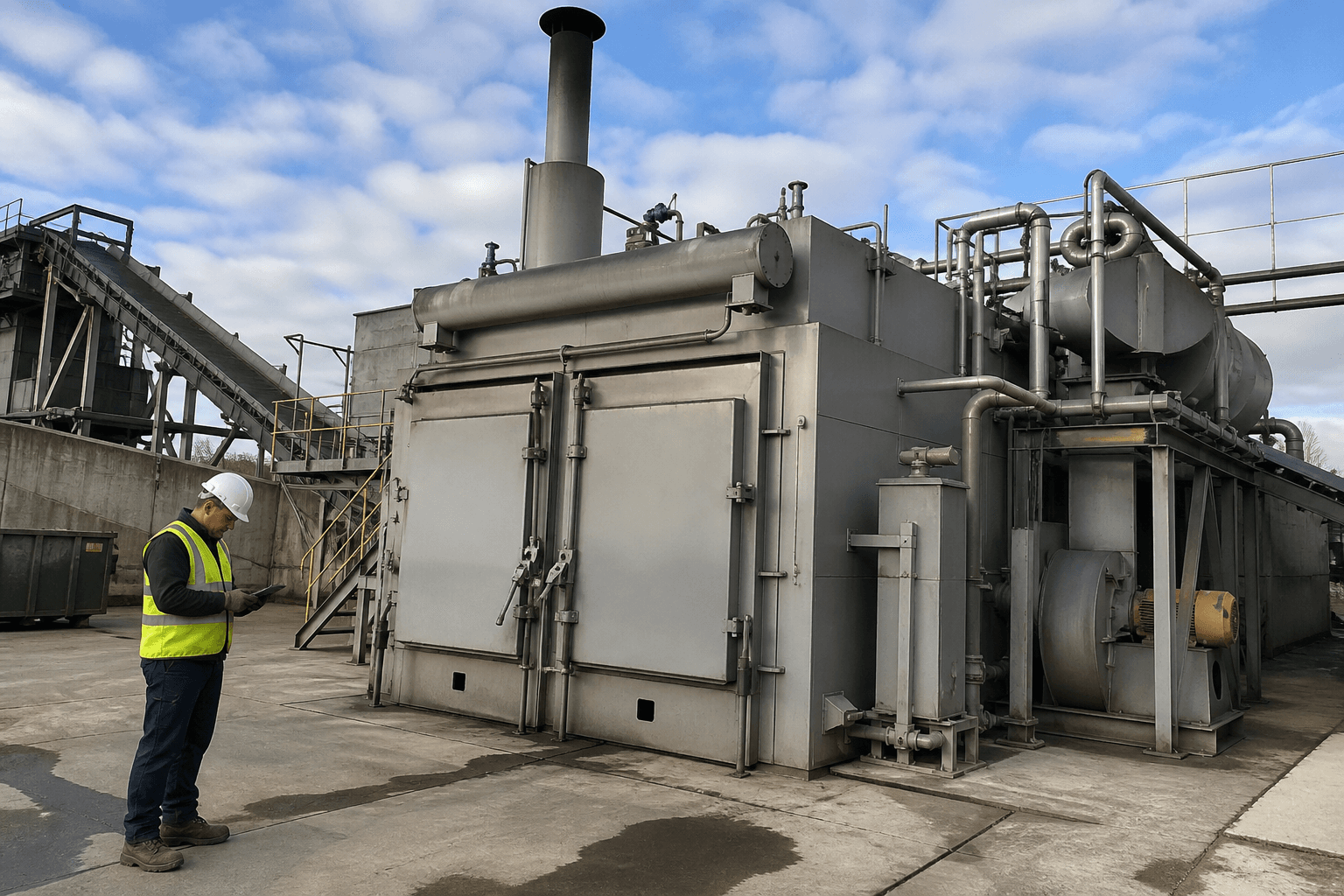
Brand Protection Incinerators
Branded, counterfeit, prototype and condemned stock destroyed under witness, with the log behind the certificate.
Branded stock that must not reach a market is the one waste stream where the disposal route is a brand risk in its own right. Every transfer is a chance for it to be diverted, photographed or resold. Destroying it on your own site, under your own witness, ends that exposure at the charge door.
Four Models,
One Solution
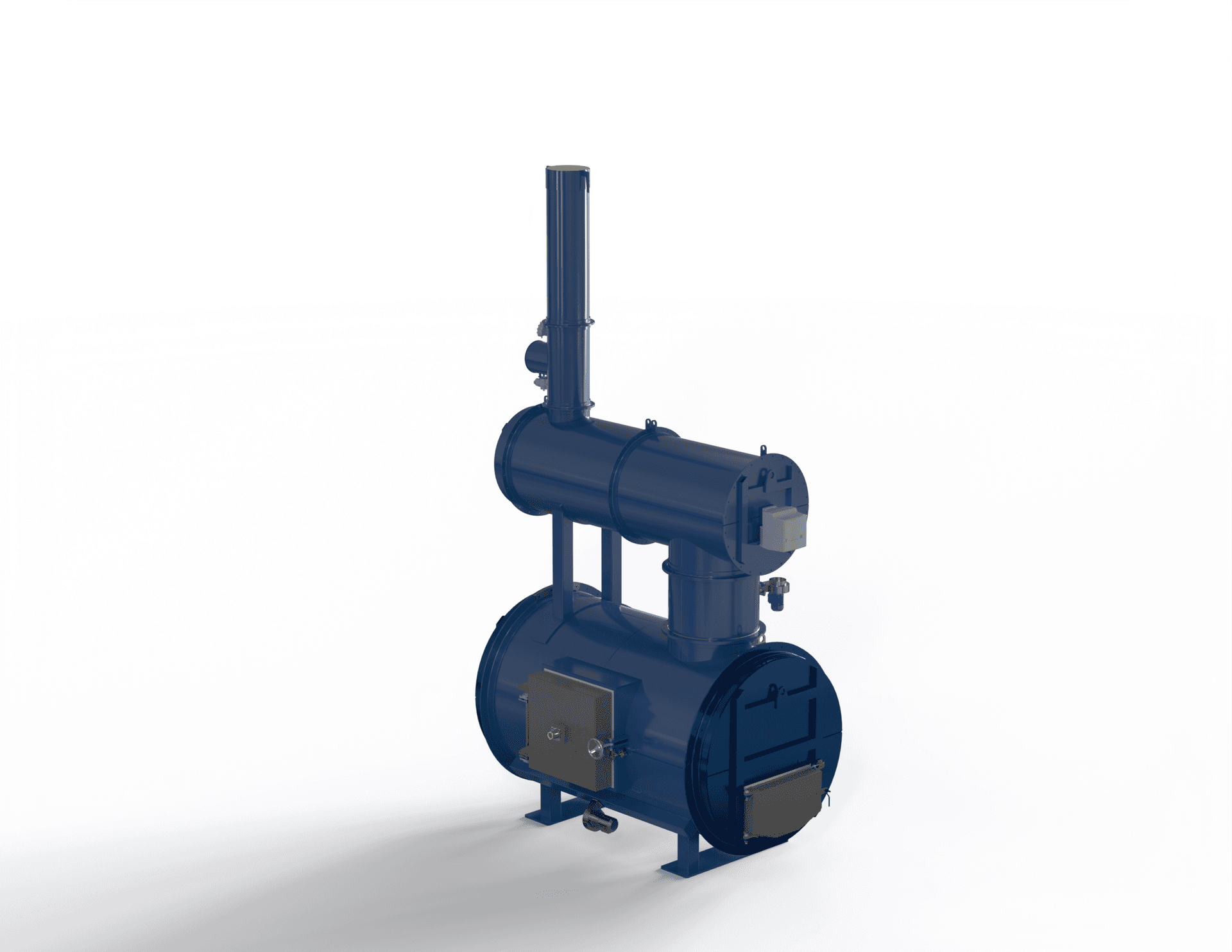
The entry point to the LitBurn range. A 3.3 m³ primary chamber and three burners give continuous 125 kg/h destruction in a footprint that fits a standard yard bay, which makes it the usual choice for a single-site operator replacing skip hire rather than a multi-site waste contract.
The most specified unit in the range. Chamber volume rises to 5.5 m³ for 250 kg/h continuous throughput while the external width grows by only 230 mm over the LBI-125, so sites that outgrow the smallest unit rarely have to rework the slab or the building line.
A 9.6 m³ chamber — nearly double the LBI-250 — for medium-scale industrial waste destruction. At this size most operators pair the unit with heat recovery, because the thermal output during a full shift is large enough to displace a dedicated water heater.
The largest LitBurn: a 16.2 m³ chamber running 500 kg/h continuously. Specified where waste arrives faster than a batch unit can clear it — large manufacturing sites, industrial estates, and operators consolidating several smaller waste contracts onto one machine.
Which Model
Fits Your Volume
Pick a model to see what it clears in a day of brand protection & secure destruction.
A brand owner or manufacturer destroying episodic consignments — a three-tonne seizure in three witnessed shifts.
It is still waste, with waste codes
Branded goods being destroyed are waste and need the right EWC codes named on the permit — usually the 16 03 off-spec or 15 01 packaging lines, or textile codes for apparel. Commercial sensitivity does not remove a single permitting or duty-of-care obligation.
The witness is the point of the procedure
A named witness, present at the charge, signing against a time-stamped run record, is what a destruction certificate rests on. Write down who may act as witness before the first run rather than deciding on the day.
Seizures follow the authority's route
Goods seized by Border Force or trading standards are destroyed under their arrangements. Confusing the two — destroying material that is somebody's evidence — is the one failure in this stream that cannot be corrected afterwards.
Declare the halogenated condition for coated goods
Coated textiles, PVC trim and laminated packaging can push a charge past 1% halogenated organic content, setting the secondary minimum at 1,100°C. Apparel-heavy destruction runs are the usual case in this stream.
Why Burn It
On Site
4 things change on the day this stream stops leaving the site.
The diversion window closes
Branded goods are worth stealing from a waste stream. Removing the transfer, the transfer station and the third-party sorting line removes every place where that has ever happened, rather than adding a clause to a contract about it.
Your witness, your procedure
A nominated person watches the charge and signs against the run record. Contract destruction gives you a certificate written by the party you are trusting, which is a weaker instrument in exactly the case where it matters.
Nothing is recognisable afterwards
Shredding leaves branded fragments and a residue stream that still travels. Incineration at 850°C for two seconds leaves mineral ash with no mark, no fibre and no component that could be reassembled or photographed.
The count closes the file
Unit counts reconciled against a run log, a weight and a witness signature close a destruction obligation — under a licence, a settlement, or a customer contract — with evidence rather than with an invoice.
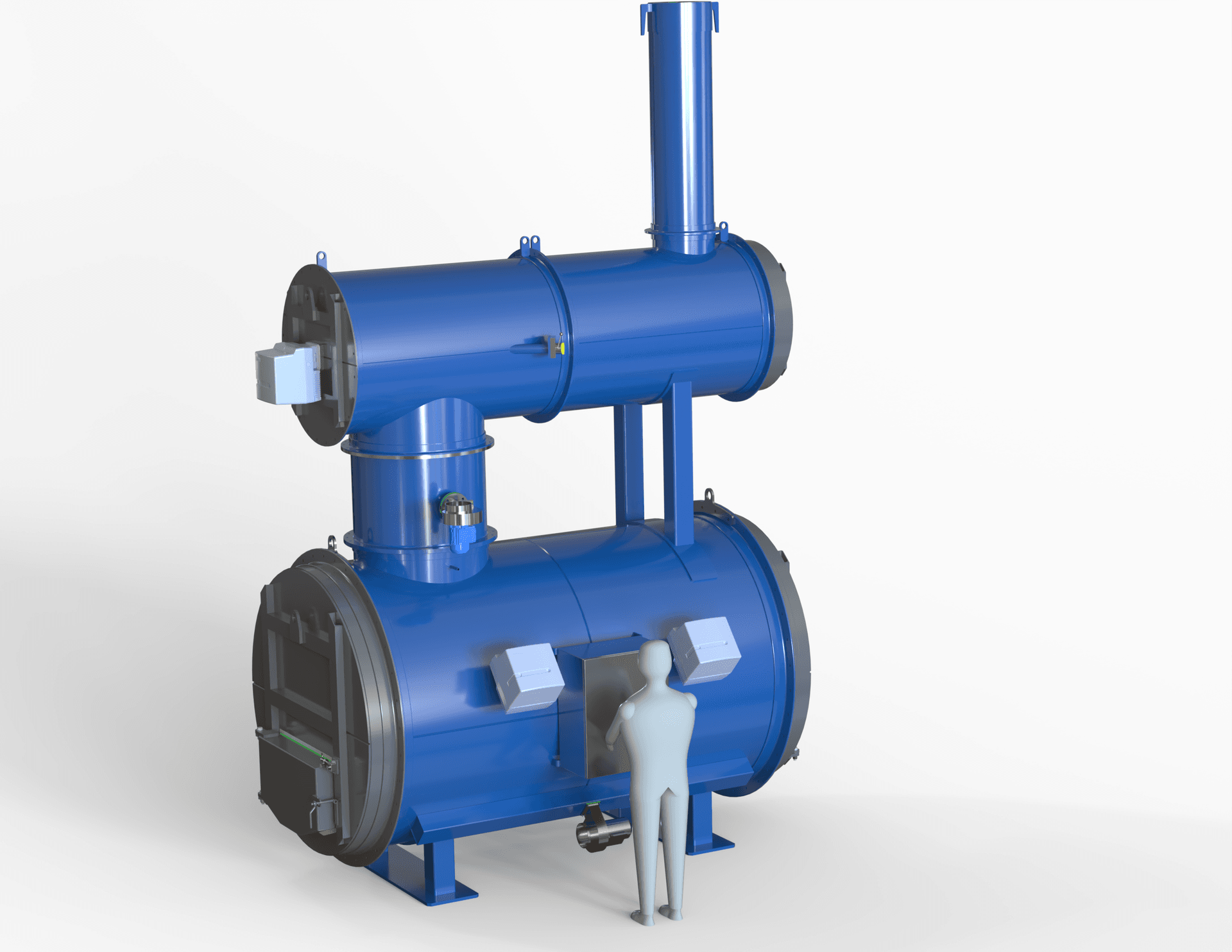
Dual-chamber unit, continuous duty
Primary chamber running 850–1,200°C with a secondary holding flue gas above 850°C for two seconds. Rated to run for a shift rather than for a charge, because an industrial stream arrives at the rate the line produces it and a batch machine simply queues it up in the yard.
Front dual-door loading
Charged through a front dual door at floor level, so tote bins, stillages and wheeled skips are fed at the height a forklift or a pump truck already works at. No hoist, no tipping platform, no lifting waste over a top rim.
What Ships
With The Unit
Identical whichever stream it is specified for. The operating procedure changes; the machine does not.
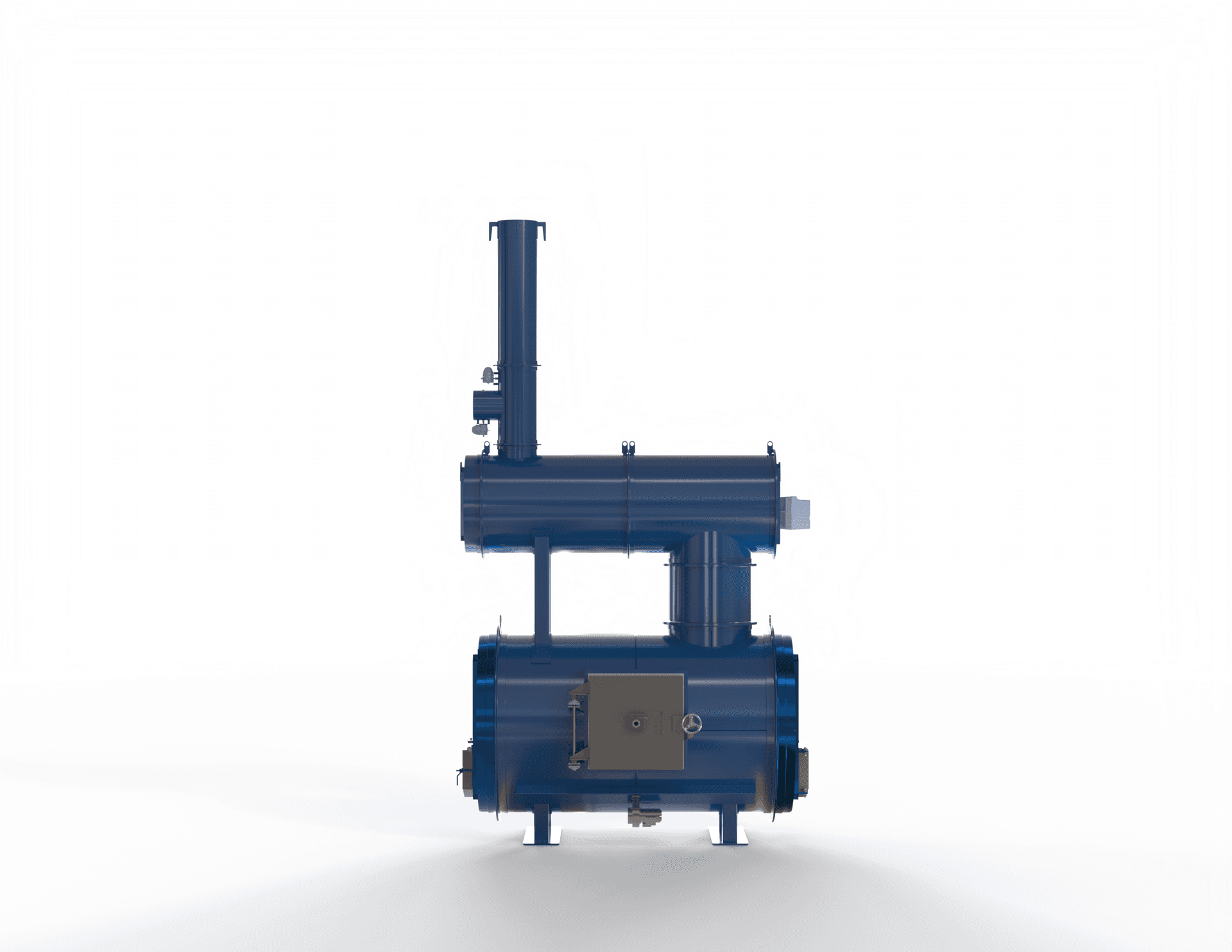
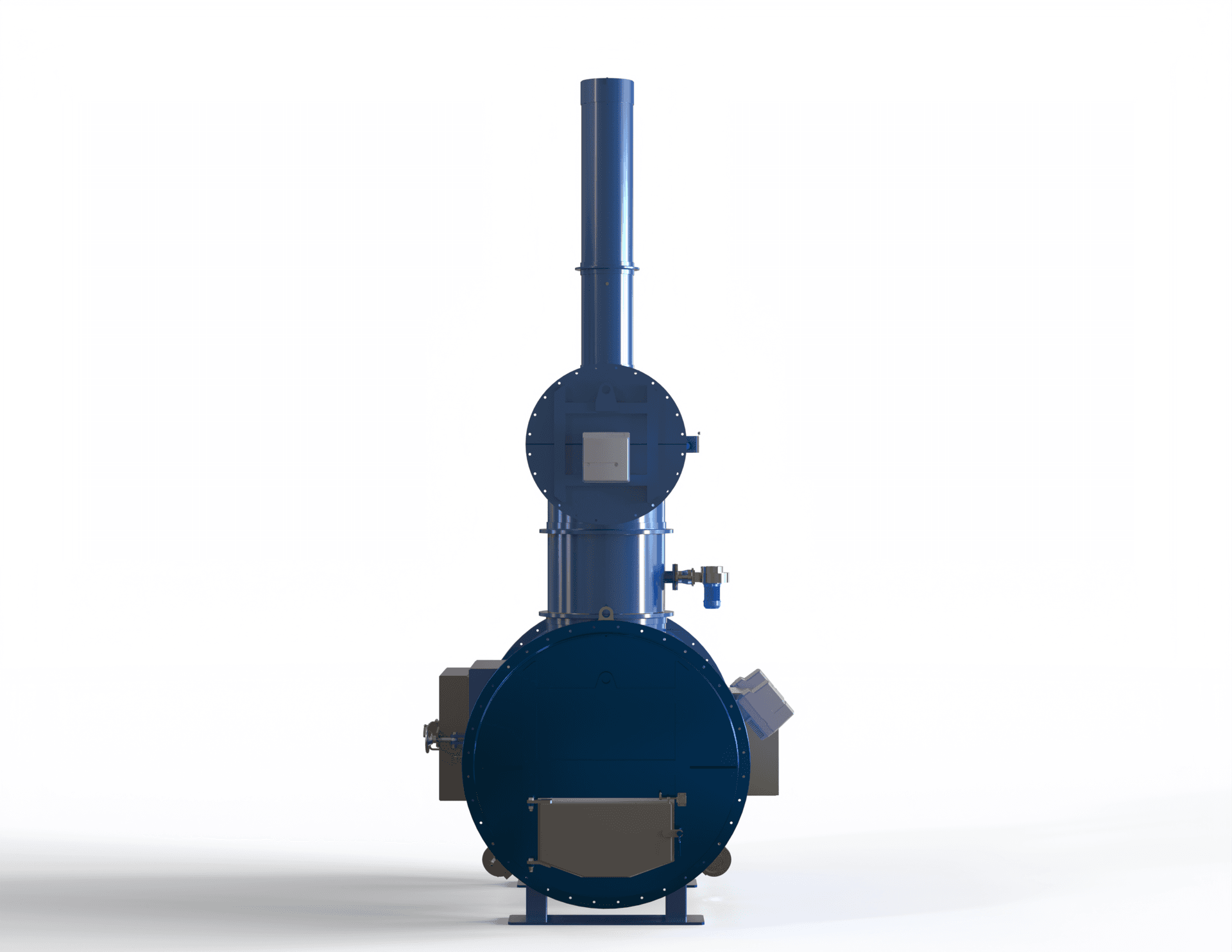
Dual-chamber unit, continuous duty
Primary chamber running 850–1,200°C with a secondary holding flue gas above 850°C for two seconds. Rated to run for a shift rather than for a charge, because an industrial stream arrives at the rate the line produces it and a batch machine simply queues it up in the yard.
Front dual-door loading
Charged through a front dual door at floor level, so tote bins, stillages and wheeled skips are fed at the height a forklift or a pump truck already works at. No hoist, no tipping platform, no lifting waste over a top rim.
IP6X control panel with cycle logging
PLC control with chamber thermocouples, interlocked charge door and a time-stamped temperature record per run. For destruction that has to be evidenced — brand protection, customer-mandated disposal, off-spec write-off — that log is the difference between a certificate and a claim.
Three-burner set and fuel train
Configured for natural gas, LPG, diesel, biofuel or hydrogen. High-calorific streams such as polymer and rubber need less burner input once they are alight, not more — the burners are there to reach and hold the condition, not to do the work the waste is already doing.
Coretex refractory lining
Monolithic castable lining rated for the full range and for sustained running at the top of it. On plastics and solvent-bearing waste the chamber spends real time near the ceiling of that range, which is exactly the duty that eats a cheaper lining.
Stack, dispersion data and commissioning
Stack to the height your site-specific dispersion assessment calls for, the emissions data pack the permit application references, on-site commissioning, a witnessed first run and operator training for the shift staff who will actually run it.
How One Burn Runs,
Start To Finish
One run is one countable event, reconciled against a manifest and evidenced by a time-stamped temperature log.
One Cycle,
Start To Finish
Adds a witnessed-destruction procedure rather than a new hazard: nominated witness, sealed transfer from the secure store, and a run record that reconciles unit counts against the destruction certificate.
Stock is held in the secure store and counted against the destruction instruction — the licence clause, the settlement, the recall or the internal condemnation. That count is what the certificate will be written against.
The person who will sign is named before the run rather than found afterwards: brand protection, quality, legal, or the rights holder's own representative where the instruction requires it.
Goods go from the secure store to the front dual door in sealed cages, and are charged with the witness present. The interlocked charge door means nothing is added once the run is under way.
Primary combustion with two-second secondary retention above 850°C, or 1,100°C where the goods carry more than 1% halogenated organic content — coated textiles, PVC trim and some laminated packaging are the usual reasons.
The count, the run log, the ash weight and the witness signature close the file. A certificate issued without those four is an assertion about goods nobody watched being destroyed.
What You Can Burn —
And What You Can't
One run takes the whole stream without pre-sorting. What must never enter it is a short, hard list.
Yes: accepted in a run
No pre-sorting between these
- Recovered counterfeit goodsCounterfeit stock a rights holder holds and is entitled to destroy — apparel, accessories, packaging and labelling that must never reach a market.
- Branded seconds, rejects and QC failuresFully branded product that failed inspection and cannot be sold at any grade without becoming a brand liability of its own.
- Prototypes, samples and pre-launch materialDevelopment samples, tooling trials, pre-launch packaging and sales samples carrying designs that have not been released.
- Discontinued and end-of-licence stockProduct whose licence, sponsorship or endorsement has ended and whose terms require destruction rather than clearance sale.
- Labels, artwork and packagingThe material that makes counterfeit goods credible: labels, swing tags, security features, cartons and printed artwork, destroyed with or without the product.
- Confidential physical records and mediaPaper records and non-electronic media held on site, where destruction rather than shredding-and-transfer is the required standard.
No: never charged
Not a permit question — these stay out
- Goods seized by Border Force or trading standardsSeized material is destroyed under those authorities' own arrangements and evidential rules. What you destroy here is stock you lawfully hold.
- Product under investigation or subject to legal holdAnything that is evidence, or that a dispute, insurance claim or regulatory investigation still needs, is held until the people entitled to release it do so.
- Battery-bearing and electronic goodsElectronics and cells are WEEE and battery waste with their own recovery obligations, and a fire risk in a charge. Secure WEEE destruction is a different route.
- Saleable stock that could be donated or downgradedWhere goods can lawfully be de-branded, donated or sold as seconds, that is the hierarchy answer. Destruction is for material that genuinely cannot leave in any form.
Can you legally burn brand protection & secure destruction on site?
Technically, yes: the chamber destroys almost everything on the accepted list at 850–1,200°C, and capability is rarely the constraint. Legally is a separate question. What your site is allowed to burn is set by your environmental permit from the Environment Agency, SEPA or NIEA and the waste codes written into it. The never-charged list is different again: those materials are out of scope for the unit or governed by a direction, and no permit wording brings them back in. Send us the codes you hold, or the ones you expect to apply for, and we will tell you which of this list they cover before anything is specified.
Send us your waste codesWhat does destroying a 3-tonne counterfeit seizure take?
Arithmetic on published model figures, not a customer reference. Your numbers go through the same steps.
How This
Was Worked Out
3,000 kg against the LBI-125's 125 kg/h = 24 hours, or three witnessed shifts, leaving 90–150 kg of ash and no point in the route where the goods left your control. Apparel and packaging are bulky and light — a 3.3 m³ chamber fills long before the hourly rating is reached. Count cages, not kilogrammes, when this stream is the reason for the purchase.
90–150 kg
0
1 per run
3.3 m³
Send your daily or weekly arisings and we will confirm the model, the run time and the permit route.
Related Products
& Services
Complementary equipment and engineering services for your process.


Sizing and background
- [TOOL]Work out the burn rate for your own arisings
- [TOOL]Size the combustion air and flue gas duty
- [BLOG]Improving manifold airflow evenness by 65%
- [BLOG]Ash management from industrial waste incinerators
- [BLOG]The feasibility of small-scale modular incinerator units
- [BLOG]Precious metal incineration and recovery
- [BLOG]Evaluating flue gas cleaning systems in industrial incinerators
Brand protection & secure destruction Questions
Answered against the published figures for the models specified for this stream, not a generic range sheet.
Brand protection destruction is the controlled elimination of goods that carry a mark, a design or a specification the owner cannot allow into circulation: counterfeit stock recovered by a rights holder, seconds and rejects bearing full branding, prototypes and sample runs, discontinued product under a licence that requires destruction, and packaging or labelling that would legitimise any of it. The problem it solves is not hazard, it is diversion. Branded waste has value precisely because it is branded, and every step in a conventional disposal route — the yard, the vehicle, the transfer station, the sorting line — is a place where a pallet of it can be photographed, diverted or quietly resold. A grey-market listing of goods a brand believed were destroyed is a far more expensive event than the disposal ever was. Destruction on site removes the steps rather than policing them. Stock moves from a secure store to a charge door in the same building, under a nominated witness, and the unit produces a time-stamped temperature record for the run. What leaves is 3–5% mineral ash with no mark, no material and no recoverable form. One boundary matters: goods seized by Border Force or trading standards are destroyed under those authorities' own arrangements. What a brand owner destroys here is its own stock — recovered counterfeits it holds, its rejects, its prototypes, its licensed product at end of term.
3,000 kg against the LBI-125's 125 kg/h = 24 hours, or three witnessed shifts, leaving 90–150 kg of ash and no point in the route where the goods left your control. Apparel and packaging are bulky and light — a 3.3 m³ chamber fills long before the hourly rating is reached. Count cages, not kilogrammes, when this stream is the reason for the purchase.
Because the transfer is the exposure. Once branded goods leave your site they pass through a vehicle, a yard and a sorting operation, and every grey-market reappearance of supposedly destroyed stock happened somewhere in that chain. On-site destruction replaces a certificate about goods you did not watch with a record of goods you did.
Shredding leaves branded fragments and a residue stream that still has to travel, which reintroduces the problem one step later. Incineration at 850°C for two seconds leaves mineral ash with no mark, no fibre and nothing photographable — the material stops existing rather than becoming smaller.
Whoever the instruction requires: brand protection, quality, legal, or the rights holder's representative under a settlement. The important part is that the person is nominated before the run, is present at the charge, and signs against the time-stamped cycle record rather than against a summary written afterwards.
No. Seized goods are destroyed under the seizing authority's own arrangements and evidential rules. This route is for stock you lawfully hold — recovered counterfeits, your own rejects, prototypes and end-of-licence product.
Four things the run produces: the counted manifest of what was charged, the time-stamped chamber temperature log, the ash weight at 3–5% of input mass, and the witness signature. Together they answer the question a certificate alone only asserts.
Bulky rather than difficult. Garments and packaging fill chamber volume long before they reach the hourly rating, so size on cages rather than tonnes. Coated and PVC-trimmed goods are also the reason this stream routinely declares the 1,100°C condition.
Ready to
Incinerate?
Send the stream, the volume and the site constraints. We will confirm the model, the permit route, and what the specification has to say to satisfy the regulator.
- The diversion window closes
- Your witness, your procedure
- Nothing is recognisable afterwards
- The count closes the file