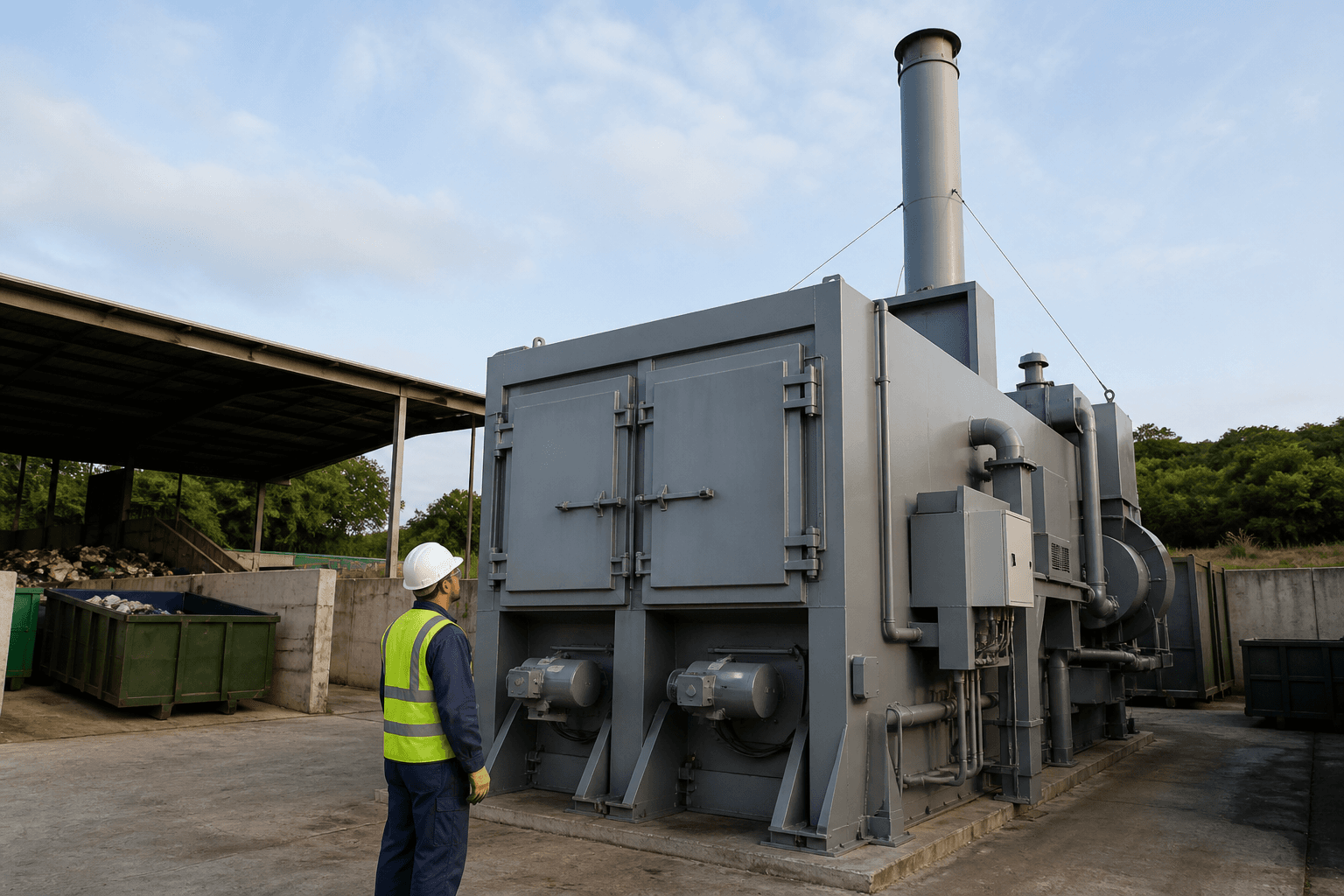
Commercial Waste Incinerators
Back-of-house residual from shops, centres, offices and estates once the recyclables are out.
A retail park, a shopping centre or a multi-tenant estate produces residual waste in a quantity that surprises everyone but the person who books the collections. Compactors fill, containers get exchanged, and every exchange is priced. Destroying the residual fraction on site changes the schedule and the invoice at the same time.
Four Models,
One Solution
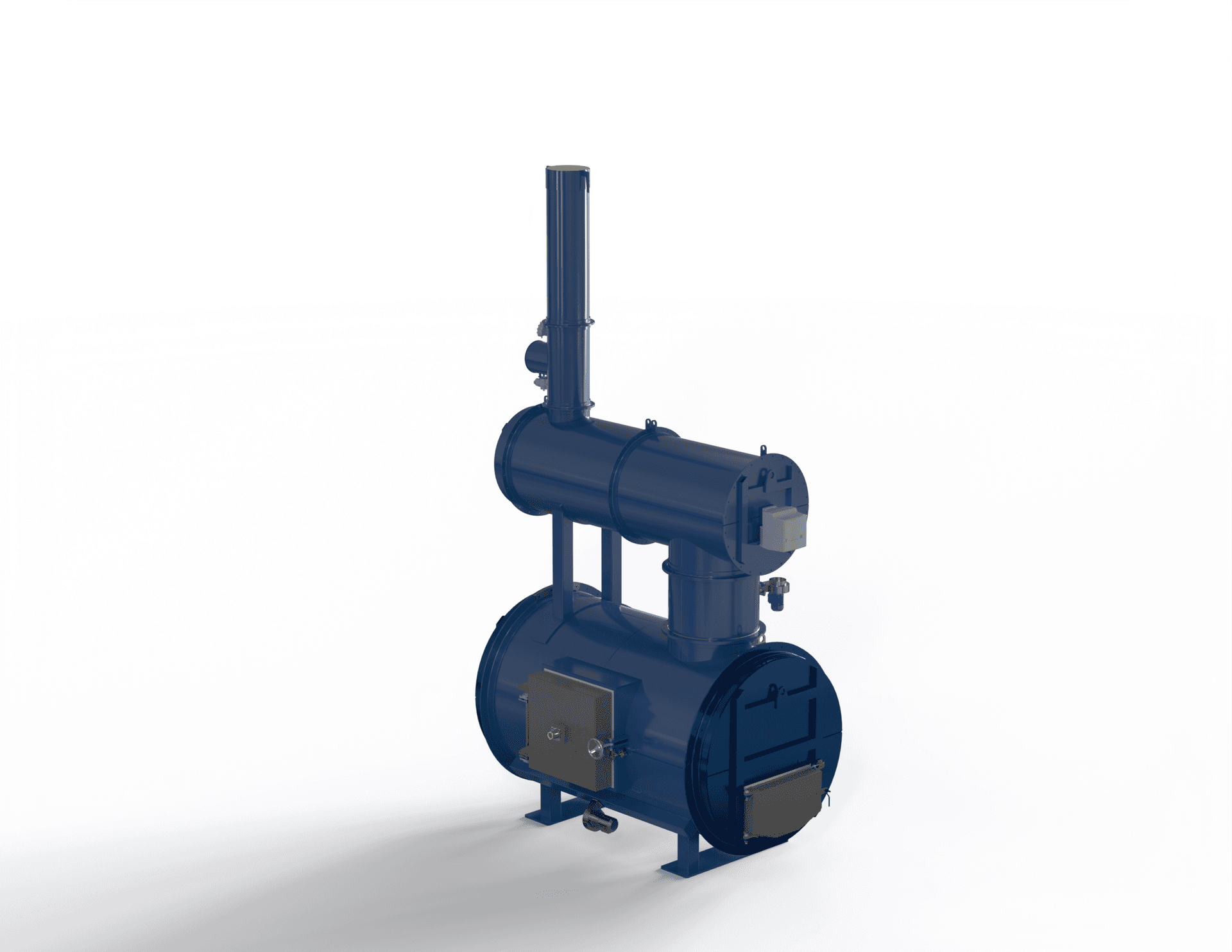
The entry point to the LitBurn range. A 3.3 m³ primary chamber and three burners give continuous 125 kg/h destruction in a footprint that fits a standard yard bay, which makes it the usual choice for a single-site operator replacing skip hire rather than a multi-site waste contract.
The most specified unit in the range. Chamber volume rises to 5.5 m³ for 250 kg/h continuous throughput while the external width grows by only 230 mm over the LBI-125, so sites that outgrow the smallest unit rarely have to rework the slab or the building line.
A 9.6 m³ chamber — nearly double the LBI-250 — for medium-scale industrial waste destruction. At this size most operators pair the unit with heat recovery, because the thermal output during a full shift is large enough to displace a dedicated water heater.
The largest LitBurn: a 16.2 m³ chamber running 500 kg/h continuously. Specified where waste arrives faster than a batch unit can clear it — large manufacturing sites, industrial estates, and operators consolidating several smaller waste contracts onto one machine.
Which Model
Fits Your Volume
Pick a model to see what it clears in a day of commercial & retail waste.
A single large store, a small centre or an office campus clearing a tonne or so a week.
Workplace separate collection is mandatory
Businesses must present dry recyclables and food waste separately from residual waste. A unit takes what is left; a unit that quietly takes the lot is a compliance problem for the site, not a saving.
20 03 01 and 15 01 on the permit
Commercial waste of a household nature codes as 20 03 01, with packaging under 15 01. Where stock destruction is in scope, the 16 03 off-spec lines belong there too — name them at application.
Duty of care runs across tenants
An estate consolidating tenant waste is taking on the duty of care for it. That needs documenting between landlord and tenant as clearly as it would with an external contractor.
Branded stock destruction has its own procedure
Where written-off goods carry branding that must not reach a market, the witnessed-destruction procedure from the industrial brand-protection stream applies rather than a residual charge.
Why Burn It
On Site
4 things change on the day this stream stops leaving the site.
Container exchanges stop setting the schedule
A centre's waste operation is organised around how often containers are exchanged. Removing most of the mass locally means the yard is no longer arranged around a vehicle's calendar.
Compactor and yard space comes back
Compactors, bin stores and container bays occupy some of the most expensive square metres in a retail building. Their footprint is set by collection frequency, and shrinking the stream shrinks the requirement.
Damaged and unsaleable stock is destroyed properly
Written-off goods put in a residual container leave a building intact and recognisable. Destroying them on site closes that off, and where they are branded the brand-protection procedure applies.
Multi-tenant billing gets simpler
A single destruction point under one permit replaces a set of tenant-by-tenant collection arrangements that nobody can audit and everybody disputes.
Dual-chamber unit, continuous duty
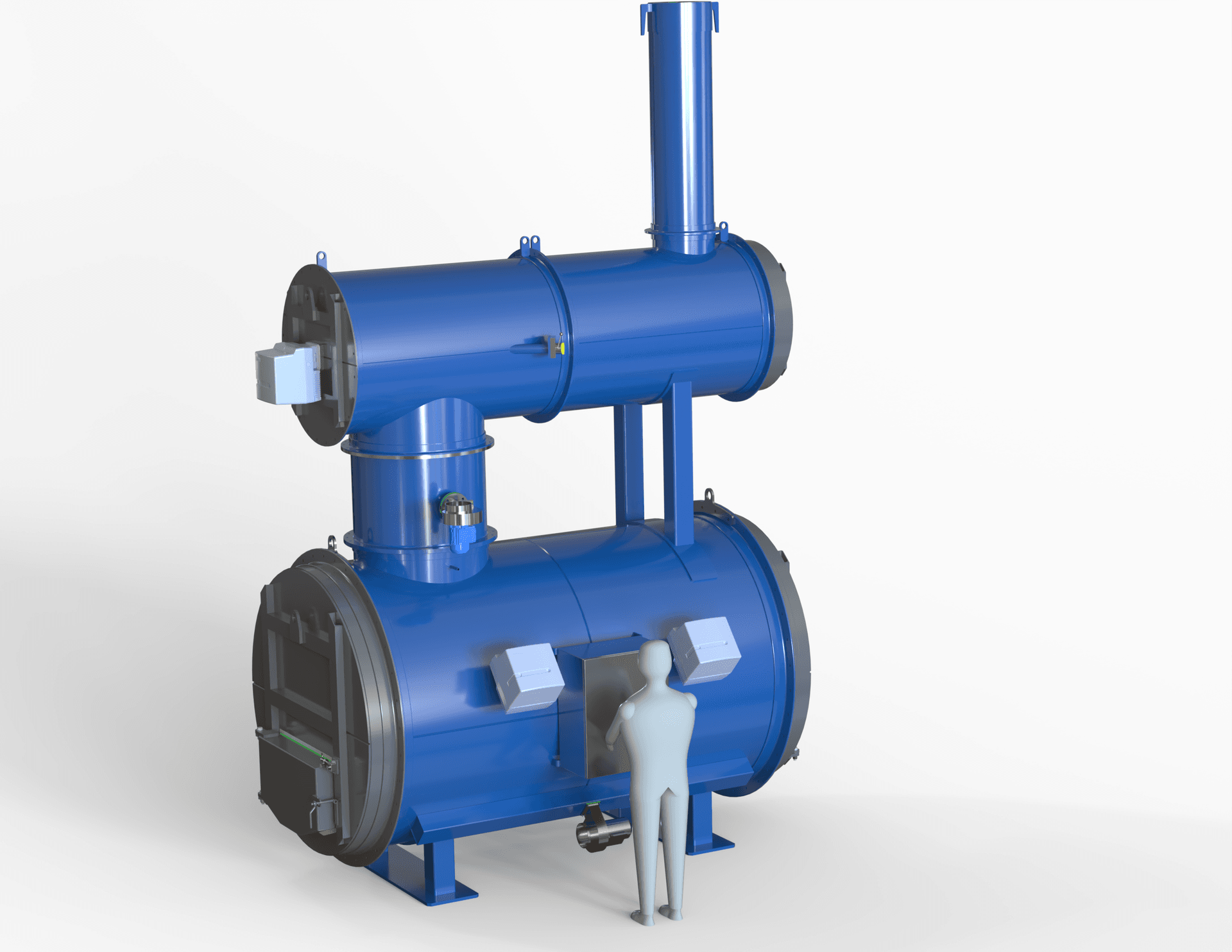
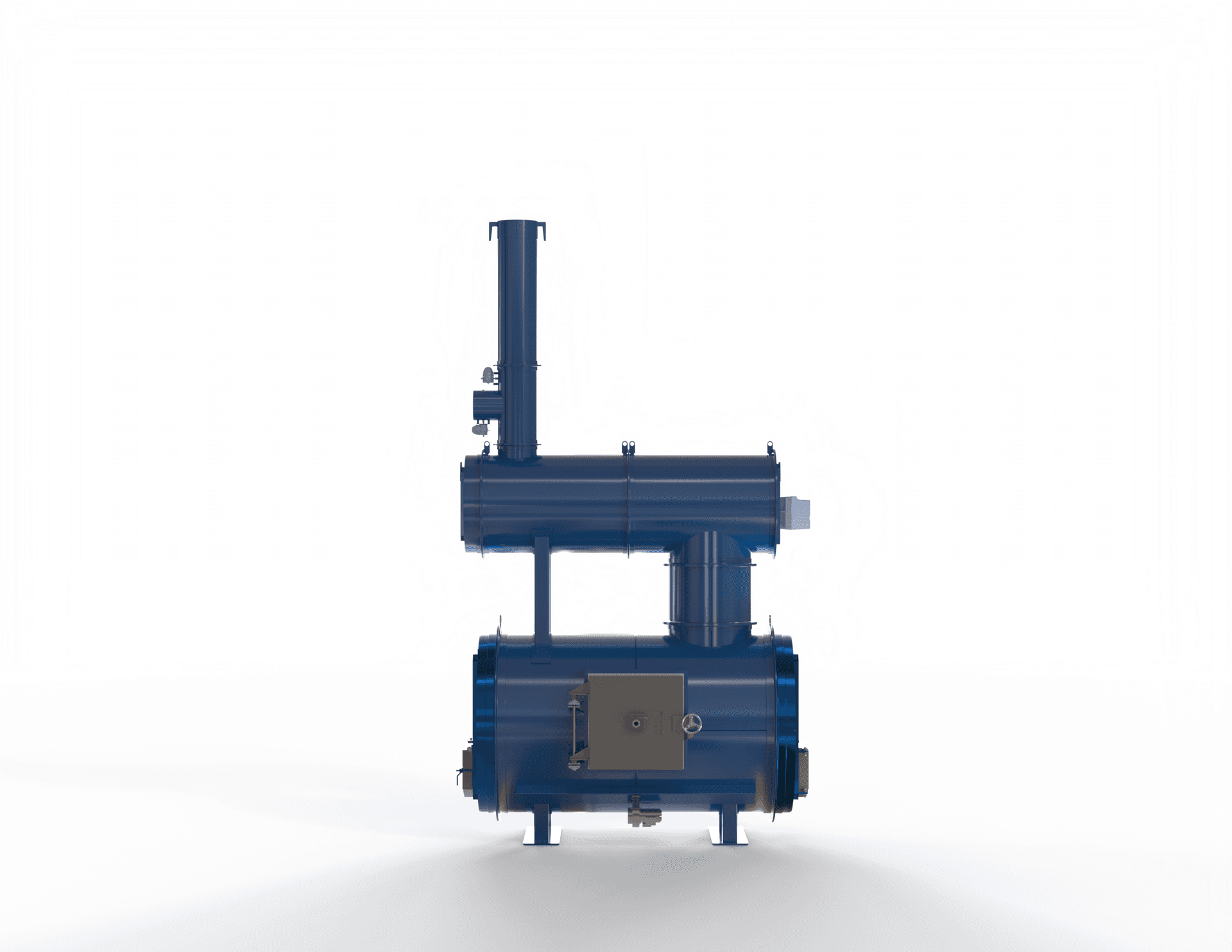
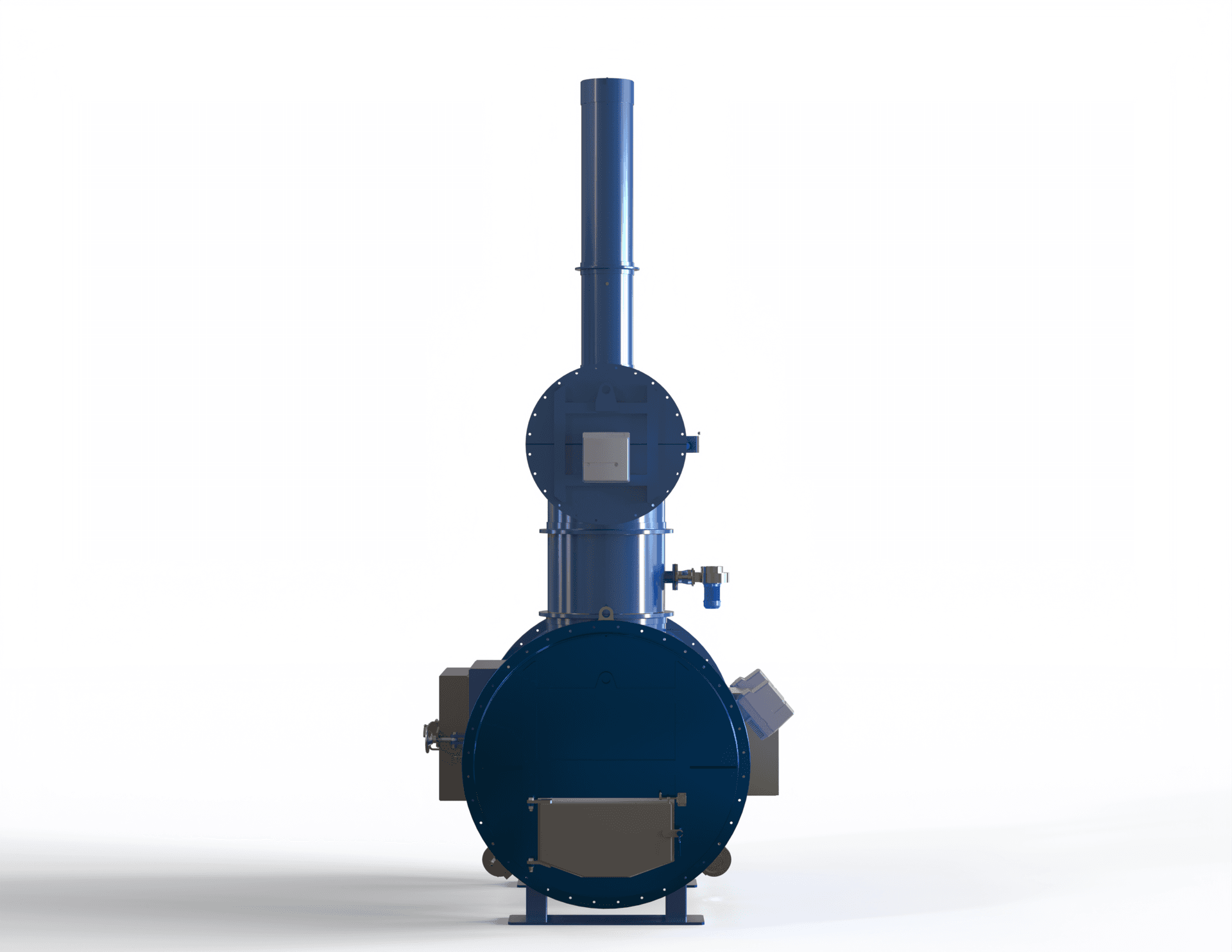
Primary chamber running 850–1,200°C with a secondary holding flue gas above 850°C for two seconds. Rated to run for a shift, because mixed waste arrives at the rate a site produces it rather than in charges somebody can schedule.
Front dual-door loading
Charged through a front dual door at floor level, so 1,100-litre bins, cages and wheeled containers are fed at the height they are already moved at. No tipping platform, no hoist, no lifting sacks over a rim.
What Ships
With The Unit
Identical whichever stream it is specified for. The operating procedure changes; the machine does not.
Dual-chamber unit, continuous duty
Primary chamber running 850–1,200°C with a secondary holding flue gas above 850°C for two seconds. Rated to run for a shift, because mixed waste arrives at the rate a site produces it rather than in charges somebody can schedule.
Front dual-door loading
Charged through a front dual door at floor level, so 1,100-litre bins, cages and wheeled containers are fed at the height they are already moved at. No tipping platform, no hoist, no lifting sacks over a rim.
IP6X control panel with cycle logging
PLC control with chamber thermocouples, interlocked charge door and a time-stamped temperature record per run. On a residual stream the log is what a permit compliance visit reads, and what a duty-of-care question is answered from.
Three-burner set and fuel train
Configured for natural gas, LPG, diesel, biofuel or hydrogen. Mixed municipal and commercial waste is wetter and more variable than an industrial stream, so burner support matters more here than on a polymer charge.
Coretex refractory lining
Monolithic castable lining rated for the full temperature range, replaceable in service. Mixed waste swings in calorific value between one bin and the next, and the lining is specified for that cycling rather than for a steady feed.
Stack, dispersion data and commissioning
Stack to the height your site-specific dispersion assessment calls for, the emissions data pack the permit application references, on-site commissioning, a witnessed first run and operator training for depot or site staff.
How One Burn Runs,
Start To Finish
One run is one countable event, reconciled against a manifest and evidenced by a time-stamped temperature log.
One Cycle,
Start To Finish
Adds 20 03 01 and 15 01 packaging lines to the permit. The workplace separate-collection rules do most of the work upstream: what reaches the door is the residual left after recyclables and food waste are gone.
Dry recyclables and food waste are collected apart under the workplace rules. The residual container is what remains, and the tenant-facing segregation is what keeps it that way.
Retail residual reliably contains batteries, vapes, aerosols and small electricals. They are pulled at the bin store, not at the charge door.
1,100-litre wheeled containers and cages are fed through the front dual door at floor level while the unit runs. No decanting and no sorting line.
Primary combustion with two-second secondary retention above 850°C, or 1,100°C where packaging film pushes the charge past 1% halogenated organic content.
Residue is 3–5% of input mass. The run log is what the estate's waste records and its duty-of-care position are written from.
What You Can Burn —
And What You Can't
One run takes the whole stream without pre-sorting. What must never enter it is a short, hard list.
Yes: accepted in a run
No pre-sorting between these
- Mixed back-of-house residualThe residual container from shops, offices and centres once dry recyclables and food waste have been separately collected.
- Contaminated and non-recyclable packagingFilms, laminates, mixed-material packaging and transit protection that recycling will not take once contaminated in use.
- Damaged and unsaleable stockGoods written off as damaged, soiled or out of date for sale, where donation or downgrading is not available.
- Facilities and cleaning wasteSweepings, cleaning consumables, mop heads and general facilities waste from the operation of the building.
- Point-of-sale and display materialPrinted display, signage, seasonal fittings and branded point-of-sale material at end of campaign, which should not appear elsewhere in use.
- Mixed tenant residual under one permitResidual waste consolidated from tenants across an estate, provided every stream sits inside the permitted scope.
No: never charged
Not a permit question — these stay out
- Separately collected recyclables and food wasteBoth are required to be collected separately and both have routes above disposal. This is the exclusion that keeps the rest of the stream defensible.
- Batteries, vapes and small electricalsWEEE and battery obligations, plus the most common ignition source in a mixed commercial charge. They come out at the bin store.
- Aerosols and pressurised containersSealed vessels under heat, and abundant in retail residual waste. They have their own route regardless of how empty they seem.
- Clinical waste from in-store servicesPharmacy, beauty and health services in a retail setting produce clinical waste with its own codes and colour coding. It goes through the healthcare route, not the residual one.
Can you legally burn commercial & retail waste on site?
Technically, yes: the chamber destroys almost everything on the accepted list at 850–1,200°C, and capability is rarely the constraint. Legally is a separate question. What your site is allowed to burn is set by your environmental permit from the Environment Agency, SEPA or NIEA and the waste codes written into it. The never-charged list is different again: those materials are out of scope for the unit or governed by a direction, and no permit wording brings them back in. Send us the codes you hold, or the ones you expect to apply for, and we will tell you which of this list they cover before anything is specified.
Send us your waste codesWhat does a shopping centre's 6 tonnes a week need?
Arithmetic on published model figures, not a customer reference. Your numbers go through the same steps.
How This
Was Worked Out
6,000 kg a week against the LBI-250's 250 kg/h = 24 hours, or three shifts, leaving 180–300 kg of ash instead of six tonnes of container exchanges. Retail residual is bulky before it is compacted. If the centre already runs a compactor, size on the compacted density; if it does not, count containers against the 5.5 m³ chamber.
180–300 kg a week
≈95% of mass removed
5.5 m³
2.9 t
Send your daily or weekly arisings and we will confirm the model, the run time and the permit route.
Related Products
& Services
Complementary equipment and engineering services for your process.
Sizing and background
- [TOOL]Work out the burn rate for your own arisings
- [TOOL]Size the combustion air and flue gas duty
- [BLOG]Validating feasibility for an 8,200 kg/h waste-to-energy incinerator
- [BLOG]Designing modular incinerator systems for waste-to-energy
- [BLOG]Integrating vibration analysis for incinerator predictive maintenance
- [BLOG]Advanced gas cleaning for ultra-low emission incinerators
- [BLOG]Evaluating flue gas cleaning systems in industrial incinerators
Commercial & retail waste Questions
Answered against the published figures for the models specified for this stream, not a generic range sheet.
Commercial residual waste is the back-of-house stream from shops, shopping centres, offices, warehouses and multi-tenant estates: mixed refuse, contaminated and non-recyclable packaging, damaged or unsaleable stock, and the cleaning and facilities waste that goes with occupying a building. Workplace recycling rules have reshaped this stream. Businesses now separate dry recyclables and food waste from residual, which means the residual container holds a genuinely mixed, contaminated fraction rather than a lazily-filled bin. That is the material a unit is specified for, and the separation is what makes the case defensible when a regulator asks. The commercial argument is usually the simplest on the site. Residual waste is priced per container exchange or per tonne, both of which scale with volume, and a multi-tenant estate has very little control over how fast its containers fill. Reducing 95% of the mass on site changes the exchange frequency more than it changes any single line on the invoice. The combustion condition is the standard 850–1,200°C primary with two-second secondary retention. Mixed commercial waste occasionally carries enough plastic film and packaging to cross the 1% halogenated organic threshold that takes the secondary to 1,100°C, which is worth declaring rather than discovering.
6,000 kg a week against the LBI-250's 250 kg/h = 24 hours, or three shifts, leaving 180–300 kg of ash instead of six tonnes of container exchanges. Retail residual is bulky before it is compacted. If the centre already runs a compactor, size on the compacted density; if it does not, count containers against the 5.5 m³ chamber.
Yes — separate collection of dry recyclables and food waste is a legal requirement for workplaces, not an option a unit removes. What changes is the residual container: it stops being exchanged as often, because most of its mass no longer leaves the site.
It does, and consolidation is usually where the economics come from. The catch is duty of care: taking tenants' waste means taking responsibility for it, so the landlord–tenant arrangement needs documenting as carefully as an external contract would be.
Yes, with the off-spec codes named in the permit. Where the goods are branded and must not reach a market, use the witnessed-destruction procedure rather than treating them as residual — the difference is a counted manifest and a signature against the run log.
Considerably. Uncompacted retail residual fills a chamber at a fraction of the hourly rating, while compacted waste approaches it. If a compactor is already in use, size on that density; if not, count containers against chamber volume and expect volume rather than weight to govern.
It stays separate. Pharmacy, beauty and health services produce clinical waste with its own codes, colour coding and permit lines. It can share a permitted unit only where those codes are named, and it never shares a bin with residual waste.
It depends on tonnage, gate fees and how many container exchanges disappear. That is an arithmetic question rather than a principle, and it is one we would rather do honestly before a purchase than defend afterwards — send the weekly arisings and the current invoice.
Ready to
Incinerate?
Send the stream, the volume and the site constraints. We will confirm the model, the permit route, and what the specification has to say to satisfy the regulator.
- Container exchanges stop setting the schedule
- Compactor and yard space comes back
- Damaged and unsaleable stock is destroyed properly
- Multi-tenant billing gets simpler