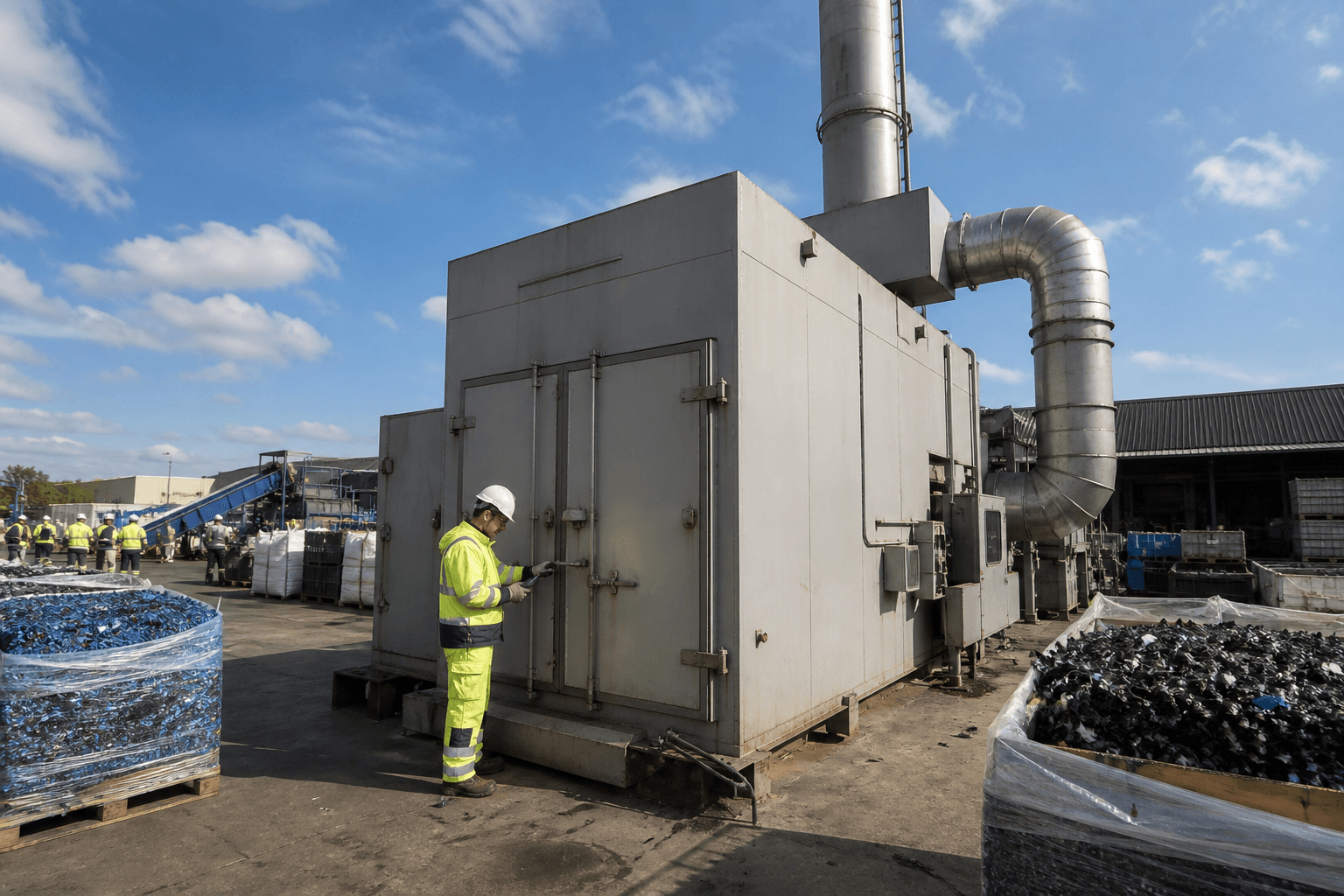
Plastic Waste Incinerators
Non-recyclable polymer, cured rubber and composite off-cuts — the fraction recyclers quote at zero.
Some polymer waste has a recycler and some does not. Laminated film, filled and pigmented compound, cured rubber and glass or carbon composite are the fractions that get quoted at zero and go to landfill instead. Those are the ones a unit is for — high in energy, awkward in a skip, and fed rather than dumped.
Four Models,
One Solution
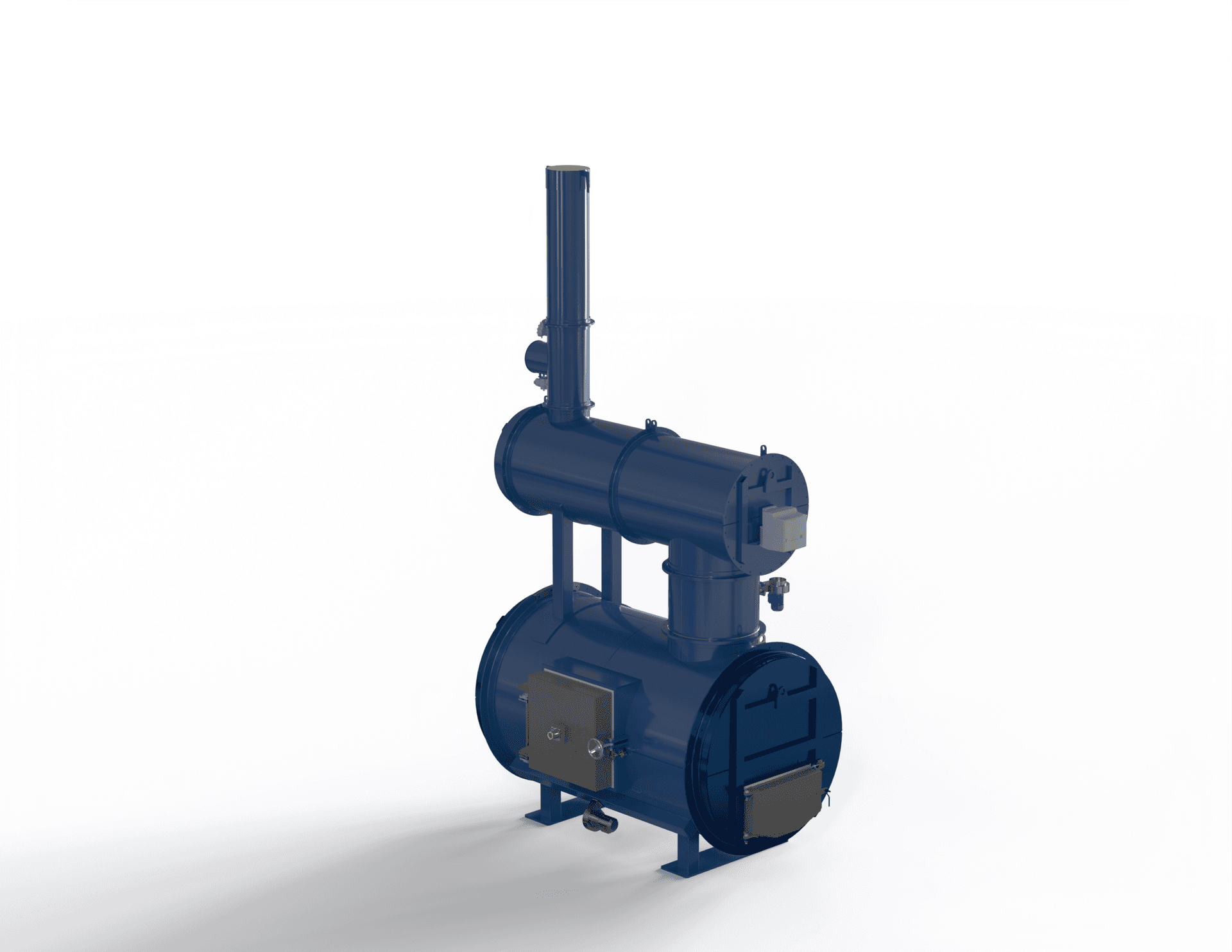
The entry point to the LitBurn range. A 3.3 m³ primary chamber and three burners give continuous 125 kg/h destruction in a footprint that fits a standard yard bay, which makes it the usual choice for a single-site operator replacing skip hire rather than a multi-site waste contract.
The most specified unit in the range. Chamber volume rises to 5.5 m³ for 250 kg/h continuous throughput while the external width grows by only 230 mm over the LBI-125, so sites that outgrow the smallest unit rarely have to rework the slab or the building line.
A 9.6 m³ chamber — nearly double the LBI-250 — for medium-scale industrial waste destruction. At this size most operators pair the unit with heat recovery, because the thermal output during a full shift is large enough to displace a dedicated water heater.
The largest LitBurn: a 16.2 m³ chamber running 500 kg/h continuously. Specified where waste arrives faster than a batch unit can clear it — large manufacturing sites, industrial estates, and operators consolidating several smaller waste contracts onto one machine.
Which Model
Fits Your Volume
Pick a model to see what it clears in a day of polymer, rubber & composite waste.
A moulding shop or small processor clearing a tonne a week of trim, purge and mis-mouldings.
07 02 and 19 12 on the permit
Waste from the manufacture, formulation and use of plastics, synthetic rubber and man-made fibres sits in the 07 02 group, with 19 12 lines where material has been through mechanical treatment. Name the ones the site actually produces at application.
The hierarchy question is sharpest here
Polymer recycling markets are real for clean single-material scrap, so this is the stream where a regulator is most likely to ask what was diverted. Keep the evidence of the recyclable fraction leaving to recovery alongside the run records.
1,100°C for PVC, PTFE and chlorinated rubber
These materials push a charge past the 1% halogenated organic threshold and raise the secondary-chamber minimum. Answer it from the bill of materials and declare the higher condition against the streams that need it.
Composite residue is higher than 3–5%
Glass reinforcement does not burn. A GRP-heavy run leaves a larger mineral residue than the range figure suggests, which is a sizing and ash-handling fact rather than a fault, and it belongs in the disposal arithmetic.
Why Burn It
On Site
4 things change on the day this stream stops leaving the site.
The fraction recyclers refuse still has to go somewhere
Mixed, laminated and filled polymer gets quoted at zero or at a cost, and it ends up in a residual skip on a standard-rate ticket. That is the stream a unit is genuinely for.
Volume disappears at the point it is made
Polymer trim and rubber off-cut are bulky, light and fill skips fast. At 3–5% residue the yard stops being organised around how often a residual container is emptied.
The energy is used rather than buried
High-calorific material burns with very little burner support once it is alight, and at the larger sizes the thermal output is worth capturing for process or space heating.
Confidential tooling and part geometry are destroyed
Trial mouldings, tooling proofs and pre-launch parts carry geometry a competitor would find useful. Destruction on site removes them completely rather than sending recognisable parts to a sorting line.
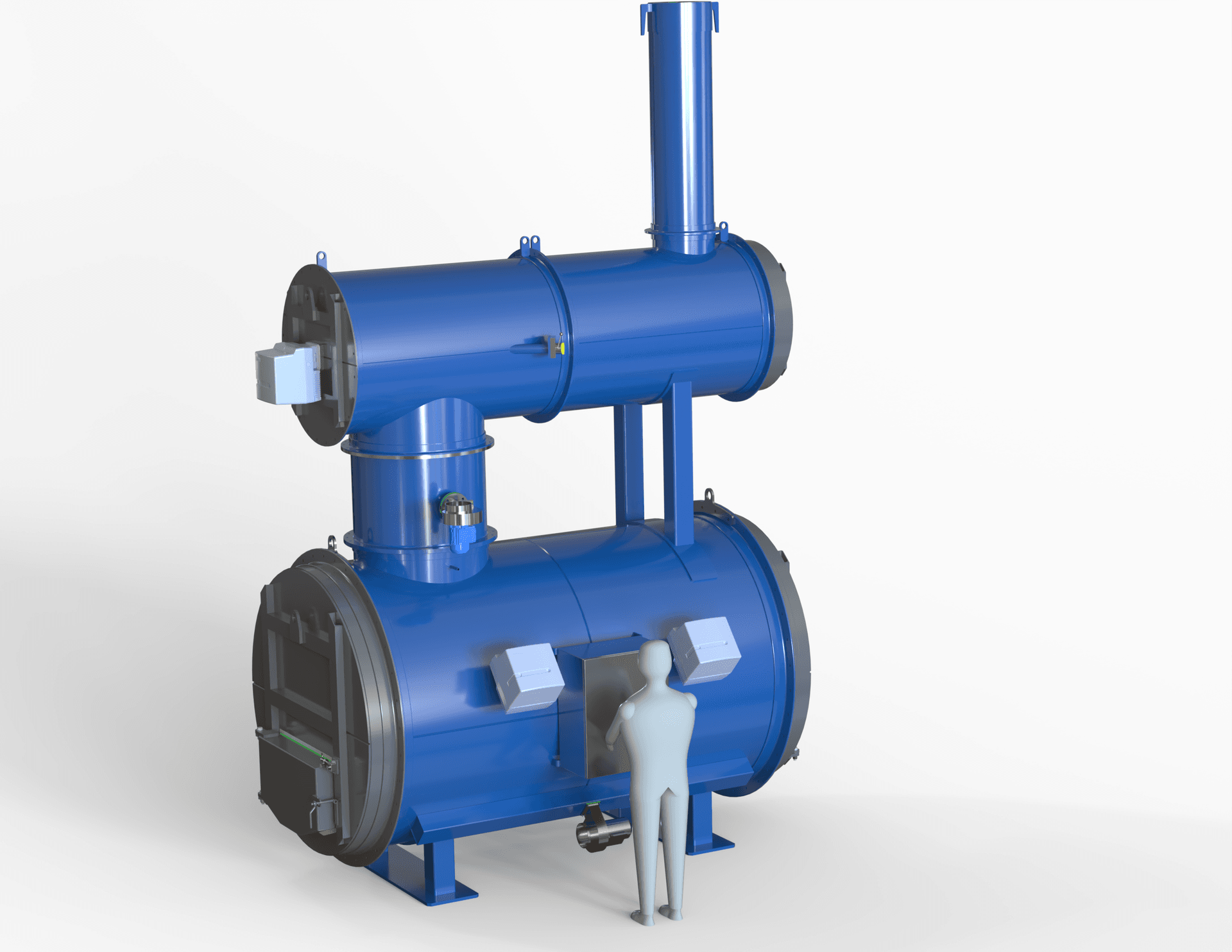
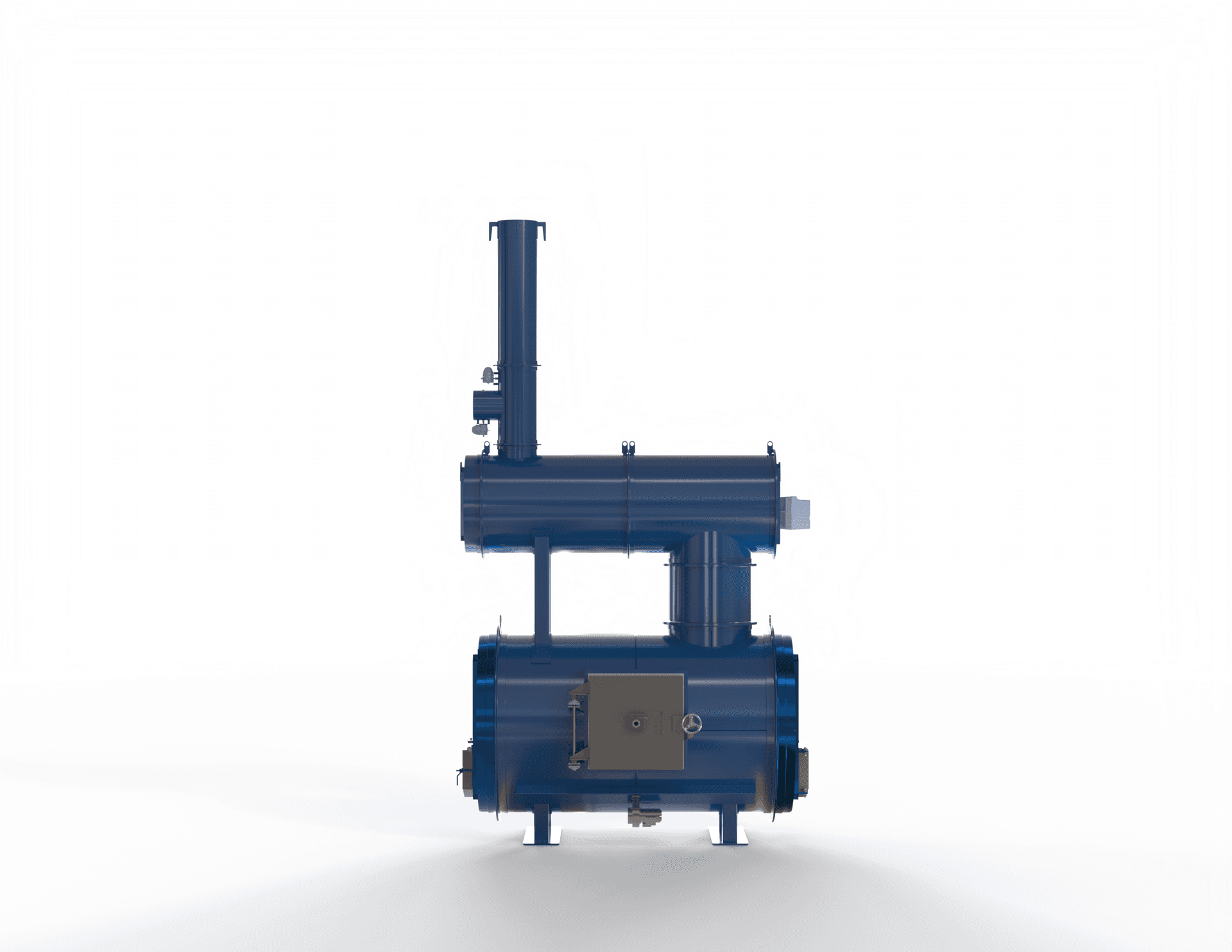
Dual-chamber unit, continuous duty
Primary chamber running 850–1,200°C with a secondary holding flue gas above 850°C for two seconds. Rated to run for a shift rather than for a charge, because an industrial stream arrives at the rate the line produces it and a batch machine simply queues it up in the yard.
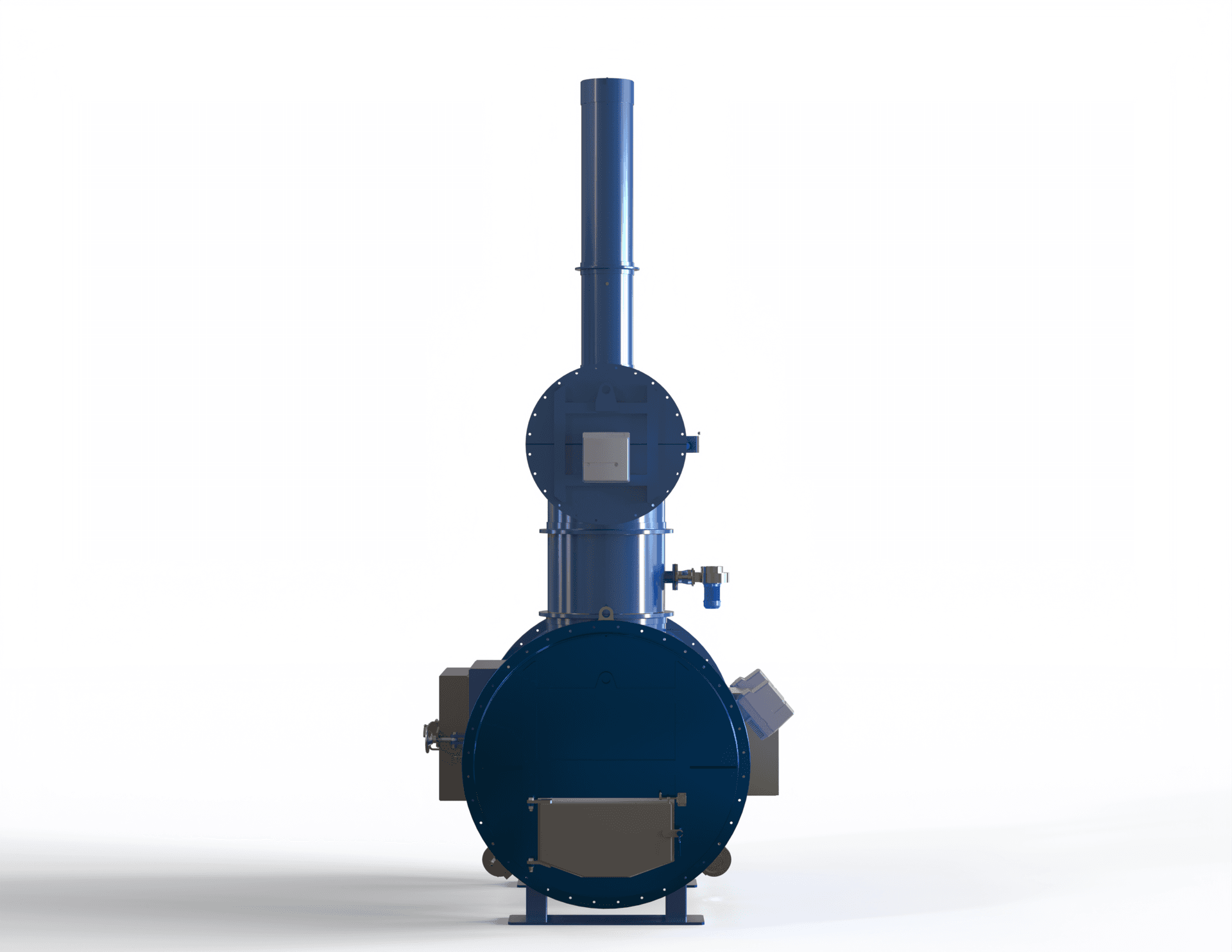
Front dual-door loading
Charged through a front dual door at floor level, so tote bins, stillages and wheeled skips are fed at the height a forklift or a pump truck already works at. No hoist, no tipping platform, no lifting waste over a top rim.
What Ships
With The Unit
Identical whichever stream it is specified for. The operating procedure changes; the machine does not.
Dual-chamber unit, continuous duty
Primary chamber running 850–1,200°C with a secondary holding flue gas above 850°C for two seconds. Rated to run for a shift rather than for a charge, because an industrial stream arrives at the rate the line produces it and a batch machine simply queues it up in the yard.
Front dual-door loading
Charged through a front dual door at floor level, so tote bins, stillages and wheeled skips are fed at the height a forklift or a pump truck already works at. No hoist, no tipping platform, no lifting waste over a top rim.
IP6X control panel with cycle logging
PLC control with chamber thermocouples, interlocked charge door and a time-stamped temperature record per run. For destruction that has to be evidenced — brand protection, customer-mandated disposal, off-spec write-off — that log is the difference between a certificate and a claim.
Three-burner set and fuel train
Configured for natural gas, LPG, diesel, biofuel or hydrogen. High-calorific streams such as polymer and rubber need less burner input once they are alight, not more — the burners are there to reach and hold the condition, not to do the work the waste is already doing.
Coretex refractory lining
Monolithic castable lining rated for the full range and for sustained running at the top of it. On plastics and solvent-bearing waste the chamber spends real time near the ceiling of that range, which is exactly the duty that eats a cheaper lining.
Stack, dispersion data and commissioning
Stack to the height your site-specific dispersion assessment calls for, the emissions data pack the permit application references, on-site commissioning, a witnessed first run and operator training for the shift staff who will actually run it.
How One Burn Runs,
Start To Finish
One run is one countable event, reconciled against a manifest and evidenced by a time-stamped temperature log.
One Cycle,
Start To Finish
Adds 07 02 and 19 12 lines to the permit, a declared halogenated condition for PVC and chlorinated rubber, and a feed-rate discipline: high-calorific material is metered in, never tipped.
Clean single-polymer scrap goes to recovery — this is the stream where the hierarchy question is asked hardest and answered most often in favour of recycling.
PVC, PTFE and chlorinated rubber are identified from the bill of materials rather than by eye. What they decide is the declared secondary-chamber condition, so the answer belongs in the permit not the log book.
Material is fed steadily through the front dual door while the unit runs. A full stillage tipped in raises chamber temperature faster than the control system can use, which loses throughput rather than gaining it.
Primary combustion with two-second secondary retention above 850°C, or 1,100°C for the halogenated fraction. High-calorific waste needs less burner input once alight, and the burners hold the condition rather than driving it.
Residue is mineral ash plus filler, pigment and any glass reinforcement. A composite-heavy run leaves more than the usual 3–5%, and the difference should be expected rather than investigated.
What You Can Burn —
And What You Can't
One run takes the whole stream without pre-sorting. What must never enter it is a short, hard list.
Yes: accepted in a run
No pre-sorting between these
- Mixed and laminated plastic wasteMulti-layer film, barrier laminates and mixed-polymer parts with no separation route — the fraction a recycler will not quote for.
- Filled, pigmented and compounded materialCompound carrying fillers, pigments, flame retardants or additives that put it outside a recycler's specification even where the base polymer is common.
- Cured rubber and vulcanised off-cutsTrim, flash, mis-mouldings and process waste from rubber production, which cannot be re-melted once vulcanised.
- Thermoset and composite trimGRP, carbon composite and thermoset off-cuts and rejects. The resin burns; glass reinforcement reports to the ash as an inert mineral fraction.
- Purge, start-up and changeover materialExtruder and moulding purge, colour changeover waste and start-up material that belongs to no batch and meets no specification.
- Trial mouldings and tooling proofsDevelopment parts, tooling trials and pre-launch mouldings carrying geometry that should not leave the site in a recognisable form.
No: never charged
Not a permit question — these stay out
- Clean single-polymer scrapUncontaminated single-material scrap has a recycling market and the hierarchy requires it to take it. This is the exclusion that keeps the rest of the stream defensible.
- Whole tyres and tyre wasteTyres carry their own regulatory and permitting regime and their own recovery routes. They are not a charge for this class of unit at any size.
- Foamed and expanded material in bulkExpanded foam is almost all air: it fills a chamber for a handful of kilogrammes and some grades carry blowing agents. Compaction or a dedicated route is the sensible answer.
- Polymer bonded to batteries or electronicsAssemblies containing cells or electronics are WEEE and battery waste with their own obligations, and cells are a fire hazard in a charge regardless of how much of the part is plastic.
Can you legally burn polymer, rubber & composite waste on site?
Technically, yes: the chamber destroys almost everything on the accepted list at 850–1,200°C, and capability is rarely the constraint. Legally is a separate question. What your site is allowed to burn is set by your environmental permit from the Environment Agency, SEPA or NIEA and the waste codes written into it. The never-charged list is different again: those materials are out of scope for the unit or governed by a direction, and no permit wording brings them back in. Send us the codes you hold, or the ones you expect to apply for, and we will tell you which of this list they cover before anything is specified.
Send us your waste codesWhat size incinerator for 5 tonnes of polymer trim a week?
Arithmetic on published model figures, not a customer reference. Your numbers go through the same steps.
How This
Was Worked Out
5,000 kg a week against the LBI-250's 250 kg/h = 20 hours, or two and a half shifts, leaving 150–250 kg of ash — more if the stream carries glass reinforcement or heavy filler. Polymer trim is bulky: 5 tonnes is a lot of skips and not much weight per cubic metre. Check chamber volume against your bin count, and add margin for composite runs where the mineral fraction stays behind.
150–250 kg a week
Metered, never tipped
5.5 m³
2.9 t
Send your daily or weekly arisings and we will confirm the model, the run time and the permit route.
Related Products
& Services
Complementary equipment and engineering services for your process.
Sizing and background
- [TOOL]Work out the burn rate for your own arisings
- [TOOL]Size the combustion air and flue gas duty
- [BLOG]Improving manifold airflow evenness by 65%
- [BLOG]Ash management from industrial waste incinerators
- [BLOG]The feasibility of small-scale modular incinerator units
- [BLOG]Precious metal incineration and recovery
- [BLOG]Evaluating flue gas cleaning systems in industrial incinerators
Polymer, rubber & composite waste Questions
Answered against the published figures for the models specified for this stream, not a generic range sheet.
Polymer and rubber waste from manufacturing covers sprues and runners, slitting trim, purge and start-up material, cured or vulcanised rubber off-cuts, laminated and multi-layer film, filled and pigmented compound, and glass or carbon fibre composite trim. Production waste from plastics and rubber processing codes in the 07 02 group, with 19 12 lines where the material has been through mechanical treatment first. The honest position on this stream is that much of it should be recycled. Clean single-polymer scrap — uncontaminated, uncoloured, one material — has a real market and the hierarchy requires it to take it. What has no market is the mixed, laminated, filled, cured or contaminated fraction: thermoset once it is set, rubber once it is vulcanised, film once it is a three-layer barrier laminate, composite once glass and resin are one part. Those materials are also energy-dense, which is what makes the operating discipline matter. Polymer and rubber carry more energy per kilogram than almost anything else a factory produces, so a stillage tipped in whole spikes the chamber rather than raising throughput. Metered feeding keeps the unit at condition and gets more through the door in an hour than forcing it does. Two material notes are worth stating plainly. PVC, PTFE and chlorinated rubbers push a charge past 1% halogenated organic content and set the secondary minimum at 1,100°C. And composite behaves differently from plastic: the resin burns and the reinforcement does not disappear — glass fibre reports to the ash as an inert mineral fraction, which raises residue above the usual 3–5% for a composite-heavy run.
5,000 kg a week against the LBI-250's 250 kg/h = 20 hours, or two and a half shifts, leaving 150–250 kg of ash — more if the stream carries glass reinforcement or heavy filler. Polymer trim is bulky: 5 tonnes is a lot of skips and not much weight per cubic metre. Check chamber volume against your bin count, and add margin for composite runs where the mineral fraction stays behind.
Where there is a market for it, yes — and for clean single-polymer scrap there usually is. The hierarchy makes that a duty rather than a preference. The fraction with no market is what this page is about: laminated film, filled and pigmented compound, cured rubber and composite, which are otherwise landfilled at standard rate.
Not when it is metered in. Tipping a full stillage of polymer raises chamber temperature faster than the control can use it, which costs throughput and works the lining hard. Steady feeding is the discipline, and the Coretex lining is specified for sustained running near the top of the range.
Yes, at the declared condition. PVC and other chlorinated polymers push the charge past 1% halogenated organic content, which raises the secondary-chamber minimum to 1,100°C. The unit holds that as built; what matters is declaring it in the permit against the streams that carry it.
It stays. The resin burns and the reinforcement reports to the ash as an inert mineral fraction, so a composite-heavy run leaves noticeably more residue than the 3–5% range figure. Plan the ash handling for that rather than treating it as a surprise.
No. Tyres have their own regulatory regime, their own recovery routes and their own permitting expectations. Rubber production waste — trim, flash, mis-mouldings, vulcanised off-cuts — is a different stream and is what this page covers.
More than on any other industrial stream. Polymer and rubber carry a lot of energy and a unit running a full shift produces real thermal output. Most sites specifying an LBI-375 or LBI-500 for this waste look at capturing it for process or space heating — a site engineering exercise rather than a change to the unit.
Ready to
Incinerate?
Send the stream, the volume and the site constraints. We will confirm the model, the permit route, and what the specification has to say to satisfy the regulator.
- The fraction recyclers refuse still has to go somewhere
- Volume disappears at the point it is made
- The energy is used rather than buried
- Confidential tooling and part geometry are destroyed