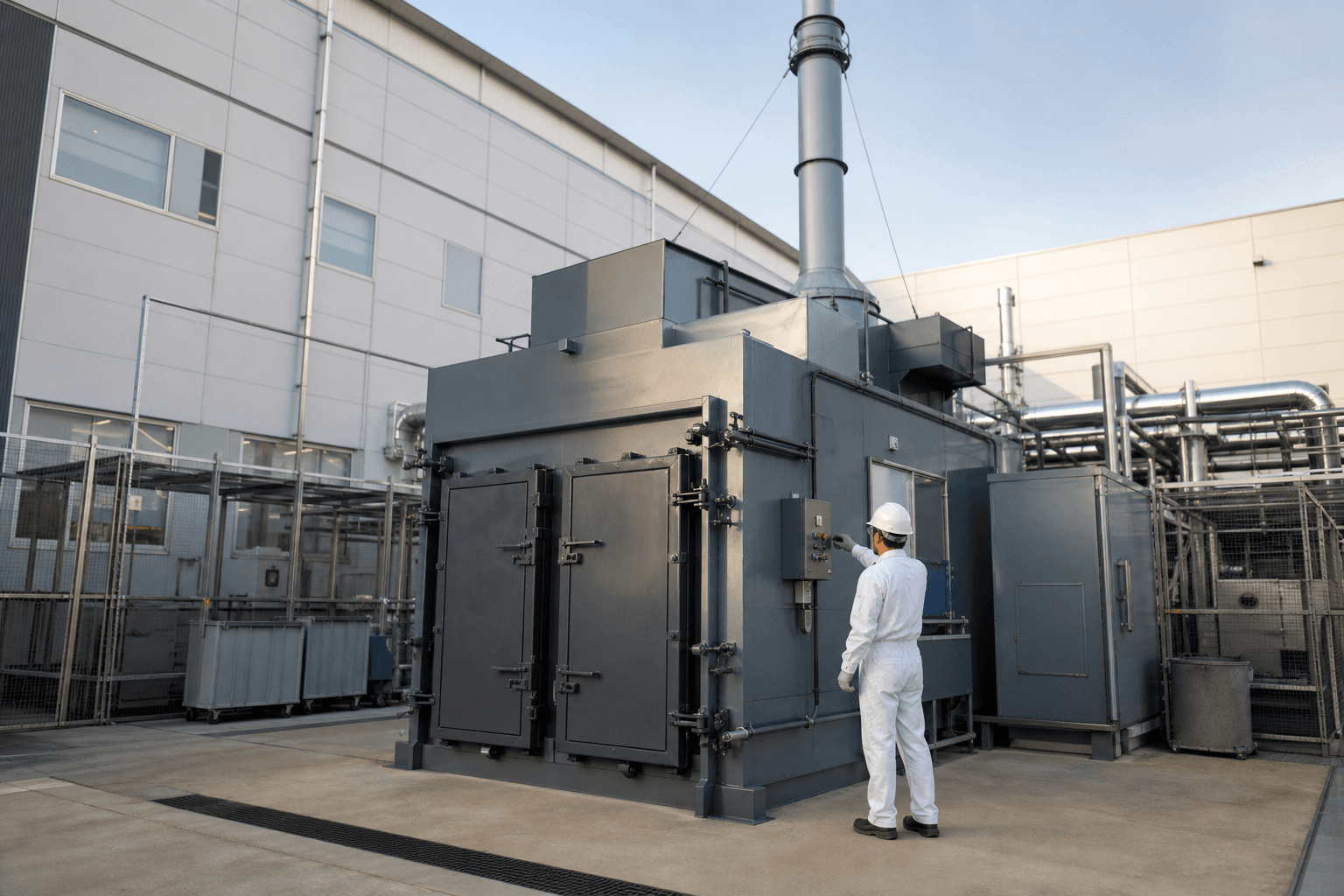
R&D Laboratory Waste Incinerators
Solvent-wetted consumables, chromatography media, disposable labware, expired reagents and test articles.
A development laboratory generates waste that is confidential before it is hazardous. Test articles, failed formulations, chromatography media and solvent-wetted consumables all carry information about a programme as well as chemistry, and the usual answer — a licensed collection and somebody else's certificate — hands both to a third party. A LitBurn ends the sample and the record of it in the same run.
Four Models,
One Solution
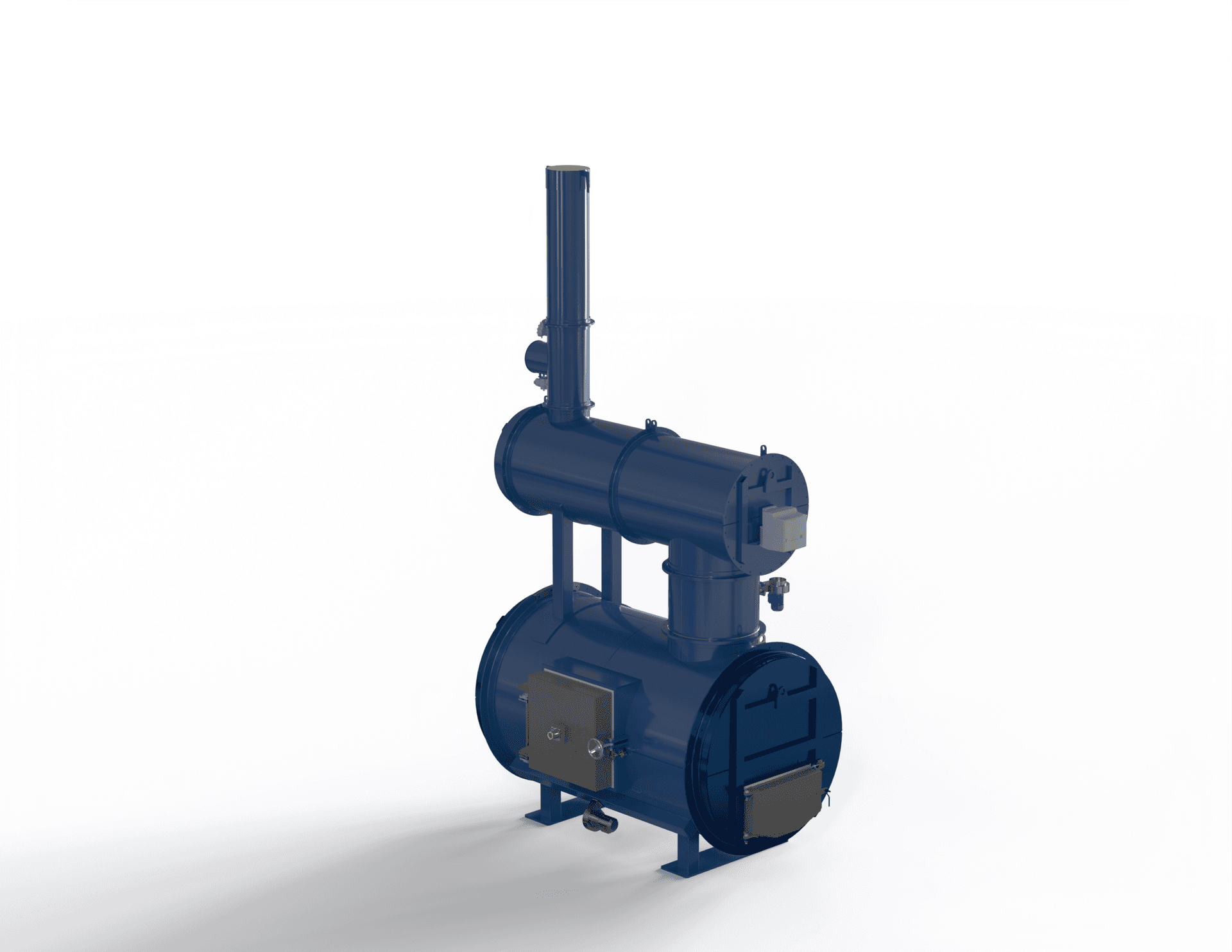
The entry point to the LitBurn range. A 3.3 m³ primary chamber and three burners give continuous 125 kg/h destruction in a footprint that fits a standard yard bay, which makes it the usual choice for a single-site operator replacing skip hire rather than a multi-site waste contract.
The most specified unit in the range. Chamber volume rises to 5.5 m³ for 250 kg/h continuous throughput while the external width grows by only 230 mm over the LBI-125, so sites that outgrow the smallest unit rarely have to rework the slab or the building line.
A 9.6 m³ chamber — nearly double the LBI-250 — for medium-scale industrial waste destruction. At this size most operators pair the unit with heat recovery, because the thermal output during a full shift is large enough to displace a dedicated water heater.
The largest LitBurn: a 16.2 m³ chamber running 500 kg/h continuously. Specified where waste arrives faster than a batch unit can clear it — large manufacturing sites, industrial estates, and operators consolidating several smaller waste contracts onto one machine.
Which Model
Fits Your Volume
Pick a model to see what it clears in a day of r&d laboratory waste.
A development or analytical laboratory: half a shift a week clears 400 kg of consumables, media and test articles without a hazardous collection for the solid fraction.
Laboratory chemical waste codes
Laboratory waste generally falls in the 16 05 06* group for discarded chemicals, with 18 01 03* and 18 01 09 applying where the work is clinical rather than chemical. The permit has to name what the laboratory actually generates, not a generic laboratory entry.
Declare 1,100°C for halogenated residues
Chlorinated solvent residues, fluorinated stationary phases and halogenated candidate molecules push an R&D charge past the 1% halogenated organic threshold. Declaring the 1,100°C secondary condition at application is safer than assessing it charge by charge.
Absorbed in, bulk out
The boundary between this stream and a licensed liquids route is whether the solvent is absorbed on a solid or standing in a container. Write that boundary into the laboratory's own waste procedure — it is the rule that keeps the permit honest.
Confidentiality is not a waste control
Destroying development material on site protects the programme, but it does not exempt the waste from classification. The hazard properties still decide the codes, the segregation and what the permit must name.
Why Burn It
On Site
4 things change on the day this stream stops leaving the site.
The waste is a readable record
Labelled vials, coded test articles, printed chromatograms and batch sheets describe a programme to anyone who reads them. Destroying them on site keeps that record inside the confidentiality boundary it was generated in.
Small volumes, difficult collections
R&D produces modest tonnages of awkward, mixed, hazard-classified material — the profile that attracts the highest per-kilogram collection rates and the longest lead times. On-site destruction inverts that economics.
Sharps and glassware go in closed
Contaminated glass, needles and pipette tips are charged in their sealed containers. The step that causes laboratory injuries at the disposal stage — decanting — does not exist in the cycle.
One route for a mixed stream
Wipes, media, labware, reagents and test articles destroy at the same condition, so the laboratory segregates once at the bench rather than into five contractor streams with five different collection schedules.
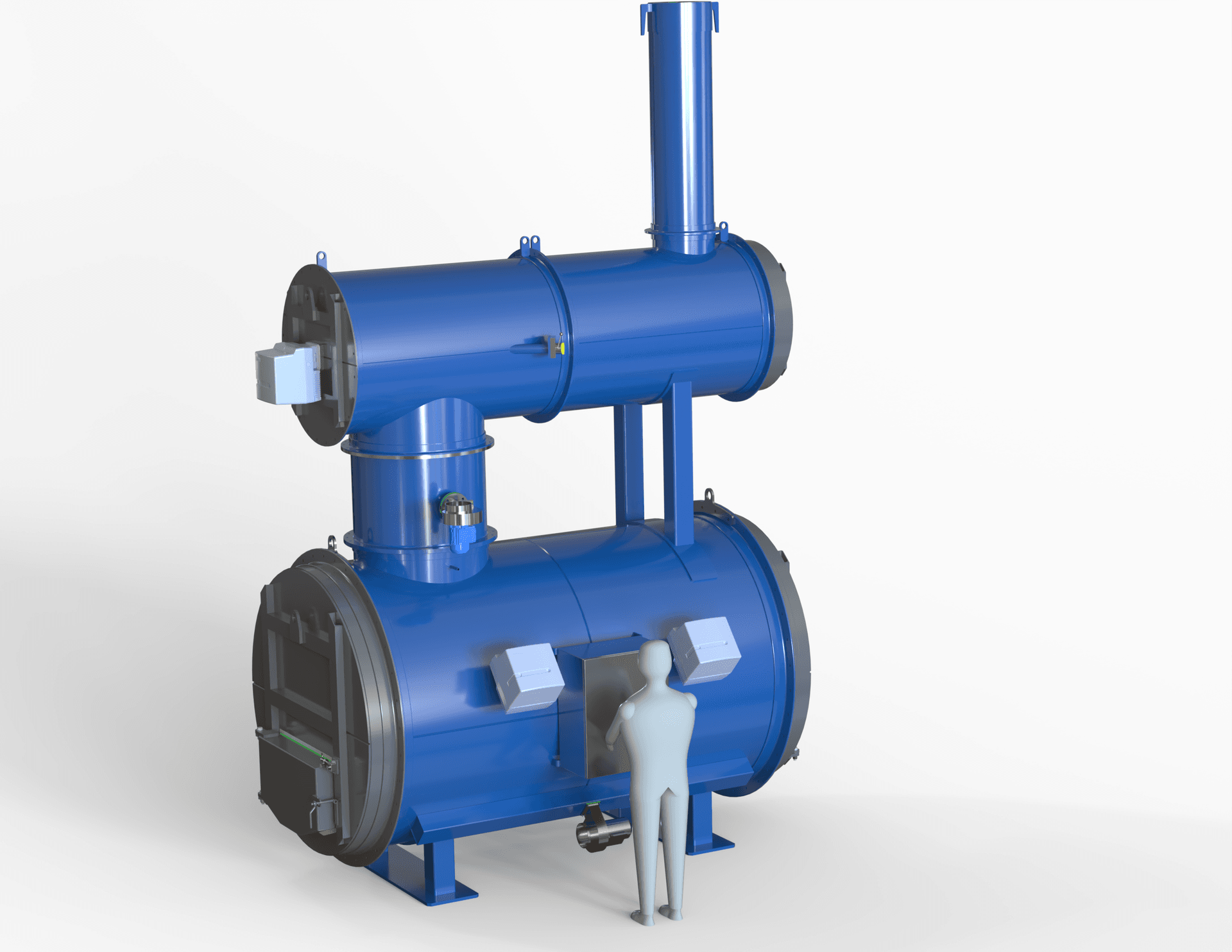
Dual-chamber unit, 1,100°C capable
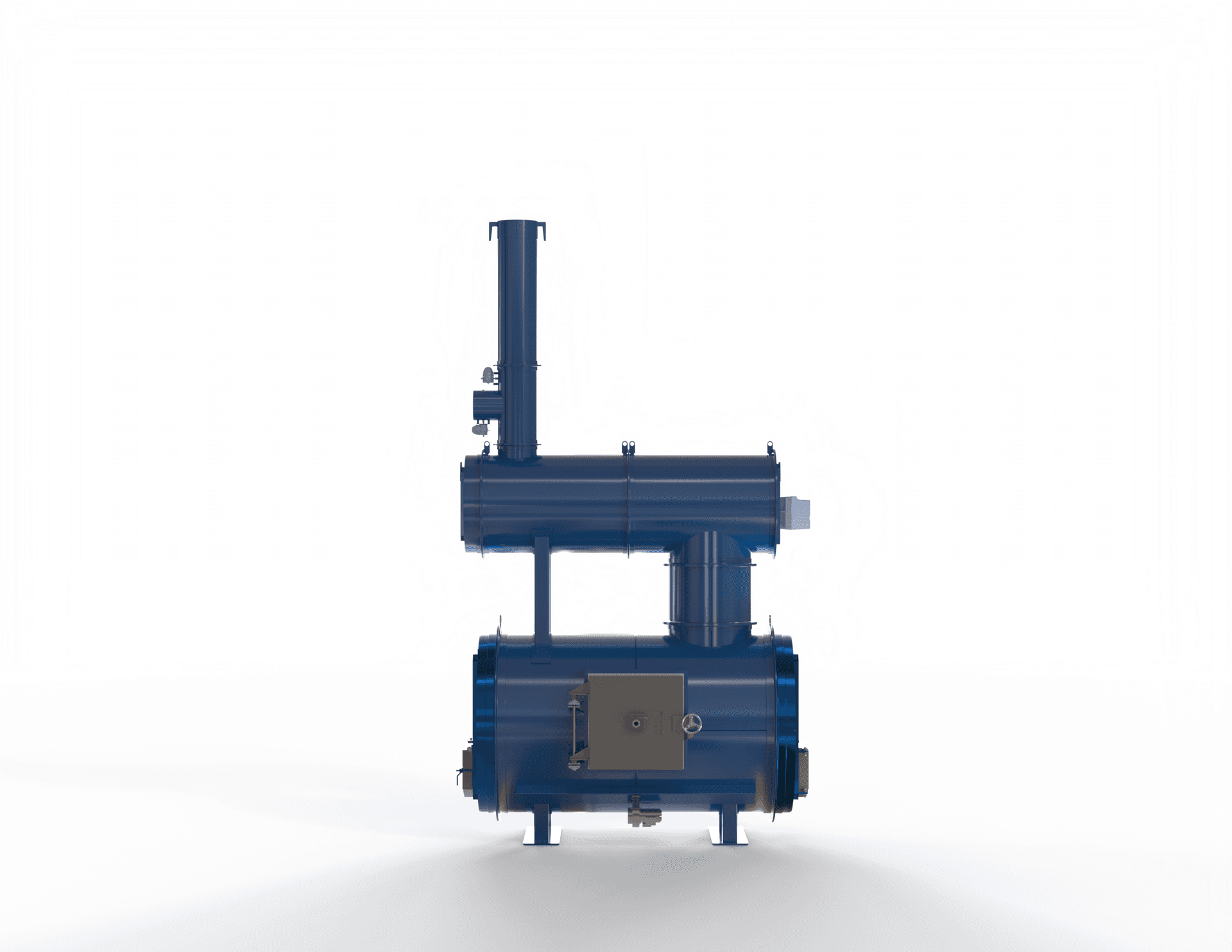
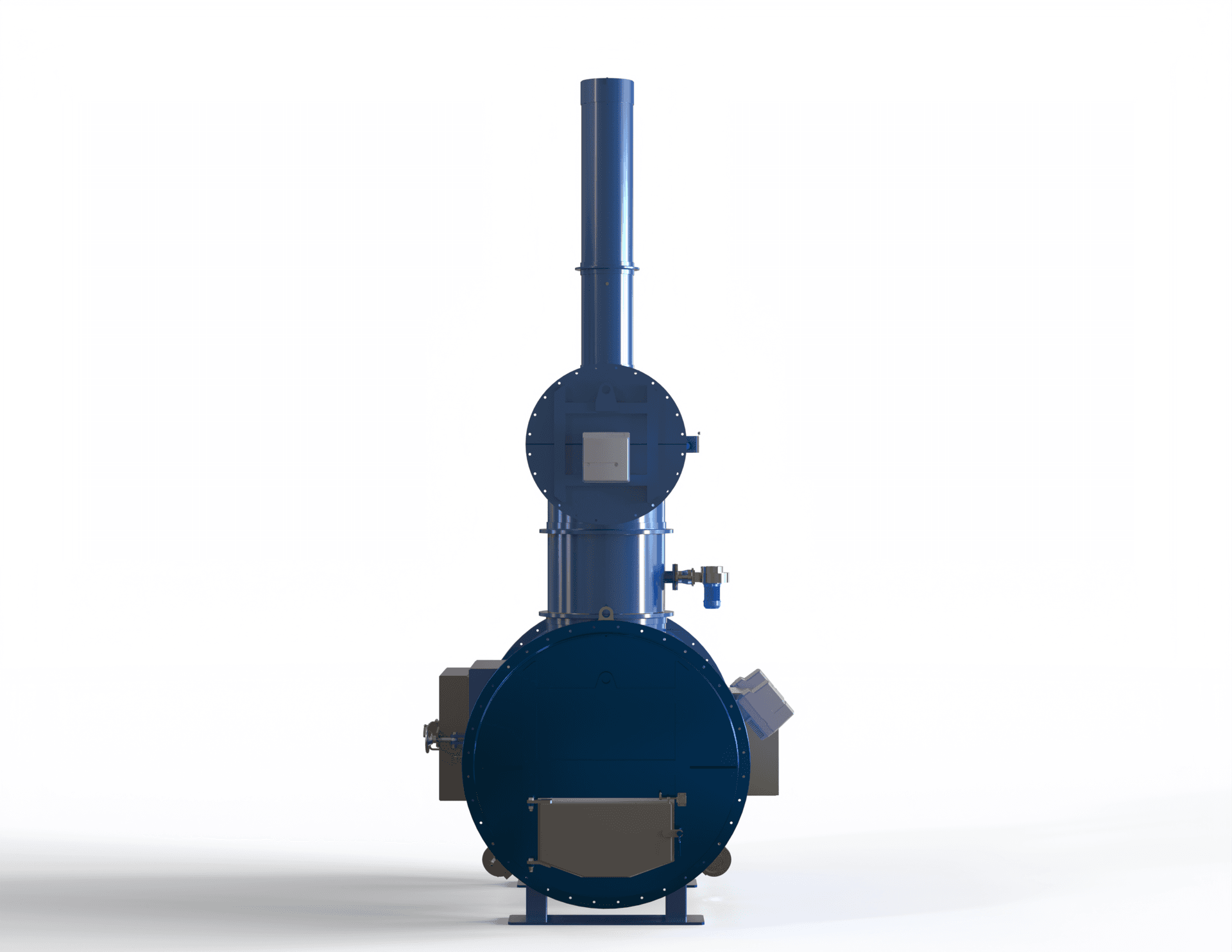
Primary chamber running 850–1,200°C with a secondary chamber holding flue gas above 850°C for two seconds. Where the charge carries more than 1% halogenated organic content — PVC and PVdC blisters, chlorinated actives, fluorinated excipients — the secondary minimum rises to 1,100°C and the unit holds it as built rather than as an upgrade.
Front dual-door loading
The LBI range is charged through a front dual door at floor level, not lifted over a top rim. Quarantine cages, wheeled bins and pallet-decanted totes go in at the height they arrive at, which is what makes a returns hall workable without a hoist.
What Ships
With The Unit
Identical whichever stream it is specified for. The operating procedure changes; the machine does not.
Dual-chamber unit, 1,100°C capable
Primary chamber running 850–1,200°C with a secondary chamber holding flue gas above 850°C for two seconds. Where the charge carries more than 1% halogenated organic content — PVC and PVdC blisters, chlorinated actives, fluorinated excipients — the secondary minimum rises to 1,100°C and the unit holds it as built rather than as an upgrade.
Front dual-door loading
The LBI range is charged through a front dual door at floor level, not lifted over a top rim. Quarantine cages, wheeled bins and pallet-decanted totes go in at the height they arrive at, which is what makes a returns hall workable without a hoist.
IP6X control panel with cycle logging
PLC control with chamber thermocouples, interlocked charge door and a time-stamped temperature record per run. That record is the evidence behind a certificate of destruction — without it a certificate asserts a temperature nobody measured.
Burner set and fuel train
Configured for natural gas, LPG, diesel, biofuel or hydrogen, with three burners across the LBI range. Fuel choice is a site decision; the combustion condition is identical whichever is specified.
Coretex refractory lining
Monolithic castable lining rated for the full temperature range and for sustained running at the top of it. Replaceable in service rather than requiring the shell to be scrapped with it — relevant on a unit that may run shifts rather than single burns.
Stack, dispersion data and commissioning
Stack supplied to the height your site-specific dispersion assessment calls for, with the emissions data pack the permit application references, on-site commissioning, a witnessed first run and operator training for the staff who will hold the charge-door key.
How One Burn Runs,
Start To Finish
One run is one countable event, reconciled against a manifest and evidenced by a time-stamped temperature log.
One Cycle,
Start To Finish
Adds laboratory segregation at source and a declared solvent-wetting limit: absorbed residues are in scope, bulk liquid is not. Sharps and contaminated glassware are charged in their containers, closed.
Solid and absorbed-liquid waste is separated from bulk liquid at the point of generation. The incinerator changes the endpoint, not the segregation discipline that decides what may reach it.
Sharps bins, glassware boxes and sealed waste containers are charged unopened through the front dual door. Nothing is emptied at the disposal stage.
R&D charges are assumed halogenated: with chlorinated solvent residues and fluorinated phases in the mix, the secondary condition is declared at 1,100°C rather than the 850°C baseline.
The primary chamber destroys media, labware, wipes and test articles at 850–1,200°C; the secondary holds the declared retention condition so the organic fraction — candidate molecules included — is destroyed rather than volatilised.
Residue is 3–5% mineral ash plus the inert glass and metal fraction. The run is logged against the laboratory waste record, and the ash leaves under an ordinary transfer note where the charge carried no hazardous classification.
What You Can Burn —
And What You Can't
One run takes the whole stream without pre-sorting. What must never enter it is a short, hard list.
Yes: accepted in a run
No pre-sorting between these
- Solvent-wetted wipes, swabs and bench matsAbsorbed residues from cleaning, spill response and sample handling. Absorbed is the operative word — the liquid is held on a solid, not standing in a container.
- Spent chromatography media and columnsSilica, resin and packed columns carrying analyte and mobile-phase residue, where recovery is not economic and the residue is exactly what makes it confidential.
- Disposable labware and consumablesPipette tips, plates, tubes, gels, membranes, gloves and disposable PPE from the bench, charged as collected rather than sorted by substrate.
- Contaminated glassware and sharps, charged closedVials, ampoules, needles and broken glass in their sealed containers. Glass reports to the ash as inert residue; nobody handles the contents at the disposal stage.
- Expired reagents and standards in small containersDate-lapsed reagents, reference standards and prepared solutions in laboratory-scale containers, within the container sizes agreed at specification.
- Test articles, failed formulations and coded samplesDevelopment material that never became a product, together with the labels, chromatograms and batch sheets that describe it.
No: never charged
Not a permit question — these stay out
- Bulk liquid solventA Winchester of dichloromethane is not an absorbed residue. Bulk liquids go to a licensed hazardous liquids route; a controlled-air chamber of this class is not a liquid injection plant.
- Compressed gas cylinders and lecture bottlesSealed vessels under heat, including the small cylinders that accumulate behind a GC bench. Back through the gas supplier, always.
- Radioactive and radiolabelled materialA separate regulatory regime entirely, with its own authorisation and its own disposal route. No permit wording brings it into a waste incinerator's scope.
- Lithium batteries, instruments and electronicsData loggers, powered instruments and battery packs cause thermal runaway and contaminate the ash. WEEE route, and the data on them destroyed separately.
Can you legally burn r&d laboratory waste on site?
Technically, yes: the chamber destroys almost everything on the accepted list at 850–1,200°C, and capability is rarely the constraint. Legally is a separate question. What your site is allowed to burn is set by your environmental permit from the Environment Agency, SEPA or NIEA and the waste codes written into it. The never-charged list is different again: those materials are out of scope for the unit or governed by a direction, and no permit wording brings them back in. Send us the codes you hold, or the ones you expect to apply for, and we will tell you which of this list they cover before anything is specified.
Send us your waste codesWhat size incinerator for a laboratory producing 400 kg a week?
Arithmetic on published model figures, not a customer reference. Your numbers go through the same steps.
How This
Was Worked Out
400 kg of laboratory waste a week against the LBI-125's 125 kg/h = about 3.2 hours of running, or half a shift a week, leaving 12–20 kg of ash and removing the hazardous collection for everything except bulk liquid solvent. Laboratory charges rarely fill a chamber. Specify on how long waste would otherwise accumulate in the store between runs, not on getting close to the rated throughput.
12–20 kg a week
1,100°C — halogenated residues
0 for the solid fraction
None — bins charged closed
Send your daily or weekly arisings and we will confirm the model, the run time and the permit route.
Related Products
& Services
Complementary equipment and engineering services for your process.
Sizing and background
- [TOOL]Work out the burn rate for your own arisings
- [TOOL]Size the combustion air and flue gas duty
- [BLOG]Integrating vibration analysis for incinerator predictive maintenance
- [BLOG]Advanced gas cleaning for ultra-low emission incinerators
- [BLOG]Evaluating flue gas cleaning systems in industrial incinerators
R&D laboratory waste Questions
Answered against the published figures for the models specified for this stream, not a generic range sheet.
A laboratory waste incinerator is a dual-chamber unit used to destroy the solid and absorbed-liquid waste streams of a development or analytical laboratory on the site that generated them. In pharmaceutical R&D that means solvent-wetted wipes and swabs, spent chromatography media and columns, disposable labware, pipette tips, gel plates, expired reagents in small containers, and the test articles and failed formulations that never became a product. The stream splits on one line: absorbed versus bulk. Solvent absorbed onto a wipe, a column packing or a bench mat is a solid waste and belongs in a charge. Bulk liquid solvent in a Winchester is not — a controlled-air chamber of this class is not a liquid injection plant, and that route stays with a licensed hazardous liquids contractor whatever else changes. Confidentiality is the driver that is usually left unstated. A development laboratory's waste is a readable record of what was tried: labelled vials, batch sheets, printed chromatograms, coded test articles. Consigning it to a contractor moves that record off site under a certificate, which is a weaker control than destroying it under supervision by staff already inside the programme's confidentiality boundary. The combustion condition is the standard one — 850–1,200°C with two-second secondary retention above 850°C — rising to 1,100°C where the charge carries more than 1% halogenated organic content. Laboratory streams hit that threshold easily: dichloromethane and chloroform residues on wipes, fluorinated stationary phases and halogenated candidate molecules all count, so the higher condition is the sensible declaration for an R&D charge.
400 kg of laboratory waste a week against the LBI-125's 125 kg/h = about 3.2 hours of running, or half a shift a week, leaving 12–20 kg of ash and removing the hazardous collection for everything except bulk liquid solvent. Laboratory charges rarely fill a chamber. Specify on how long waste would otherwise accumulate in the store between runs, not on getting close to the rated throughput.
Absorbed solvent, yes — wipes, swabs, bench mats and packed media carrying residue are solid wastes and belong in a charge. Bulk liquid solvent, no. A controlled-air chamber of this class is not a liquid injection plant, and Winchesters and drums of solvent stay with a licensed hazardous liquids contractor.
Completely. At 850–1,200°C with the declared secondary retention, labelled vials, coded test articles, printed chromatograms and batch sheets all leave as mineral ash with no recoverable structure. That is a stronger control than a certificate for material somebody else took away.
Usually assume so. Chlorinated solvent residues, fluorinated stationary phases and halogenated candidate molecules all count towards the 1% halogenated organic threshold, and an R&D charge is mixed by nature. Declaring 1,100°C at application avoids assessing every charge against a line you cannot measure at the bench.
Yes, charged closed in their containers. Nobody opens a sharps bin or a glassware box at the disposal stage, so the handling step that causes laboratory injuries is removed rather than made safer. Glass and metal report to the ash as inert fraction.
Out of scope, and no permit wording brings them in. Radioactive material sits under a separate regulatory regime with its own authorisation and disposal route, and it has to be segregated at the bench rather than filtered out at the charge door.
The LBI-125 covers most single-site laboratories — 400 kg a week is about half a shift of running. The sizing question is how long waste would otherwise sit in the store between runs rather than how close a run gets to the rated throughput, because laboratory charges rarely fill a chamber.
Ready to
Incinerate?
Send the stream, the volume and the site constraints. We will confirm the model, the permit route, and what the specification has to say to satisfy the regulator.
- The waste is a readable record
- Small volumes, difficult collections
- Sharps and glassware go in closed
- One route for a mixed stream