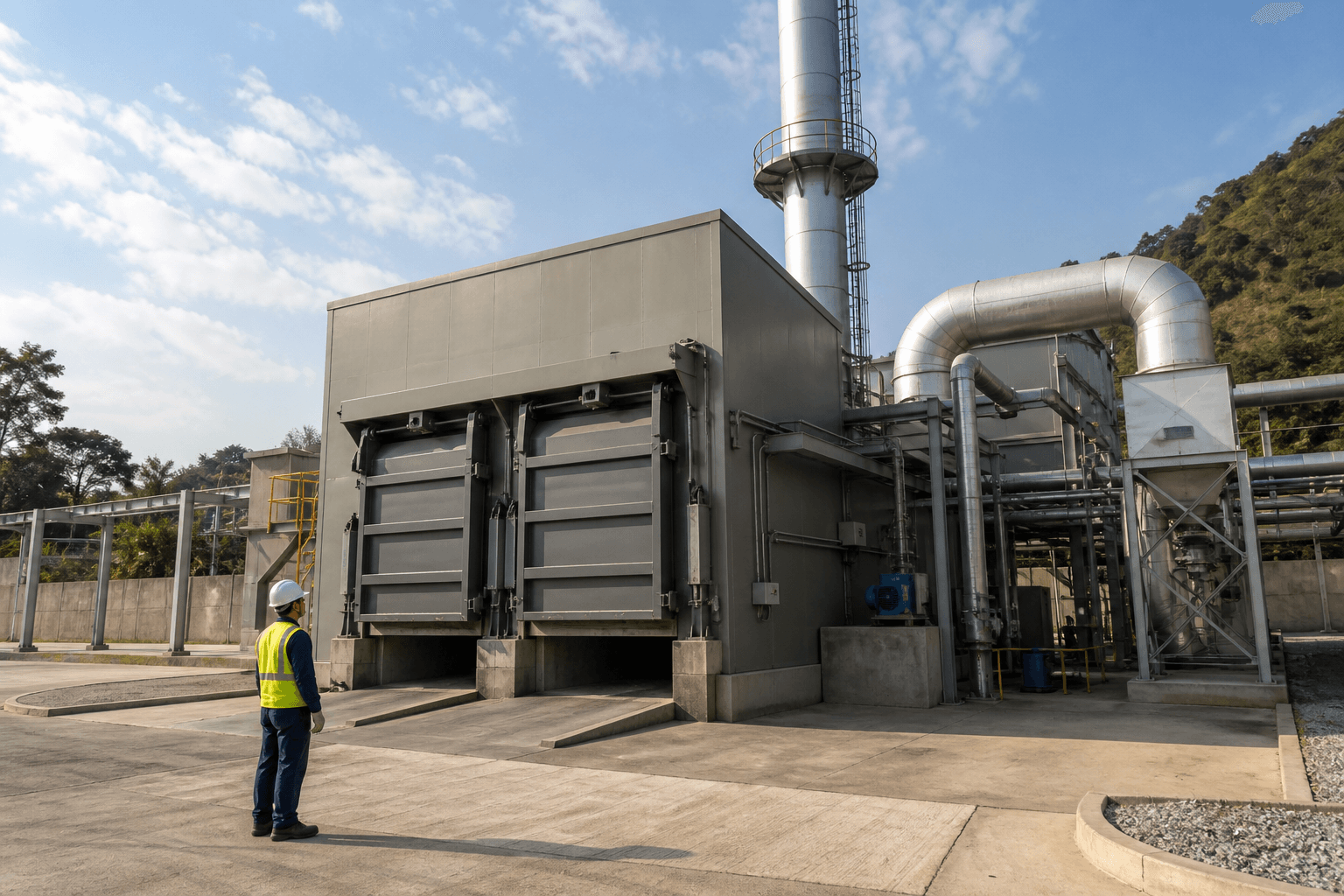
Water Treatment Waste Incinerators
Inlet screenings, rag and spent filter media from water and wastewater treatment. Sludge goes elsewhere.
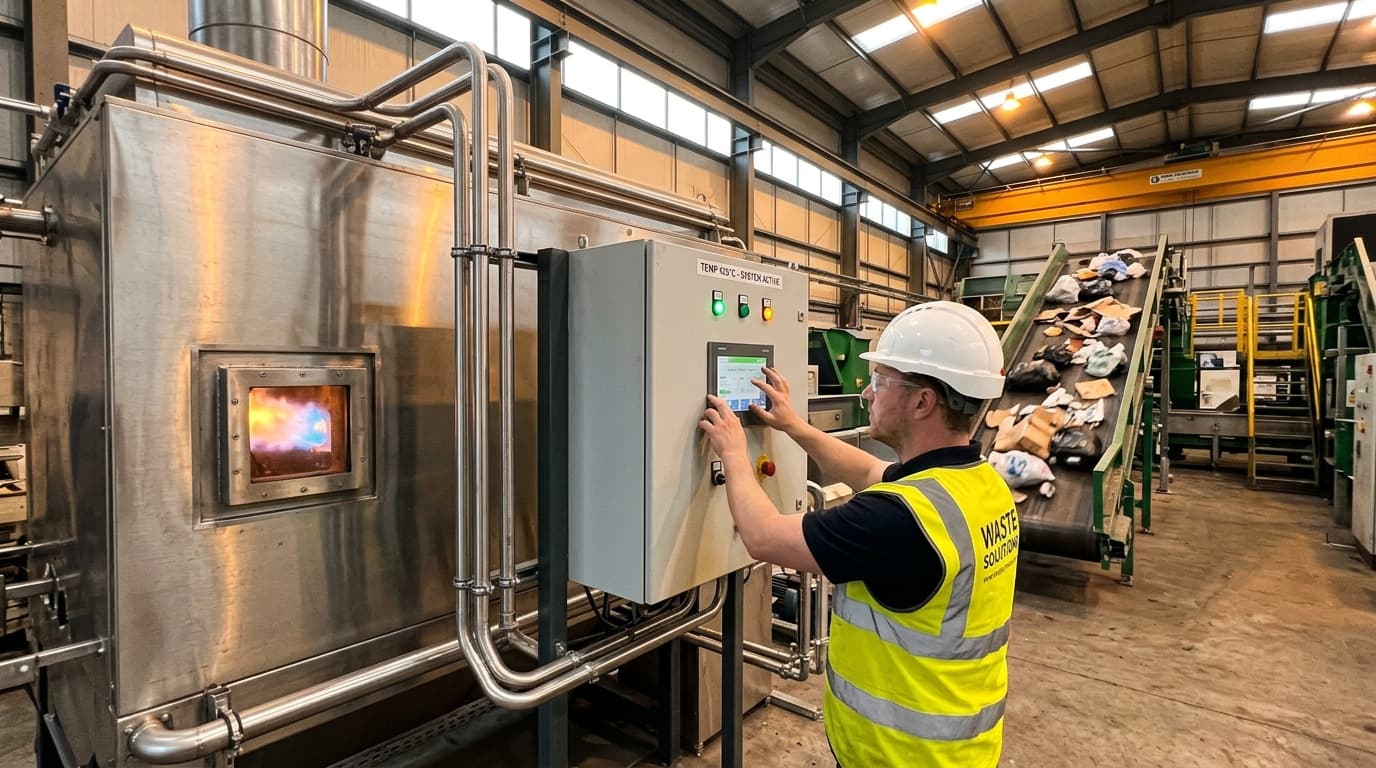
An inlet screen catches everything the sewer network was never meant to carry: wipes, rag, sanitary items and plastics. It arrives every day, it is offensive, it is 80% water, and it is the one residue at a treatment works with no recovery route at all.
Four Models,
One Solution
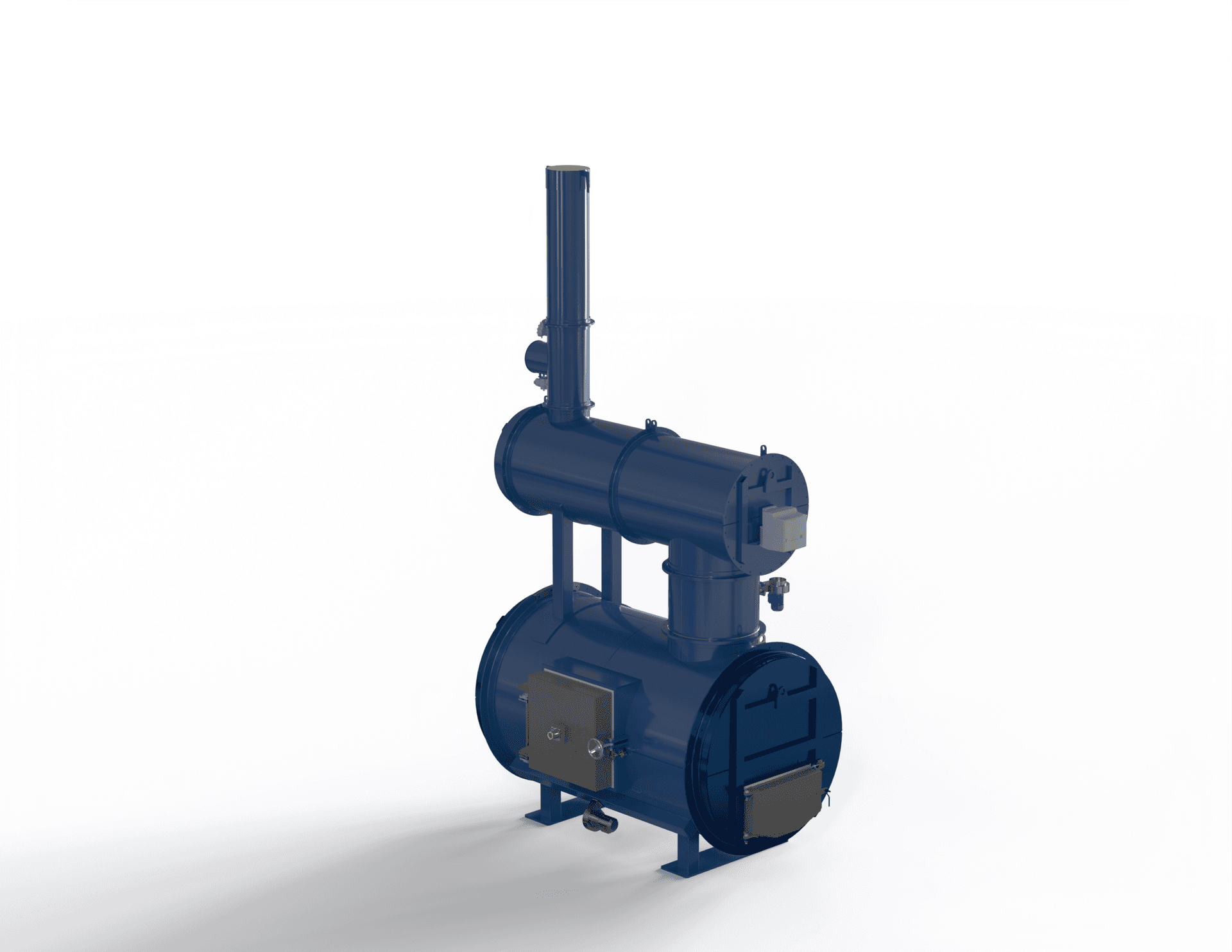
The entry point to the LitBurn range. A 3.3 m³ primary chamber and three burners give continuous 125 kg/h destruction in a footprint that fits a standard yard bay, which makes it the usual choice for a single-site operator replacing skip hire rather than a multi-site waste contract.
The most specified unit in the range. Chamber volume rises to 5.5 m³ for 250 kg/h continuous throughput while the external width grows by only 230 mm over the LBI-125, so sites that outgrow the smallest unit rarely have to rework the slab or the building line.
A 9.6 m³ chamber — nearly double the LBI-250 — for medium-scale industrial waste destruction. At this size most operators pair the unit with heat recovery, because the thermal output during a full shift is large enough to displace a dedicated water heater.
The largest LitBurn: a 16.2 m³ chamber running 500 kg/h continuously. Specified where waste arrives faster than a batch unit can clear it — large manufacturing sites, industrial estates, and operators consolidating several smaller waste contracts onto one machine.
Which Model
Fits Your Volume
Pick a model to see what it clears in a day of water treatment residues.
A small works or pumping station group clearing a tonne a week of pressed screenings.
19 08 codes on the permit
Wastewater treatment residues code in the 19 08 group — screenings, grit and media each with their own line. Name the ones the works actually produces and burns.
Sludge keeps its own regime
Sewage sludge recovery is governed separately and ranks above disposal. Nothing about having a unit on site changes where sludge goes, and a permit for screenings does not reach it.
Dewatering is a precondition
Undewatered screenings are mostly water. Charging them wastes fuel and capacity, and the permit's assumptions about throughput are made on a dewatered feed.
Odour and dispersion get scrutinised
Treatment works already attract odour complaints, so a dispersion assessment for a unit on that site will be looked at carefully. Expect it to be the long pole in the consent.
Why Burn It
On Site
4 things change on the day this stream stops leaving the site.
Screenings have no recovery route
Unlike sludge, unlike grit, unlike almost everything else at a works, screenings go to disposal. That makes them the fraction where destruction is genuinely the top of the available hierarchy.
Storage is an odour complaint waiting to happen
Screenings held between collections are the commonest source of odour complaints at a treatment works, and complaints are the thing that draws regulatory attention to a site.
Works are often remote
Treatment works sit away from population by design, which puts them at the end of the same long collection routes as any other remote site.
Volumes are steady and predictable
Unlike every other stream in this sector, this one arrives at the same rate every day. That makes it the easiest environmental stream to size a unit around.
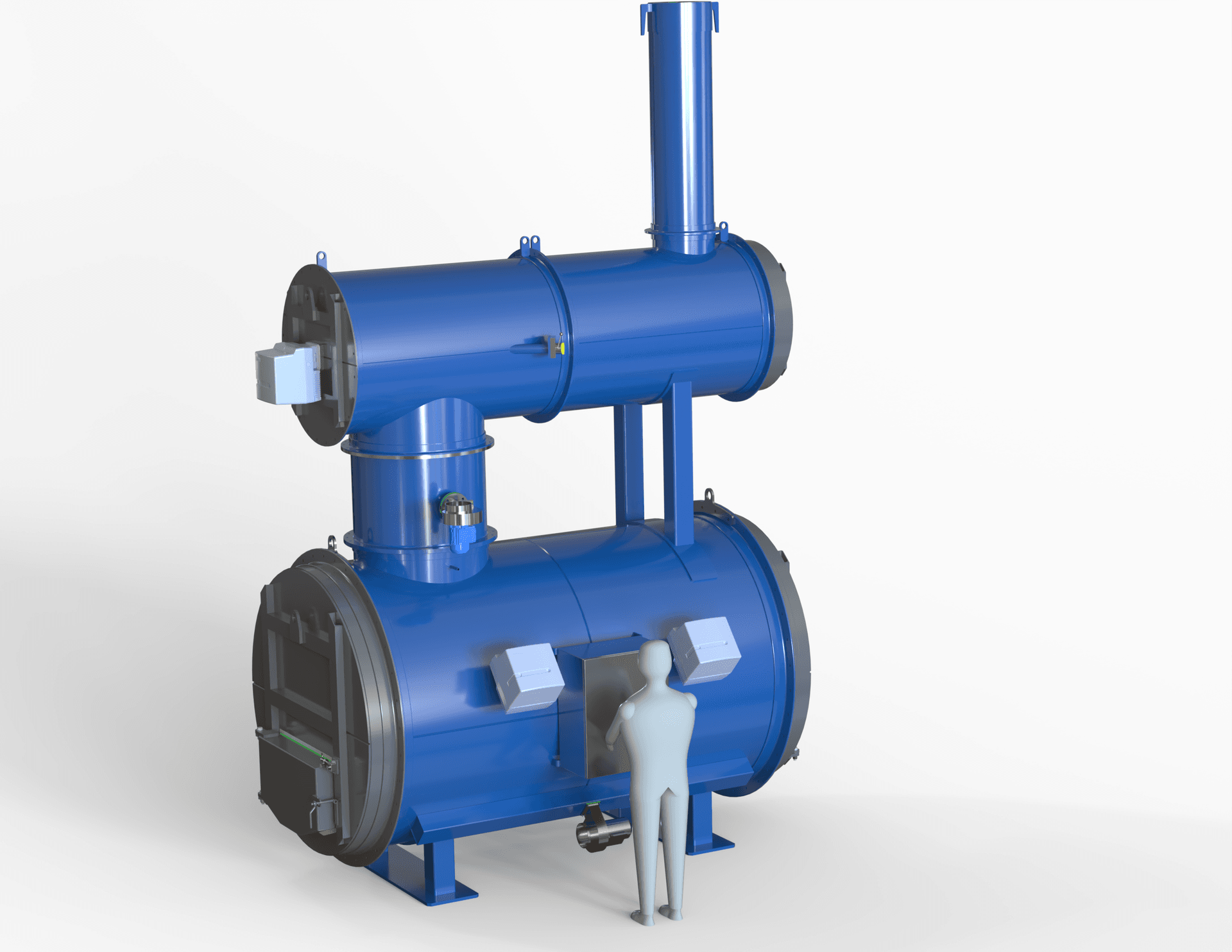
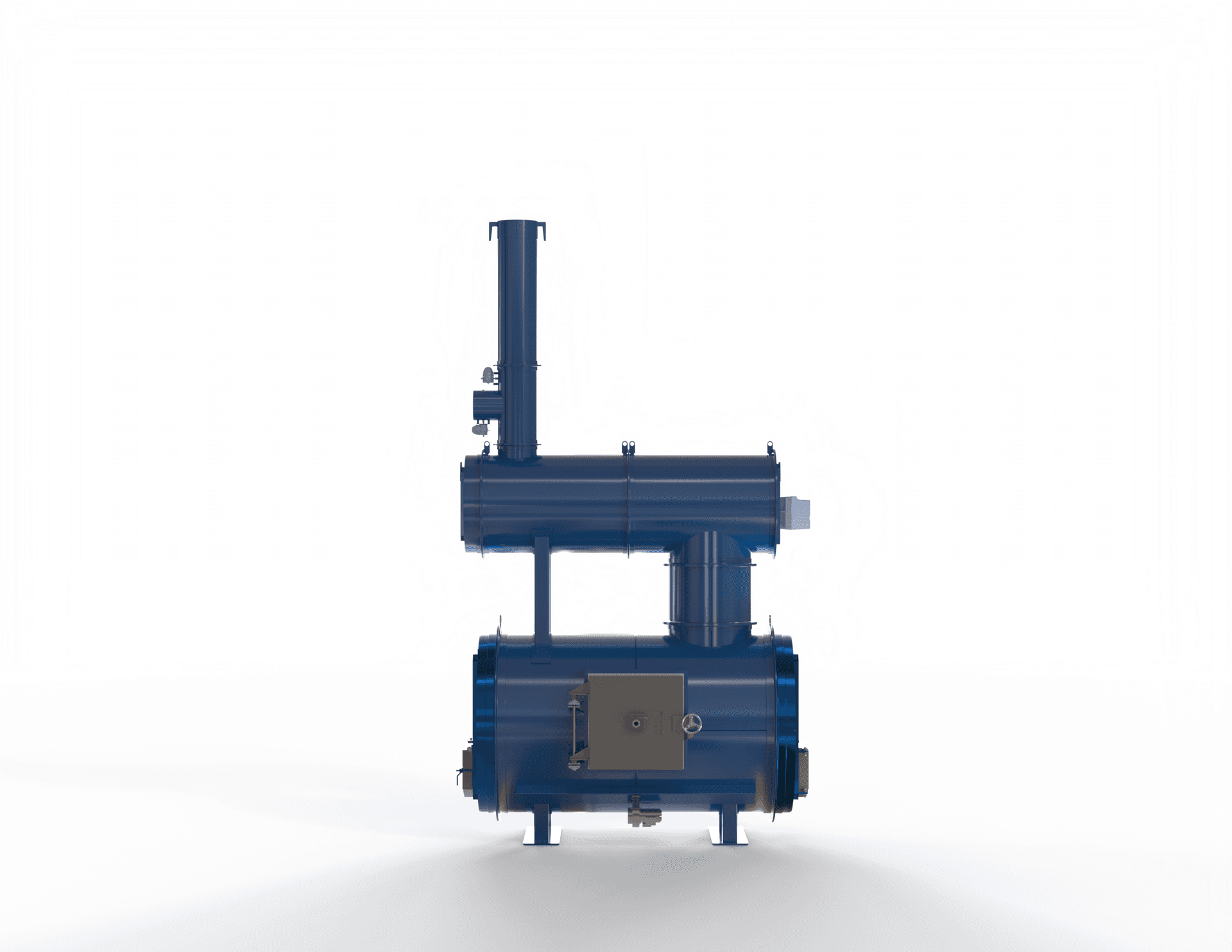
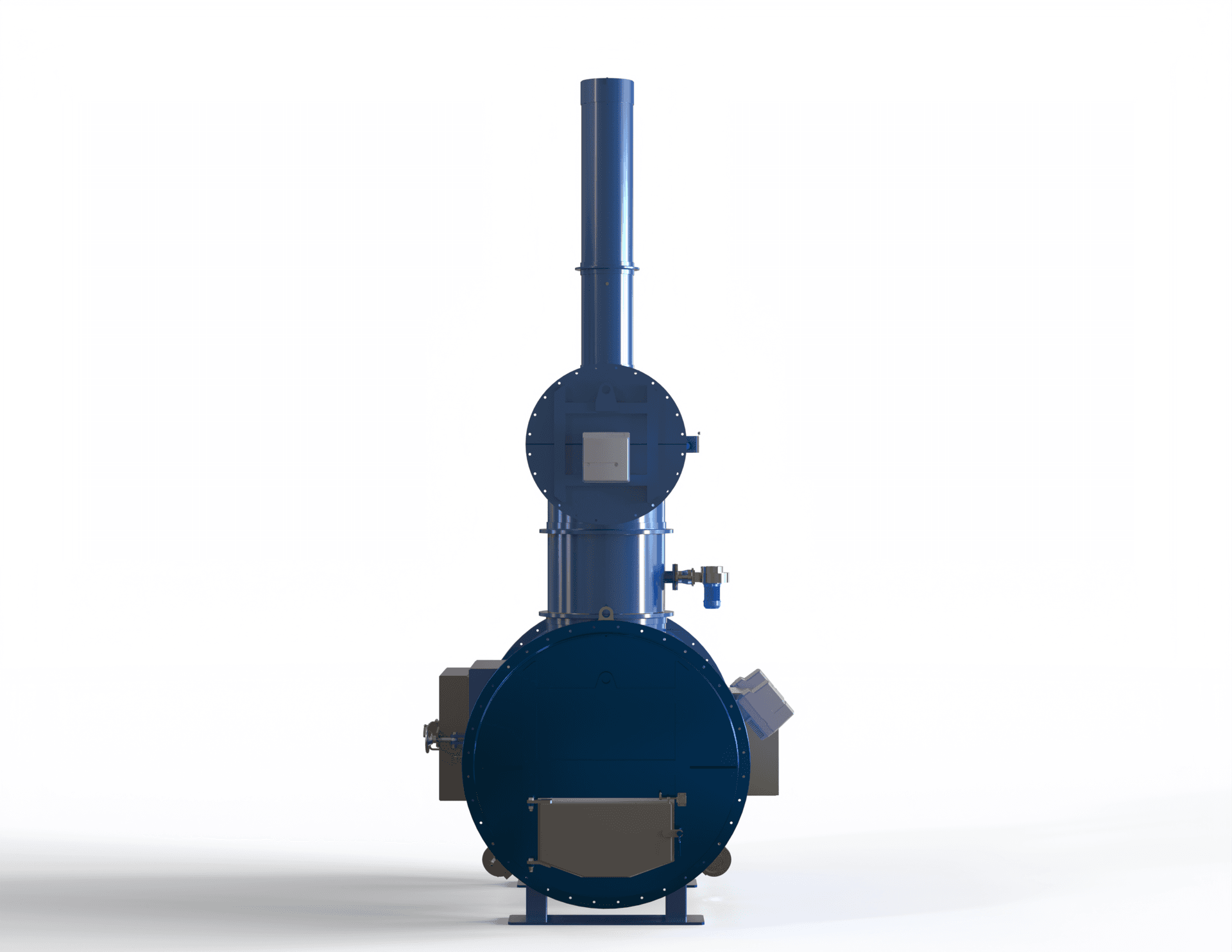
Dual-chamber unit, 1,100°C capable
Primary chamber running 850–1,200°C with a secondary holding flue gas above 850°C for two seconds. Environmental waste is the stream most likely to carry halogenated content — chlorinated solvents in contaminated arisings, salt-laden marine debris, POPs-bearing material — so the 1,100°C condition is stated here rather than treated as an exception.
Front dual-door loading
Charged through a front dual door at floor level, so bulk bags, tote bins and wheeled skips go in at the height a site telehandler already works at. Clearance waste arrives in whatever it was collected in, and it is not decanted.
What Ships
With The Unit
Identical whichever stream it is specified for. The operating procedure changes; the machine does not.
Dual-chamber unit, 1,100°C capable
Primary chamber running 850–1,200°C with a secondary holding flue gas above 850°C for two seconds. Environmental waste is the stream most likely to carry halogenated content — chlorinated solvents in contaminated arisings, salt-laden marine debris, POPs-bearing material — so the 1,100°C condition is stated here rather than treated as an exception.
Front dual-door loading
Charged through a front dual door at floor level, so bulk bags, tote bins and wheeled skips go in at the height a site telehandler already works at. Clearance waste arrives in whatever it was collected in, and it is not decanted.
IP6X control panel with cycle logging
PLC control with chamber thermocouples, interlocked charge door and a time-stamped temperature record per run. For hazardous waste produced and destroyed on one site, that log is the evidence behind a consignment record nobody drove anywhere.
Burner set and fuel train
Configured for natural gas, LPG, diesel, biofuel or hydrogen. This stream runs wet and dirty — flood silt, harbour arisings, screenings — so burner support does more work here than on a dry industrial charge.
Coretex refractory lining
Monolithic castable lining rated for the full range and replaceable in service. Environmental loads swing from saturated to solvent-bearing between one bag and the next, and the lining is specified for that cycling rather than for a steady feed.
Stack, dispersion data and commissioning
Stack to the height your site-specific dispersion assessment calls for, the emissions data pack the permit application references, on-site commissioning, a witnessed first run and operator training. Hazardous scope means a bespoke permit rather than standard rules, and the assessment is the long pole.
How One Burn Runs,
Start To Finish
One run is one countable event, reconciled against a manifest and evidenced by a time-stamped temperature log.
One Cycle,
Start To Finish
Adds the 19 08 treatment codes to the permit, and states the boundary immediately: sludge is not a charge. Screenings and media are, drained and dewatered.
Screenings are washed and pressed as part of normal works operation. That step is what makes them chargeable rather than a wet mass — it belongs to the process, not to the incinerator.
Sludge goes to digestion or its own recovery route. The separation is unambiguous and it is what keeps this stream defensible.
Pressed screenings and drained media are fed steadily through the front dual door. Anything still releasing liquid goes back to the press rather than to the chamber.
Two-second secondary retention above 850°C. Plastics in the screenings can push a charge past 1% halogenated organic content, so the higher condition is worth declaring.
Residue carries grit and mineral content above the 3–5% figure. The run log feeds the site's waste returns directly.
What You Can Burn —
And What You Can't
One run takes the whole stream without pre-sorting. What must never enter it is a short, hard list.
Yes: accepted in a run
No pre-sorting between these
- Inlet and fine screeningsWipes, rag, sanitary products, plastics and debris removed at the works inlet, washed and pressed before charging.
- Spent filter media and cartridgesDepth filters, cartridges and media at end of life, drained and with no free liquid remaining.
- Drained screen washings solidsThe solid fraction recovered from washing and pressing, dewatered to a chargeable condition.
- Contaminated works consumables and PPEGloves, coveralls, sheeting and consumables contaminated in normal works operation.
- Debris from network and pumping stationsRag and debris recovered from pumping stations, wet wells and network maintenance, drained before charging.
- Contaminated absorbents from works spillsSorbents used on chemical or fuel spills within the works, subject to the free-liquid rule.
No: never charged
Not a permit question — these stay out
- Sewage sludge and biosolidsIt has recovery routes — digestion and recycling to land — that rank above disposal, and it is mostly water. This is not the machine for it.
- Grit and inert screenings fractionsMineral, does not burn, and fills the chamber while adding to the ash. It goes to an inert route.
- Liquid chemicals and dosing residuesTreatment chemicals in liquid form are a licensed liquids question, not a solid charge.
- Undewatered screeningsStraight off the screen they are mostly water: they burn badly, slow the unit and achieve nothing. They go back to the press first.
Can you legally burn water treatment residues on site?
Technically, yes: the chamber destroys almost everything on the accepted list at 850–1,200°C, and capability is rarely the constraint. Legally is a separate question. What your site is allowed to burn is set by your environmental permit from the Environment Agency, SEPA or NIEA and the waste codes written into it. The never-charged list is different again: those materials are out of scope for the unit or governed by a direction, and no permit wording brings them back in. Send us the codes you hold, or the ones you expect to apply for, and we will tell you which of this list they cover before anything is specified.
Send us your waste codesWhat does a works producing 3 tonnes of screenings a week need?
Arithmetic on published model figures, not a customer reference. Your numbers go through the same steps.
How This
Was Worked Out
3,000 kg of pressed screenings a week against the LBI-250's 250 kg/h = about 12 hours, or a shift and a half, with sludge going to digestion as it always did. That figure is dewatered weight. Screenings straight off the screen can be several times heavier for the same solids, and sizing on wet tonnage is how sites end up with a machine that never keeps up.
None
Above 3–5%
5.5 m³
2.9 t
Send your daily or weekly arisings and we will confirm the model, the run time and the permit route.
Related Products
& Services
Complementary equipment and engineering services for your process.


Sizing and background
- [TOOL]Work out the burn rate for your own arisings
- [TOOL]Size the combustion air and flue gas duty
- [BLOG]Ash management from industrial waste incinerators
- [BLOG]Integrating vibration analysis for incinerator predictive maintenance
- [BLOG]Advanced gas cleaning for ultra-low emission incinerators
- [BLOG]Evaluating flue gas cleaning systems in industrial incinerators
Water treatment residues Questions
Answered against the published figures for the models specified for this stream, not a generic range sheet.
Water and wastewater treatment residues are the solid fractions a works removes from the flow: inlet and fine screenings — wipes, rag, sanitary products, plastics and debris — spent filter media and cartridges, contaminated consumables, and the drained fraction of grit and screen washings. They code in the 19 08 group. Sewage sludge is deliberately not on that list. It has established recovery routes — anaerobic digestion, and recycling to land under its own regime — that rank above disposal and are what the industry is built around. A chamber is not the answer to a stream that has a working recovery route and is mostly water. Screenings are a different case entirely. They are non-recyclable by nature, offensive to handle and store, and they have grown as a problem in direct proportion to the volume of wet wipes entering the network. Nothing about them improves in a skip waiting for a collection. The practical constraint is moisture. Screenings come off the press at high water content and burn well below the plate rating until they have been dewatered properly. Sizing this stream on wet tonnage rather than dewatered tonnage is the commonest way to specify the wrong machine.
3,000 kg of pressed screenings a week against the LBI-250's 250 kg/h = about 12 hours, or a shift and a half, with sludge going to digestion as it always did. That figure is dewatered weight. Screenings straight off the screen can be several times heavier for the same solids, and sizing on wet tonnage is how sites end up with a machine that never keeps up.
No, and it should not be. Sludge has established recovery routes — anaerobic digestion and recycling to land — that rank above disposal, and it is mostly water besides. This unit is for screenings and media, which have no recovery route at all.
Because nothing else will take them. They are non-recyclable by composition, offensive to store, and they have grown steadily as wet wipes have entered the network. They are the one residue at a works where disposal is genuinely the top of the available hierarchy.
Pressed to the point where no free liquid remains, which is what a normal screenings press achieves. Wetter than that and they burn below the rating, waste fuel and cost you capacity — the press is part of the operation, not an optional upstream nicety.
The dispersion assessment will get close attention, because works already attract odour complaints and sit under scrutiny for it. That is the long item in the programme. The waste codes themselves are straightforward.
It removes the stored-screenings source, which is usually the strongest one on a works. What it introduces is a combustion source with its own dispersion assessment. On most sites that trade is favourable, but it should be argued with the assessment rather than asserted.
Yes — consolidating screenings from satellite sites onto a hub is a common shape, and the steady daily volume makes it easy to size. Movements between works are still carriage of waste with the documentation that implies.
Ready to
Incinerate?
Send the stream, the volume and the site constraints. We will confirm the model, the permit route, and what the specification has to say to satisfy the regulator.
- Screenings have no recovery route
- Storage is an odour complaint waiting to happen
- Works are often remote
- Volumes are steady and predictable