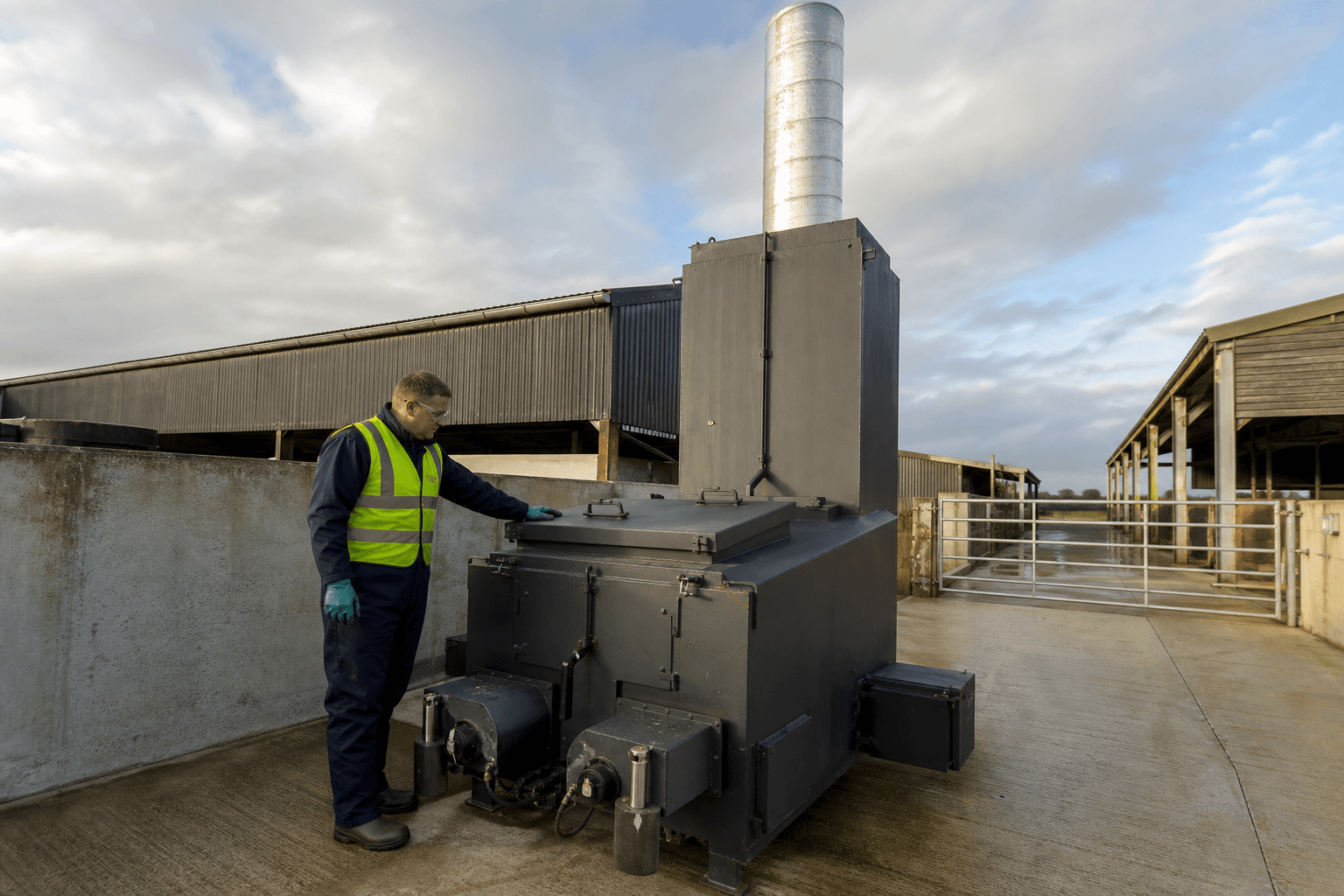
Pig Incinerators
Piglet losses and fallen pigs destroyed on the unit — no collection point, no vehicle that has been at another pig site.
Pre-weaning mortality means a farrowing unit produces piglet losses every single day, and pig biosecurity is currently the tightest in UK livestock because of African swine fever. AniBurn units destroy fallen pigs on the unit, so nothing waits at a collection point and no vehicle that has been at another pig site comes through the gate.
Three Models,
One Solution
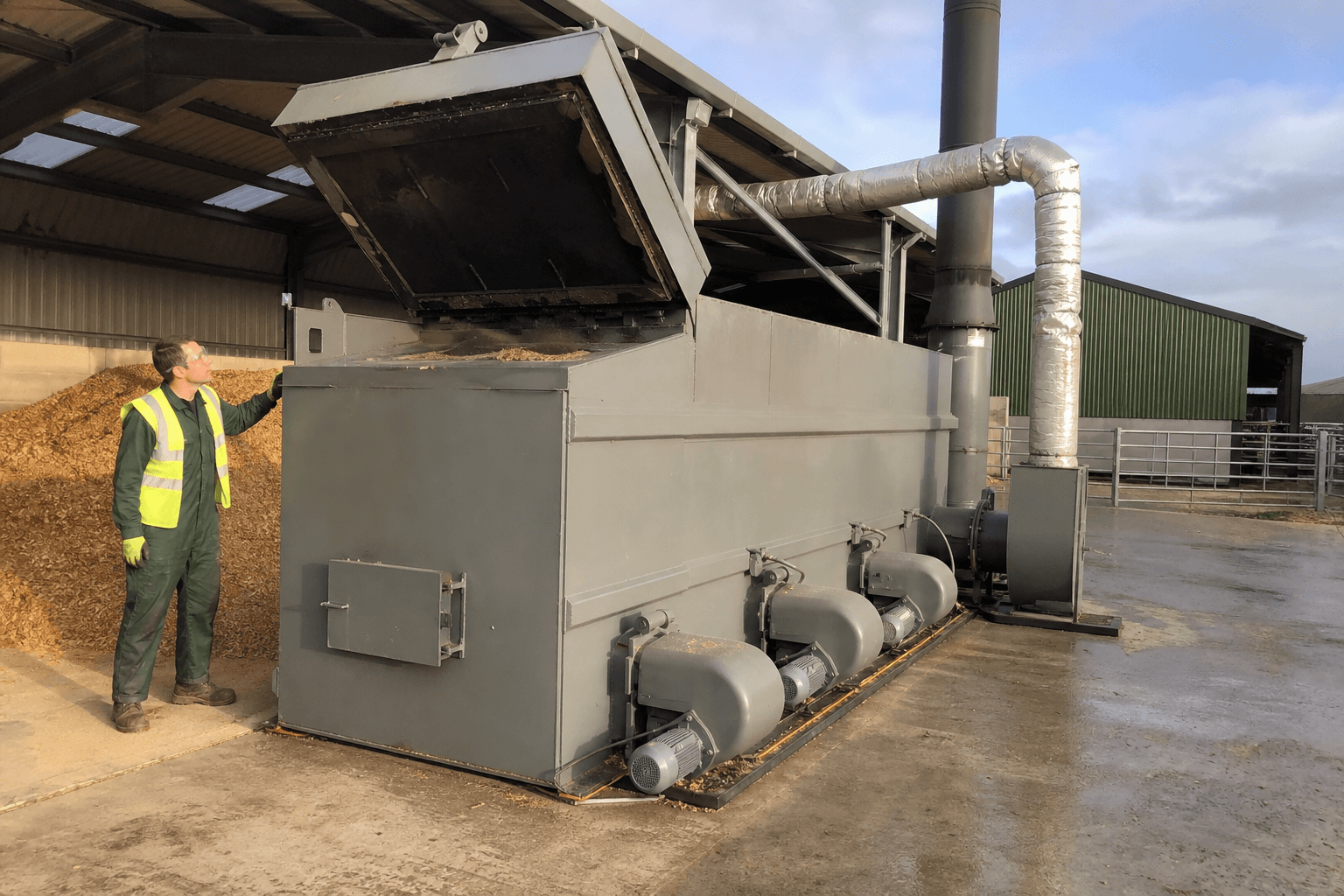
150 kg per charge for veterinary practices, small farms and pet cremation. The chamber is tall relative to its load rating because carcass waste is bulky and wet — volume, not weight, is the binding constraint.
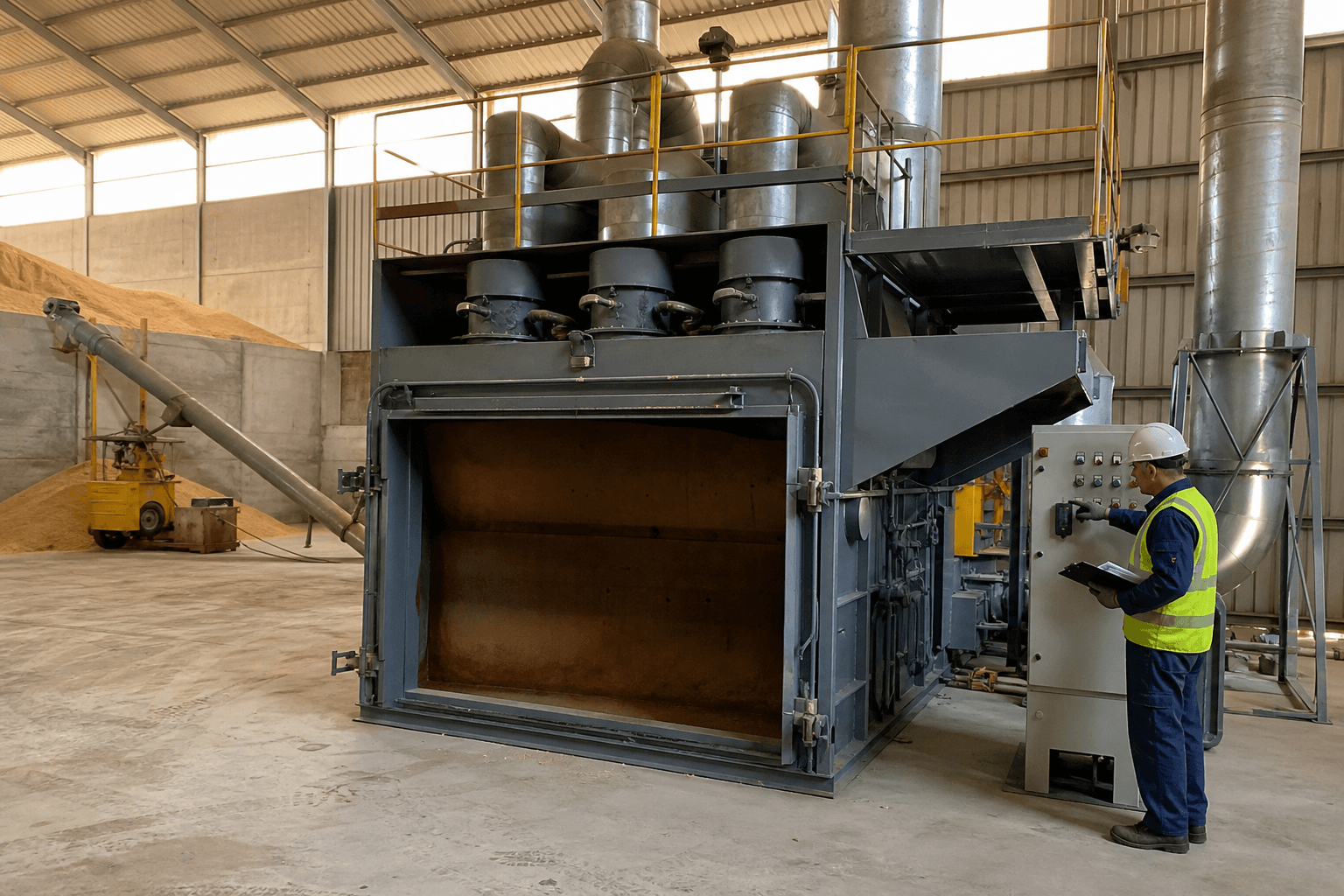
250 kg per charge with a 2880 mm chamber. The usual specification for a working livestock farm that needs fallen stock dealt with on site under biosecurity rules rather than held for collection.
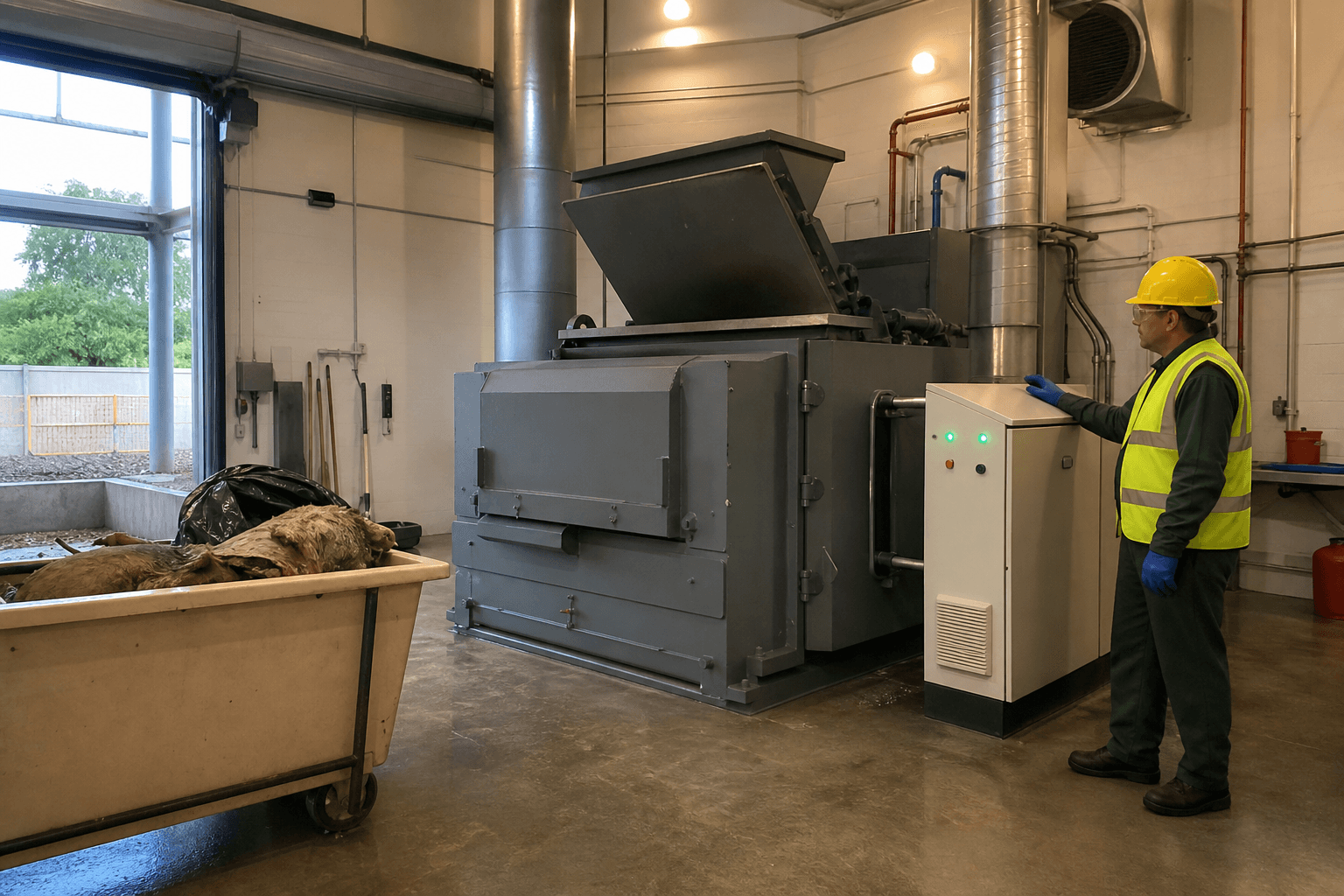
The largest AniBurn: 300 kg per charge in a 3180 mm chamber. Sized for commercial pet crematoria and larger livestock units where a single daily cycle has to clear everything held in cold storage.
Which Model
Fits Your Volume
Pick a model to see what it clears in a day of pigs.
Pre-weaning losses on a breeding unit: piglets are small and frequent, so a 150 kg charge is a week of them with no vehicle coming onto the site.
Report notifiable disease before disposing
African swine fever, classical swine fever and foot-and-mouth are notifiable. Suspicion is reported immediately and APHA directs what happens to the carcass. Destroying it first removes the diagnostic sample and delays the response.
The catering waste feeding ban
Feeding catering waste, kitchen scraps or food that has been through a kitchen to pigs has been illegal in the UK since 2001. It is the route ASF is most likely to enter the country by, and it applies regardless of how the material is packaged or intended.
APHA approval and environmental permit
Pig carcasses are animal by-products: the plant needs APHA approval under the retained ABP Regulation and an environmental permit from the Environment Agency, SEPA or NIEA.
Movement records still apply
Destruction on site does not remove the holding's obligation to record movements and deaths. The cycle log and the herd record should agree.
Why Burn It
On Site
4 things change on the day this stream stops leaving the site.
Nothing arrives at the gate
African swine fever moves on vehicles and boots. A collection round that has been at other pig units is the single hardest exception to close in a pig biosecurity plan, and destroying on site closes it entirely.
A daily task becomes a daily cycle
Pre-weaning mortality is continuous and predictable. On-site destruction turns it into a scheduled burn rather than a store that has to be managed, chilled or covered.
The collection point disappears
A carcass bin near the perimeter attracts vermin, birds and scavengers, and it is where an outside vehicle has to come. Removing the bin removes both problems at once.
Outdoor units get an answer
Outdoor breeding herds are spread over ground with no hardstanding and no chilled store. A unit at the steading is a shorter, cleaner journey than a run to a collection point across the paddocks.
Dual-chamber unit
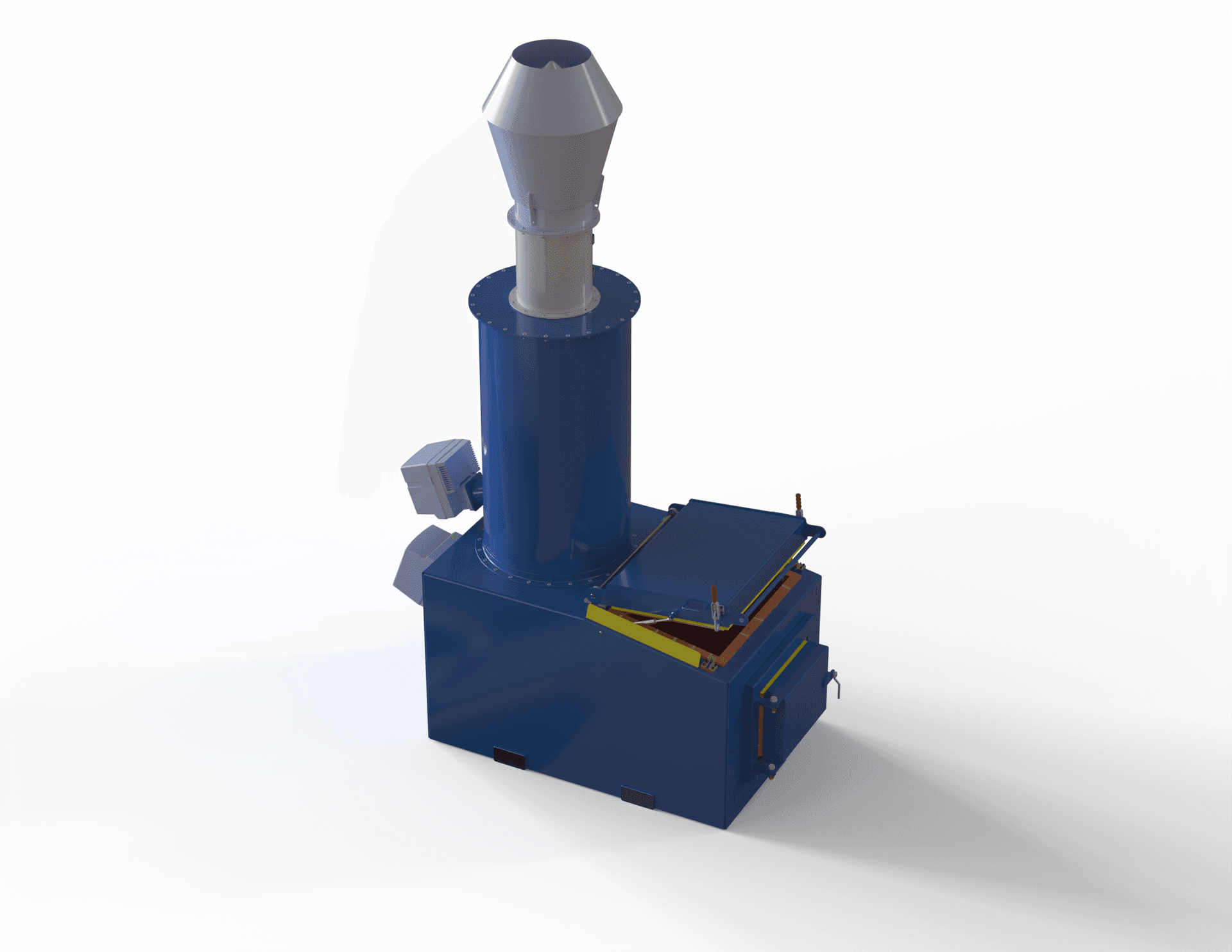
Primary chamber running 850–1,200°C with a secondary chamber holding flue gas above 850°C for two seconds. For animal by-products this is not a preference: it is the combustion condition an APHA-approved incineration plant has to meet.
Two-burner set and fuel train
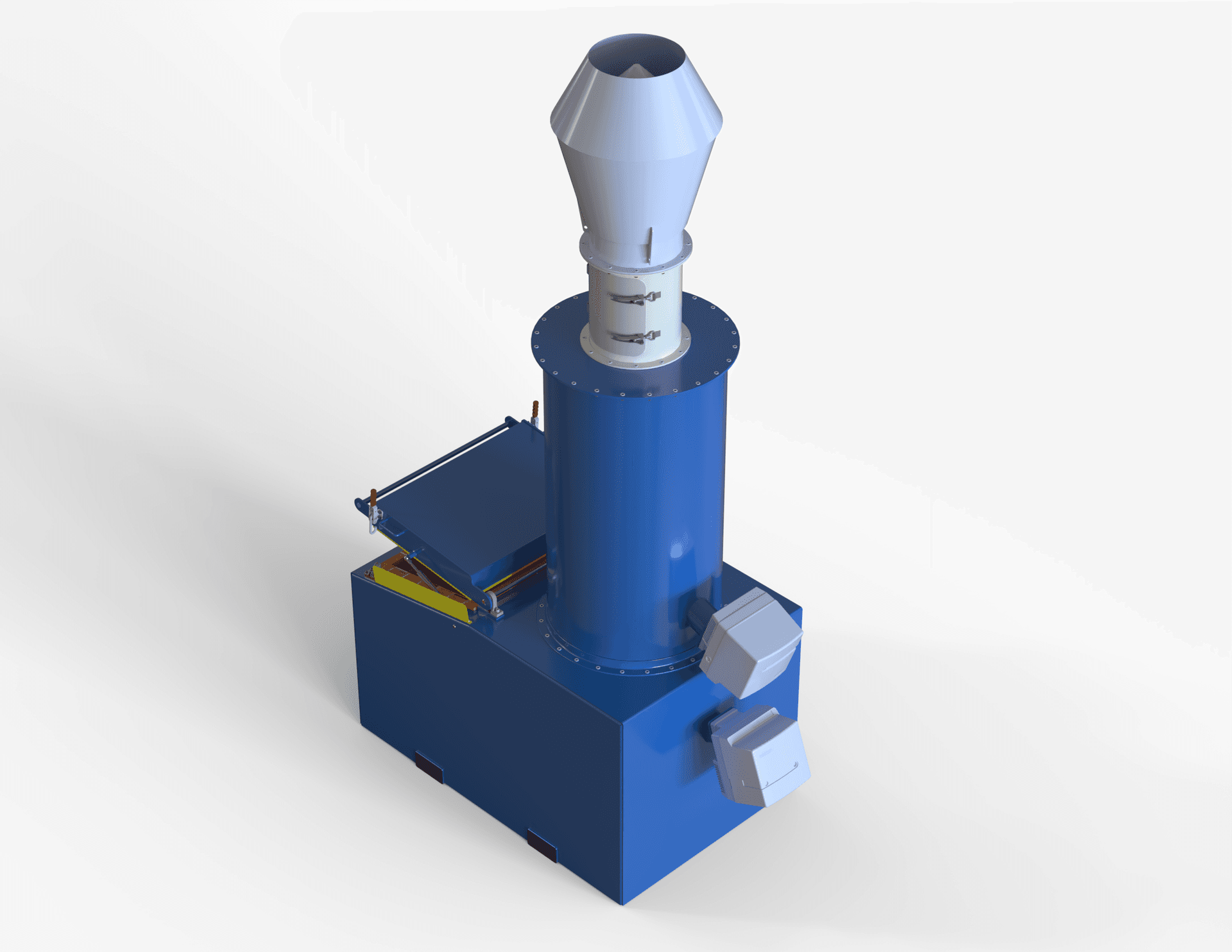
All three AniBurn models carry two burners, configured for natural gas, LPG, diesel, biofuel or hydrogen. Carcass waste is wet, so burner duty on this stream is doing more evaporation than on any other — fuel choice is a site decision, the combustion condition is not.
What Ships
With The Unit
Identical whichever stream it is specified for. The operating procedure changes; the machine does not.
Dual-chamber unit
Primary chamber running 850–1,200°C with a secondary chamber holding flue gas above 850°C for two seconds. For animal by-products this is not a preference: it is the combustion condition an APHA-approved incineration plant has to meet.
Two-burner set and fuel train
All three AniBurn models carry two burners, configured for natural gas, LPG, diesel, biofuel or hydrogen. Carcass waste is wet, so burner duty on this stream is doing more evaporation than on any other — fuel choice is a site decision, the combustion condition is not.
Top-loading charge door
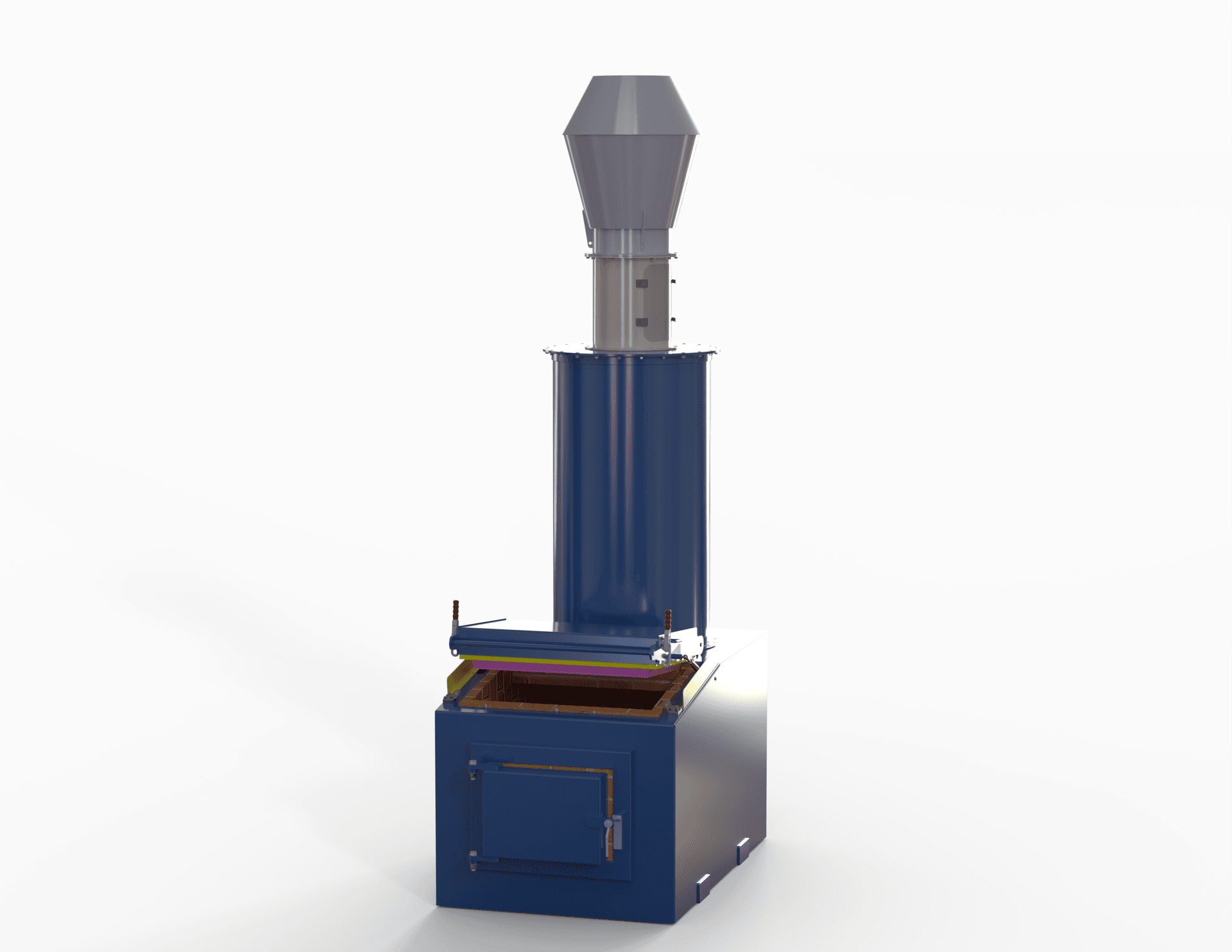
Carcasses are dead weight and awkward to handle. Top loading means a carcass goes in from above with a hoist, loader or teleporter rather than being dragged through a door at chest height, which is the difference between a two-person job and a one-person one.
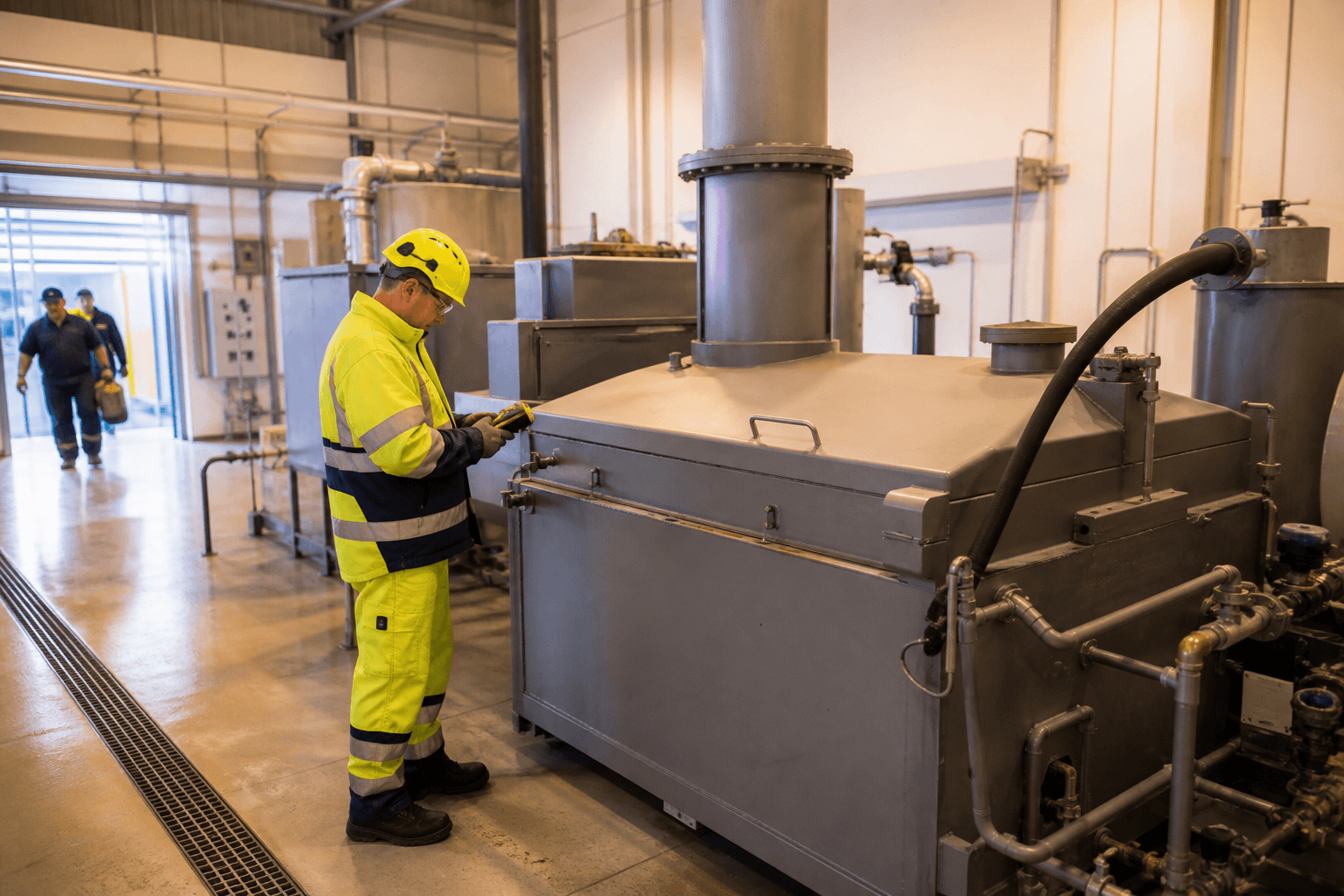
IP6X control panel
PLC control with cycle logging and chamber thermocouples. The cycle log is the record that a fallen-stock disposal, an APHA-directed cull or an individual pet cremation actually happened, and when.
Coretex refractory lining
Monolithic castable lining rated for the full temperature range, replaceable in service. Wet, fatty loads are the hardest duty a refractory sees, which makes lining quality the thing that decides service life on this stream rather than on any other.
Stack, dispersion data and commissioning
Stack supplied to the height your site-specific dispersion assessment calls for, with the emissions data the permit application references, plus on-site commissioning and operator training. On a livestock unit the neighbours are the reason the assessment matters.
How One Burn Runs,
Start To Finish
One charge is one countable event. That is what makes a batch unit auditable and a continuous one not.
One Cycle,
Start To Finish
Adds pig-specific biosecurity: no vehicle onto the unit, no food waste anywhere near the charge, and APHA direction the moment a notifiable disease is suspected.
Losses come out on the daily round and go straight to the unit. The interval between death and destruction is the part of the process biosecurity actually cares about.
150, 250 or 300 kg per charge. Piglets, weaners and growers are trivially inside it; a sow at 200–300 kg is at the top of the range and a mature boar above it needs a collector.
Piglet bins tip in from above; an adult carcass goes in with a hoist or loader. Top loading is what keeps an adult sow a one-operator job rather than a two-person drag.
Primary combustion at 850–1,200°C with two seconds above 850°C in the secondary chamber. Pigs are fatty, so once the moisture is off the fat carries the burn and the cycle settles.
3–5% sterile ash. Log the cycle against the unit's mortality record — during any disease investigation those two are read together.
What You Can Burn —
And What You Can't
One charge takes the whole stream without pre-sorting. What must never enter it is a short, hard list.
Yes: accepted in a charge
No pre-sorting between these
- Pre-weaning piglet lossesThe routine farrowing-house stream, including stillborn and mummified piglets. Small individually, and the volume that sets the weekly charge.
- Weaner and grower casualtiesLosses through the weaner and grower stages, well inside the charge rating.
- Sows and gilts inside the ratingAdults up to the 300 kg charge rating. Check your own carcass weights against that figure before sizing — it is the limit that binds on this stream.
- Farrowing house wasteAfterbirth and pen waste, with the bedding and straw recovered alongside a carcass.
- Outbreak and outdoor lossesCasualties from a scour, strep or PRRS outbreak, and losses brought in from an outdoor unit's paddocks.
- Veterinary and husbandry wastePost-mortem remains from an on-farm examination, plus tails, teeth and surgical waste from routine husbandry.
No: never charged
Not a permit question — these stay out
- Mature boars and the largest sowsA capacity limit. A boar above 300 kg exceeds the largest model in the range, and that carcass goes to an approved collector rather than being made to fit.
- Catering and food waste of any kindFeeding catering waste to pigs has been illegal in the UK since 2001 and it is an African swine fever introduction route. Nothing that has been through a kitchen should be on a pig unit at all, including near the incinerator.
- Carcasses where a notifiable disease is suspectedSuspicion of ASF, classical swine fever or foot-and-mouth is reported immediately and APHA directs what happens next. Destroying the carcass first removes the diagnostic sample and is a serious error.
- Slurry and washingsLiquid cannot be charged into a batch chamber. Pig units produce a lot of it and it has its own storage and spreading route.
- Veterinary sharps, bottles and vaccine packagingClinical waste has its own container and route. Farrowing houses generate a steady stream of it and none of it belongs in a mortality bin.
- Feed bags and packagingWoven polypropylene and film melt rather than burn and can carry halogenated content that changes the permit condition. They have a collection route.
Can you legally burn pigs on site?
Technically, yes: the chamber destroys almost everything on the accepted list at 850–1,200°C, and capability is rarely the constraint. Legally is a separate question. What your site is allowed to burn is set by your environmental permit from the Environment Agency, SEPA or NIEA and the waste codes written into it, plus APHA approval, because animal by-products are regulated under their own rules. The never-charged list is different again: those materials are out of scope for the unit or governed by a direction, and no permit wording brings them back in. Send us the codes you hold, or the ones you expect to apply for, and we will tell you which of this list they cover before anything is specified.
Send us your waste codesWhat size incinerator for a week of pre-weaning losses?
Arithmetic on published model figures, not a customer reference. Your numbers go through the same steps.
How This
Was Worked Out
40 piglets at ≈2 kg = 80 kg, plus 3 weaners at ≈20 kg = 60 kg and ≈30 kg of farrowing waste — ≈170 kg, or one ABI-250 charge, leaving 5–9 kg of ash at 3–5%. Weights here are typical rather than measured. Size against a week where something has gone wrong in the farrowing house, not an average one, and check whether your adult carcasses fall inside the 300 kg rating.
ABI-250
1
5–9 kg
Send your daily or weekly arisings and we will confirm the model, the charge count and the permit route.
Related Products
& Services
Complementary equipment and engineering services for your process.
Sizing and background
- [TOOL]Work out the burn rate for your own arisings
- [TOOL]Size the combustion air and flue gas duty
- [BLOG]Optimising animal carcass incinerators for UK bio-security
- [BLOG]The long-term operational costs of animal carcass incinerators
- [BLOG]Training programmes for animal incinerator operators
- [BLOG]Minimising the environmental impact of animal incinerators
- [BLOG]Agricultural incinerators and aquaculture waste
Pigs Questions
Answered against the published figures for the models specified for this stream, not a generic range sheet.
A pig incinerator is an APHA-approved dual-chamber unit handling the mortality of a pig unit: pre-weaning piglet losses, weaner and grower casualties, and adult sows and boars where the carcass falls inside the charge rating. Piglets at 1–8 kg and weaners at 10–30 kg are trivially inside it; a sow at 200–300 kg is at the top of the range, and a mature boar above that is not. Pre-weaning mortality is a structural feature of pig production rather than a sign of a problem — a proportion of piglets are lost to crushing, starvation and low viability in every farrowing house in the world. That means a farrowing unit has a daily, predictable disposal task, and the question is only whether it is dealt with on site or held for someone else to take away. African swine fever is why pig biosecurity currently outranks every other UK livestock sector. The virus is present in Europe, survives in pork products for months, and moves on vehicles, boots and food waste rather than on the wind. Every pig unit's plan is built around keeping vehicles and unauthorised material off the site, and a fallen stock lorry that has been at other pig units is the exception people find hardest to close. The related rule worth stating on any pig page: feeding catering waste, kitchen scraps or any food that has been through a kitchen to pigs is illegal in the UK, and has been since 2001. It is a feeding prohibition rather than a disposal one, but it belongs in the same conversation — food waste on a pig unit is a disease-introduction route regardless of what it is intended for.
40 piglets at ≈2 kg = 80 kg, plus 3 weaners at ≈20 kg = 60 kg and ≈30 kg of farrowing waste — ≈170 kg, or one ABI-250 charge, leaving 5–9 kg of ash at 3–5%. Weights here are typical rather than measured. Size against a week where something has gone wrong in the farrowing house, not an average one, and check whether your adult carcasses fall inside the 300 kg rating.
A sow at 200–300 kg fits the ABI-300's rating, at the top of the range. A mature boar above 300 kg does not, and that carcass needs an approved collector. Piglets, weaners and growers are trivially inside every model.
It removes the two routine ways material and vehicles reach the unit: the collection lorry that has been at other pig sites, and the carcass bin at the perimeter that attracts vermin and requires an outside visit. ASF moves on vehicles, boots and food waste, not on the wind.
Nothing that has been through a kitchen should be on a pig unit at all. Feeding catering waste to pigs has been illegal since 2001, and having it on site — even destined for an incinerator — creates the exact introduction risk the ban exists to prevent.
Report it immediately and do not destroy the carcass. APHA needs the animal to diagnose from, and they direct what happens next. An on-site incinerator is a way of complying with that direction, never a way of pre-empting it.
Most run one cycle a day or every other day, sized around the daily round. Pre-weaning losses are continuous, so this stream suits a routine burn rather than an occasional one.
It burns well once the moisture is off — pigs carry more fat than sheep or cattle, and that fat sustains the burn through the cycle. The early evaporation phase is the same as any carcass load.
Outdoor units usually have the strongest logistics case: no hardstanding, no chilled store, and paddocks spread over a long distance from any collection point. The unit sits at the steading and the journey is shorter and cleaner than a run to the perimeter.
Yes. Pig carcasses are animal by-products, so the plant must be approved under the retained ABP Regulation, and separately permitted by the Environment Agency, SEPA or NIEA. Two consents, two regulators, two different risks.
Ready to
Incinerate?
Send the stream, the volume and the site constraints. We will confirm the model, the permit route, and what the specification has to say to satisfy the regulator.
- Nothing arrives at the gate
- A daily task becomes a daily cycle
- The collection point disappears
- Outdoor units get an answer