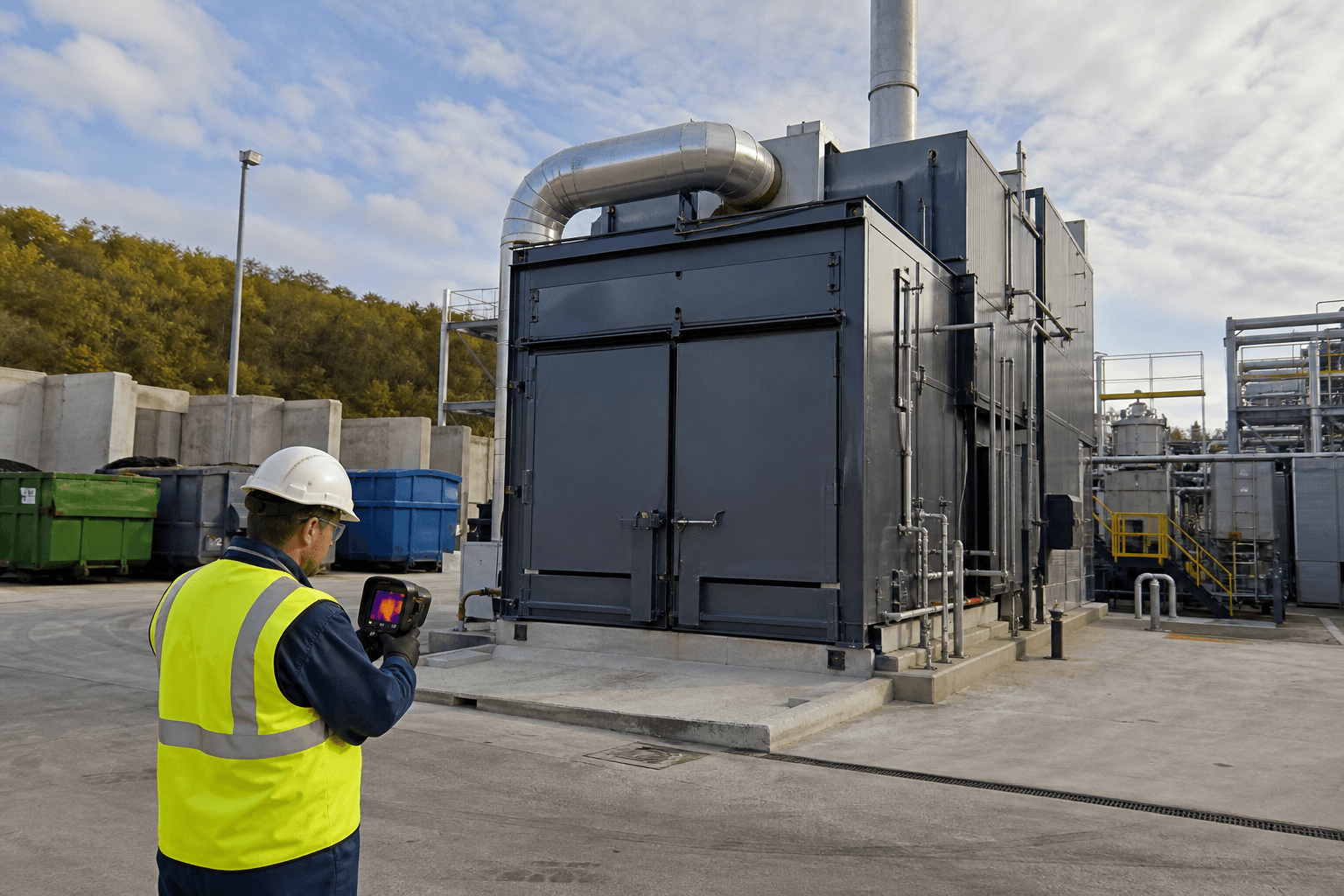
Spill Response Waste Incinerators
Sorbents, booms, granules, PPE and debris from an incident — cleared the same week, not the same quarter.
A spill produces more contaminated waste in an hour than a site produces in a month, and it produces it at the worst possible moment. The response is judged on how fast the site is clean and how completely the material is dealt with — neither of which improves while a hazardous collection is being booked.
Four Models,
One Solution
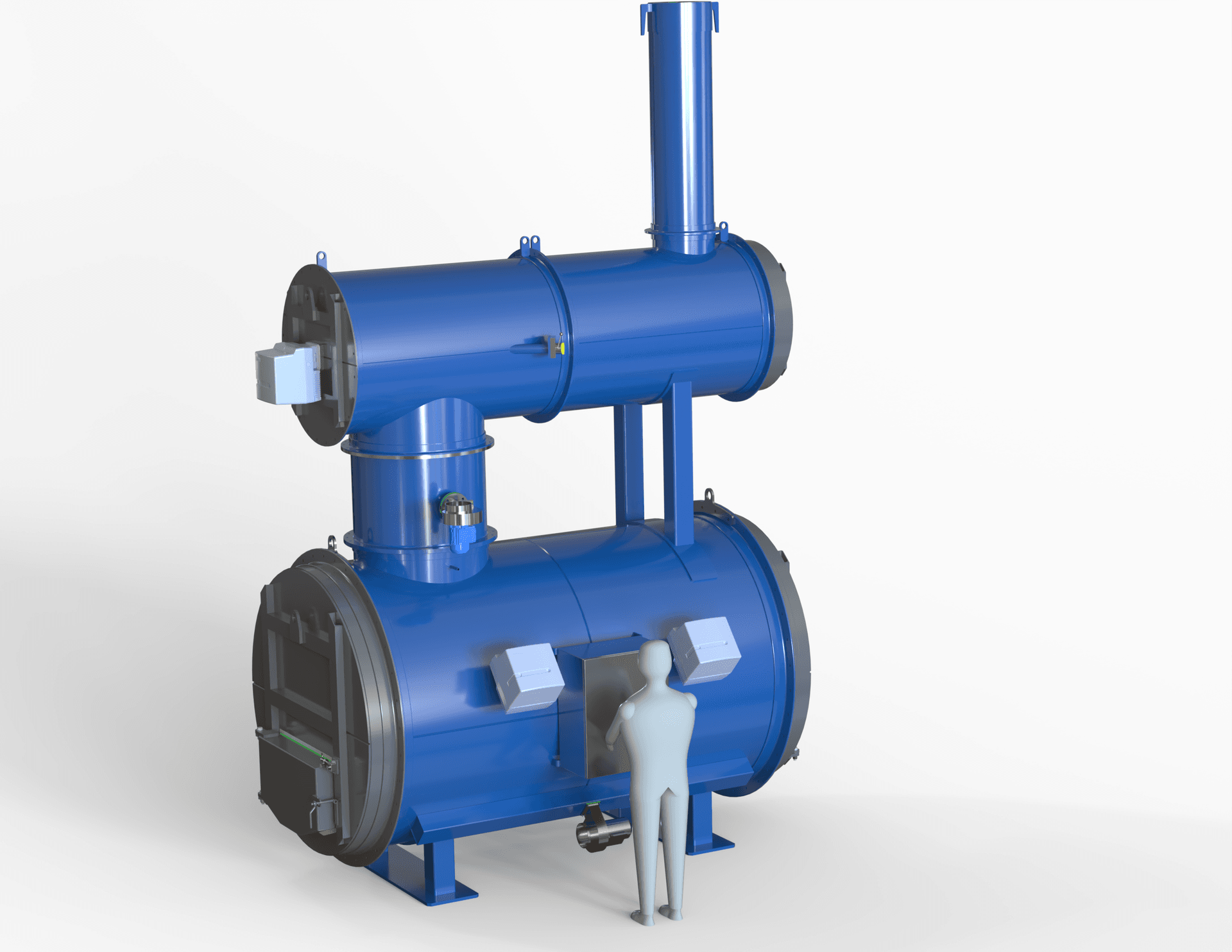
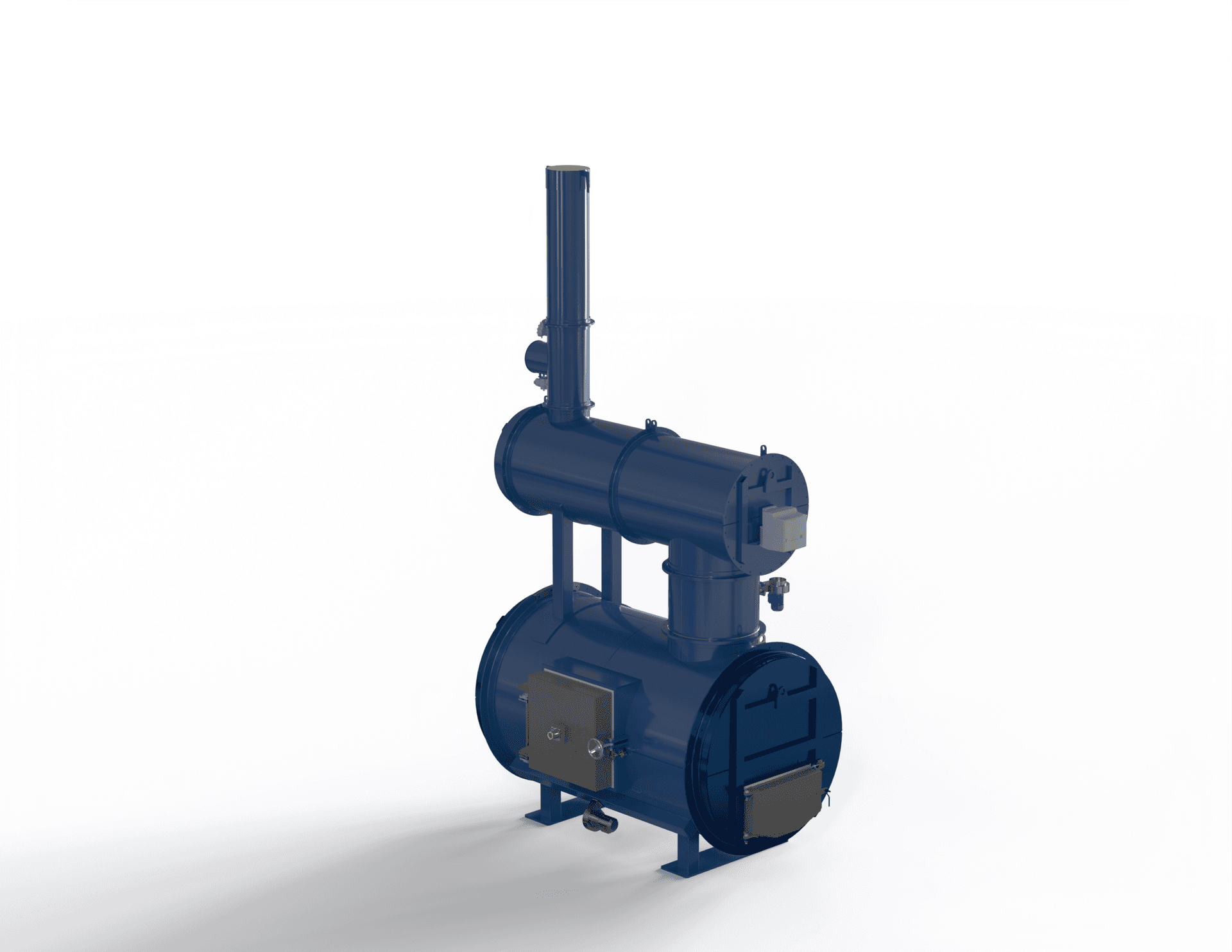
The entry point to the LitBurn range. A 3.3 m³ primary chamber and three burners give continuous 125 kg/h destruction in a footprint that fits a standard yard bay, which makes it the usual choice for a single-site operator replacing skip hire rather than a multi-site waste contract.
The most specified unit in the range. Chamber volume rises to 5.5 m³ for 250 kg/h continuous throughput while the external width grows by only 230 mm over the LBI-125, so sites that outgrow the smallest unit rarely have to rework the slab or the building line.
A 9.6 m³ chamber — nearly double the LBI-250 — for medium-scale industrial waste destruction. At this size most operators pair the unit with heat recovery, because the thermal output during a full shift is large enough to displace a dedicated water heater.
The largest LitBurn: a 16.2 m³ chamber running 500 kg/h continuously. Specified where waste arrives faster than a batch unit can clear it — large manufacturing sites, industrial estates, and operators consolidating several smaller waste contracts onto one machine.
Which Model
Fits Your Volume
Pick a model to see what it clears in a day of spill response & incident waste.
A site holding response capability for its own incidents: two shifts clears a two-tonne event.
15 02 02* where the spill was hazardous
Sorbents, filter materials and protective clothing contaminated by hazardous substances are 15 02 02*. The spilled substance decides the classification, so the response record and the waste record have to agree.
Containment and reporting come first
Pollution incident reporting, containment and any regulator notification are unaffected by having a unit. Destruction is the end of the clean-up, not part of the response obligations.
Recovery ranks above destruction for free product
Pumped and skimmed product should go for recovery where it can. What is destroyed is the material used to contain and absorb it, which has no recovery route.
Absorbed in, never free liquid
The single operating rule. Applied in the field by the responder filling the bag, which is where it actually works — not at the charge door with a loaded telehandler waiting.
Why Burn It
On Site
4 things change on the day this stream stops leaving the site.
Emergency collections are priced as emergencies
A hazardous uplift booked at short notice costs what short notice costs, and the quote arrives when your negotiating position is weakest. Capacity already on site removes that conversation.
The surge is absorbed as running hours
A continuous unit takes an incident's worth of sorbent as extra shifts rather than as a storage problem. That is the difference between a week of clearing and a month of holding.
Contaminated material stops sitting on site
Bagged sorbent under sheeting on hardstanding is a fire loading, a rainfall problem and a visible reminder to every regulator and neighbour who visits.
The incident closes when the waste does
Investigations, insurers and regulators all want an end point. Destruction with a run record gives one that does not depend on somebody else's schedule.
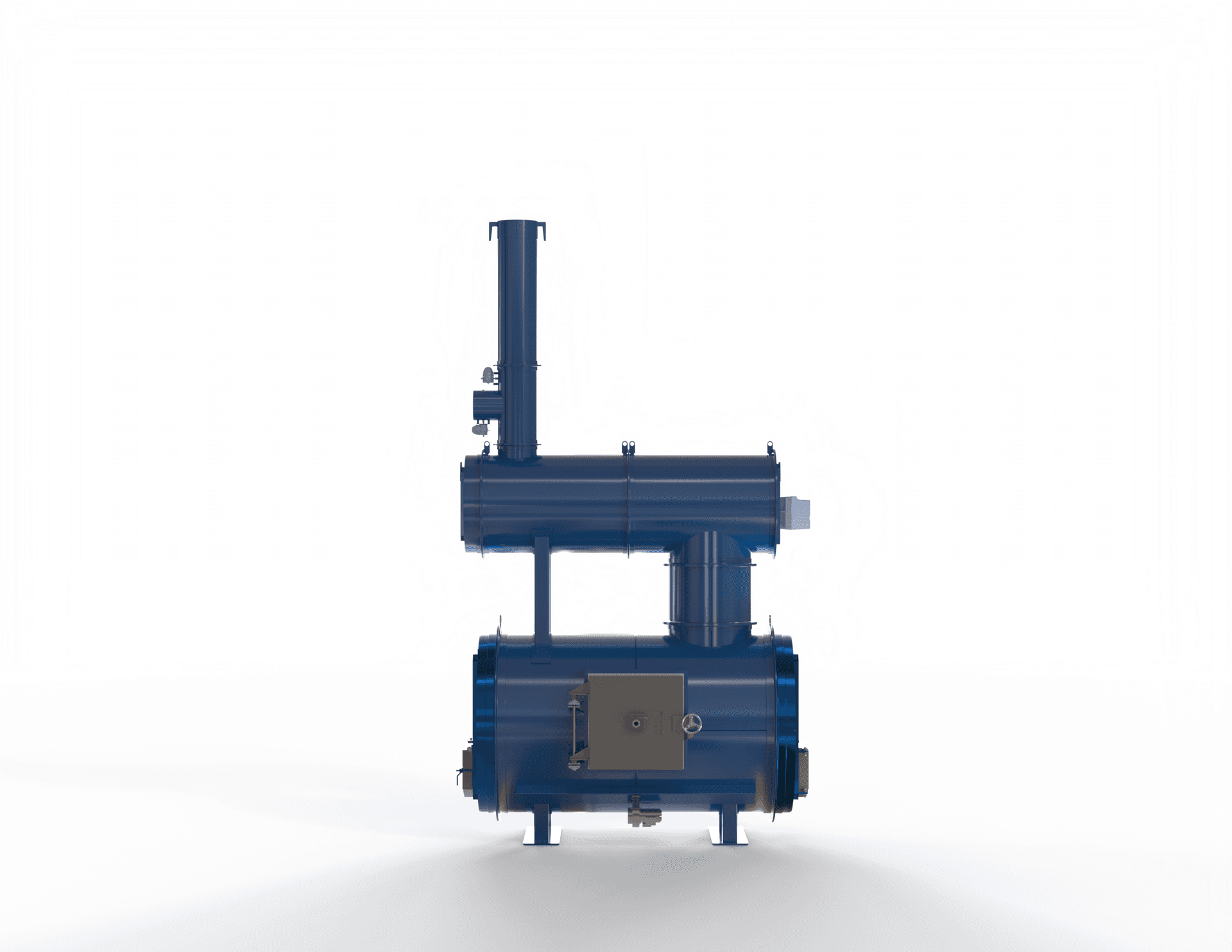
Dual-chamber unit, 1,100°C capable
Primary chamber running 850–1,200°C with a secondary holding flue gas above 850°C for two seconds. Environmental waste is the stream most likely to carry halogenated content — chlorinated solvents in contaminated arisings, salt-laden marine debris, POPs-bearing material — so the 1,100°C condition is stated here rather than treated as an exception.
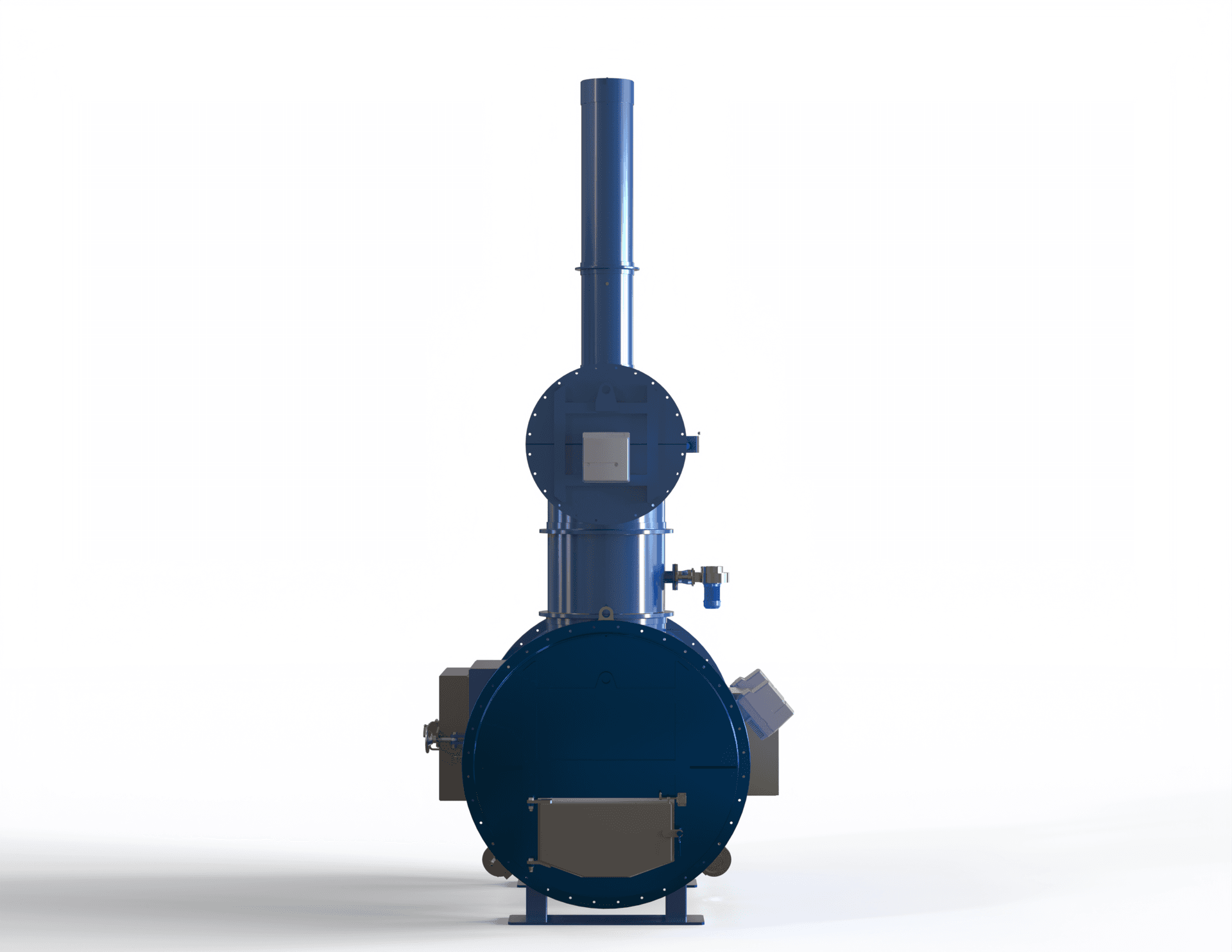
Front dual-door loading
Charged through a front dual door at floor level, so bulk bags, tote bins and wheeled skips go in at the height a site telehandler already works at. Clearance waste arrives in whatever it was collected in, and it is not decanted.
What Ships
With The Unit
Identical whichever stream it is specified for. The operating procedure changes; the machine does not.
Dual-chamber unit, 1,100°C capable
Primary chamber running 850–1,200°C with a secondary holding flue gas above 850°C for two seconds. Environmental waste is the stream most likely to carry halogenated content — chlorinated solvents in contaminated arisings, salt-laden marine debris, POPs-bearing material — so the 1,100°C condition is stated here rather than treated as an exception.
Front dual-door loading
Charged through a front dual door at floor level, so bulk bags, tote bins and wheeled skips go in at the height a site telehandler already works at. Clearance waste arrives in whatever it was collected in, and it is not decanted.
IP6X control panel with cycle logging
PLC control with chamber thermocouples, interlocked charge door and a time-stamped temperature record per run. For hazardous waste produced and destroyed on one site, that log is the evidence behind a consignment record nobody drove anywhere.
Burner set and fuel train
Configured for natural gas, LPG, diesel, biofuel or hydrogen. This stream runs wet and dirty — flood silt, harbour arisings, screenings — so burner support does more work here than on a dry industrial charge.
Coretex refractory lining
Monolithic castable lining rated for the full range and replaceable in service. Environmental loads swing from saturated to solvent-bearing between one bag and the next, and the lining is specified for that cycling rather than for a steady feed.
Stack, dispersion data and commissioning
Stack to the height your site-specific dispersion assessment calls for, the emissions data pack the permit application references, on-site commissioning, a witnessed first run and operator training. Hazardous scope means a bespoke permit rather than standard rules, and the assessment is the long pole.
How One Burn Runs,
Start To Finish
One run is one countable event, reconciled against a manifest and evidenced by a time-stamped temperature log.
One Cycle,
Start To Finish
Adds 15 02 02* to the permit and inherits the absorbents rule wholesale: absorbed material is a charge, free liquid is not. The difference here is volume, which arrives all at once.
Containment and recovery of free product come before anything else. What reaches this route is the material used to do that — never the recovered product itself.
Pumped and skimmed product goes to a licensed liquids route, where much of it is recoverable. This step is both the hierarchy answer and the reason the charge stays chargeable.
Sorbent that drips is separated out at the staging area. The check is made by the person filling the bag, in the field, not at the charge door two days later.
Fed steadily with two-second secondary retention above 850°C, or 1,100°C where the spilled substance was solvent or chlorinated. Hydrocarbon-loaded sorbent is energy-dense and is metered rather than dumped.
Residue is mineral ash with the inert fraction of granular carriers. The run log, the weights and the incident record close together.
What You Can Burn —
And What You Can't
One run takes the whole stream without pre-sorting. What must never enter it is a short, hard list.
Yes: accepted in a run
No pre-sorting between these
- Sorbent pads, rolls, socks and boomsDeployed sorbent from containment and clean-up, drained to no free liquid and bagged at the incident.
- Spent granular absorbent and dry sweepGranules, clay and compound used on hard surfaces, swept and bagged with the contamination they lifted.
- Contaminated PPE and coverallsDisposable suits, gloves, boot covers and respiratory consumables used by the response team.
- Containment mats, drain covers and sheetingSingle-use containment products and sheeting contaminated in the response and not recoverable for reuse.
- Contaminated debris and vegetationSurface debris, vegetation and litter lifted with the spill, where the contamination rules out ordinary disposal.
- Spill kit contents at end of lifeDeployed or time-expired kit contents replaced after use, contaminated or not fit to return to the cabinet.
No: never charged
Not a permit question — these stay out
- Recovered free product and pumped liquidGoes to a licensed liquids route, where much of it can be recovered. This class of unit does not inject liquid, and the hierarchy would prefer recovery anyway.
- Saturated sorbent that releases liquidLiquid waste in a solid carrier. Separated at the staging area on the same rule the industrial absorbents stream runs.
- Unidentified substances and abandoned containersAnything not characterised is not charged. Unknown drums and containers found at an incident are handled as hazardous unknowns, not fed to a chamber to find out.
- Asbestos, cylinders and battery-bearing debrisRoad and industrial incidents produce all three. None of them burn safely and each has its own route.
Can you legally burn spill response & incident waste on site?
Technically, yes: the chamber destroys almost everything on the accepted list at 850–1,200°C, and capability is rarely the constraint. Legally is a separate question. What your site is allowed to burn is set by your environmental permit from the Environment Agency, SEPA or NIEA and the waste codes written into it. The never-charged list is different again: those materials are out of scope for the unit or governed by a direction, and no permit wording brings them back in. Send us the codes you hold, or the ones you expect to apply for, and we will tell you which of this list they cover before anything is specified.
Send us your waste codesWhat does a 2-tonne spill response leave to destroy?
Arithmetic on published model figures, not a customer reference. Your numbers go through the same steps.
How This
Was Worked Out
2,000 kg of drained sorbent and contaminated materials against the LBI-125's 125 kg/h = about 16 hours, or two shifts, with recovered free product going separately to a liquids route. Size on the incident you plan for, not the year's average. A site that has never had a spill and a site that had one last year both need the same capacity on the day it happens.
60–100 kg
0
None
2.5 t
Send your daily or weekly arisings and we will confirm the model, the run time and the permit route.
Related Products
& Services
Complementary equipment and engineering services for your process.
Sizing and background
- [TOOL]Work out the burn rate for your own arisings
- [TOOL]Size the combustion air and flue gas duty
- [BLOG]Ash management from industrial waste incinerators
- [BLOG]Integrating vibration analysis for incinerator predictive maintenance
- [BLOG]Advanced gas cleaning for ultra-low emission incinerators
- [BLOG]Evaluating flue gas cleaning systems in industrial incinerators
Spill response & incident waste Questions
Answered against the published figures for the models specified for this stream, not a generic range sheet.
Spill response waste is what is left after an incident is contained: used sorbent pads, rolls, socks and booms, spent granular absorbent, contaminated PPE and coveralls, drain covers and containment mats, and the debris, vegetation and surface material lifted with the spill. Where the spilled substance is hazardous, so is the waste, coding as 15 02 02*. This is the industrial absorbents stream under different conditions. Routine maintenance produces a predictable trickle; an incident produces a surge — a tanker failure, a bund breach, a road traffic collision, a pipeline leak — and the surge is the whole problem. A month of capacity arrives in an afternoon. The rule that governs it is unchanged and non-negotiable: material is absorbed, not wet. Sorbent that releases liquid under its own weight is liquid waste carried in a solid, and it goes to a licensed liquids route. Recovered free product goes there too, and where it can be recovered rather than destroyed, the hierarchy says it should be. What an on-site unit changes is the interval between containment and closure. The material stops accumulating on hardstanding under sheeting while an emergency collection is priced, and the incident stops being open because of its waste.
2,000 kg of drained sorbent and contaminated materials against the LBI-125's 125 kg/h = about 16 hours, or two shifts, with recovered free product going separately to a liquids route. Size on the incident you plan for, not the year's average. A site that has never had a spill and a site that had one last year both need the same capacity on the day it happens.
No. Pumped and skimmed free product goes to a licensed liquids route, where much of it is recoverable — which is both the lawful answer and the better one. This unit destroys the sorbents, PPE and debris used to contain the spill.
If it releases liquid under its own weight, it is too wet. The check happens in the field by whoever is bagging it, which is the only place it works. A bag with liquid standing in it is a liquid waste that has not been separated yet.
That depends on your exposure rather than your history. Sites holding significant volumes of hydrocarbons or chemicals usually already carry response equipment for the same reason. Where spills are routine rather than hypothetical — depots, terminals, transport hubs — the unit earns its keep on the maintenance stream between incidents.
850–1,200°C primary with two-second secondary retention as standard, and 1,100°C where the spilled substance was a chlorinated or solvent-bearing material. The substance that spilled decides it, so the permit should cover the worst case your site holds.
It shortens the part they ask about last: what happened to the waste. Containment, notification and investigation obligations are unchanged. But a time-stamped destruction record beats an open item waiting on a collection, and the material stops being visible on your hardstanding.
Yes, provided it has been characterised and screened. Contaminated surface debris and vegetation are in scope; what has to come out first is the same short list as everywhere in this sector — asbestos, cylinders, batteries and any unidentified container.
Ready to
Incinerate?
Send the stream, the volume and the site constraints. We will confirm the model, the permit route, and what the specification has to say to satisfy the regulator.
- Emergency collections are priced as emergencies
- The surge is absorbed as running hours
- Contaminated material stops sitting on site
- The incident closes when the waste does