AMBI-250 250 kg military & defence incinerator
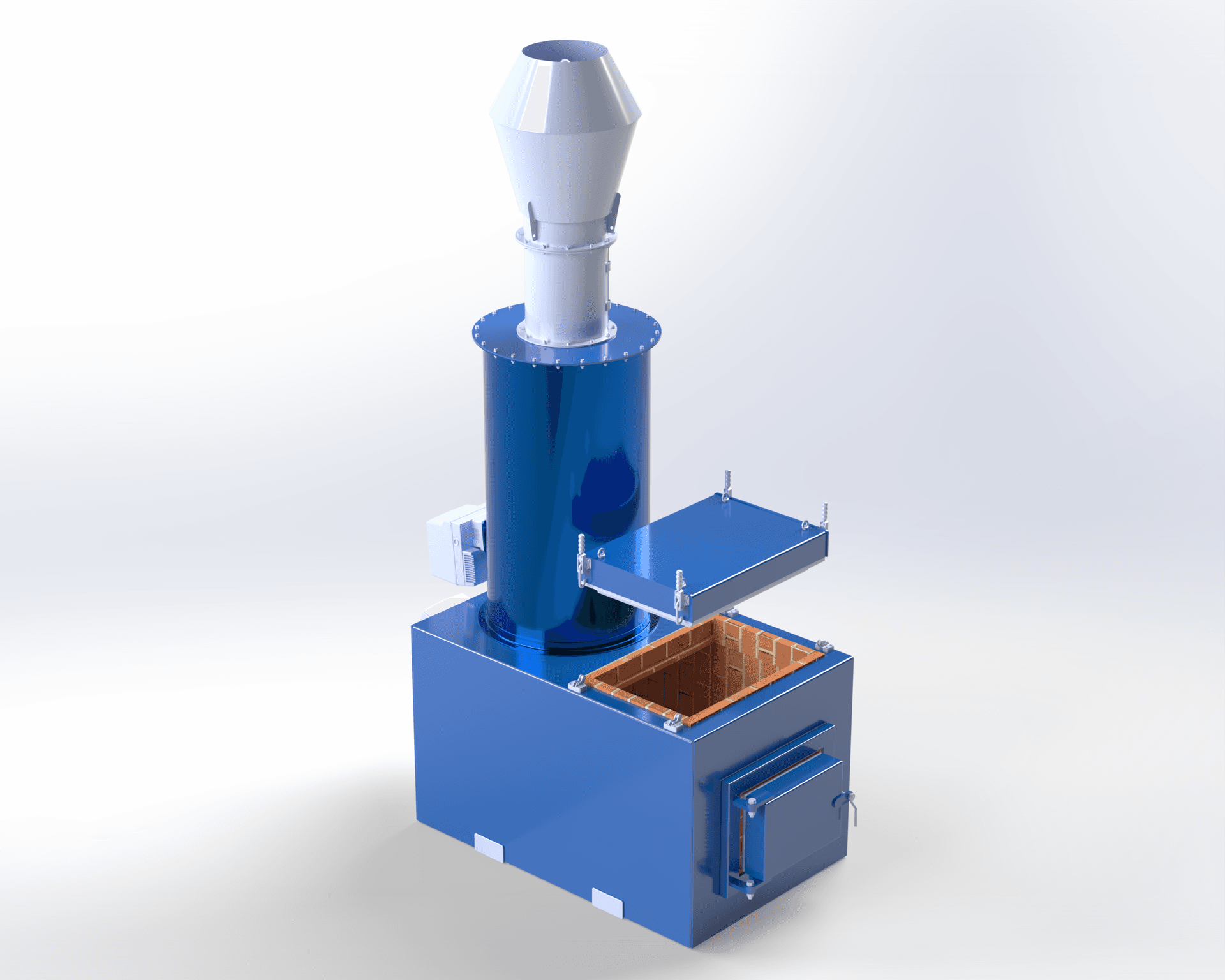
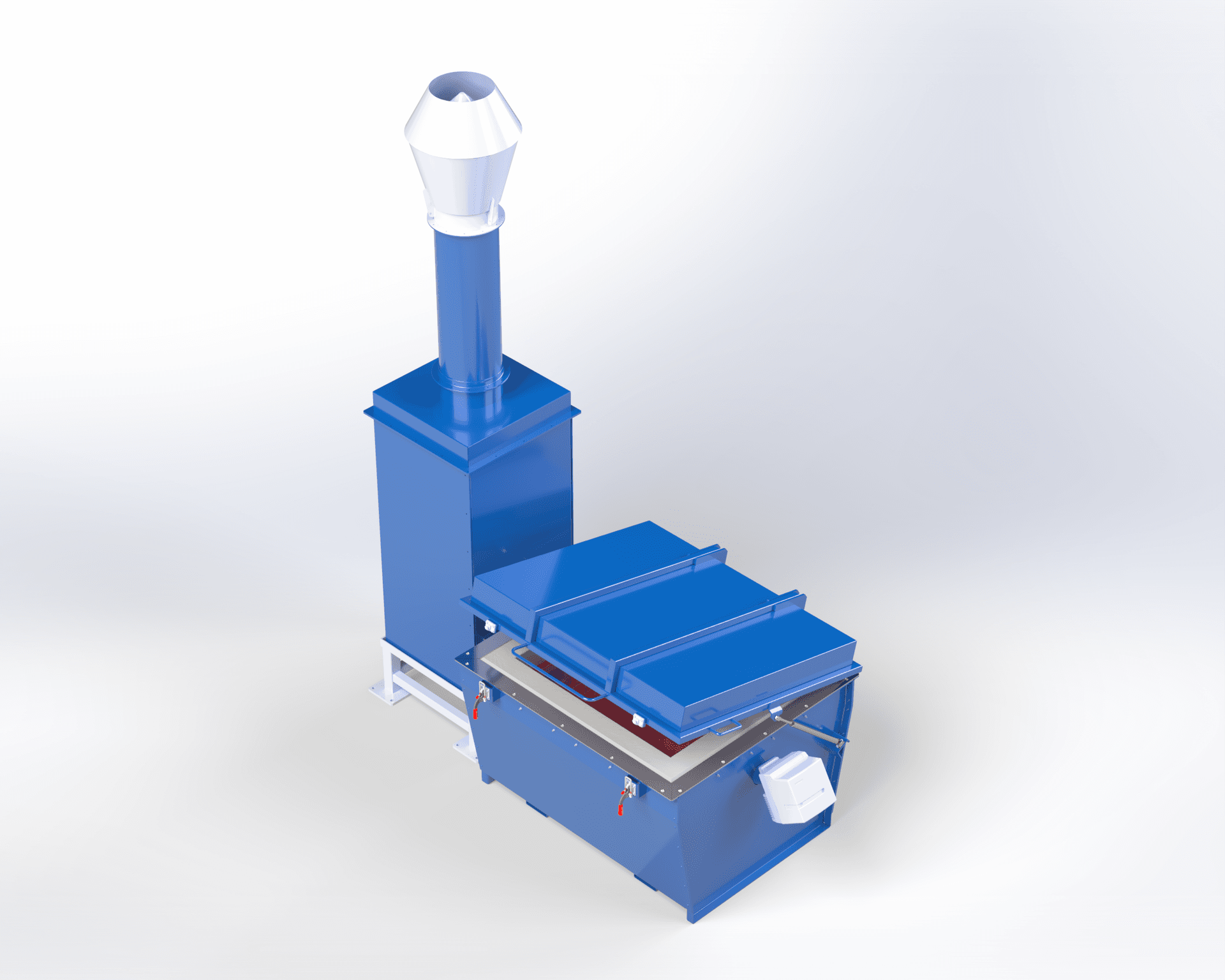
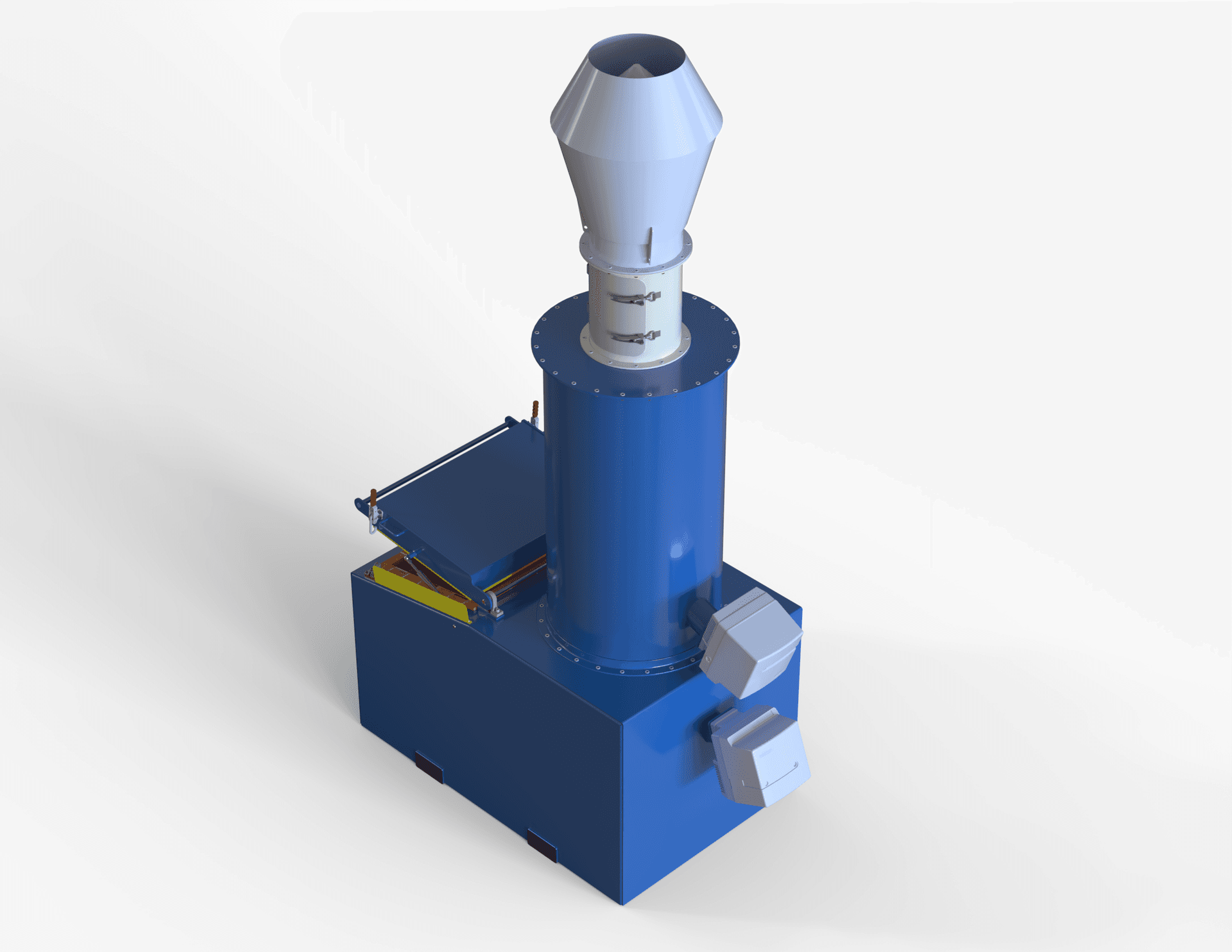
250 kg per charge for established base infrastructure. The two-burner arrangement and 1250 mm chamber handle classified document destruction and ammunition-adjacent waste in the same unit.
- Chamber
- 1250 × 610 × 630 mm
- External dimensions
- On request
- Burners
- 2
- Loading
- Top
- [LOAD]
- 250kg
- [BURN_RATE]
- <50kg/h
- [DUTY]
- Batch
- [WEIGHT]
- 2.3t
AMBI-250 In Full
- Chamber
- 1250 × 610 × 630 mm
- External dimensions
- On request
- Burners
- 2
- Loading
- Top
- Operating temperature
- 850–1,200°C
- Gas retention
- 2.0 s
- Ash residue
- 3–5%
- Heat-up time
- 30 min
- Fuel
- Natural gas / H₂ / diesel / LPG / bio
- Control panel
- IP6X rated PLC
- Refractory
- Coretex lining
- Origin
- United Kingdom
Rated Per Charge
The number in the model name is the load per charge, not an hourly rate.
The 250 kg in the model name is the load per charge, not an hourly rate. The unit burns at under 50 kg/h, so the practical planning unit is one charge a day rather than one hour. What counts is the complete cycle — first load to complete burn-down — because that is how declared throughput is measured, and it is confirmed against your own waste at commissioning. Size on what has to be cleared per cycle, and allow cool-down and ash removal before the next charge.
Every unit reaches operating temperature within 30 minutes and holds flue gas above 850°C for two seconds in the secondary chamber — the Industrial Emissions Directive condition. Ash residue is 3–5% of input mass.
Specified for
- Ammunition & ordnance wastePackaging, propellant-contaminated consumables and range sweepings destroyed on site, without a contractor declaration.
- Classified document destructionProtectively marked paper, microfiche and mixed media destroyed on site under supervision, with a burn that can be witnessed.
- Base & field camp wasteMixed camp refuse, field medical waste and sensitive material cleared on site where no collection route exists.
- Field medical & aid post wasteSharps, dressings, pathological waste and contaminated PPE from aid posts cleared where no clinical collection exists.
- Uniform, insignia & ID destructionCondemned uniform, insignia, name tapes, ID cards and passes destroyed rather than released into a textile stream.
- Fuel, oil & contaminated absorbentsOil-soaked absorbents, spill-kit residues, fuel-contaminated rag and filters cleared on site instead of consigned out.
Before you specify
Permit
Burning waste on a defence establishment requires an environmental permit from the Environment Agency in England and Wales, SEPA in Scotland or NIEA in Northern Ireland. The application needs the same technical data pack as any commercial operator, and temporary and training sites are not exempt either.
Stack height
Comes out of a site-specific dispersion assessment, not a standard figure.
Full compliance requirementsRest Of The Military & defence Range
Same size, other waste types
Related Products
& Services
Complementary equipment and engineering services for your process.
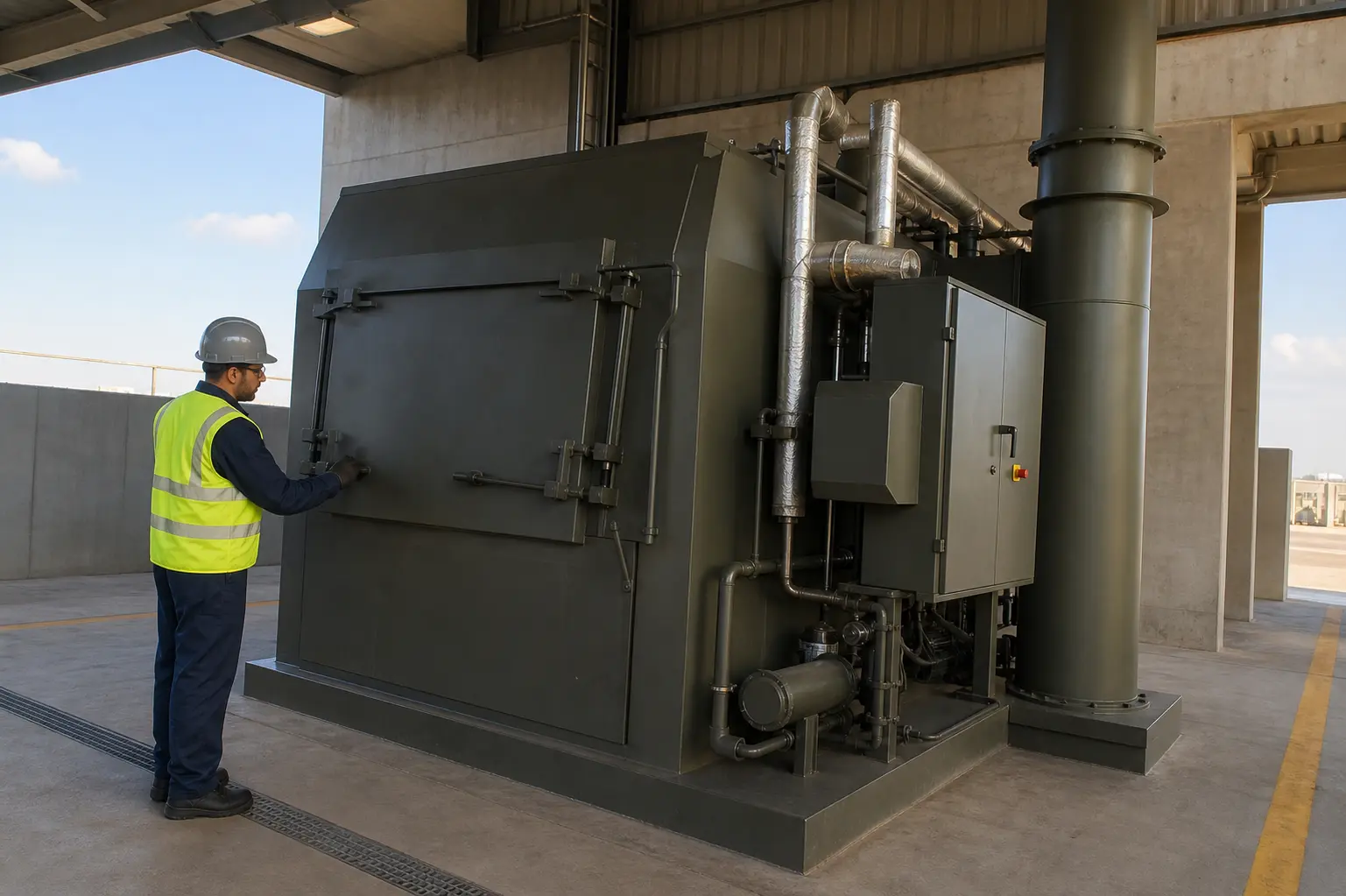
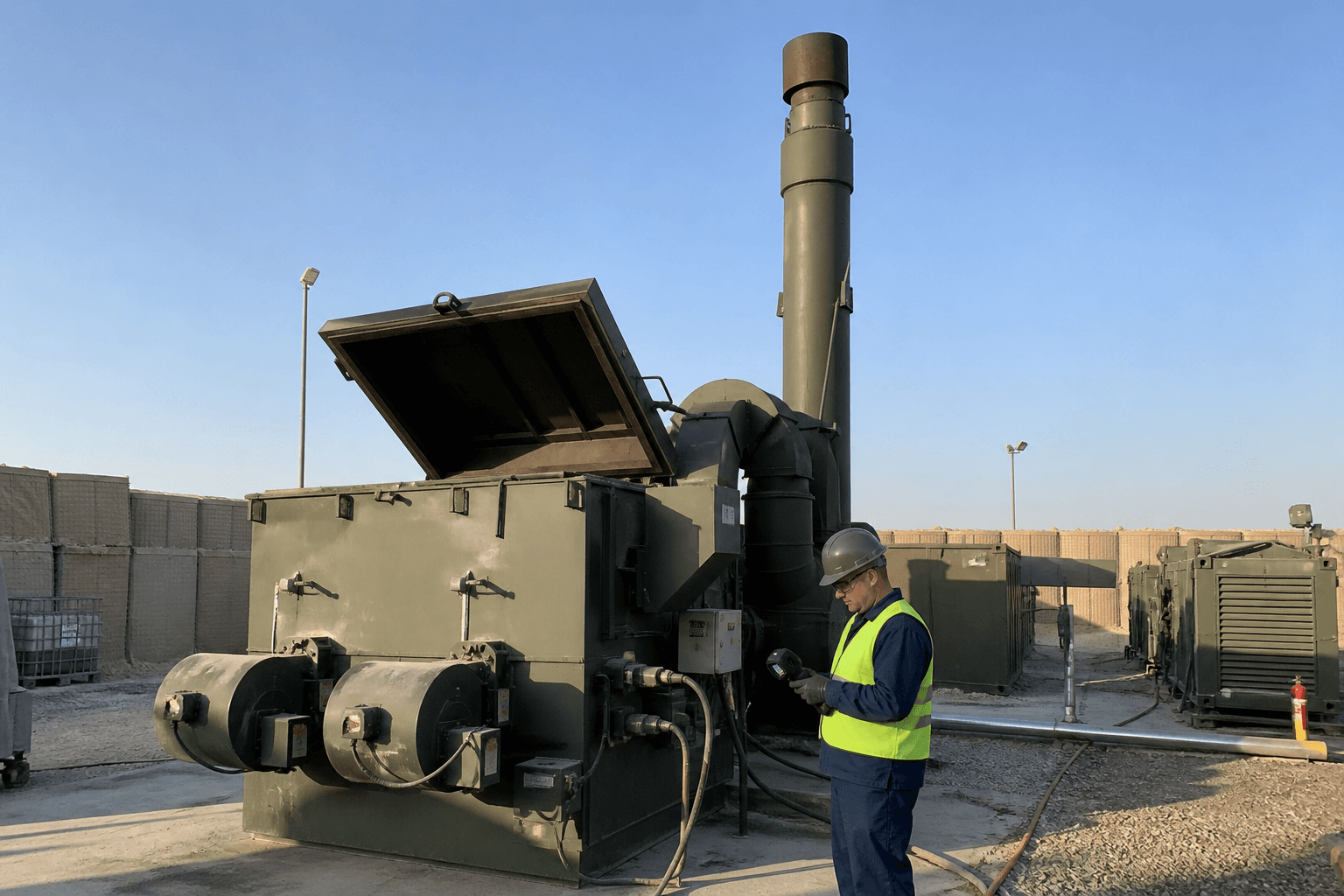
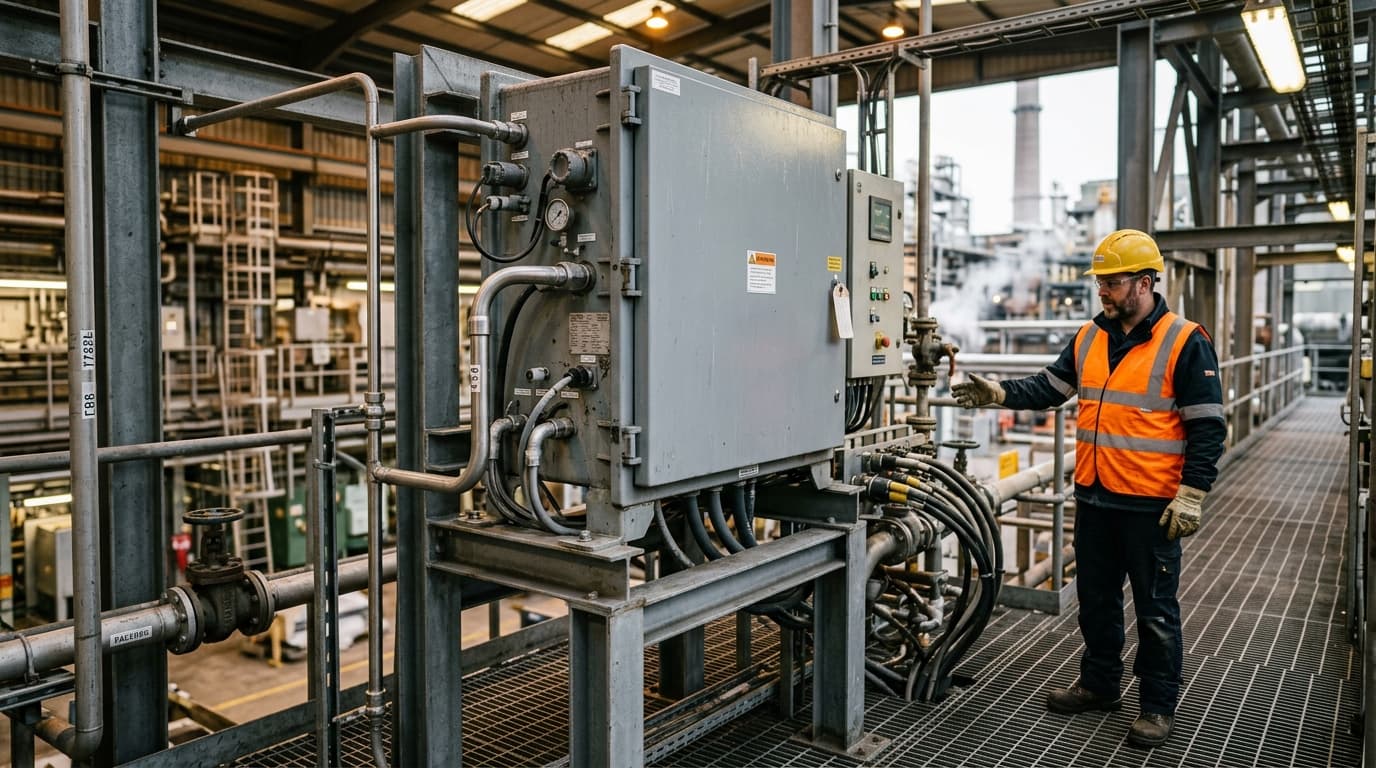
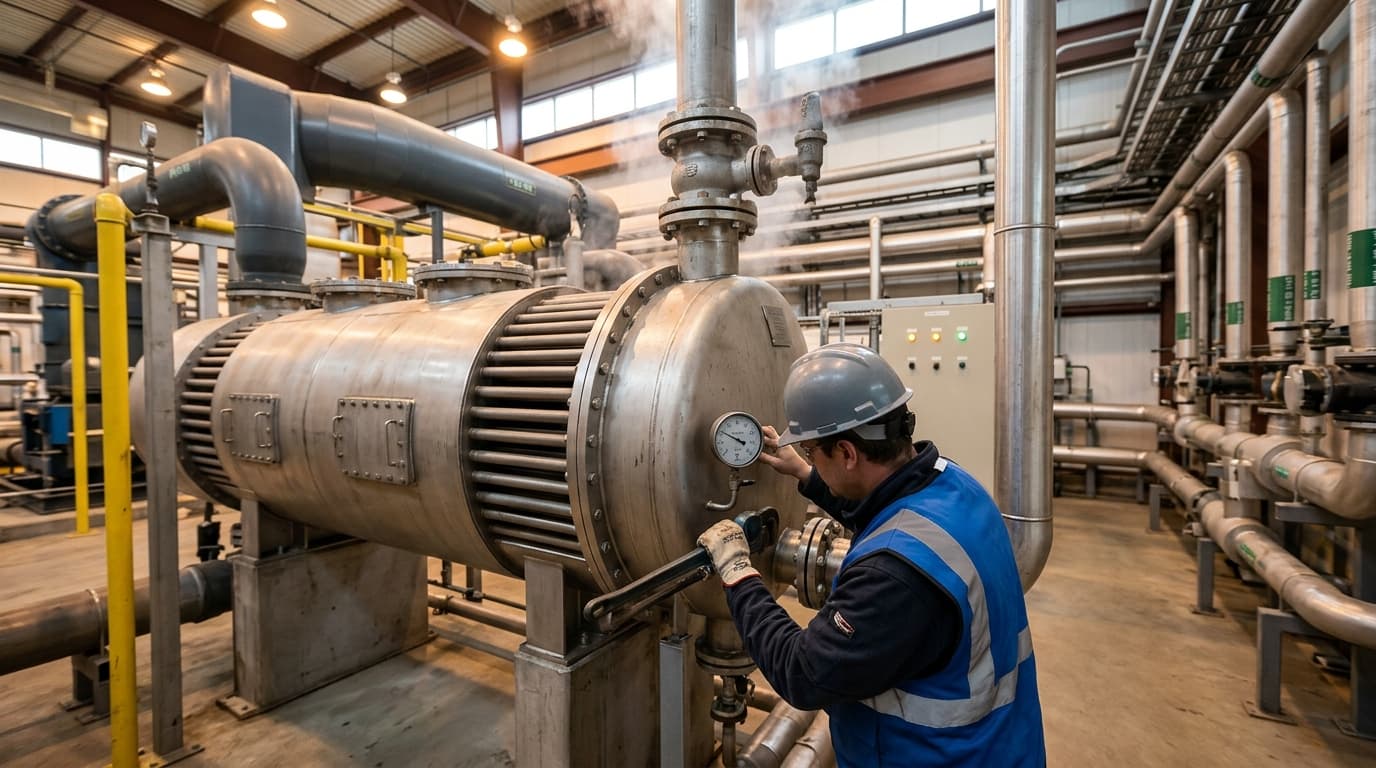
Sizing and background
- [TOOL]Work out the burn rate for your own arisings
- [TOOL]Size the combustion air and flue gas duty
- [BLOG]Fuel-to-air ratio in ammunition incinerators
- [BLOG]NOx reduction in ammunition incinerators
- [BLOG]Advanced process control for ammunition incinerators
- [BLOG]Integrating vibration analysis for incinerator predictive maintenance
- [BLOG]Advanced gas cleaning for ultra-low emission incinerators
AMBI-250 Questions
Every answer below is derived from this model's published figures, not from a generic range sheet.
The AMBI-250 takes 250 kg per charge and burns at under 50 kg/h, so the planning unit is one charge a day rather than an hourly figure. The complete cycle — first load to complete burn-down, taking in heat-up, cool-down and ash removal — runs to several hours, and the exact figure is confirmed against your own waste at commissioning. Size it on what has to be cleared per cycle.
Batch. The AMBI-250 is charged, run, and emptied as one cycle rather than fed continuously. The practical planning unit is one cycle per working day, with cool-down and ash removal before the next charge.
The AMBI-250 is specified for ammunition & ordnance waste, classified document destruction, base & field camp waste, field medical & aid post waste, uniform, insignia & id destruction and fuel, oil & contaminated absorbents. It reaches 850–1,200°C and holds flue gas above 850°C for two seconds in the secondary chamber, which is the Industrial Emissions Directive condition for these streams.
The AMBI-250 weighs 2.3 t installed; external dimensions are confirmed at quotation stage. You need clear working space around it for top loading, which usually means overhead access or a loading platform, plus a stack whose height comes out of a site-specific dispersion assessment rather than a standard figure.
Yes. Running this unit needs an environmental permit from the Environment Agency in England and Wales, SEPA in Scotland or NIEA in Northern Ireland. The waste codes for defence waste have to be named in the application, and a permit written for general waste does not silently cover them. We supply the technical data pack the permit application relies on.
The AMBI-250 runs on natural gas, hydrogen, diesel, LPG or biofuel through 2 burners. Being hydrogen-ready matters if you expect to decarbonise the site later: the unit does not need replacing when the fuel supply changes.
Thirty minutes from cold to operating temperature. From there it runs between 850°C and 1,200°C, with a 2.0-second gas retention time in the secondary chamber and a Coretex refractory lining. Control is through an IP6X-rated PLC panel.
Ash residue is 3–5% of input mass, so roughly 95% of what you load stops being a disposal cost. On a 250 kg charge that leaves about 10 kg of ash to remove — the only fraction still attracting gate fees and Landfill Tax.
Because the transfer itself is the risk. Once protectively marked material leaves the perimeter it is in someone else's chain of custody, and the establishment is relying on a certificate rather than on having watched it happen. On-site incineration removes the transfer entirely — the material is destroyed where it was generated, by staff who already hold the clearance to handle it.
Yes. These are batch units: a charge is loaded, the door is secured, and the burn runs as a discrete cycle rather than a continuous feed. That makes it straightforward to have a nominated witness present for the charge and to record the cycle against a destruction register. The ash that remains is 3–5% of input mass with no recoverable structure.
Yes. Crown status does not exempt a site from the environmental permitting regime. Burning waste requires a permit from the Environment Agency in England and Wales, SEPA in Scotland or NIEA in Northern Ireland, and the application needs the same technical data pack as any commercial operator. We supply that pack as part of the specification.
Is the AMBI-250 the right size?
Send your waste streams and weekly arisings. We will confirm the model, the permit route for your site, and what the disposal-cost case looks like with fuel and capital included.