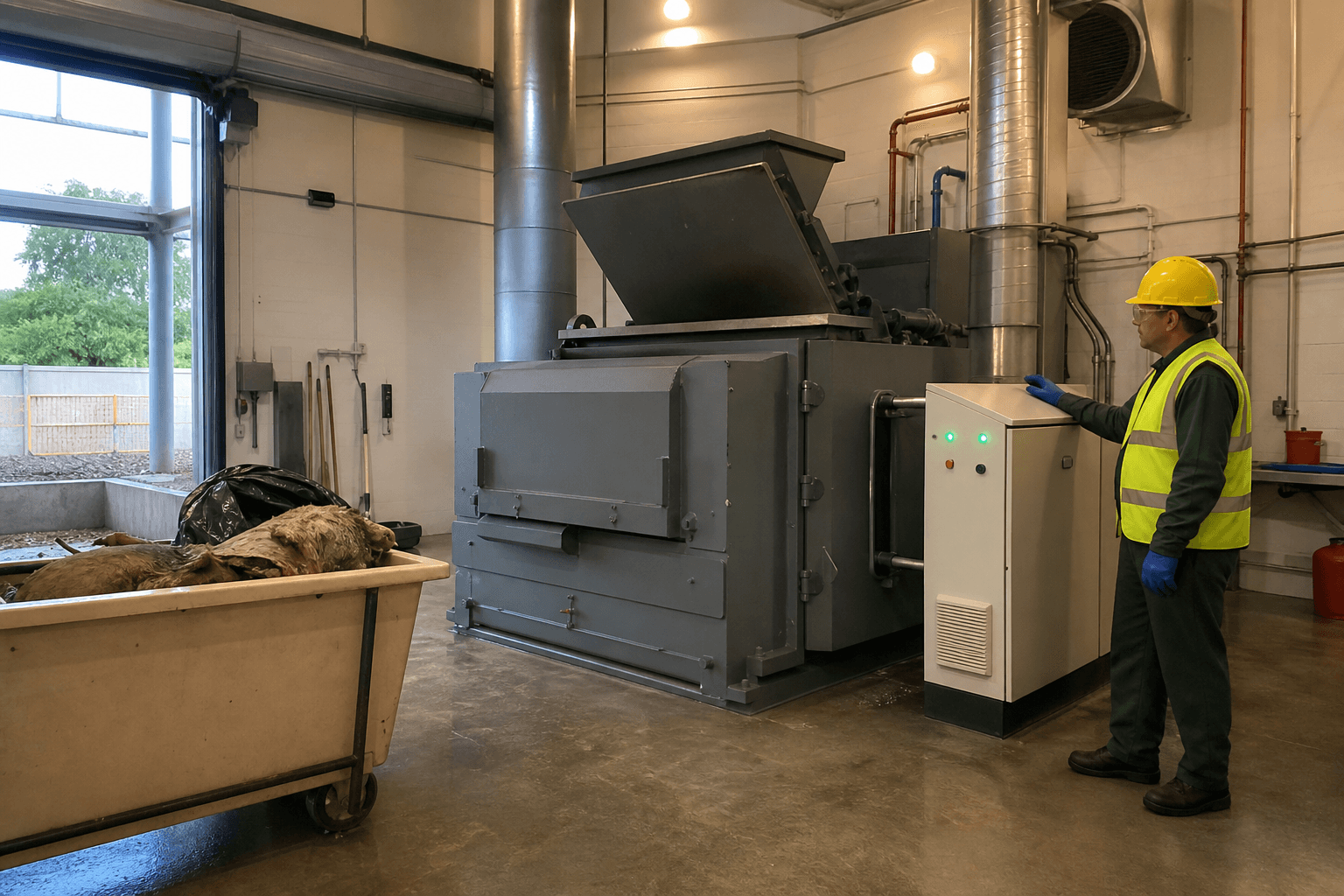
Abattoir & Slaughterhouse Waste Incinerators
Condemned carcasses, SRM and gut content destroyed on site. Sized for small and craft abattoirs, not high-throughput plants.
Every slaughter operation produces material that must not enter the food or feed chain: specified risk material, carcasses condemned at inspection, gut content and trimmings. AniBurn units destroy that fraction on site — which suits a small or craft abattoir and an on-farm slaughter unit, not a high-throughput plant.
Three Models,
One Solution
150 kg per charge for veterinary practices, small farms and pet cremation. The chamber is tall relative to its load rating because carcass waste is bulky and wet — volume, not weight, is the binding constraint.
250 kg per charge with a 2880 mm chamber. The usual specification for a working livestock farm that needs fallen stock dealt with on site under biosecurity rules rather than held for collection.
The largest AniBurn: 300 kg per charge in a 3180 mm chamber. Sized for commercial pet crematoria and larger livestock units where a single daily cycle has to clear everything held in cold storage.
Which Model
Fits Your Volume
Pick a model to see what it clears in a day of abattoir & slaughter waste.
A craft or small abattoir's condemned fraction from one kill day, with the by-product category confirmed before the charge is loaded.
The category decides everything
Material is category 1, 2 or 3 under the retained ABP Regulation, and the category sets the lawful route. The plant's APHA approval is category-specific: check it covers what you intend to charge before, not after.
Specified risk material must be separated and stained
SRM is removed at dressing, stained so it is identifiable, and destroyed by an approved route. It cannot go to feed rendering, it cannot be composted, and it cannot be mixed into a general by-product bin.
Environmental permit
Required from the Environment Agency, SEPA or NIEA alongside the APHA approval. On a food premises the permit sits with the plant's other consents, not in place of them.
Records have to agree
Condemnation records, the by-product register and the incinerator cycle log describe the same material. An inspection follows that trail, and a mismatch between them is what gets written up.
Why Burn It
On Site
4 things change on the day this stream stops leaving the site.
The condemned fraction leaves the same day
A rejection at inspection is a documented event with a required destination. Destroying it on site closes the loop the day it happens, rather than storing a condemned carcass in a plant that also handles food.
No chilled store for by-product
Waiting on a collection means refrigerated storage for material with no value, taking space and power in a building where both are expensive.
Small operations get a proportionate route
Craft and mobile abattoirs are too small to be attractive to a by-product collector and too regulated to improvise. An on-site unit is a route sized to what they actually produce.
Fewer vehicles through a food premises
Every by-product collection is a vehicle movement into a licensed food building. Removing routine collections removes a documented hygiene interface.
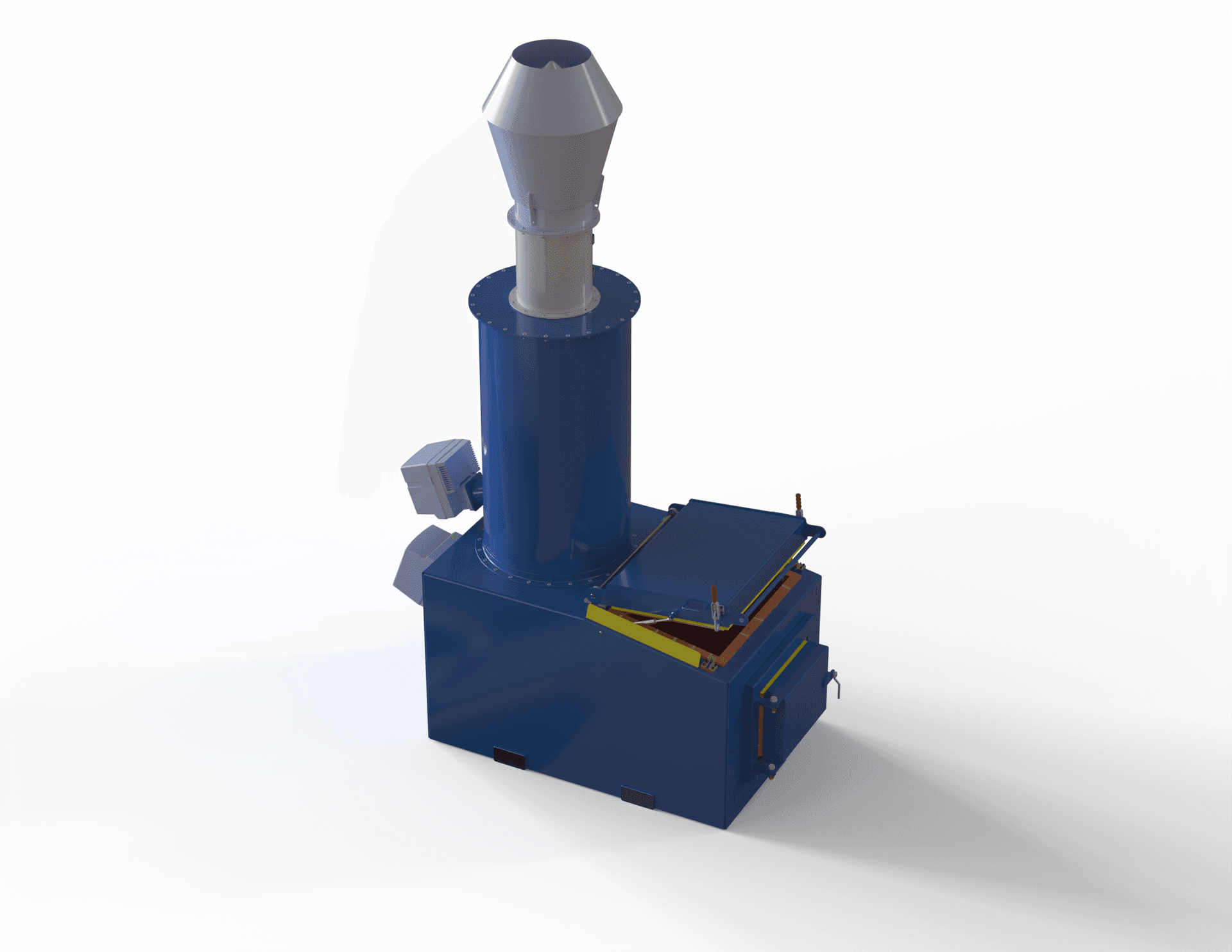
Dual-chamber unit
Primary chamber running 850–1,200°C with a secondary chamber holding flue gas above 850°C for two seconds. For animal by-products this is not a preference: it is the combustion condition an APHA-approved incineration plant has to meet.
Two-burner set and fuel train
All three AniBurn models carry two burners, configured for natural gas, LPG, diesel, biofuel or hydrogen. Carcass waste is wet, so burner duty on this stream is doing more evaporation than on any other — fuel choice is a site decision, the combustion condition is not.
What Ships
With The Unit
Identical whichever stream it is specified for. The operating procedure changes; the machine does not.
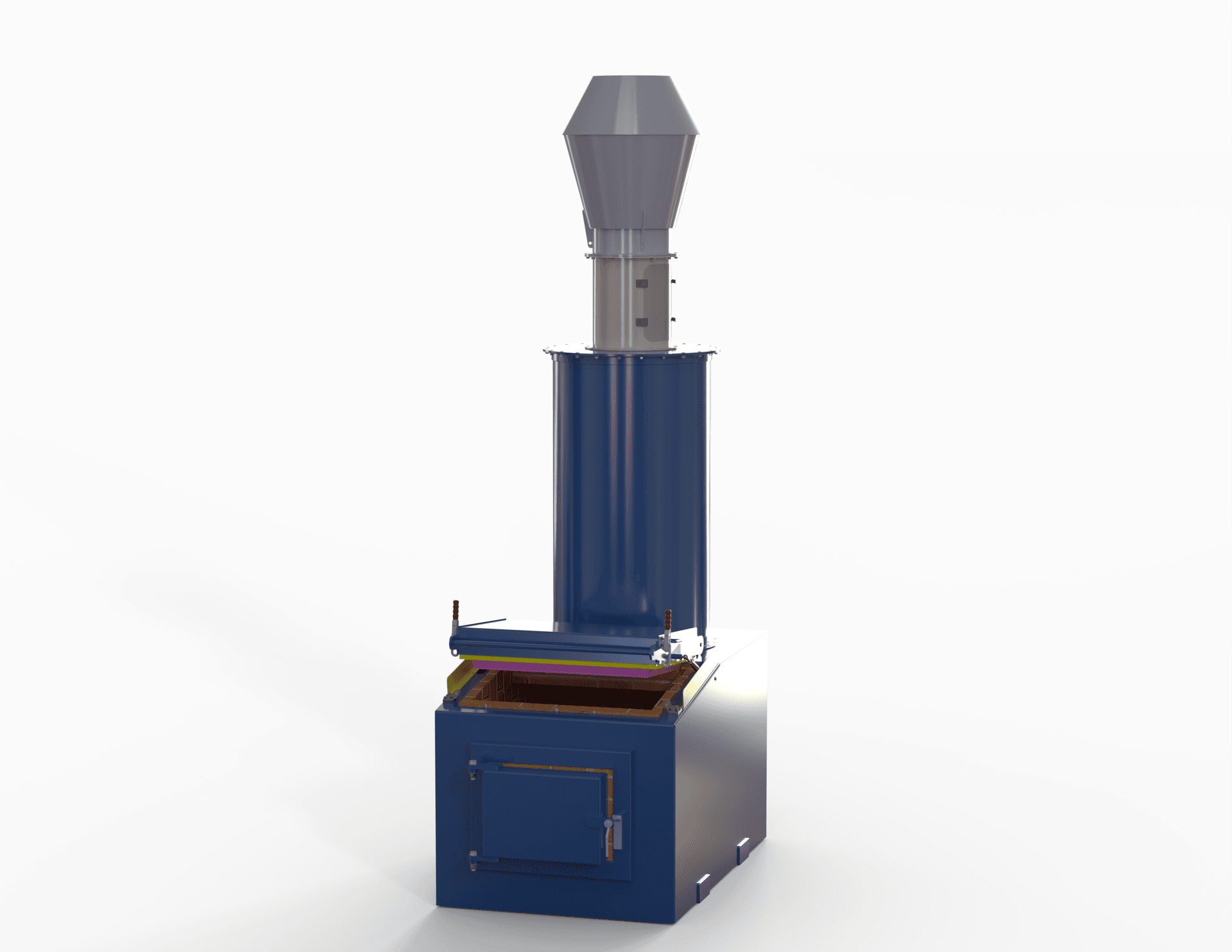
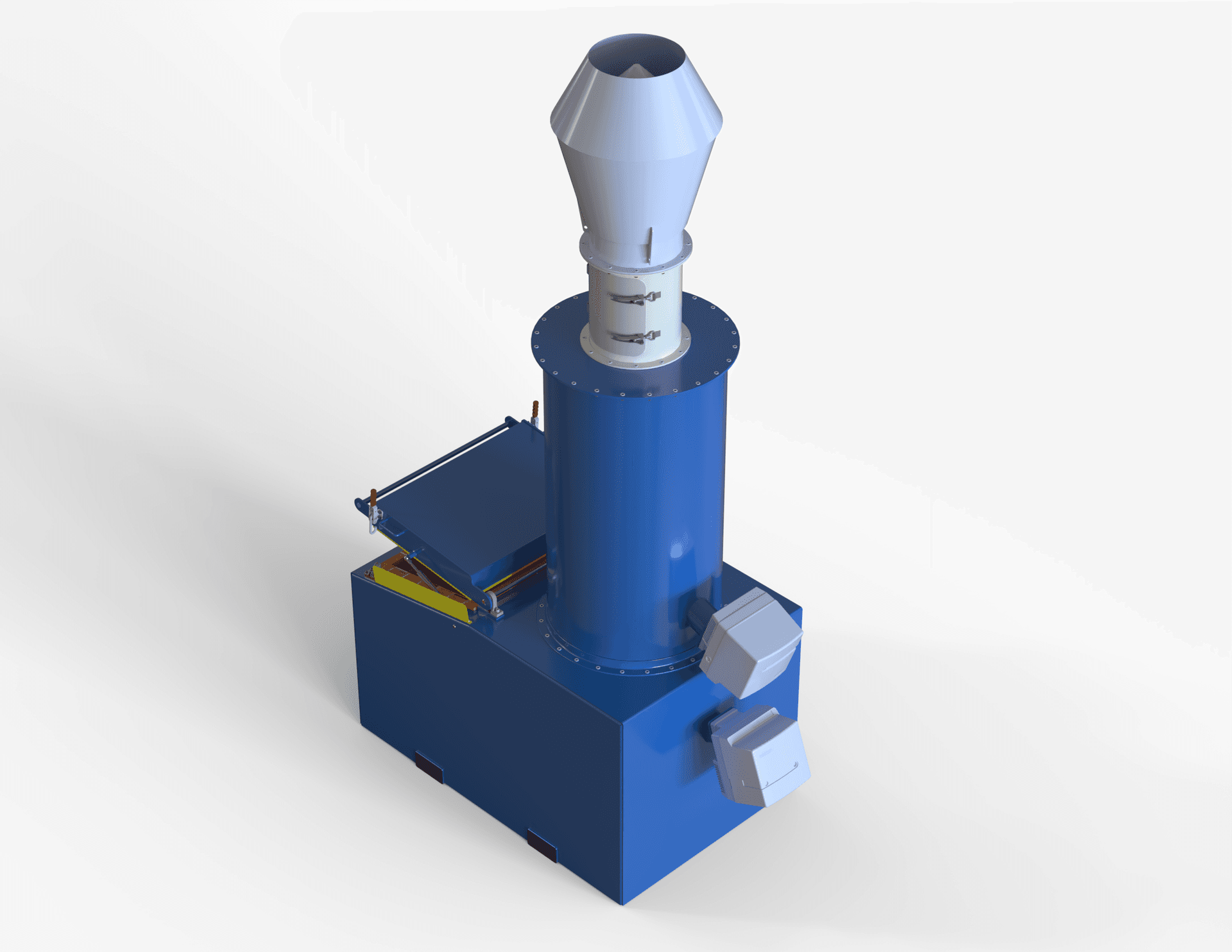
Dual-chamber unit
Primary chamber running 850–1,200°C with a secondary chamber holding flue gas above 850°C for two seconds. For animal by-products this is not a preference: it is the combustion condition an APHA-approved incineration plant has to meet.
Two-burner set and fuel train
All three AniBurn models carry two burners, configured for natural gas, LPG, diesel, biofuel or hydrogen. Carcass waste is wet, so burner duty on this stream is doing more evaporation than on any other — fuel choice is a site decision, the combustion condition is not.
Top-loading charge door
Carcasses are dead weight and awkward to handle. Top loading means a carcass goes in from above with a hoist, loader or teleporter rather than being dragged through a door at chest height, which is the difference between a two-person job and a one-person one.
IP6X control panel
PLC control with cycle logging and chamber thermocouples. The cycle log is the record that a fallen-stock disposal, an APHA-directed cull or an individual pet cremation actually happened, and when.
Coretex refractory lining
Monolithic castable lining rated for the full temperature range, replaceable in service. Wet, fatty loads are the hardest duty a refractory sees, which makes lining quality the thing that decides service life on this stream rather than on any other.
Stack, dispersion data and commissioning
Stack supplied to the height your site-specific dispersion assessment calls for, with the emissions data the permit application references, plus on-site commissioning and operator training. On a livestock unit the neighbours are the reason the assessment matters.
How One Burn Runs,
Start To Finish
One charge is one countable event. That is what makes a batch unit auditable and a continuous one not.
One Cycle,
Start To Finish
Adds the by-product category as the controlling question: category 1 material carries the strictest route, and the approval has to cover the category before the charge is loaded.
Establish whether the material is category 1, 2 or 3 under the retained ABP Regulation. Category decides the route, and the plant's approval has to cover the category being charged before it is loaded.
Specified risk material is separated at the point of dressing and stained, so it is identifiable as category 1 from that moment on. It does not get mixed back into a general by-product bin.
Condemned carcasses, offal bins and trimmings go in from above with a hoist or bin tipper. Watch the rating: 150, 250 or 300 kg per charge is a kill day's condemned fraction, not a kill day's total by-product.
Primary combustion at 850–1,200°C with two seconds above 850°C in the secondary chamber. Wet gut content and fatty trimmings burn very differently — a mixed charge runs more evenly than either alone.
3–5% sterile ash. Log the cycle against the condemnation records and the by-product register: the paperwork trail is what an inspection follows, and the two have to agree.
What You Can Burn —
And What You Can't
One charge takes the whole stream without pre-sorting. What must never enter it is a short, hard list.
Yes: accepted in a charge
No pre-sorting between these
- Condemned carcasses and partsMaterial condemned at post-mortem inspection, and casualty animals condemned before slaughter.
- Specified risk materialWhere the plant's approval covers category 1. This is the fraction with no by-product route at all, which is what makes on-site destruction worth the permit.
- Gut content and dressing wasteStomach and gut content, and trimmings from dressing that have no category 3 outlet.
- Small blood volumesWhere the quantity is small and it is not going for processing. Charged with absorbent rather than as free liquid.
- Rejected hides and hoovesMaterial turned back from the by-product route and left with nowhere else to go.
- Residue and lairage rejectionsMaterial rejected on residue or contamination grounds, ante-mortem casualties that died in lairage, and waste from an on-farm or mobile slaughter operation.
No: never charged
Not a permit question — these stay out
- Category 1 material where the approval does not cover itThe approval is category-specific. Charging category 1 material into a plant approved only for category 2 or 3 is a serious breach, and the distinction is not visible in the bin — it is in the paperwork.
- A high-throughput plant's daily by-productA scale limit, not a rule. Hundreds of animals a day produces tonnes of by-product per shift. At 150–300 kg per charge and roughly one charge a day, that needs a rendering contract, not a batch incinerator.
- Category 3 material with a working commercial routeA commercial point. Category 3 by-product has value in pet food, rendering and other processing. Burning it converts a saleable output into a fuel bill.
- Bulk blood and liquid effluentLiquid cannot be charged into a batch chamber and is handled through the plant's effluent and by-product systems.
- Cleaning chemicals, sanitisers and their containersPlant chemicals are regulated waste with a dedicated route, and concentrated sanitiser has no business in a combustion chamber.
- Packaging, wrap and crates from the cutting roomPolymer packaging melts, fouls the chamber and can carry halogenated content that changes the permit condition. It belongs in the plant's recycling stream.
Can you legally burn abattoir & slaughter waste on site?
Technically, yes: the chamber destroys almost everything on the accepted list at 850–1,200°C, and capability is rarely the constraint. Legally is a separate question. What your site is allowed to burn is set by your environmental permit from the Environment Agency, SEPA or NIEA and the waste codes written into it, plus APHA approval, because animal by-products are regulated under their own rules. The never-charged list is different again: those materials are out of scope for the unit or governed by a direction, and no permit wording brings them back in. Send us the codes you hold, or the ones you expect to apply for, and we will tell you which of this list they cover before anything is specified.
Send us your waste codesWhat size incinerator for a small abattoir's condemned fraction?
Arithmetic on published model figures, not a customer reference. Your numbers go through the same steps.
How This
Was Worked Out
≈180 kg of condemned material against the ABI-250's 250 kg rating = one charge, occupying most of a working day, and 5–9 kg of ash at 3–5%. Note what this figure is: the condemned and category 1 fraction of a small abattoir's day, not its total by-product output. Size on the fraction that has to be destroyed, and keep a processing route for the rest.
Most of a working day
5–9 kg
None for this fraction
Send your daily or weekly arisings and we will confirm the model, the charge count and the permit route.
Related Products
& Services
Complementary equipment and engineering services for your process.
Sizing and background
- [TOOL]Work out the burn rate for your own arisings
- [TOOL]Size the combustion air and flue gas duty
- [BLOG]Optimising animal carcass incinerators for UK bio-security
- [BLOG]The long-term operational costs of animal carcass incinerators
- [BLOG]Training programmes for animal incinerator operators
- [BLOG]Minimising the environmental impact of animal incinerators
- [BLOG]Agricultural incinerators and aquaculture waste
Abattoir & slaughter waste Questions
Answered against the published figures for the models specified for this stream, not a generic range sheet.
Abattoir waste is everything that leaves a slaughter operation other than meat. Under the retained ABP Regulation it splits into three categories, and the category — not the appearance of the material — decides the lawful route. Category 1 is the most tightly controlled and includes specified risk material; category 2 covers material condemned as unfit and gut content; category 3 covers by-products from animals fit for consumption but not intended for it. Specified risk material is the category most often misunderstood. It is the tissue with the highest theoretical TSE risk — parts of the skull, brain, spinal cord and vertebral column in cattle over defined ages, and equivalent tissues in sheep and goats — and it must be separated, stained and destroyed. It cannot go to rendering for feed, it cannot be composted, and it cannot be sent anywhere that is not approved for category 1 material. Condemnation at inspection is the other steady producer. A carcass or part rejected by the official veterinarian at post-mortem inspection cannot re-enter the chain, and the rejection is a documented event with a documented destination. So is gut content, stomach content and the trimmings from dressing, all of which arrive continuously through the kill day. The honest scoping point: a 150–300 kg batch unit running one charge a day suits a small abattoir, a craft or mobile slaughter operation, or an on-farm slaughter unit. A high-throughput plant killing hundreds of animals a day produces tonnes of by-product per shift and needs a rendering contract and a category 1 disposal route contracted at that scale.
≈180 kg of condemned material against the ABI-250's 250 kg rating = one charge, occupying most of a working day, and 5–9 kg of ash at 3–5%. Note what this figure is: the condemned and category 1 fraction of a small abattoir's day, not its total by-product output. Size on the fraction that has to be destroyed, and keep a processing route for the rest.
Only in a plant whose APHA approval covers category 1 material. SRM is separated at dressing, stained so it stays identifiable, and destroyed by an approved route — it cannot go to feed rendering or composting. Check the approval before assuming the unit can take it.
No. A high-throughput plant killing hundreds of animals a day produces tonnes of by-product per shift, and at 150–300 kg per charge with roughly one charge a day these units cannot approach that. They suit small and craft abattoirs, mobile operations and on-farm slaughter units.
Category 1 is the most tightly controlled and includes specified risk material. Category 2 covers material condemned as unfit and gut content. Category 3 covers by-products from animals fit for human consumption but not intended for it. The category, not the appearance, sets the lawful route.
Usually not. Category 3 material has commercial outlets in pet food and rendering, so destroying it turns a saleable output into a fuel cost. The incinerator earns its place on the condemned and category 1 fraction.
Small quantities absorbed into a mixed charge, yes. Bulk blood is a liquid and cannot be charged into a batch chamber — it goes through the plant's by-product and effluent systems.
Yes. Scale does not change the regime: the plant needs APHA approval for the categories being burned and an environmental permit from the Environment Agency, SEPA or NIEA.
The condemnation record, the by-product register and the cycle log all describe the same material and should reconcile on quantity and date. That trail is what an inspection follows, and gaps between the three are the usual finding.
An animal that dies in lairage is a fallen animal rather than a slaughtered one, and it is destroyed as an animal by-product in the same way. Where a notifiable disease is suspected, report before destroying.
Ready to
Incinerate?
Send the stream, the volume and the site constraints. We will confirm the model, the permit route, and what the specification has to say to satisfy the regulator.
- The condemned fraction leaves the same day
- No chilled store for by-product
- Small operations get a proportionate route
- Fewer vehicles through a food premises