All calculators
[Natural Convection]
Free tool

Concentric Cylinders — Natural Convection

Heat transfer across the annular gap between two concentric cylinders via effective conductivity.

[FREE_TOOLS]
Built by our engineers
[EXPLORE]
More tools, always free
[FIELD_NOTE]

Orientation alone can halve your cooling: the same plate at the same ΔT convects about twice as well with its hot face up as with its hot face down.

[LIVE_TOOL]Results update as you type
[READ_THE_NUMBERS]

Results are indicative

Figures assume typical conditions and the stated method. For measured, guaranteed numbers on your plant, our engineers run site surveys, heat loss audits, and full process models.

[NEXT_STEP]

Send us the result — we'll tell you what it means for your plant.

[ABOUT_THIS_TOOL]

Concentric Cylinders — Natural Convection

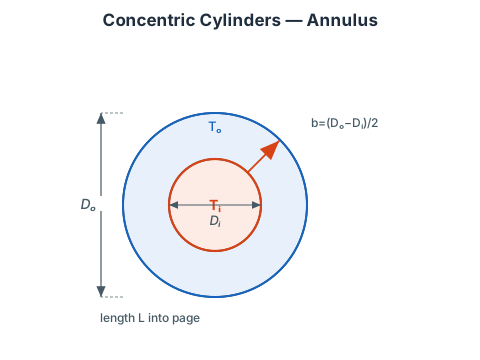
Calculates the natural-convection heat transfer across the annular gap between two long concentric cylinders held at constant temperatures Ti (inner) and To (outer). The Raithby–Hollands method represents the buoyant flow in the gap as an enhanced conduction: heat is conducted through a stationary fluid of effective conductivity keff>k.

Gap Rayleigh Number

Properties are evaluated at the mean temperature Tf=(Ti+To)/2. The characteristic length is the radial gap b=(DoDi)/2:

Rad=ν2gβ(TiTo)b3Pr

Modified Rayleigh Number and Effective Conductivity

Rac=b3(Di3/5+Do3/5)5[ln(Do/Di)]4Rad kkeff=0.386(0.861+PrPr)1/4(Rac)1/4

The correlation is valid for 102Rac107; below Rac=100 buoyancy is negligible and keff=k (pure conduction).

Heat Rate

Q=ln(Do/Di)2πkeffL(TiTo)

References

  • Raithby, G. D. and Hollands, K. G. T., A General Method of Obtaining Approximate Solutions to Laminar and Turbulent Free Convection Problems, Advances in Heat Transfer, Vol. 11, Academic Press, pp. 265–315, 1975.
  • Incropera, F. P. and DeWitt, D. P., Fundamentals of Heat and Mass Transfer, eqs. 9.58–9.60.
[UPGRADE]

Need this tool, but deeper?

We build advanced versions on request — your fluids, your geometry, your standards, validated against plant data.

[REQUEST]

Missing a calculator?

Tell us what you're sizing or estimating — we build the calculators engineers actually ask for.

[FAQ]

Frequently asked questions

Heat transfer across the annular gap between two concentric cylinders via effective conductivity. Enter your inputs and press Calculate — the worked solution shows every step of the method with your numbers substituted in.

When there is no fan, pump or significant draught — enclosures, outdoor surfaces on still days, passive heat sinks. If there is any imposed flow, compare the two mechanisms: when Gr/Re² is well below one, forced convection dominates and the forced-convection calculators are the right tools.

No — it computes the convective part only. At typical natural-convection coefficients of 2–10 W/m²·K, radiation from a painted or oxidised surface is often the same order of magnitude, so total heat loss should add a radiative term from the Radiation calculators.