All calculators
[Head-Loss]
Free tool

Duct Entrance Head Loss

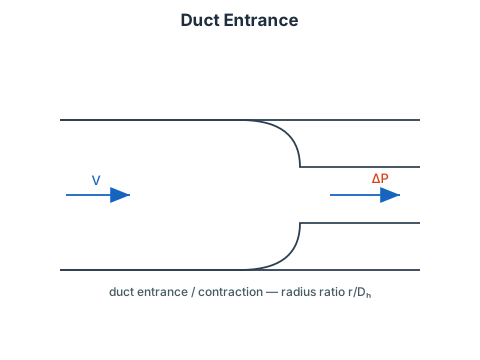
Pressure drop at a bellmouth duct entrance as a function of rounding radius.

[FREE_TOOLS]
Built by our engineers
[EXPLORE]
More tools, always free
[FIELD_NOTE]

Every K = 1 component costs one velocity head — about 60 Pa at 10 m/s in air — and fan power rises with the cube of the flow you push through it.

[LIVE_TOOL]Results update as you type
[READ_THE_NUMBERS]

Results are indicative

Figures assume typical conditions and the stated method. For measured, guaranteed numbers on your plant, our engineers run site surveys, heat loss audits, and full process models.

[NEXT_STEP]

Send us the result — we'll tell you what it means for your plant.

[ABOUT_THIS_TOOL]

Duct Entrance Head Loss

Calculates the head-loss coefficient and pressure drop at a smooth bellmouth duct (pipe) entrance as a function of the normalised rounding radius.

Rounding Ratio

x=Dhr

where r is the radius of curvature of the bellmouth and Dh is the hydraulic diameter of the duct.

  • x=0: sharp (re-entrant) entrance, K=0.50.
  • x0.20: well-rounded bellmouth, K0.03.

Loss Coefficient

A polynomial fitted to Idel'chik / ASHRAE tabulated data (accurate to ±10%):

K=235.03x4194.09x3+56.739x27.8163x+0.50

Pressure Drop

Δp=K21ρV2

where ρ is the air density and V is the mean flow velocity in the duct.

Validity

  • 0x0.20.
  • The correlation is ±10% (curve-fit accuracy).
  • The formula is for a single entrance; not applicable to re-entrant projecting entries.

Tabulated Reference Data

r/DhK
0.000.50
0.020.37
0.050.22
0.100.12
0.200.03

References

  • Roberson, J.A. and Crowe, C.T., Engineering Fluid Mechanics, 2nd Ed., Rudolf Steiner Press, London, 1976, pp. 360–384.
  • Idel'chik, I.E. and Fried, E., Flow Resistance, Taylor & Francis, 1989, p. 52.
  • ASHRAE, Handbook Fundamentals, 1977, p. 32.31.
[UPGRADE]

Need this tool, but deeper?

We build advanced versions on request — your fluids, your geometry, your standards, validated against plant data.

[REQUEST]

Missing a calculator?

Tell us what you're sizing or estimating — we build the calculators engineers actually ask for.

[FAQ]

Frequently asked questions

Pressure drop at a bellmouth duct entrance as a function of rounding radius. Enter your inputs and press Calculate — the worked solution shows every step of the method with your numbers substituted in.

K expresses a component's pressure drop in velocity heads: Δp = K·½ρV². A K of 1 means the component destroys exactly the kinetic energy of the approaching flow. It is dimensionless, so the same K applies at any flow rate — the pressure drop then scales with velocity squared.

Compute each component's Δp at its local velocity and add them, together with straight-duct friction. Where the duct area is constant you can equivalently sum the K values first. The result is the static pressure the fan must develop at that flow rate.