All calculators
[Head-Loss]
Free tool

Duct Exit Head Loss

Pressure drop at an abrupt duct exit (K = 1.0).

[FREE_TOOLS]
Built by our engineers
[EXPLORE]
More tools, always free
[FIELD_NOTE]

Every K = 1 component costs one velocity head — about 60 Pa at 10 m/s in air — and fan power rises with the cube of the flow you push through it.

[LIVE_TOOL]Results update as you type
[READ_THE_NUMBERS]

Results are indicative

Figures assume typical conditions and the stated method. For measured, guaranteed numbers on your plant, our engineers run site surveys, heat loss audits, and full process models.

[NEXT_STEP]

Send us the result — we'll tell you what it means for your plant.

[ABOUT_THIS_TOOL]

Duct Exit Head Loss

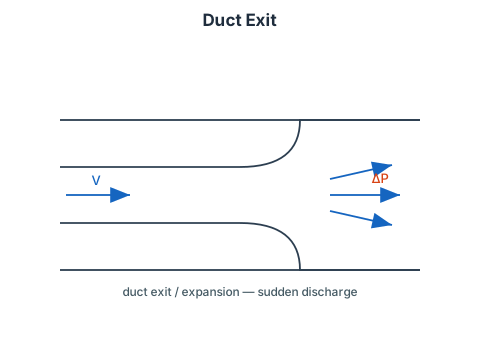
Calculates the head-loss coefficient and pressure drop for an abrupt pipe or duct exit into a large receiving space (plenum or atmosphere).

Loss Coefficient

For an abrupt (sudden expansion) exit, all of the kinetic energy of the flow is dissipated by turbulent mixing in the receiving space:

K=1.0

Pressure Drop

Δp=K21ρV2=21ρV2

where ρ is the air density and V is the mean flow velocity in the duct at the exit plane.

Physical Interpretation

The Borda–Carnot (sudden-expansion) theorem gives K=(1A1/A2)2. When the receiving space is much larger than the duct (A1/A20), this reduces to K=1.0, meaning the entire dynamic head is lost.

References

  • Idel'chik, I.E. and Fried, E., Flow Resistance, a Design Guide for Engineers, Taylor & Francis, Washington D.C., 1989, p. 349.
[UPGRADE]

Need this tool, but deeper?

We build advanced versions on request — your fluids, your geometry, your standards, validated against plant data.

[REQUEST]

Missing a calculator?

Tell us what you're sizing or estimating — we build the calculators engineers actually ask for.

[FAQ]

Frequently asked questions

Pressure drop at an abrupt duct exit (K = 1.0). Enter your inputs and press Calculate — the worked solution shows every step of the method with your numbers substituted in.

K expresses a component's pressure drop in velocity heads: Δp = K·½ρV². A K of 1 means the component destroys exactly the kinetic energy of the approaching flow. It is dimensionless, so the same K applies at any flow rate — the pressure drop then scales with velocity squared.

Compute each component's Δp at its local velocity and add them, together with straight-duct friction. Where the duct area is constant you can equivalently sum the K values first. The result is the static pressure the fan must develop at that flow rate.