All calculators
[Conduction]
Free tool

Embedded Rectangular Volume

Shape factor and heat rate for a rectangular volume buried in a semi-infinite medium.

[FREE_TOOLS]
Built by our engineers
[EXPLORE]
More tools, always free
[FIELD_NOTE]

A buried pipe's heat loss needs no mesh or simulation — a conduction shape factor reduces the whole 3-D problem to one multiplication: Q = S · k · ΔT.

[LIVE_TOOL]Results update as you type
[READ_THE_NUMBERS]

Results are indicative

Figures assume typical conditions and the stated method. For measured, guaranteed numbers on your plant, our engineers run site surveys, heat loss audits, and full process models.

[NEXT_STEP]

Send us the result — we'll tell you what it means for your plant.

[ABOUT_THIS_TOOL]

Embedded Rectangular Volume

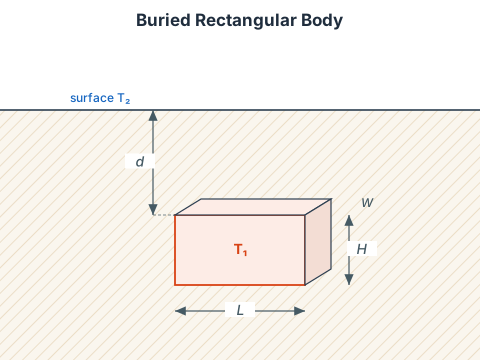
Calculates the shape factor S and heat rate Q for a rectangular parallelepiped of dimensions L×W×H buried at depth d in a semi-infinite medium of thermal conductivity k, below an isothermal surface.

Shape Factor

The empirical correlation (Holman, 1990) is:

S=1.685L[log10(1+Wd)]0.59(Hd)0.078

where log10 is the common logarithm (base 10).

Heat Transfer Rate

Q=Sk(TbTi)

where Tb is the body temperature and Ti is the isothermal surface temperature.

Thermal Resistance

R=kS1[K/W]

Reference

Holman, J. P., Heat Transfer, 7th ed., McGraw-Hill, 1990, pp. 74–83.

[UPGRADE]

Need this tool, but deeper?

We build advanced versions on request — your fluids, your geometry, your standards, validated against plant data.

[REQUEST]

Missing a calculator?

Tell us what you're sizing or estimating — we build the calculators engineers actually ask for.

[FAQ]

Frequently asked questions

Shape factor and heat rate for a rectangular volume buried in a semi-infinite medium. Enter your inputs and press Calculate — the worked solution shows every step of the method with your numbers substituted in.

The conductivity of the medium between the two isothermal surfaces — soil or concrete for buried objects, the layer material for walls. The tools include a table of common materials; use a measured value when you have one, since soil conductivity especially varies with moisture content.

For geometries within their validity limits they typically agree with full numerical solutions to within a few percent. The worked solution reports which case or correlation was applied, so you can check the limits against your geometry.