All calculators
[Forced Convection]
Free tool

Fully-Developed Tube Flow

Heat transfer coefficient for fully-developed laminar or turbulent flow in a smooth tube.

[FREE_TOOLS]
Built by our engineers
[EXPLORE]
More tools, always free
[FIELD_NOTE]

In turbulent flow h scales with velocity to the power 0.8 — doubling the air speed buys you roughly 75% more heat transfer, not double.

[LIVE_TOOL]Results update as you type
[READ_THE_NUMBERS]

Results are indicative

Figures assume typical conditions and the stated method. For measured, guaranteed numbers on your plant, our engineers run site surveys, heat loss audits, and full process models.

[NEXT_STEP]

Send us the result — we'll tell you what it means for your plant.

[ABOUT_THIS_TOOL]

Fully-Developed Tube Flow

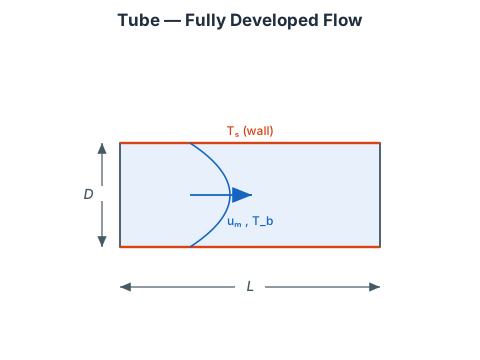
Calculates the convective heat transfer coefficient for hydrodynamically and thermally fully-developed flow inside a smooth circular tube.

Film Temperature

Fluid properties are evaluated at the film temperature (average of wall and bulk):

Tf=2Tw+Tb

Reynolds Number

ReD=μρumD

Nusselt Number

Laminar flow (Re < 2 300) — uniform heat flux boundary:

Nu=4.36

Turbulent flow (2 300 ≤ Re < 5 × 10⁶):

f=(0.79lnRe1.64)2 Nu=1+12.7f/8(Pr2/31)(f/8)(Re1000)Pr

This is the Gnielinski correlation, valid for 0.5 < Pr < 2 000.

Heat Transfer Coefficient and Heat Rate

h=DNuk Q=h(πDL)(TwTb)

Validity

  • Reynolds number: laminar < 2 300; turbulent 2 300 – 5 × 10⁶
  • Prandtl number: 0.5 – 2 000
  • Smooth tube; fully-developed both hydrodynamically and thermally
  • Transition region (2 300 < Re < 10 000) predictions are approximate

References

  • Gnielinski, V., Int. Chem. Eng., 16, 359, 1976.
  • Incropera, F.P. and DeWitt, D.P., Fundamentals of Heat and Mass Transfer, 3rd ed., John Wiley & Sons, eq. 8.53, 8.63a & 8.63b, 1990.
[UPGRADE]

Need this tool, but deeper?

We build advanced versions on request — your fluids, your geometry, your standards, validated against plant data.

[REQUEST]

Missing a calculator?

Tell us what you're sizing or estimating — we build the calculators engineers actually ask for.

[FAQ]

Frequently asked questions

Heat transfer coefficient for fully-developed laminar or turbulent flow in a smooth tube. Enter your inputs and press Calculate — the worked solution shows every step of the method with your numbers substituted in.

Fluid properties like viscosity and conductivity change strongly with temperature, so correlations specify evaluating them at the film temperature — the average of the surface and free-stream (or wall and bulk) temperatures. The calculator does this automatically through its built-in property database.

The underlying correlations are empirical fits to experimental data; ±10–25% is typical depending on geometry and Reynolds range. Treat the outputs as sizing estimates — for guaranteed numbers on a specific piece of plant, measurement or validated CFD is the next step.