All calculators
[Radiation]
Free tool

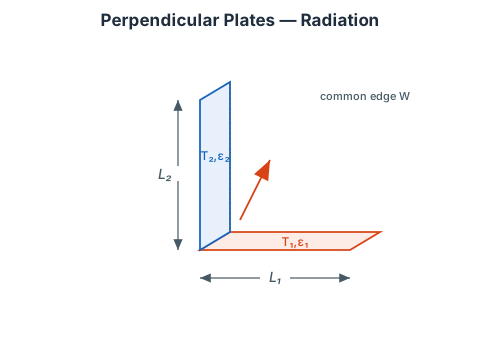
Perpendicular Plates — Common Edge

Net radiant heat exchange between two gray rectangles meeting at a common edge.

[FREE_TOOLS]
Built by our engineers
[EXPLORE]
More tools, always free
[FIELD_NOTE]

Radiation scales with absolute temperature to the fourth power — a surface at 600 °C radiates over five times more than the same surface at 300 °C.

[LIVE_TOOL]Results update as you type
[READ_THE_NUMBERS]

Results are indicative

Figures assume typical conditions and the stated method. For measured, guaranteed numbers on your plant, our engineers run site surveys, heat loss audits, and full process models.

[NEXT_STEP]

Send us the result — we'll tell you what it means for your plant.

[ABOUT_THIS_TOOL]

Perpendicular Plates Sharing a Common Edge

Computes the net radiant heat exchange between two isothermal gray surfaces that share a common edge and meet at right angles. Each plate extends a distance L1 (or L2) away from the shared edge, which has width W.

View Factor

With the dimensionless ratios

x=WL1,y=WL2

the shape factor between two perpendicular rectangles with a common edge is

F12=πx1[xtan1x1+ytan1y1x2+y2tan1x2+y21+41lnG] G=1+x2+y2(1+x2)(1+y2)[(1+x2)(x2+y2)x2(1+x2+y2)]x2[(1+y2)(x2+y2)y2(1+x2+y2)]y2

For two equal squares meeting at a common edge (x=y=1) this gives F120.200.

Net Radiant Exchange

Treating both plates as gray, diffuse surfaces forming a two-surface enclosure, the net heat rate is

Q=ε1A11ε1+A1F121+ε2A21ε2σ(T14T24)

with σ=5.670374×10⁸ W/m2K4, A1=L1W, A2=L2W, and temperatures in Kelvin. When both surfaces are black (ε1=ε2=1) this reduces to Q=σA1F12(T14T24).

References

[UPGRADE]

Need this tool, but deeper?

We build advanced versions on request — your fluids, your geometry, your standards, validated against plant data.

[REQUEST]

Missing a calculator?

Tell us what you're sizing or estimating — we build the calculators engineers actually ask for.

[FAQ]

Frequently asked questions

Net radiant heat exchange between two gray rectangles meeting at a common edge. Enter your inputs and press Calculate — the worked solution shows every step of the method with your numbers substituted in.

A gray surface has an emissivity that is constant across wavelength, so one number ε between 0 and 1 characterises how it emits and absorbs. It is the standard engineering idealisation; real oxidised metals and painted surfaces follow it closely enough for plant calculations.

Use the built-in table as a starting point: polished aluminium is around 0.05, oxidised steel around 0.8, painted or anodised surfaces around 0.9. Surface condition dominates — use the in-service condition, not the as-machined one.