All calculators
[Natural Convection]
Free tool

Vertical Channel — Isothermal

Average h and heat rate for a symmetric isothermal vertical parallel-plate channel.

[FREE_TOOLS]
Built by our engineers
[EXPLORE]
More tools, always free
[FIELD_NOTE]

Orientation alone can halve your cooling: the same plate at the same ΔT convects about twice as well with its hot face up as with its hot face down.

[LIVE_TOOL]Results update as you type
[READ_THE_NUMBERS]

Results are indicative

Figures assume typical conditions and the stated method. For measured, guaranteed numbers on your plant, our engineers run site surveys, heat loss audits, and full process models.

[NEXT_STEP]

Send us the result — we'll tell you what it means for your plant.

[ABOUT_THIS_TOOL]

Vertical Parallel-Plate Channel — Isothermal

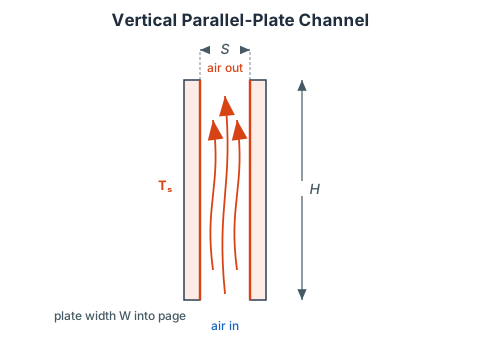
Calculates the average convective heat transfer coefficient and total heat rate for a symmetric vertical channel: two parallel isothermal plates separated by a spacing S, open to ambient at both ends. Buoyancy drives a chimney-like flow up the gap. When the plates are close together the flow becomes fully developed (the Elenbaas limit); when they are far apart each plate behaves as an isolated vertical plate. The Bar-Cohen & Rohsenow composite correlation bridges the two limits smoothly.

Channel Rayleigh Number

Properties are evaluated at the film temperature Tf=(Ts+T)/2. The spacing S is the characteristic length:

RaS=ν2gβ(TsT)S3Pr,El=RaSHS

Nusselt Number (composite)

NuS=[El2576+El1/22.873]1/2

The first term dominates at small El (fully-developed flow) and the second at large El (isolated-plate limit).

Heat Transfer Coefficient and Heat Rate

h=SNuSk,Q=hA(TsT),A=2HW

References

  • Bar-Cohen, A. and Rohsenow, W. M., Thermally Optimum Spacing of Vertical, Natural Convection Cooled, Parallel Plates, J. Heat Transfer, 106, 116, 1984.
  • Incropera, F. P. and DeWitt, D. P., Fundamentals of Heat and Mass Transfer, eq. 9.45.
[UPGRADE]

Need this tool, but deeper?

We build advanced versions on request — your fluids, your geometry, your standards, validated against plant data.

[REQUEST]

Missing a calculator?

Tell us what you're sizing or estimating — we build the calculators engineers actually ask for.

[FAQ]

Frequently asked questions

Average h and heat rate for a symmetric isothermal vertical parallel-plate channel. Enter your inputs and press Calculate — the worked solution shows every step of the method with your numbers substituted in.

When there is no fan, pump or significant draught — enclosures, outdoor surfaces on still days, passive heat sinks. If there is any imposed flow, compare the two mechanisms: when Gr/Re² is well below one, forced convection dominates and the forced-convection calculators are the right tools.

No — it computes the convective part only. At typical natural-convection coefficients of 2–10 W/m²·K, radiation from a painted or oxidised surface is often the same order of magnitude, so total heat loss should add a radiative term from the Radiation calculators.