Closing the Loop on Moisture and Oil Across Snack Fryer Lines
A multi-line continuous snack frying facility in UK was controlling final product moisture and oil content through operator intervention and periodic laboratory testing. Moisture and oil readings were typically available only every two hours, leaving the production team to judge fryer temperature and line speed between samples. The site engaged EnerTherm Engineering to provide continuous measurement, automated correction and production data visibility across several fryer lines.
Quality control was delayed by the sampling cycle
Final moisture affects texture, shelf life and product yield. Oil content also influences texture, flavour, ingredient cost and the declared nutritional value on pack. Before the project, neither parameter was visible continuously at the fryer outlet.
Operators adjusted temperature and conveyor speed using experience, visual checks and delayed laboratory feedback. Changes in raw material condition, oil quality and shift operation could introduce variation long before a laboratory result identified it. Product changeovers added further risk because each recipe required manual entry of target temperatures and belt speeds.
| Before implementation | Operational consequence |
|---|---|
| Manual fryer temperature and line-speed control | Corrections depended on individual operator judgement |
| Moisture and oil samples taken up to every two hours | Process deviations could persist between laboratory results |
| Manual settings at each product changeover | Targets and drive settings could take time to stabilise |
| No live plant-network data for moisture or oil | Supervisors could not see process condition in real time |
Inline measurement at the fryer outlet
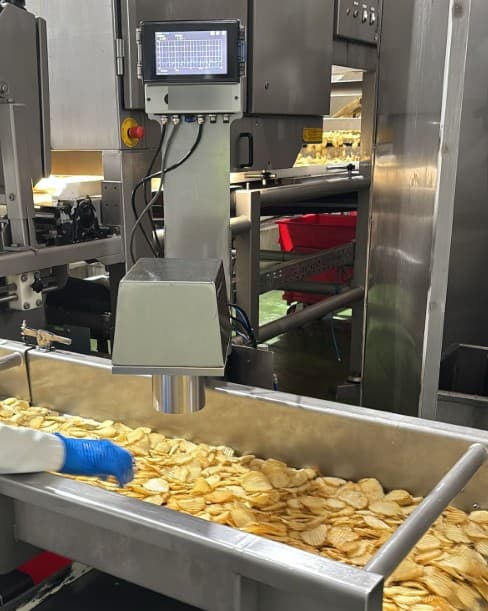
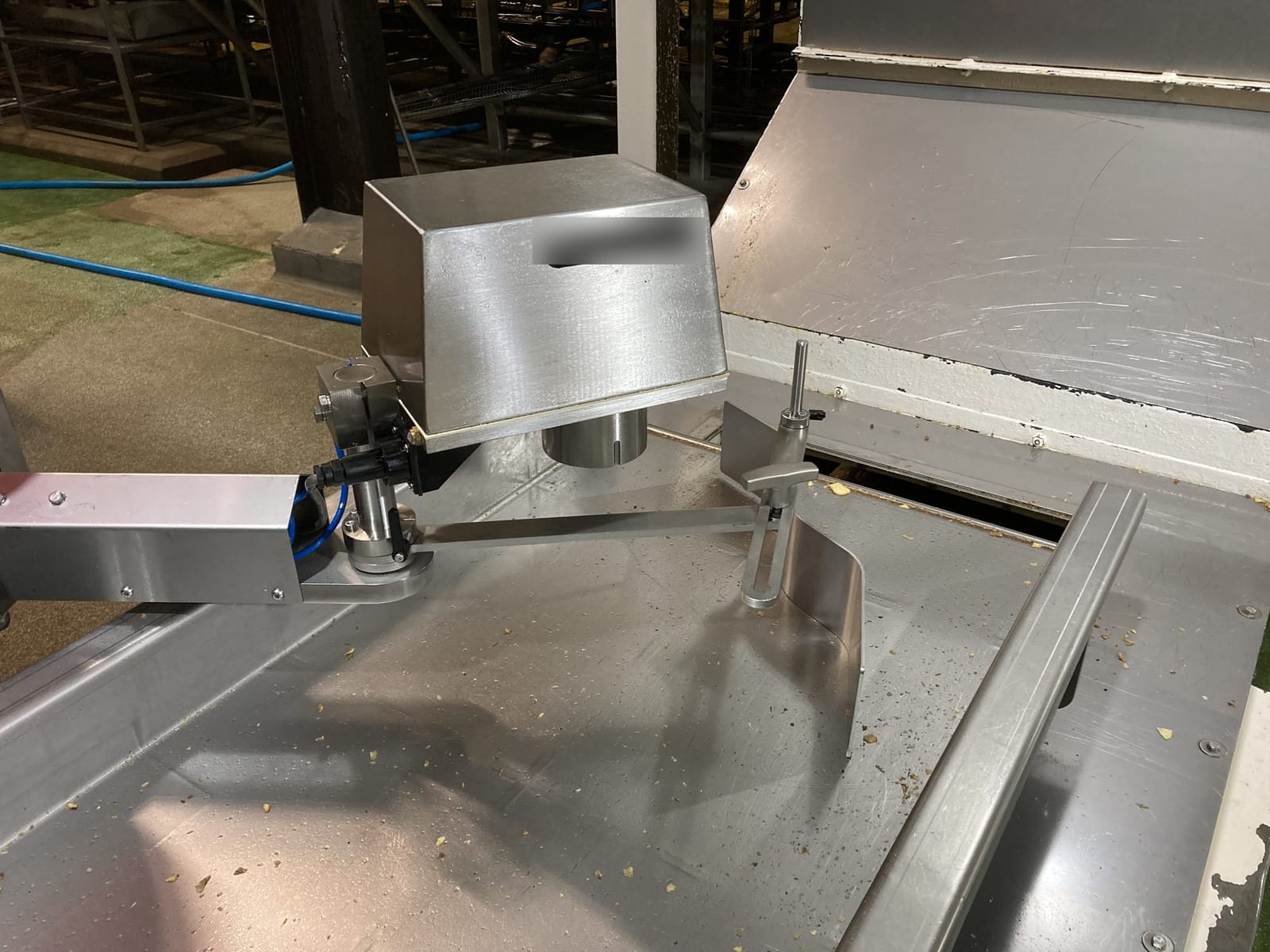
EnerTherm Engineering installed an inline sensor above the product conveyor at the fryer outlet, where it measures moisture and oil content in real time. The installation includes protected optics, air purging and mechanical product-bed guidance so that the sensor receives a consistent reading despite heat, oil mist and product fines.
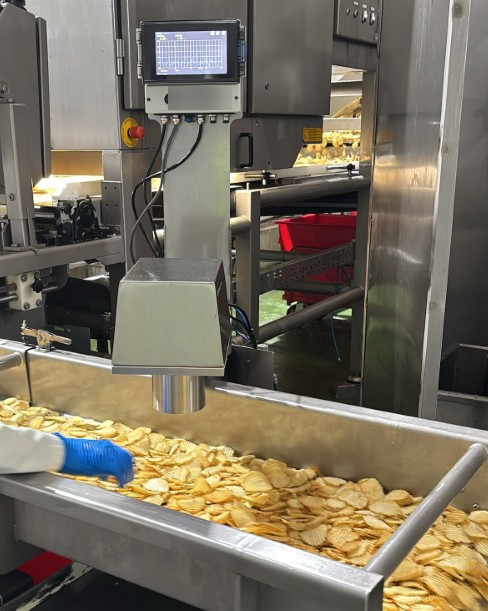
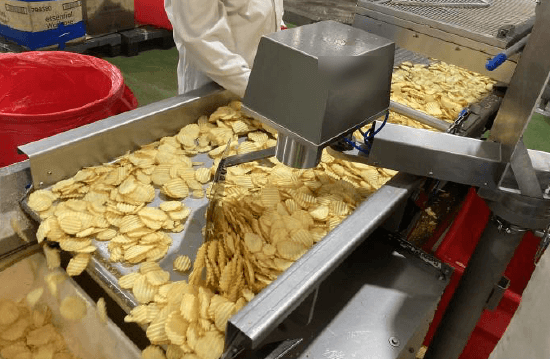
The sensor head sits above a continuous bed of fried potato slices as they leave the fryer. This location allows the control system to assess finished product rather than infer quality from upstream variables. Its local display also gives line personnel an immediate indication of operating condition.
The team designed the installation for the practical conditions around a fryer. Positive-pressure air purging keeps the sensor lens clear and protects electronics, while defined product presentation prevents the instrument from reading gaps in the product flow. Weekly site checks, scheduled deeper service and screen-based service-hour tracking support maintainable operation.
Two coordinated loops control the variables that matter
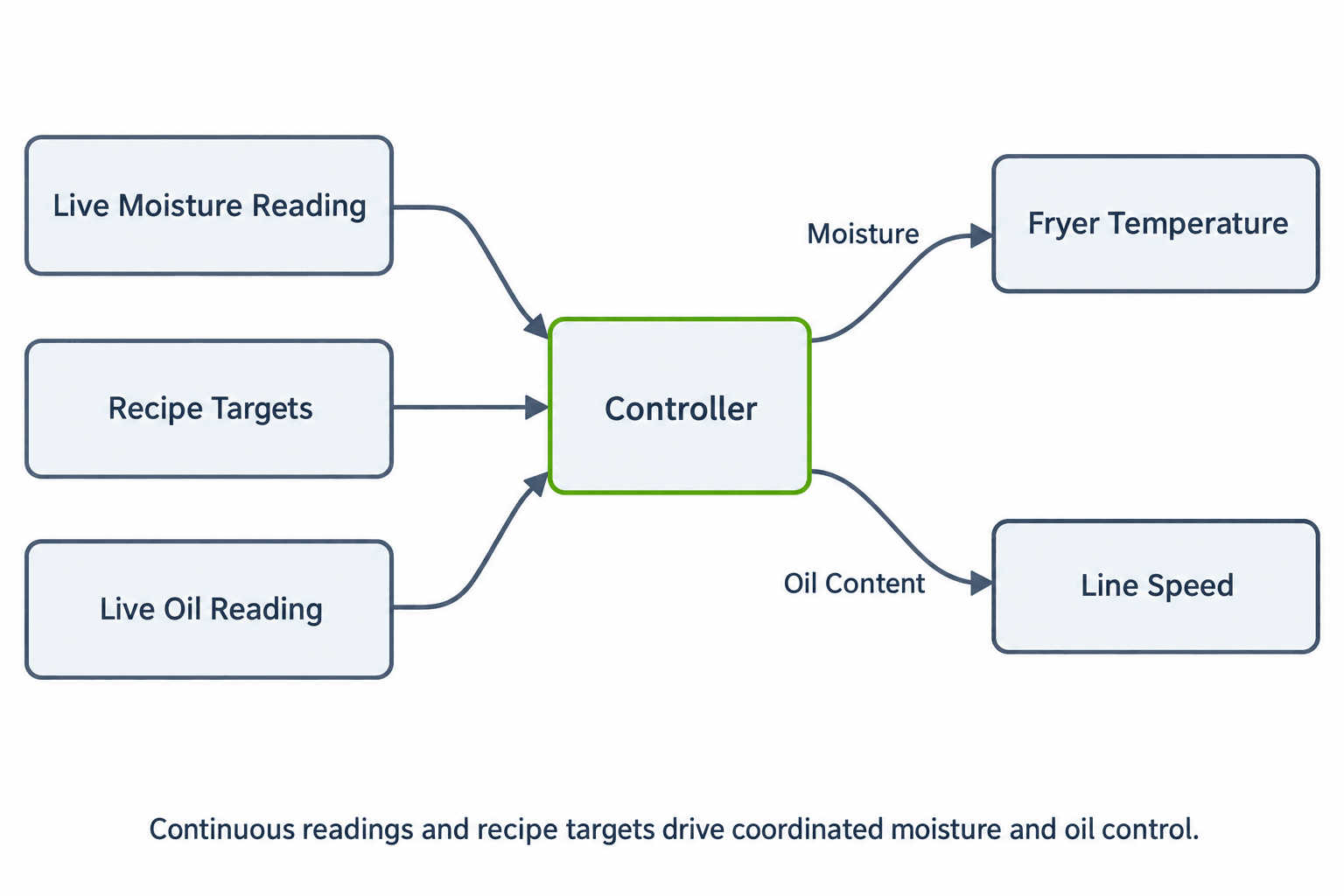
EnerTherm Engineering developed software to compare the live moisture and oil readings against recipe targets, calculate an appropriate response and adjust the relevant process variable. The controller manages two coupled loops: moisture through fryer temperature and oil content through line speed.
Moisture control through fryer temperature
When moisture moves away from its target, the controller applies a graded offset to the fryer oil-temperature setpoint. Small deviations receive small adjustments, while larger deviations receive proportionate corrections within limits set by the site. The burner then responds to the revised temperature demand.
Oil-content control through residence time
Oil uptake is strongly affected by the time each slice spends in the fryer. The controller therefore adjusts the line master speed when oil content moves from target. The infeed, wash belt, blancher, flow wheels, hold-down conveyor and take-out conveyor follow the master speed through fixed ratios, preserving product-bed consistency while changing fryer residence time.
The continuous fryer conveyor imagery reflects the importance of this relationship: a speed adjustment changes the time that the product bed remains in the frying oil. EnerTherm Engineering configured the control logic so that moisture remains the priority where the two loops require competing actions, protecting product safety and stability.
The controller waits for product to travel from the point of intervention to the outlet sensor, then averages readings over a defined window before making the next correction.
This timing model prevents the system from reacting to product that was already in the fryer before a change was made. It also avoids excessive control movement and supports stable operation during normal process variation.
Recipes, colour assessment and operator control
Each product recipe stores its own moisture and oil targets, tolerances, drive ratios, response steps and stabilisation periods. At changeover, operators load the recipe rather than manually re-entering temperature and conveyor settings. This reduces set-up activity and provides a consistent starting condition for each production run.
The control system also incorporates the site's QA/QC colour charts. Operators can grade product as too light or too dark from the same interface, and the system applies an appropriate temperature correction without requiring automatic control to be disabled.
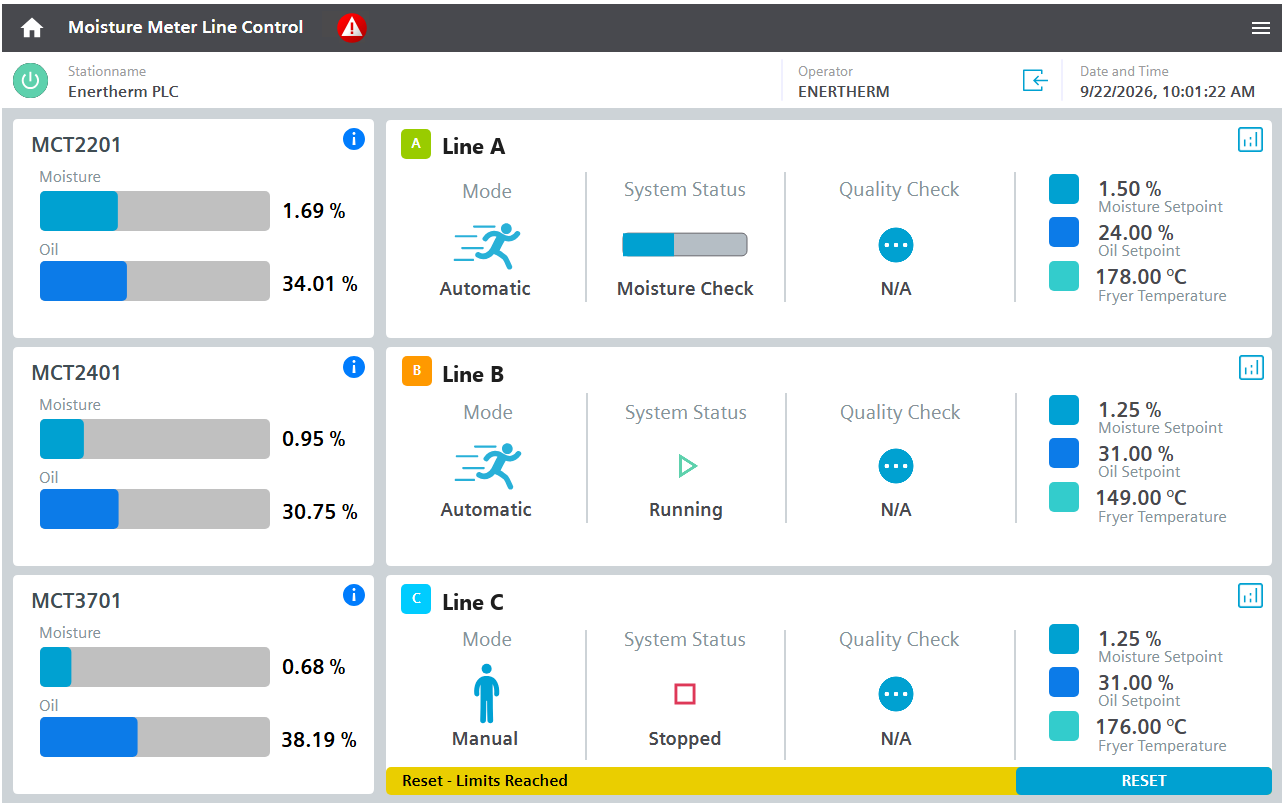
The operator overview screen presents live moisture and oil readings for Lines A to C, current operating mode, process status and active setpoints. It distinguishes conditions such as Moisture Check, Running and Stopped, and highlights conditions requiring intervention, including limit resets. Operators can select Manual, Semi-Automatic or Fully Automatic operation according to line readiness and operating confidence.
| Control readiness stage | System requirement |
|---|---|
| Process ready | Relevant equipment is confirmed in production mode |
| Product flowing | Infeed operation and product presence at the sensor are confirmed |
| Reading stable | Moisture and oil values remain stable for the configured period |
| Control engaged | The selected loops take control and the screen shows Running |
Loss of sensor communication, loss of product flow or prolonged operation outside configured limits returns the line to manual control. The safeguards keep responsibility with the operator while allowing automated control to manage routine process variation.
Integrating with existing plant automation
The facility operated equipment supplied by more than one automation vendor. EnerTherm Engineering avoided unnecessary replacement of the installed control estate by designing a dedicated control panel that interfaces with the existing plant PLCs and field equipment.
The panel and HMI connect the sensor, fryer controls and plant network while logging process and recipe data to the site database. The control panel was designed and built to BS EN 60204-1 and marked for conformity assessment in UK.
Project management covered the site survey, sensor selection, mechanical positioning, panel design, software development, automation integration, commissioning and operator training. During commissioning, the team calibrated inline readings against laboratory results, confirmed residence times and drive ratios, tuned the loops and delivered operating and maintenance documentation.
Measured operational value
The system provides continuous moisture and oil measurement at the fryer outlet on several production lines. Corrections now occur within minutes of a detected deviation rather than after the next laboratory sample. This reduces the volume of product that can move outside moisture or oil-content limits before action is taken.
EnerTherm Engineering calculated a conservative core annual saving of £13,000 per line for an example line producing 1,400 kg/h. The calculation includes reduced waste and fuel only, excluding the potential value of higher throughput, improved oil life and tighter control of oil content.
| Delivered outcome | Operational impact |
|---|---|
| Real-time moisture and oil measurement | Continuous visibility at the fryer outlet |
| Closed-loop moisture control | Fryer temperature responds to measured product condition |
| Closed-loop oil-content control | Line speed adjusts fryer residence time within defined limits |
| Recipe-driven operation | Targets, tolerances and drive ratios load at changeover |
| Central operator interface and data logging | Operators and supervisors can review live status, trends and alarms |
| Conservative annual core saving | £13,000 per example line |
The completed project combines process optimisation with software development and disciplined project delivery. By controlling moisture through fryer temperature and oil content through coordinated line speed, EnerTherm Engineering helped the site hold product targets continuously while reducing waste and fuel use. On the example 1,400 kg/h line, the quantified outcome was a conservative annual saving of £13,000.

Managing Director — EnerTherm Engineering
Dr. François Pierrel is Managing Director of EnerTherm Engineering with over two decades of expertise in thermal design, heat transfer, and industrial energy optimisation. He holds a PhD in Heat Transfer from Cranfield University and a Post-Doctorate from Heriot-Watt University.
