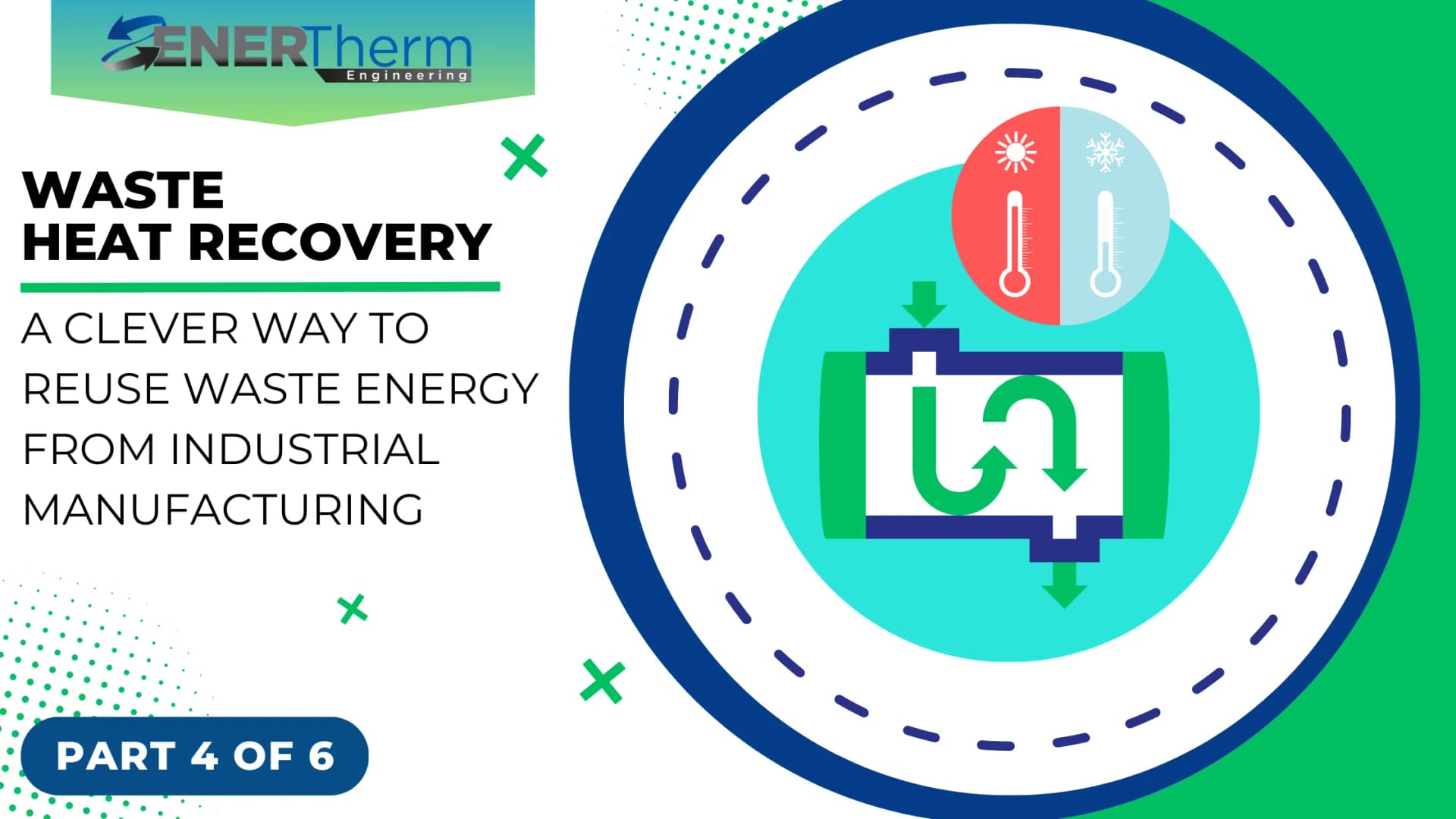
Waste Heat Recovery: A Clever Way to Reuse Waste Energy from Industrial Manufacturing (PART 4)
What is waste heat recovery, and how is it utilised in industrial manufacturing?
Waste heat recovery is a process that captures waste heat from industrial processes or power generation. Reusing heat from work processes within the same system or transferring it to another system for heating, cooling, or electricity generation is one of the most effective ways to lower operational energy costs and carbon footprints.
Waste heat recovery can be utilised for various purposes in industrial manufacturing, such as:
- Improving energy efficiency: Reducing process energy consumption and emissions through preheating, drying, or cogeneration.
- Saving costs: Lowering fuel and electricity bills by utilising recovered thermal energy for heating, cooling, or refrigeration.
- Reducing emissions: Displacing fossil fuels or grid electricity in district heating, absorption chilling, or heat pump applications.
Reusing Heat from Work Processes: Practical Industrial Applications
Reusing heat from work processes is a highly effective thermodynamic strategy to capture thermal energy that would otherwise escape into the atmosphere. Industrial work processes—such as calcination, combustion, extrusion, and metal casting—generate substantial thermal waste. Rather than letting this energy dissipate, modern facilities redirect it back into production lines or auxiliary systems.
Here is how reusing heat from work processes operates across different manufacturing stages:
| Work Process | Waste Heat Source | Temperature Range (°C) | Optimal Reuse Application |
|---|---|---|---|
| Metal Forging / Glass Melting | Furnace exhaust gases | 600–1400 | Combustion air preheating, steam generation |
| Steam Boiler Operations | Flue gas & blowdown | 150–250 | Boiler feed water preheating (economisers) |
| Plastic Injection Moulding | Hydraulic & jacket cooling water | 40–90 | Space heating, domestic hot water preheating |
| Air Compression | Compressor cooling air / oil | 50–90 | District heating, space heating, drying |
| Chemical Synthesis | Exothermic reactor jackets | 100–300 | Organic Rankine Cycle (ORC) power generation |
The physical workflow of capturing and reusing heat from work processes can be mapped as follows:
This visualisation highlights how waste energy is continuously cycled back into productive use, creating a highly efficient closed loop. Reusing heat from work processes directly reduces the load on primary utility boilers, driving down fuel consumption and carbon intensity.
How efficient is waste heat recovery for industrial manufacturing?
The efficiency of waste heat recovery for industrial manufacturing depends on various factors, such as the type of waste heat source (low, medium, or high temperature), the specific recovery technology deployed, and the heat recovery ratio.
- The type of waste heat source refers to the temperature level of the waste heat stream generated by an industrial process or power plant. The main temperature bands are:
- Low temperature (<100°C), typically produced by cooling, ventilation, or washing systems. This heat can be recovered using heat exchangers, heat pumps, or absorption chillers.
- Medium temperature (100°C–400°C), typically produced by combustion, drying, or chemical reactions. This range is ideal for recovery via economisers, condensers, or organic Rankine cycles.
- High temperature (>400°C), typically produced by melting, calcination, or gasification processes. This high-grade heat is best recovered using steam Rankine cycles, gas turbines, or thermoelectric generators.
- The type of waste heat recovery technology determines the method of capturing and transferring waste heat:
- Economisers are heat exchangers that preheat boiler feed water or combustion air using waste heat from flue gases.
- Condensers condense water vapour from flue gases, recovering latent heat to preheat feed water or provide hot water for other uses.
- Organic Rankine cycles use an organic fluid (such as pentane or ammonia) with a lower boiling point than water to convert medium-temperature waste heat into mechanical power or electricity.
- Absorption chillers use a refrigerant (such as water) and an absorbent (such as lithium bromide) to produce chilled water or air, driven by low-temperature waste heat.
- Heat pumps utilise refrigerant cycles and electricity to transfer heat from a low-temperature source to a high-temperature sink, even in colder conditions, or run in reverse to provide cooling.
- The heat recovery ratio refers to the percentage of waste heat that is successfully recovered and reused. This ratio depends on the temperature difference between the source and the sink, the design of the recovery technology, and local operational conditions. The typical heat recovery ratio for these systems ranges from 10 to 90 per cent.
What are the pros and cons of waste heat recovery for industrial manufacturing?
Waste heat recovery offers several advantages for industrial manufacturing, including:
- Enhanced energy performance and lower emissions through the direct displacement of primary fuel demands in utility systems.
- Reduced utility costs via the recycling of thermal energy for heating, cooling, and power generation.
- Improved operational competitiveness by raising overall thermodynamic efficiency and thermal system resilience.
However, implementing these systems also presents certain challenges:
- High upfront investment, which can make capital-intensive recovery projects less appealing to small and medium-sized enterprises compared to simpler energy efficiency measures.
- Technical complexity, particularly when integrating large-scale, multi-source heat recovery systems into existing plant architectures.
- Operational challenges, which demand careful monitoring and system diagnostics to maintain optimal performance and reliability over time.
- Market barriers, including a historical lack of regulatory incentives, limited technical awareness, and information gaps among industrial stakeholders.
How much can waste heat recovery contribute to net zero and decarbonisation goals for industrial manufacturing?
Waste heat recovery can contribute significantly to net zero and decarbonisation goals by directly displacing the fossil fuel combustion required for heating and cooling. According to the International Energy Agency (IEA), waste heat recovery could cut global CO₂ emissions from industrial manufacturing by 1.2 gigatonnes per year by 2050, compared to a business-as-usual scenario. This would represent a 12 per cent reduction in industrial emissions and a 3 per cent reduction in global emissions.
The total contribution of waste heat recovery to industrial decarbonisation depends on the availability of high-quality waste heat, deployment rates, technology adoption, and supportive policy frameworks.
The IEA estimates that waste heat recovery could constitute approximately 10 per cent of cumulative industrial CO₂ emissions reductions by 2050. Achieving this requires accelerating the global deployment of waste heat recovery systems from 100 megatonnes per year in 2020 to 500 megatonnes by 2030, and to 1,200 megatonnes by 2050. Correspondingly, the installed capacity of waste heat recovery must rise from 100 megawatts in 2020 to 500 megawatts by 2030, and to 1,200 megawatts by 2050.
Is waste heat recovery future proof for industrial manufacturing?
Waste heat recovery is highly future proof, offering a reliable, low-cost solution to improve energy efficiency and lower carbon emissions across industrial processes. However, realising its full long-term potential requires addressing several key factors:
- Technological developments: Continuous innovation is needed to improve the efficiency, reliability, and durability of recovery systems while reducing upfront capital and maintenance costs.
- Policy support: Stronger regulatory frameworks, financial incentives, and carbon-pricing mechanisms are required to build investment confidence among industrial users.
- Consumer demand: Growing market pressure for low-carbon products will continue to incentivise manufacturers to adopt and maintain efficient heat recovery schemes.
- System integration: Recovery systems must be compatible with other low-carbon technologies, such as industrial heat pumps, combined heat and power (CHP) configurations, or carbon capture, utilisation, and storage (CCUS) infrastructure.
Ensuring that waste heat recovery remains future proof requires close collaboration between policymakers, manufacturers, research bodies, and end-users. By sharing best practices and optimising thermal integration, waste heat recovery will continue to play a pivotal role in the global transition to net-zero manufacturing.
Take Action for a Sustainable Future with Enertherm Engineering
Are you ready to take the next step towards a more sustainable and efficient future for your industry? Enertherm Engineering is here to help you harness the power of waste heat recovery. Our innovative solutions are designed to turn waste energy into a valuable resource, reducing your carbon footprint and boosting your bottom line.
Don't let your waste energy go to waste. Contact us today to learn more about how our waste heat recovery systems can benefit your business. Together, we can create a greener, more efficient world.
