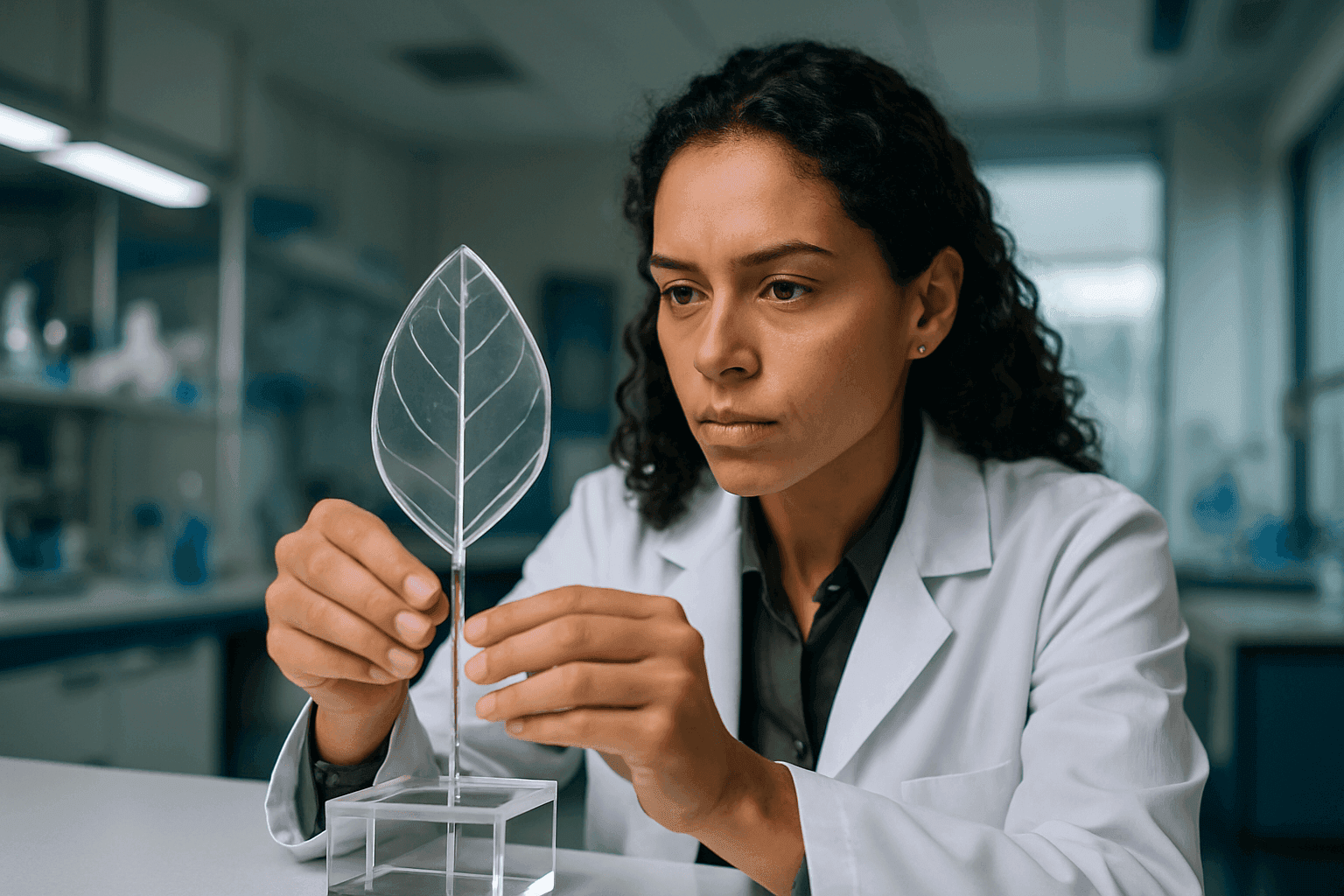
The Artificial Leaf: Mimicking Nature to Power a Sustainable Future
Imagine a technology that uses sunlight, water and, in some designs, carbon dioxide to make fuels or chemicals. Artificial leaves couple light absorption to chemical reactions. In Daniel G. Nocera’s 2011 wireless water-splitting device, solar-to-hydrogen efficiency was 2.5% under one-sun simulated illumination; a wired configuration reached 4.7%.
What is an Artificial Leaf?
An artificial leaf is a human-made device engineered to replicate the core function of a plant leaf: capturing solar energy to drive a chemical reaction. Instead of producing sugars for growth, these devices typically produce hydrogen fuel by splitting water molecules (H₂O) into hydrogen (H₂) and oxygen (O₂), or reduce carbon dioxide (CO₂) into usable carbon-based fuels or chemicals.
Unlike a conventional solar panel, which produces electricity for immediate use or battery storage, an artificial leaf couples light capture directly to chemical production. The resulting fuel can store solar energy for use when sunlight is unavailable and may suit applications that are difficult to electrify, including some industrial processes, shipping and long-duration energy storage.
The concept was demonstrated in a widely cited 2011 study by Daniel G. Nocera and colleagues at the Massachusetts Institute of Technology. It used a silicon-based device coated with chemical catalysts; when exposed to sunlight while immersed in water, it drove water splitting.
The Inspiration: Natural Photosynthesis
Natural photosynthesis is the process by which green plants and other organisms convert light energy into chemical energy. Plants absorb sunlight, water from the soil and carbon dioxide from the air to produce glucose and oxygen. The process underpins most food chains and affects atmospheric composition.
The artificial leaf draws direct inspiration from this biological process. Instead of biomass, it can produce hydrogen, syngas or other chemicals.
Artificial photosynthesis does not need to copy every biological step. It uses sunlight to move electrons and drive useful reactions with water and, in some designs, carbon dioxide. Researchers can therefore select light absorbers and catalysts for a particular product rather than reproduce the biochemistry of a living leaf.
How Artificial Leaves Mimic Photosynthesis
An artificial leaf uses several components to capture light and drive chemical reactions.
Key Components of Artificial Leaf Technology
An artificial leaf typically comprises:
- Light Absorber: Often a semiconductor such as silicon or perovskite, this captures sunlight in a similar way to chlorophyll. Light generates electron-hole pairs.
- Catalysts: These materials speed chemical reactions without being consumed. They split water or reduce carbon dioxide. Common catalysts include cobalt-based compounds, nickel-molybdenum-zinc alloys and copper-based structures.
- Electrolyte/Water: The reaction medium. Water supplies hydrogen for hydrogen production, while carbon dioxide supplies the carbon and oxygen in carbon-reduction products.
- Membrane or Support Structure: This provides the physical framework and can separate the produced gases, preventing recombination.
In a practical device, the interfaces between these components matter as much as the materials. The light absorber must deliver charges to the catalyst quickly, while the electrolyte and membrane must allow ions to move without allowing hydrogen and oxygen to mix. Gas separation is essential because mixed hydrogen and oxygen reduce energy yield and create a safety risk.
The Electrochemical Process
When sunlight hits the light-absorbing material, it generates charge within the device. Catalysts use that charge to drive reactions. At the anode, water is oxidised, releasing oxygen, protons and electrons. At the cathode, protons and electrons combine to form hydrogen gas, or carbon dioxide is reduced to carbon-based fuels such as carbon monoxide, methanol or ethylene.
The overall water-splitting reaction is:
2H2O→2H2+O2Here, H2O is water, H2 is hydrogen gas and O2 is oxygen gas. The light absorber supplies the energy needed to drive this energy-intensive reaction.
For example, a device developed by MIT Professor Daniel Nocera used a silicon solar cell with a cobalt-based catalyst on one side to release oxygen and a nickel-molybdenum-zinc alloy on the other to release hydrogen. Researchers at the University of Cambridge have also developed a hybrid device combining light-harvesting organic polymers with bacterial enzymes to convert sunlight, water and carbon dioxide into formate. Another innovation from the University of Michigan uses artificial photosynthesis to bind two carbon atoms into hydrocarbons such as ethylene, a key component in plastic manufacture.
Solar-to-hydrogen efficiency describes the share of incoming sunlight stored as the chemical energy of hydrogen. It is useful, but does not alone determine whether an artificial leaf is viable. Product purity, operating lifetime, catalyst cost, water quality and the energy needed to compress or store fuel also affect performance.
Sustainable Benefits: Cutting Down Emissions
Artificial-leaf systems can make hydrogen without using natural gas as the chemical feedstock, provided their energy input comes from sunlight and the full system is designed and operated accordingly.
Producing Clean Hydrogen Fuel
Unlike conventional hydrogen production from fossil fuels, artificial leaves use sunlight and water to produce hydrogen at the point of production. That hydrogen can be used in fuel cells or stored for later use.
The climate benefit depends on the full system. Water treatment, device manufacture, transport and hydrogen storage all have environmental impacts, so an artificial leaf is not automatically zero-carbon. Comparisons need lifecycle emissions per kilogram of hydrogen alongside solar-to-hydrogen efficiency, operating lifetime and compression or storage energy.
Carbon Dioxide Reduction and Conversion
Advanced artificial-leaf systems can convert carbon dioxide (CO₂) from the atmosphere or industrial emissions into carbon-based fuels and chemicals. Possible products include methanol, formic acid, ethane and ethylene, which are precursors for plastics and other industrial compounds.
Carbon dioxide conversion is most useful when powered by low-carbon energy, using a responsibly chosen carbon source, and when the product displaces a fossil-derived alternative. Fuels made from captured CO₂ release carbon again when burned, creating a circular carbon flow rather than permanent carbon removal. Long-lived chemical products or verified carbon storage are required before a system can credibly be described as carbon-negative.
Decentralised and Off-Grid Energy Solutions
Artificial leaf technology could support decentralised fuel production where sunlight, water supply, gas separation and fuel storage are available locally. Output depends on device area, solar irradiance, solar-to-fuel efficiency, operating hours, hydrogen-storage capacity and the energy demand of the intended use. A device cannot be described as household-scale without those specifications.
For off-grid use, the appeal is the ability to turn intermittent sunlight into a transportable energy carrier at the point of use. A household-scale system would also need safe fuel storage, water management, maintenance and equipment suited to local conditions. Reliability and simple operation are as important as laboratory efficiency.
Advancements and Innovations in Artificial Leaf Design
Artificial photosynthesis is developing new light absorbers, catalysts and device structures to improve solar-to-fuel efficiency, product selectivity and operating lifetime.
Enhanced Efficiency and Materials
Early artificial leaf designs had relatively low efficiencies: Nocera’s 2011 study reported 4.7% solar-to-hydrogen efficiency for its wired configuration and 2.5% for its wireless configuration, both under one-sun simulated illumination. Later laboratory systems have reported solar-to-hydrogen efficiencies of about 10% or more under specified test conditions. Researchers are studying perovskites, two-dimensional materials and metal-organic frameworks to improve light absorption, charge transport and catalytic activity.
Perovskites can absorb light strongly and can be paired with other semiconductors in tandem devices to capture more of the solar spectrum. Their long-term stability in moisture, heat and strong sunlight remains a major engineering question. Silicon is more mature and durable, while earth-abundant catalysts could reduce dependence on scarce precious metals.
Recent innovations include:
- Semi-Artificial Leaves: Organic polymers combined with bacterial enzymes to convert sunlight, water and CO₂ into formate for the chemicals industry, avoiding toxic or unstable light absorbers.
- Advanced Catalysts: Copper “nanoflowers” integrated with perovskite light absorbers to produce hydrocarbons such as ethane and ethylene from CO₂.
- Floating Devices: Lightweight, flexible artificial leaves that float on water and convert sunlight, CO₂ and water into synthetic gas. Performance must be reported using a defined measure, such as solar-to-fuel efficiency or product formation rate per illuminated area.
- Glycerol Integration: Systems using silicon nanowire electrodes and glycerol oxidation to supply electrons while producing chemical by-products. Performance depends on the baseline, reaction conditions and whether the comparison measures product rate, energy efficiency or carbon-conversion efficiency.
Real-World Deployment and Scalability
A significant challenge is adapting laboratory technologies for real-world conditions. Researchers have designed artificial leaves that can draw CO₂ directly from the air, rather than relying on pressurised tanks, by encapsulating the photosynthesis unit in a transparent, gas-permeable membrane. Their usefulness at scale depends on capture rate, product selectivity, energy balance and membrane lifetime outdoors.
Moving beyond the laboratory means testing artificial leaves under changing daylight, heat, dust, water impurities and fluctuating carbon dioxide concentrations. A commercially useful system must maintain output and selectivity over months or years, rather than demonstrate a high result in a short controlled experiment. Modular panels, replaceable catalyst layers and integrated gas handling may make maintenance and scaling more practical.
Challenges and Future Outlook
The main constraints are linked: efficiency sets fuel output per unit area; selectivity determines the separation burden; durability affects replacement cost; and gas handling affects safety and delivered energy.
Overcoming Technical Hurdles
Key challenges include:
- Efficiency Improvement: Solar-to-fuel efficiency must be assessed with illuminated area, solar spectrum, operating temperature and product energy content.
- Cost-Effectiveness: Material and fabrication costs must be spread over a device lifetime long enough to justify them. Earth-abundant materials may help, but do not alone establish a low system cost.
- Durability and Stability: Light absorbers, catalysts, membranes and electrical contacts must retain performance through repeated wet, illuminated and gas-producing operation.
- Scalability: Large-area manufacture must preserve gas separation, electrical connections and product quality, rather than simply enlarge a laboratory prototype.
- Hydrogen Storage Safety: Generated hydrogen requires separation from oxygen, leak control, suitable storage and equipment appropriate to the intended location.
Product selectivity is another central challenge for carbon dioxide reduction. A catalyst may produce a mixture of carbon monoxide, formate, methane, ethylene and other compounds; separating that mixture can consume energy and add cost. Researchers therefore need systems that consistently produce the intended fuel or chemical, alongside robust methods for measuring performance under realistic operating conditions.
The Promise of a Cleaner Tomorrow
Artificial leaf technology remains largely at the research and prototype stage. Its contribution will depend on demonstrated efficiency, lifetime, product purity, lifecycle emissions and cost at useful scale.
Fuels from sunlight, water and CO₂ using elements such as carbon, silicon, iron or copper are technically demonstrable in several laboratory systems. Artificial leaf systems may complement solar electricity, batteries and conventional electrolysers where storable molecules are needed and the resulting system can meet performance, safety and lifecycle-emissions requirements.
