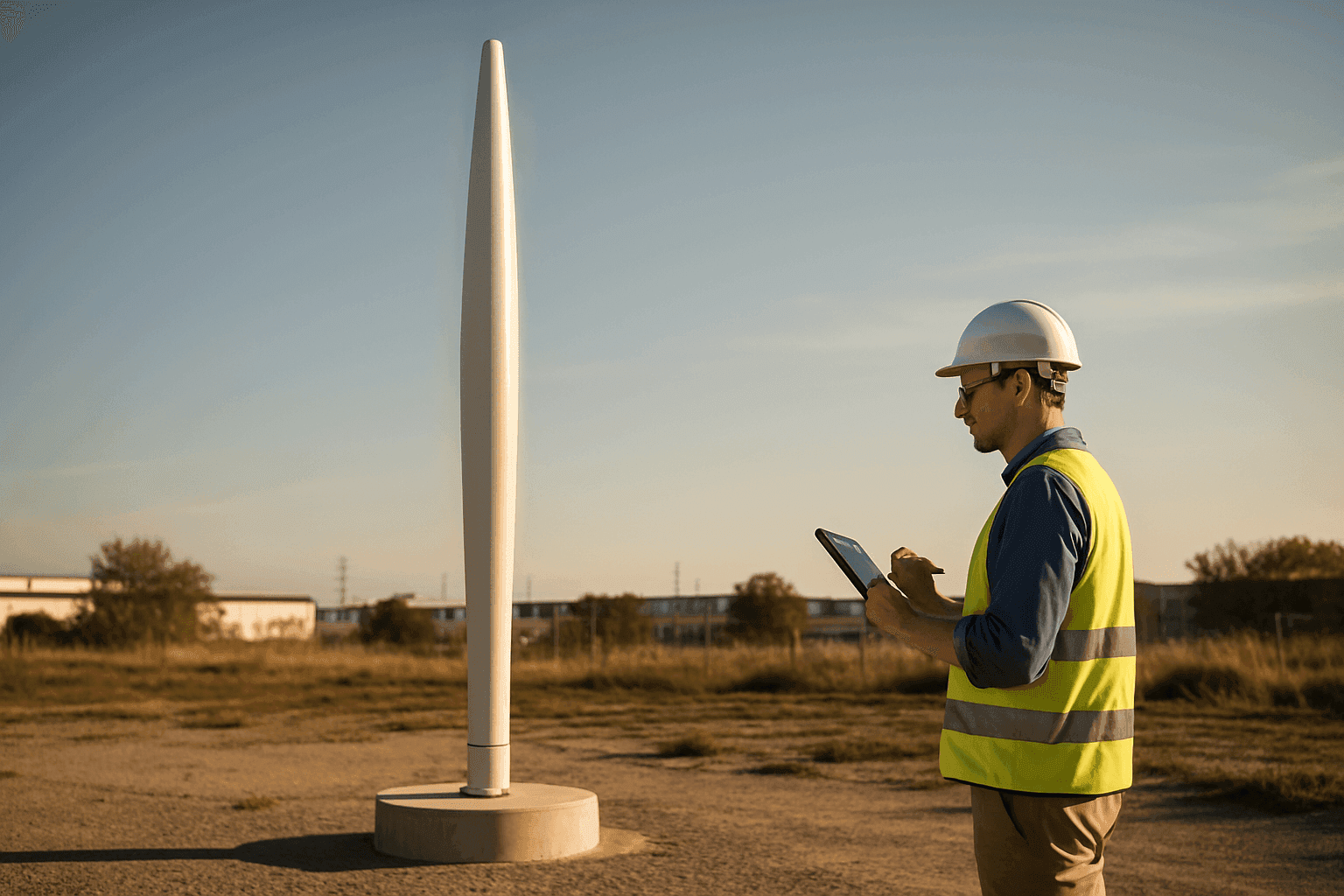
Bladeless Wind Turbines: A New Era for Quiet, Sustainable Power
As the world urgently seeks innovative and sustainable energy solutions, bladeless wind turbines are emerging as a promising alternative to traditional bladed turbines. These novel devices offer several advantages, including reduced environmental impact, lower maintenance costs, and suitability for urban environments. With ongoing research and development, bladeless wind turbines are poised to play a significant role in the future of renewable energy.
Understanding Bladeless Wind Turbines
Unlike conventional wind turbines that rely on rotating blades to capture kinetic energy, bladeless wind turbines utilise a fundamentally different aerodynamic approach. These structures typically feature a stationary base and a lightweight, flexible cylindrical mast that oscillates or vibrates in response to wind currents.
This oscillatory motion is then converted into electricity using various mechanical and electromagnetic mechanisms:
- Vortex-Induced Vibration (VIV): This is the primary physical principle behind most bladeless wind turbines. As wind flows around a bluff body (such as a cylindrical mast), it cannot follow the curves of the structure smoothly. This leads to boundary layer separation, creating alternating, swirling low-pressure patterns known as a von Kármán vortex street. These vortices exert fluctuating lateral forces on the structure, causing it to vibrate perpendicular to the wind direction.
- Aeroelastic Resonance: To maximise power output, the turbine is engineered to oscillate at its natural frequency. The shedding frequency of the vortices must match the structural resonance frequency. When this occurs, the amplitude of oscillation increases dramatically, amplifying the mechanical energy available for conversion.
- Electromagnetic Induction: Many leading designs utilise a linear generator located at the base of the mast. The oscillating movement drives a system of high-strength neodymium magnets past copper coils, generating an alternating current (AC) via Faraday's Law of Induction without the need for gears or rotating drive shafts.
- Piezoelectric Materials: Some experimental or micro-scale bladeless designs incorporate piezoelectric materials. When the mast bends, it subjects these specialised crystals to mechanical stress, directly producing an electric charge.
The Physics of Vortex Shedding
To model the frequency of the vortex shedding, engineers use the dimensionless Strouhal number (St), expressed as:
St=Uf⋅Dwhere:
- f is the vortex shedding frequency (Hz),
- D is the characteristic diameter of the cylinder (m),
- U is the free-stream wind velocity (m/s).
For a wide range of Reynolds numbers, a cylinder exhibits a Strouhal number of approximately 0.2. By designing the cylinder's mass and stiffness such that its natural frequency aligns with f, the system achieves resonance, locking in maximum kinetic energy extraction.
Key Industry Players and Prototypes
Several companies and research institutions are actively developing and refining bladeless wind turbine technology, transitioning them from laboratory models to commercial reality:
- Vortex Bladeless (Spain): This company is a pioneer in the VIV space. Their flagship cylindrical design utilises a carbon-fibre-reinforced polymer mast. The base contains a magnetic tuning system that can adjust the structural stiffness in real time, allowing the mast to synchronise and resonate across a wide range of wind speeds. Their smaller unit, the "Vortex Nano", is designed for low-power off-grid applications.
- Aeromine Technologies (U.S.): Aeromine focuses on static, roof-mounted wind systems. While technically "bladeless" on the exterior, this system uses stationary, aerofoil-like wings that capture and amplify wind flow over a building’s edge. This creates a low-pressure vacuum that pulls air through an internal, enclosed rotor-stator system located safely inside the building's footprint.
- Katrick Technologies (Glasgow): Katrick has developed a modular, honeycomb-style wind panel. This design features a hexagonal grid containing several small, highly sensitive oscillating aerofoils. When wind passes through the channels, the aerofoils flutter up and down, converting mechanical kinetic energy into electricity. This compact design is highly effective in turbulent, low-altitude urban environments.
- EWICON (Netherlands): Developed by the Delft University of Technology, the Electrohydrodynamic Wind Energy Converter (EWICON) has no moving parts whatsoever. It works by releasing positively charged water droplets into the wind. As the wind blows these droplets away from an integrated electrode grid against an opposing electric field, the potential energy of the system increases, generating a net electrical current.
- Saphon Energy (Tunisia): Saphon Energy developed the "Saphonian", a unique bladeless design inspired by the physics of sailboats and the bio-mimetic movement of fish tails. Instead of a rotating blade or an oscillating cylinder, it utilises a body shaped like a dish or sail that moves in a back-and-forth three-dimensional knot path, driving hydraulic pistons to generate electricity.
Comparison: Traditional vs. Bladeless Turbines
To understand where bladeless systems fit into the global renewable energy matrix, it is helpful to compare their operational parameters with conventional three-bladed horizontal-axis wind turbines (HAWTs).
| Metric | Traditional Bladed Turbines (HAWT) | Bladeless Turbines (VIV/Aerofoil) |
|---|---|---|
| Maximum Efficiency (Cp) | High (45 to 50 per cent) | Moderate (15 to 25 per cent) |
| Cut-In Wind Speed | 3.0 to 4.5 m/s | 1.5 to 3.0 m/s |
| LCOE (Levelised Cost of Energy) | Proven scale, moderate development costs | Higher initial development, but low operational cost |
| Maintenance & Lubrication | High (complex gearboxes, yaw motors, oils) | Very low (no gears, no lubricants required) |
| Wildlife Risk | Significant (spinning blade hazards for birds/bats) | Negligible (no rotating components) |
| Acoustic Footprint | Decibel levels can exceed 45 dB close to base | Extremely quiet (<20 dB, often infra-sound) |
| Spatial Footprint | Large (requires extensive blade clearance zones) | Small (can be spaced closely together) |
Advantages of Bladeless Wind Turbines
Bladeless wind turbines offer a compelling set of structural and environmental advantages, positioning them as a viable solution for specialised decentralised energy generation:
1. Reduced Environmental Impact
- Wildlife Safety: The absence of rotating blades removes the threat of collision for birds and bats. This allows developers to bypass complex environmental permitting processes in migratory pathways.
- Quiet Operation: Unlike traditional turbines, which produce aerodynamic "whooshing" sounds from blade tips moving at high speeds, bladeless systems operate almost silently. The oscillations typically generate sound frequencies below 20 Hz, making them completely inaudible to humans and ideal for dense residential areas.
- Minimal Visual Intrusion: Lacking towering rotating structures, bladeless installations resemble slim poles or architectural features. This significantly lowers visual pollution and eases public opposition in scenic or historic regions.
2. Lower Maintenance and Operational Costs
- Fewer Moving Parts: By eliminating complex, wear-prone parts such as gearboxes, mechanical brakes, yaw drives, and pitch control systems, the mechanical points of failure are dramatically reduced.
- No Lubricants Required: Many designs rely entirely on magnetic coupling and flexible polymers, eliminating the need for synthetic lubricants. This lowers maintenance cycles and eradicates the risk of hazardous fluid leaks.
3. Cost and Manufacturing Efficiency
- Lower Production Costs: The simple structural geometry of a hollow cylinder or static aerofoil requires less raw material. Manufacturing does not demand specialised carbon-fibre blade moulding techniques. Estimates suggest that manufacturing costs can be up to 53 per cent lower than those of equivalent traditional wind turbines.
- Easier Installation: With a lightweight build and low centre of gravity, bladeless systems do not require heavy-duty foundations or high-capacity cranes, making installation in remote or mountainous areas far more cost-effective.
4. Urban Compatibility and Micro-Siting
- Low Cut-in Speeds: Traditional turbines require strong, laminar wind flows. Bladeless variants can harvest energy from weak winds, with some cut-in thresholds starting as low as 1.5 to 3.0 m/s (3 to 7 miles per hour).
- Adaptability to Turbulent Wind: In cities, buildings deflect wind, creating highly turbulent flow. While turbulence can damage traditional turbine blades, it actually assists vortex-induced vibrations and aerodynamic suction systems, allowing bladeless devices to function effectively in chaotic urban air streams.
- High-Density Spatial Footprint: Because they do not create the massive downstream wake turbulence associated with rotating blades, bladeless masts can be grouped closely together (sometimes spaced just a few metres apart), maximising energy yield per square metre of land.
Challenges and Limitations
Despite their substantial benefits, several core technical challenges must be overcome before bladeless wind turbines can achieve mass commercial adoption:
1. Aerodynamic and Thermodynamic Efficiency Limitations
The theoretical limit of wind energy extraction is governed by the Betz Limit, which dictates that no turbine can capture more than 59.3 per cent of the kinetic energy in the wind:
Cp,max=2716≈0.593While advanced traditional turbines can operate close to this limit (Cp≈0.45 to 0.50), oscillating structures struggle to reach these conversion levels. The power coefficient (Cp) for VIV-based bladeless turbines typically ranges from 15 to 25 per cent. Because they sweep a much smaller cross-sectional area of wind compared to long rotating blades, their absolute power output per unit of height is lower.
2. Mechanical Fatigue and Structural Integrity
To generate consistent, usable electricity, the mast must oscillate millions of times over its operating life. This continuous bending subjects the base and the mast materials to severe cyclic fatigue.
- Material Science Constraints: Engineers must design masts using advanced composites (like glass-fibre or carbon-fibre reinforced polymers) that have high elastic limits and can withstand cyclic stresses without micro-fracturing.
- Foundation Stress: The mechanical load of oscillation is concentrated entirely at the base joint, requiring robust structural anchoring to prevent material failure over long-term operation.
3. Power Consistency and Tuning Complexity
For vortex shedding to induce resonance, the wind speed must match the physical characteristics of the cylinder. If the wind speed changes rapidly, the shedding frequency shifts away from the mast’s natural frequency, causing the oscillation amplitude to collapse. Constant active tuning—using magnetic fields, mechanical dampers, or electronic control systems—is required to keep the system in its resonant "lock-in" phase.
Applications of Bladeless Wind Turbines
The unique characteristics of bladeless wind turbines open up specialised deployment possibilities where traditional bladed turbines are completely impractical:
| Key Deployment Environments | Description |
|---|---|
| Urban & Residential Rooftops | Integration into commercial buildings and smart cities. |
| Remote & Off-Grid Locations | Hybrid solar-wind systems and agricultural sites. |
| Highway & Infrastructure | Capturing traffic-induced airflow along major routes. |
1. Urban and Residential Rooftops
Traditional roof-mounted wind turbines often fail due to structural vibration transfer, noise complaints, and low-altitude wind turbulence. Bladeless systems (such as Aeromine’s static panels or Katrick’s honeycomb grids) resolve these issues. They integrate seamlessly with existing commercial flat roofs, complementing solar panel installations by generating power during evening hours or winter months.
2. Remote and Off-Grid Infrastructures
For off-grid applications such as telecommunication towers, meteorological stations, and remote agricultural farms, shipping and erecting traditional turbines is cost-prohibitive. Bladeless units can be transported in standard flat-pack shipping containers and erected quickly using basic hand tools, providing reliable decentralised power.
3. Highway Infrastructure and Road Networks
Highways offer a constant source of artificial wind generated by fast-moving vehicular traffic. Installing small, modular bladeless turbines along central reservations or bridges allows municipalities to capture this local turbulence. This clean energy can directly power streetlights, smart traffic signals, and environmental monitoring sensors.
4. Sensitive Ecological Zones
In protected nature reserves and coastal areas, traditional wind farms are often restricted due to wildlife impact. Bladeless installations allow clean wind energy to be harnessed without disrupting bird and bat habitats.
The Future of Bladeless Wind Turbines
The future of bladeless wind technology rests on rapid innovations across material science, power electronics, and artificial intelligence:
- Advanced Smart Materials: Researchers are experimenting with shape-memory alloys and carbon nanotube polymers to construct masts that are lighter, stronger, and more flexible. These materials will improve the mechanical response to low winds and withstand decades of continuous oscillation.
- AI-Powered Dynamic Tuning: Modern prototypes are beginning to use microprocessors running machine learning algorithms. By monitoring real-time wind patterns and structural acceleration, these controllers can instantaneously adjust the internal magnetic fields at the base of the mast to match changing wind speeds, vastly expanding the operational envelope.
- Hybrid Energy Systems: Integrating bladeless wind structures with photovoltaic (PV) solar arrays into a single, cohesive power management system is a growing area of interest. These hybrid systems ensure a steadier, more balanced power output profile across different seasons and weather conditions.
- Supportive Policy Frameworks: As international initiatives like the European Green Deal and regional net-zero targets accelerate, governments are broadening their funding and incentive schemes. This regulatory support will encourage developers to install novel bladeless technologies, helping to drive down production costs and establish long-term reliability standards.
While traditional bladed wind turbines will continue to dominate utility-scale onshore and offshore wind farms due to their raw efficiency, bladeless wind turbines represent a vital step forward in decentralised energy generation. By providing a silent, wildlife-friendly, and low-maintenance alternative, they are set to unlock wind power potential in urban, residential, and ecologically sensitive zones that were once entirely out of reach.
