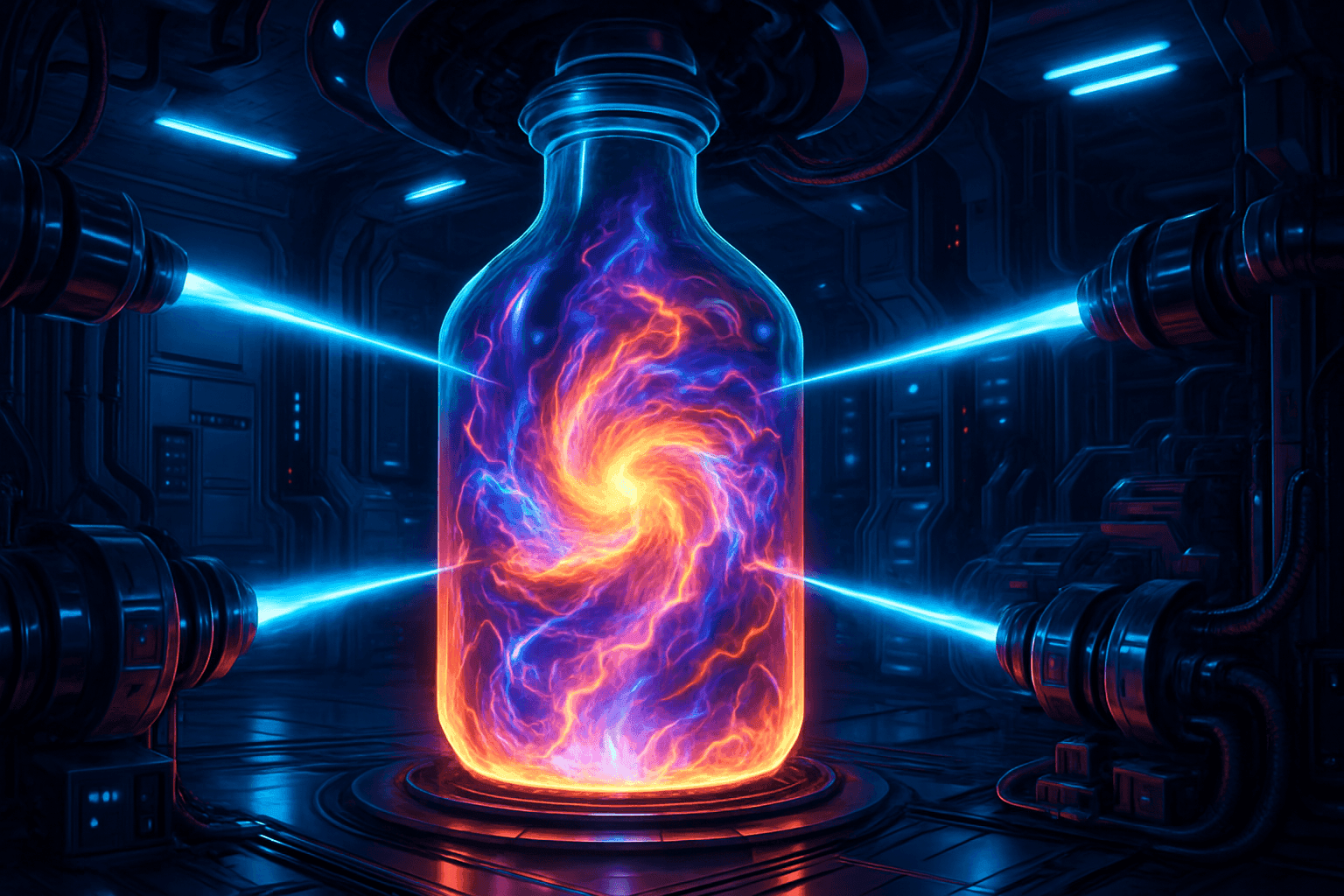
Can This “Bottle” Crack Nuclear Fusion? Inside Realta’s Reactor Design
Fusion energy, the holy grail of clean energy, is one step closer to reality thanks to innovative designs like Realta Fusion's bottle-shaped reactor. This approach, which uses powerful magnets to confine plasma, could revolutionize how we power the world.
The Quest for Limitless Energy
The world's growing energy demands require sustainable and reliable solutions. Fusion energy, which replicates the processes that power the sun and stars, offers the potential for a nearly limitless, safe, and zero-carbon energy source. Unlike nuclear fission, which splits atoms, fusion combines them, releasing vast amounts of energy.
Realta Fusion: A Novel Approach
Realta Fusion, a spin-out from the University of Wisconsin-Madison, is pioneering a compact, scalable, and modular (CoSMo™) fusion energy system. Their approach aims to provide the lowest cost and shortest path to commercial fusion energy.
Key Features of Realta Fusion's Design
- Compact: Utilizing high-temperature superconducting magnets allows for smaller, more efficient fusion energy systems.
- Scalable: CoSMo™ energy systems can scale from 50MW to 500MW of power output.
- Modular: The cylindrical design enables linear scaling through the addition of standard modules, manufactured in a central facility and assembled on-site.
How Realta Fusion's Reactor Works
Realta Fusion's reactor is based on the magnetic mirror concept. Here's a breakdown of the key components and processes:
- Magnetic Mirror: Extremely strong magnets trap super-heated hydrogen gas (plasma) within a cylindrical space. The magnetic fields at each end of the cylinder cause the charged particles to bounce back and forth, confining the plasma.
- Plasma Heating: The hydrogen isotopes (deuterium and tritium) are heated to extreme temperatures, over 100 million degrees Celsius, forming a plasma. At these temperatures, the nuclei can overcome their electrostatic repulsion and fuse.
- Fusion Reaction: The deuterium and tritium nuclei fuse to form helium and release energy in the form of high-speed neutrons.
- Energy Extraction: The neutrons collide with a surrounding “blanket” material, transferring their kinetic energy as heat. This heat can then be used to generate steam, which drives turbines to produce electricity.
The Magnetic Bottle Concept
The “magnetic bottle” is a crucial element in Realta Fusion's design. It refers to the configuration of magnetic fields that confine the plasma, preventing it from touching the reactor walls and cooling down.
Magnetic Mirrors: An Old Idea Revived
The magnetic mirror concept was explored in the 1980s but was limited by the technology of the time. Advances in high-temperature superconductors have enabled Realta Fusion to revisit this approach with significantly improved magnetic field strength and plasma confinement.
Advantages of the Magnetic Mirror Design
- Simplicity: The linear, cylindrical geometry is simpler to manufacture and scale compared to other fusion reactor designs.
- High Magnetic Fields: Stronger magnetic fields lead to better plasma confinement and higher fusion rates. Realta Fusion achieved a world-record magnetic field strength of 17 Tesla in their experiments.
- Modularity: The modular design allows for flexible power output, adapting to the specific needs of different applications.
Realta Fusion's Goals and Timeline
Realta Fusion aims to have a prototype fusion device operating by 2028. Their current focus is on validating plasma simulations with experimental data and de-risking the design before building the prototype. The company is targeting the mid-2030s for commercial fusion energy production.
Applications and Target Markets
Realta Fusion's energy system is designed to deliver industrial heat and power on-site for various applications, including:
- Data centers
- Chemical plants
- Metal recycling
- Remote mining
- Other heavy industries
Funding and Partnerships
Realta Fusion has garnered significant financial backing, including a recent $36 million Series A round led by Future Ventures and Khosla Ventures. The company also partners with the University of Wisconsin-Madison on the Wisconsin High-field Axisymmetric Mirror (WHAM) project. This public-private partnership allows Realta Fusion to leverage university research and facilities.
The WHAM Experiment
The Wisconsin High-field Axisymmetric Mirror (WHAM) is the experimental basis for Realta Fusion's technology. It is the first experiment to use high-temperature superconducting magnets in a magnetic mirror configuration, achieving a record-breaking magnetic field strength of 17 Tesla.
Key Achievements of WHAM
- Demonstrated the use of high-temperature superconducting magnets in a magnetic mirror configuration.
- Confined plasma at a world-record magnetic field strength of 17 Tesla.
- Validated plasma simulations with real-world experimental data.
Fusion Energy: A Competitive Landscape
Realta Fusion is among a growing number of companies pursuing fusion energy. While tokamaks are the most common approach, Realta Fusion's magnetic mirror design offers a unique and potentially more cost-effective path.
Other Fusion Concepts
- Tokamaks: Doughnut-shaped devices that use magnetic fields to confine plasma.
- Stellarators: Similar to tokamaks but with a more complex geometry, offering inherent steady-state operation.
- Inertial Confinement Fusion (ICF): Using lasers or particle beams to compress and heat fuel capsules.
- Z-pinch devices: Compress plasma using the magnetic field generated by an electrical current flowing through the plasma.
Challenges and Future Directions
Despite the promise of fusion energy, significant challenges remain. These include:
- Maintaining plasma stability at extremely high temperatures.
- Achieving net energy gain (producing more energy than consumed).
- Developing cost-effective and scalable reactor designs.
Realta Fusion is actively addressing these challenges through:
- Experimentally validated simulations
- Advanced plasma control techniques
- Optimization of magnet design
Conclusion: A Bright Future for Fusion
Realta Fusion's innovative bottle-shaped reactor design represents a significant step towards realizing the potential of fusion energy. By leveraging advances in superconducting magnets, plasma physics, and computing power, Realta Fusion aims to deliver clean, abundant, and reliable energy for a sustainable future. With continued progress and investment, fusion energy could play a critical role in meeting the world's growing energy needs and combating climate change.
