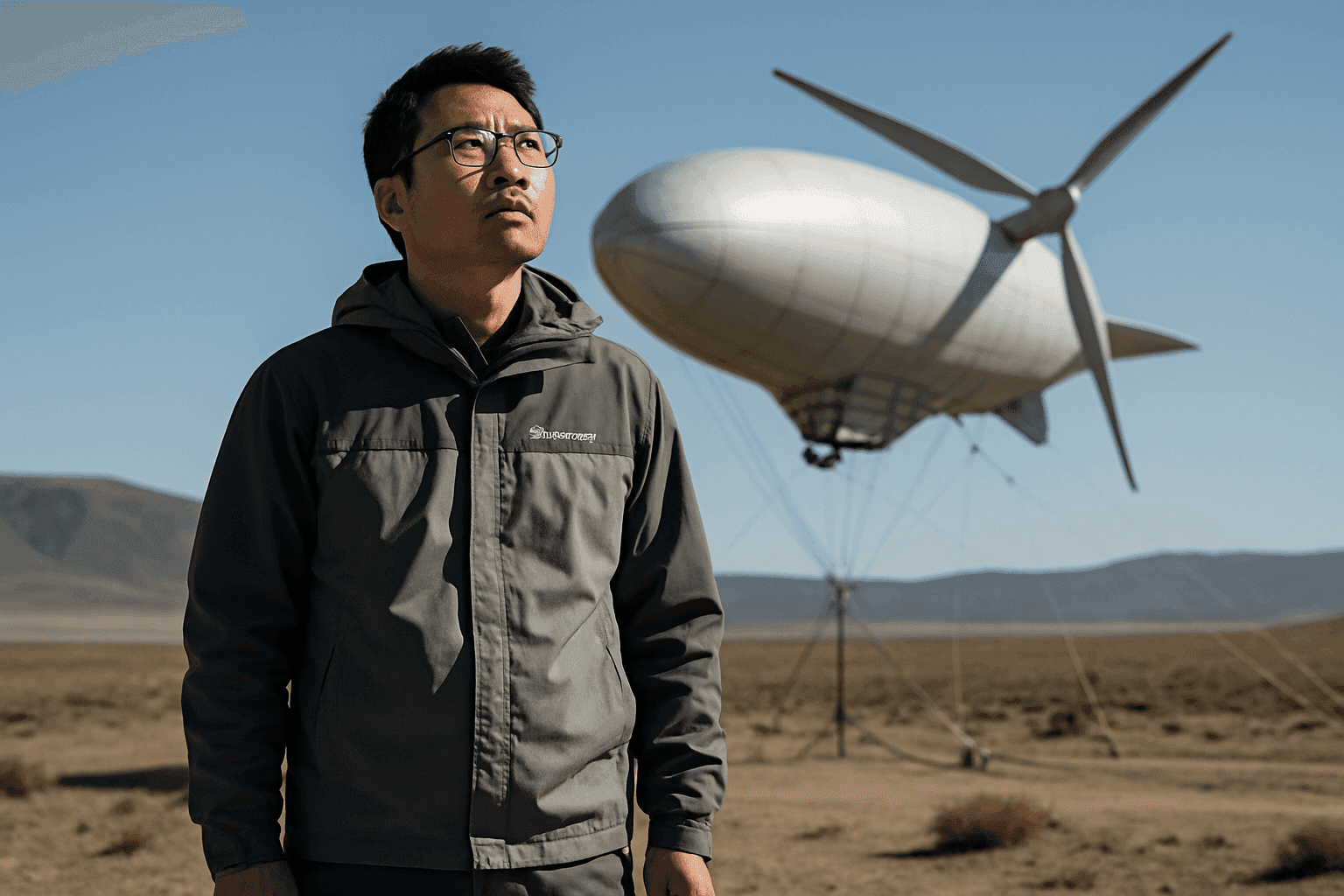
China Prepares to Flight-Test World’s First Megawatt-Level ‘Windmill’ Airship
Chinese scientists are on the cusp of a significant breakthrough in renewable energy, with plans to soon conduct the inaugural flight test of the world's first megawatt-level floating wind power generation system. Resembling an airship, this innovative ‘windmill' is poised to revolutionize power supply for remote regions and disaster-stricken areas.
The upcoming test involves the S1500 system, developed by Beijing SAWES Energy Technology Company in collaboration with Tsinghua University and the Aerospace Information Research Institute of the Chinese Academy of Sciences. The announcement was made by Weng Hanke, chief technology officer of Beijing SAWES Energy Technology Company, on August 17, marking a pivotal moment in high-altitude wind energy development.
Harnessing High-Altitude Wind for Clean Energy
The core principle behind China's ‘windmill' airship lies in exploiting the more powerful and consistent winds found at higher altitudes, which are largely untapped by conventional ground-based turbines. At an altitude of 1,500 meters, for instance, winds can blow three times faster than at ground level, potentially generating up to 27 times more power. This high-altitude wind is also more stable, allowing for a steadier energy output compared to terrestrial wind farms.
The system operates by using a helium-filled aerostat (airship) to lift lightweight power generation equipment to a predetermined height. Once airborne, this equipment converts the high-altitude wind energy into electricity, which is then transmitted back to the ground via a tethered cable. This design offers a unique advantage over traditional wind turbines, which are typically limited to harnessing wind energy within 200 meters from the Earth's surface.
A Leap in Airborne Wind Turbine Technology
The S1500 system, with its 1-megawatt (MW) generation capacity, is a substantial advancement, reportedly boasting an output more than 30 times more powerful than the best existing airborne turbines developed in other countries. This capacity is equivalent to that of a traditional 100-meter-high ground-based wind turbine tower.
This project builds upon a scientific vision first proposed in 1957 by renowned scientist Qian Xuesen, aiming to transform a long-held concept into a tangible, world-leading reality.
Milestones and Prior Successes
The journey to the megawatt-level S1500 system has involved several successful prototypes and record-breaking achievements:
- S500 System: In October 2024, the S500 floating wind power system, an airship-shaped unit 23 meters long and 15 meters in diameter, ascended to an altitude of 500 meters and began generating 50 kilowatts (kW) of electricity. This achievement broke previous global records for both altitude (297 meters) and output (30kW), which were previously held by a research team from the Massachusetts Institute of Technology. The S500 was designed for emergency power in disaster areas and remote locations.
- S1000 System: By January 2025, the team successfully test-flew the S1000 system, reaching an altitude of 1,000 meters with an output exceeding 100kW, further setting a new global benchmark for high-altitude wind energy systems. An earlier iteration of this 30-meter-long airship demonstrated the feasibility of transmitting electricity steadily to the ground from 1,000 meters in Jiangxi province.
These incremental successes have paved the way for the development and impending test flight of the S1500, the first megawatt-level unit.
Future Implications and Global Context
The developers highlight the potential of these airborne systems to provide crucial power solutions for remote locations, islands, and oilfields, as well as during emergency relief operations when conventional power infrastructure is compromised or unavailable. Once these systems are mass-produced, the cost of the electricity generated could become comparable to that from normal ground-based wind turbines.
China's rapid progress in airborne wind energy systems (AWES) positions it as a leader in this emerging field, with several other countries, including the UK and Germany, also making strides in developing similar technologies. The long-term vision for this technology includes potentially operating at altitudes of up to 10,000 meters, where winds are significantly more intense, promising even greater power generation capabilities.
