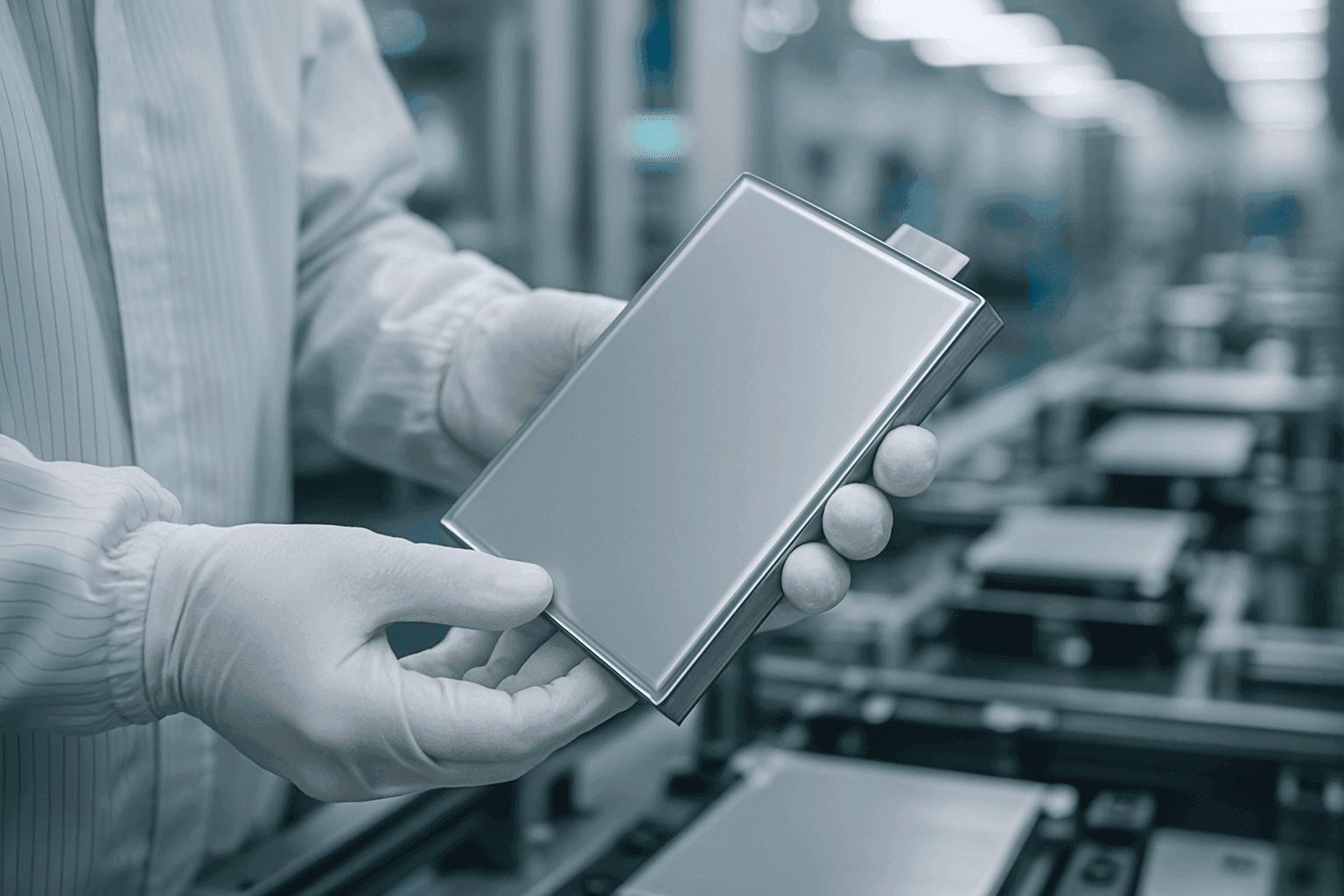
Chinese Automaker-Backed Firm Unveils Solid-State Batteries with 136 Wh/lb Energy Density
A significant advancement in battery technology has emerged from China, as carmaker-backed Anhui Anwa New Energy Technology has unveiled its first-generation solid-state batteries boasting an energy density of 300 Wh/kg (approximately 136 Wh/lb). The announcement on 4 July 2025 marks a tangible step towards the commercialisation of this promising battery chemistry, moving from laboratory theory to factory production.
Anwa's Breakthrough in Solid-State Battery Production
Anhui Anwa New Energy Technology, established in June 2020, benefits from strategic industry backing. Automotive giant Chery New Energy holds a significant stake of nearly 10 per cent in the company, with another 5.89 per cent owned by the prominent battery manufacturer Gotion High-Tech. This collaboration underscores a concerted effort within China's automotive and battery sectors to accelerate solid-state battery development and its integration into electric vehicles.
Anwa recently announced the successful rollout of the first engineering samples of its solid-state batteries from a new production line located in Wuhu, China. Whilst these are currently prototypes for rigorous testing and validation rather than immediate mass-market products, their successful production represents a crucial milestone.
Key Specifications and Safety Features
The first-generation solid-state battery from Anwa Technology achieves an energy density of 300 Wh/kg (136 Wh/lb), representing a notable improvement in energy storage per unit of weight. This is a critical factor for extending the driving range of electric vehicles without adding excessive mass.
Beyond energy density, Anwa officials confirmed that these newly produced batteries have passed a stringent safety standard referred to as "No Fire No Explosion". This addresses one of the primary concerns associated with conventional lithium-ion chemistry, where liquid electrolytes pose a risk of thermal runaway and fire. The safety advantages of solid electrolytes remain a key driver for the global pursuit of solid-state technology.
Manufacturing Process and Future Outlook
The production facility established by Anwa highlights an ambitious manufacturing strategy. The production line is designed for a "full-chain" process, incorporating an innovative five-step dry manufacturing technique. This dry approach is claimed to yield substantial benefits, including a 20 per cent reduction in energy consumption and a 30 per cent reduction in fixed asset investment compared to traditional wet battery manufacturing methods.
The initial planned production capacity for the factory is 1.25 GWh annually, operating at a production speed of 20 metres per minute. Anwa's long-term vision includes expanding the site to encompass a 5 GWh research and development (R&D) centre alongside a more integrated production line in the coming years.
Looking ahead, Anwa has already begun trial production of a second-generation battery, which promises an energy density of 400 Wh/kg (181 Wh/lb). The company has set an ambitious target of 2027 for the volume assembly of its third-generation batteries, aiming for 500 Wh/kg (227 Wh/lb). If these targets are met, they could fundamentally reshape the performance and cost dynamics of electric vehicles. Whilst specific vehicle models to feature these batteries have not been definitively confirmed, the "All-solid-state battery" branding spotted on Chery's Exeed Exlantix ET electric crossover suggests where this technology might first be integrated.
Benchmarking Against Global Standards: US DOE 2024 Advanced Battery R&D Targets
To contextualise the significance of Anwa’s energy density achievements, it is valuable to compare these developments against Western benchmarks, specifically the US Department of Energy (DOE) and its 2024 advanced battery R&D targets. The DOE’s Vehicle Technologies Office (VTO) actively funds research to push the boundaries of electrochemical storage, establishing strict targets to make electric vehicles more competitive, efficient, and affordable.
Under these US initiatives, the DOE outlines specific requirements for next-generation EV cells. The ultimate DOE energy density target for solid-state and lithium-metal designs is 500 Wh/kg (approximately 227 Wh/lb) at the cell level, with an interim commercialisation benchmark set at 350 Wh/kg. These figures are calculated to support a pack-level target capable of delivering over 300 miles of range in a typical passenger vehicle whilst maintaining safety and reducing cell costs below the $100/kWh threshold.
Evaluating Anwa's developmental timeline against the US DOE energy density roadmap highlights the rapid pace of Chinese industrial scaling:
- Anwa First-Generation (300 Wh/kg / 136 Wh/lb): Whilst slightly below the DOE's interim 350 Wh/kg advanced R&D target, this cell is already in the engineering validation phase, proving that dry manufacturing can output highly competitive densities at scale today.
- Anwa Second-Generation (400 Wh/kg / 181 Wh/lb): Currently in trial production, this generation comfortably exceeds the DOE's 350 Wh/kg benchmark, representing a level of energy density that could significantly reduce pack volume and overall vehicle weight.
- Anwa Third-Generation (500 Wh/kg / 227 Wh/lb): Planned for 2027, this objective directly aligns with the ultimate US DOE energy density target for advanced battery R&D, potentially achieving parity with the leading edge of global solid-state research.
The Broader Landscape of Chinese Solid-State Battery Development
Anwa's announcement is part of a wider trend in China, where numerous firms are actively engaged in advancing solid-state battery technology. The country is a leading player in the global race to commercialise these next-generation batteries, supported by significant investments and engineering breakthroughs.
Other Key Players and Their Progress
- QingTao Energy Development: This Chinese startup, led by Nan Cewen, a member of the Chinese Academy of Sciences, has been a pioneer in the field. As early as November 2018, QingTao's production line became operational, capable of producing solid-state batteries exceeding 400 Wh/kg. More recently, in April 2024, QingTao's semi-solid-state battery entered mass production and was integrated into the SAIC IM L6 (Zhiji L6), enabling a cruising range of over 1,000 kilometres.
- WeLion: Beijing WeLion New Energy Technology Co. Ltd is another prominent firm, known for its semi-solid-state battery cells. Their SHE350-106Ah cell offers an energy density of 347.5 Wh/kg. WeLion's products are being optimised for various applications, including e-bikes, cargo bikes, and electric vehicles, emphasising enhanced safety and extended lifespan through optimised cell chemistry.
- CATL (Contemporary Amperex Technology Co., Limited): As the world's largest battery manufacturer, CATL is heavily invested in solid-state R&D. The company's all-solid-state battery technology reportedly has the potential to reach an energy density of up to 500 Wh/kg, with trial production of sample cells beginning in November 2024. CATL aims for small-scale production of all-solid-state EV batteries by 2027.
- Huawei: Whilst primarily a technology giant, Huawei has entered the solid-state arena, filing a patent for a sulfide-based solid-state battery design. This design reportedly targets energy densities between 180 and 225 Wh/lb. Huawei's interest underscores the cross-industry push for advanced energy storage solutions.
- LiPure Energy: This Beijing-based firm announced in October 2024 that it had successfully built China's first production line for all-solid-state lithium batteries and commenced mass production, targeting various sectors including energy storage and electric two-wheelers.
The collective progress of these Chinese firms, alongside collaborations with major carmakers, indicates a strong commitment to overcoming the historical scale and manufacturing challenges associated with solid-state chemistry. Whilst mass production for the broader automotive market is still on the horizon—with many experts anticipating widespread adoption around 2027–2030—recent announcements highlight rapid, tangible advancements. This dual emphasis on high energy density and enhanced safety features positions solid-state batteries as a transformative technology for the future of global electric mobility and industrial energy storage.
