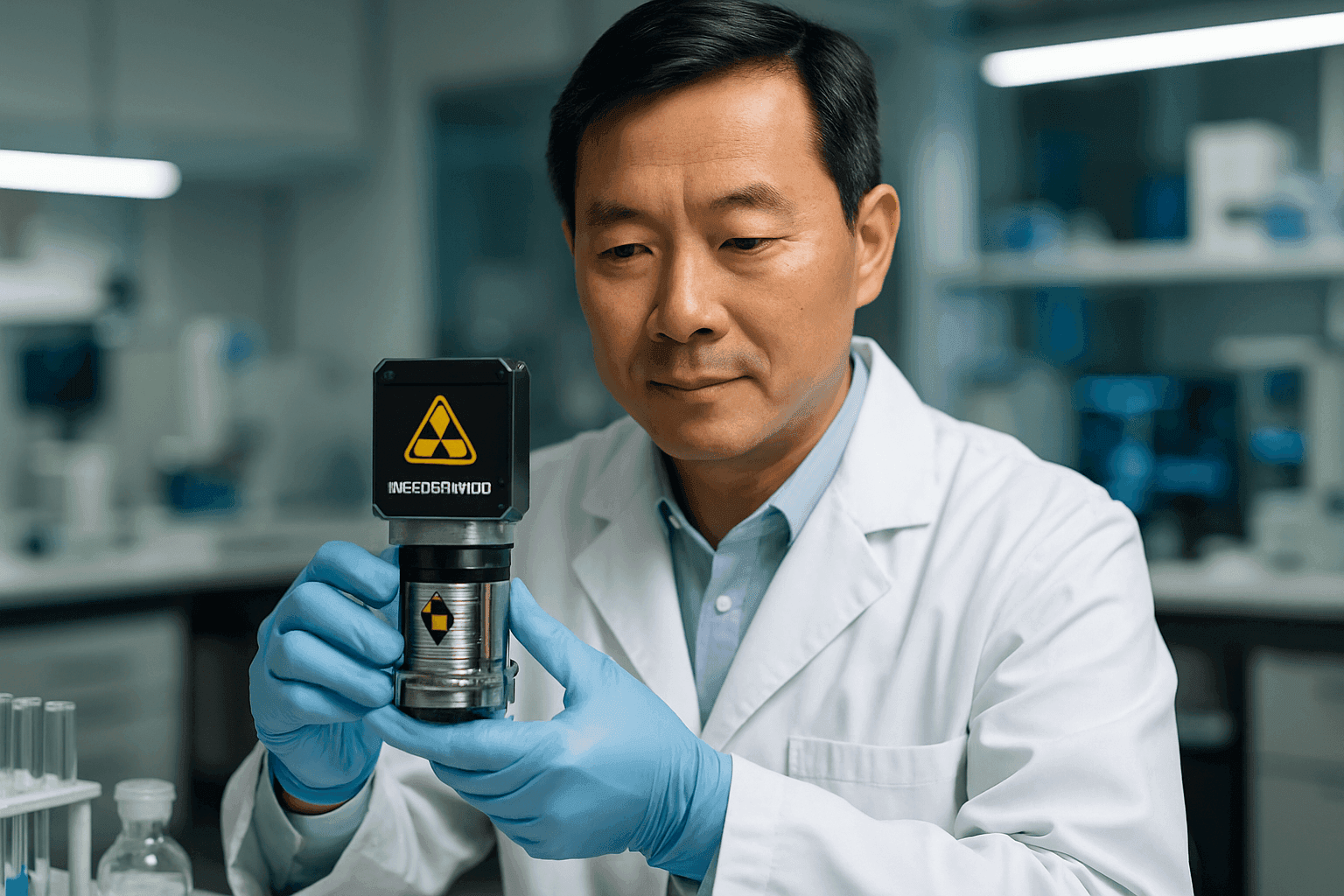
Chinese Scientists Unveil Nuclear Battery with Triple Efficiency and 50-Year Lifespan
Chinese researchers have developed a groundbreaking nuclear battery that promises significantly enhanced energy efficiency and an exceptionally long operational life, delivering three times the energy efficiency of conventional designs. The innovative battery, capable of withstanding at least half a century of radiation, represents a major leap forward in sustainable power solutions.
Breakthrough in Nuclear Battery Technology
The advancement comes from a team of scientists led by Dr. Haisheng San of Xiamen University and Dr. Xin Li of the China Institute of Atomic Energy. Their work aims to improve battery performance, particularly in extreme environments where long-term reliability is crucial, such as in space or deep-sea infrastructure. This breakthrough could redefine power sources for devices requiring consistent, long-duration energy without the need for recharging or maintenance.
Separately, Beijing Betavolt New Energy Technology Company Ltd. announced early in 2024 their BV100 nuclear battery, which is currently in the pilot testing stage with plans for mass production. This coin-sized battery, measuring 15x15x5 millimetres, utilises nickel-63 isotopes and China's first diamond semiconductor module to miniaturise atomic energy. The BV100 is designed to generate 100 microwatts of power at 3V and boasts a 50-year lifespan.
It is important to distinguish the university research from Betavolt's BV100 announcement. Both concern long-lived betavoltaic power, but they are separate developments, and reported laboratory architecture, device efficiency and commercial product specifications should not be treated as interchangeable.
How Nuclear Batteries Work
Atomic or nuclear batteries, also known as radioisotope batteries, convert energy released from the decay of radioactive isotopes directly into electrical energy. Unlike nuclear reactors, they do not rely on a chain reaction. The Betavolt battery, for instance, uses a thin sheet of nickel-63, a radioactive isotope, sandwiched between two layers of a single-crystal diamond semiconductor. As the nickel-63 decays, it emits beta particles (electrons), which are then converted into an electrical current by the diamond semiconductor, forming an independent unit.
This betavoltaic conversion process is particularly suited for low-power applications where long life is paramount, such as implantable medical devices. Conventional nuclear batteries typically have an efficiency of 0.1–5%. The recent Chinese developments aim to significantly improve upon these figures.
Power output and stored energy are different measures. A device producing 100 microwatts continuously can support very low-power electronics, sensors and intermittent transmissions, but it cannot directly replace the watt-level or higher power demanded by phones, laptops, domestic appliances or electric vehicles. Systems with short high-power bursts would require careful power management and, in many cases, an additional energy-storage component.
Wuxing Architecture and Reported Efficiency
Searches for the Wuxing architecture refer to the reported multi-layer nuclear-battery design associated with Chinese research into improved betavoltaic conversion. The name is used in discussion of an architecture intended to capture more of the energy released by beta decay than a conventional single-layer arrangement.
The practical objective of a Wuxing architecture is to reduce the losses that occur when beta particles pass through, or deposit energy beyond, an active semiconductor region. Layering radioisotope and semiconductor elements can increase the chance that emitted particles contribute to useful electrical generation, while the spacing, thickness and material quality remain critical to performance.
Some searches pair the term with “FRAC” or “C”, including Wuxing architecture FRAC, Wuxing architecture frac and Wuxing architecture C. These labels should be checked against the original research paper, patent or manufacturer documentation before being treated as official component names or product variants. Public reporting on the breakthrough has focused primarily on the architecture's reported efficiency improvement rather than on a broadly standardised FRAC or C nomenclature.
Efficiency claims also need context. A higher conversion efficiency does not automatically mean proportionally higher usable power from a finished battery: isotope activity, active area, semiconductor junction design, electrical losses, shielding, packaging and operating conditions all affect the final output.
Key Features and Safety
A key claim for these new nuclear batteries is their impressive longevity and safety profile. Betavolt asserts that their atomic energy battery is “absolutely safe, has no external radiation, and is suitable for use in medical devices such as pacemakers, artificial hearts, and cochleas in the human body.” The BV100's layered design is also claimed to prevent combustion or explosion under sudden force, and it can operate across extreme temperatures, from -60°C to 120°C.
Furthermore, the environmental impact is minimised as the nickel-63 isotope, after its decay period, transforms into a stable, non-radioactive isotope of copper, posing no threat or pollution to the environment. This eliminates the need for complex disposal procedures associated with other radioactive materials.
Those claims should nevertheless be understood in the context of regulation. A sealed betavoltaic device is designed to contain its radioisotope, but manufacture, transport, sale, use and end-of-life handling may be subject to national nuclear and radiation-safety rules. Suitability for a medical implant would also require device-specific safety, clinical and regulatory approvals; a long operating life alone does not establish approval for patient use.
Potential Applications
The long-lasting and maintenance-free nature of these nuclear batteries opens up a vast array of potential applications across various sectors:
- Aerospace: Powering satellites and deep-space probes for decades.
- Medical Equipment: Enabling pacemakers and other implantable devices to last a lifetime, removing the need for surgical replacements due to battery depletion.
- AI Equipment & Sensors: Providing stable, autonomous power for AI devices, micro-electromechanical systems (MEMS), and advanced sensors in remote or hard-to-reach locations.
- Drones & Robotics: Potentially allowing small drones to fly continuously and powering micro-robots for extended periods.
- Consumer Electronics: While current prototypes may not power high-demand devices like smartphones, future iterations aim to provide perpetual power, potentially eliminating the need for charging.
The near-term opportunity is strongest where replacing a battery is expensive, dangerous or impractical. Examples include distributed industrial sensors, subsea monitoring instruments, remote infrastructure, specialised scientific equipment and low-duty-cycle communications devices. These uses value predictable trickle power and multi-decade operation more than peak output.
The Path to Mass Production
Betavolt aims to be the first company to mass-produce miniature nuclear batteries. The BV100 is in its pilot stage, with the company planning to launch a 1-watt battery in 2025, which would significantly expand its applicability for higher-power devices. China's push for miniaturised nuclear batteries aligns with its 14th Five-Year Plan (2021-2025) to bolster its economy.
Mass production remains the key test. It requires reliable isotope supply, repeatable semiconductor fabrication, robust encapsulation, quality control, regulatory clearance and a practical route for collection or disposal at end of life. A pilot-stage announcement is therefore not the same as broad commercial availability.
Betavolt BV100 Price and Availability
As of the information publicly associated with Betavolt's pilot-stage BV100 announcement, no widely established retail Betavolt BV100 price has been published for ordinary consumers. The device has been described as a pilot-stage product rather than a consumer battery available through standard retail channels.
Any eventual price will depend on factors including nickel-63 production, semiconductor yield, encapsulation, certification, order volume and the application-specific electronics supplied with the cell. Quotes for specialised nuclear batteries are likely to be business-to-business and project-specific rather than comparable with the shelf price of a lithium-ion battery.
For people searching for a nuclear battery price in India, there is likewise no reliable public Indian retail price for the BV100 or an equivalent miniature nickel-63 nuclear battery. Prospective buyers should verify the supplier, product status, import conditions and applicable Indian radiation-safety requirements directly with an authorised manufacturer or distributor. Listings that claim a confirmed consumer price without verifiable documentation should be treated cautiously.
Other Notable Chinese Advancements
Beyond Betavolt, other Chinese institutions are also making strides in nuclear battery technology. Northwest Normal University, for instance, has developed a carbon-based nuclear battery called Zhulong-1, which uses Carbon-14 and is claimed to last a century or more. This Carbon-14 battery reportedly offers an energy density 10 times higher than a lithium-ion battery. Although current prototypes of the Zhulong-1 produce only nanowatts, efforts are underway to develop a coin-sized, cheaper-to-mass-produce Zhulong-2. China's industrial capacity for producing Carbon-14 is seen as a key advantage in pushing this technology forward.
These ongoing developments highlight China's growing leadership in advanced battery research, aiming to provide solutions for a world increasingly reliant on long-lasting, autonomous power sources.
