Digging Deeper: Quaise Energy’s Wave Drill Tech Aims for Earth’s Core
Quaise Energy, a start-up born out of MIT's Plasma Science and Fusion Center, is making waves in the geothermal energy sector with its drilling technology. On May 21, 2025, the company demonstrated its millimetre-wave drilling technology at the Nabors facility in Houston, Texas, marking a step towards unlocking deeper geothermal resources. Its long-term aim is to reach “superhot” rock; whether this can support power generation at a given location depends on local temperature gradients, well conditions and reservoir performance.
At the heart of Quaise Energy's technology is a hybrid drilling system: conventional equipment handles the shallower, softer formations, while directed millimetre waves are intended to penetrate the hard, hot crystalline rock below. Rather than replacing the drilling industry’s rigs, crews and well-control practices, Quaise's approach is designed to add a high-energy rock-vapourisation stage to an established drilling workflow.
The Promise of Deep Geothermal Energy
Geothermal energy, harnessing heat from within the Earth, can provide constant power when a project has a sustainable heat source, suitable wells and a functioning surface plant. Unlike solar and wind, a geothermal plant is not dependent on daily weather conditions. However, traditional geothermal plants are limited to locations with naturally occurring hot reservoirs near the surface. Quaise Energy seeks to overcome this limitation by drilling deeper to access hotter rock where local geology permits.
Conventional geothermal projects usually depend on unusually favourable local geology: accessible heat, permeable rock and naturally circulating water. Deep geothermal drilling targets heat rather than a rare near-surface reservoir. The deeper a well reaches, the more widely available high temperatures become, although well construction, casing and heat management become correspondingly more demanding.
According to Paul Woskov, a senior fusion research engineer at MIT, tapping into just 0.1% of the Earth's heat could supply the world's energy needs for over 20 million years. The challenge lies in reaching these extreme depths efficiently and economically.
How Quaise Energy's Technology Works
Quaise Energy's approach combines conventional drilling with millimetre-wave technology adapted from nuclear fusion research.
- Conventional Drilling: Traditional rigs bore through the first 2–3 kilometres until they hit basement rock.
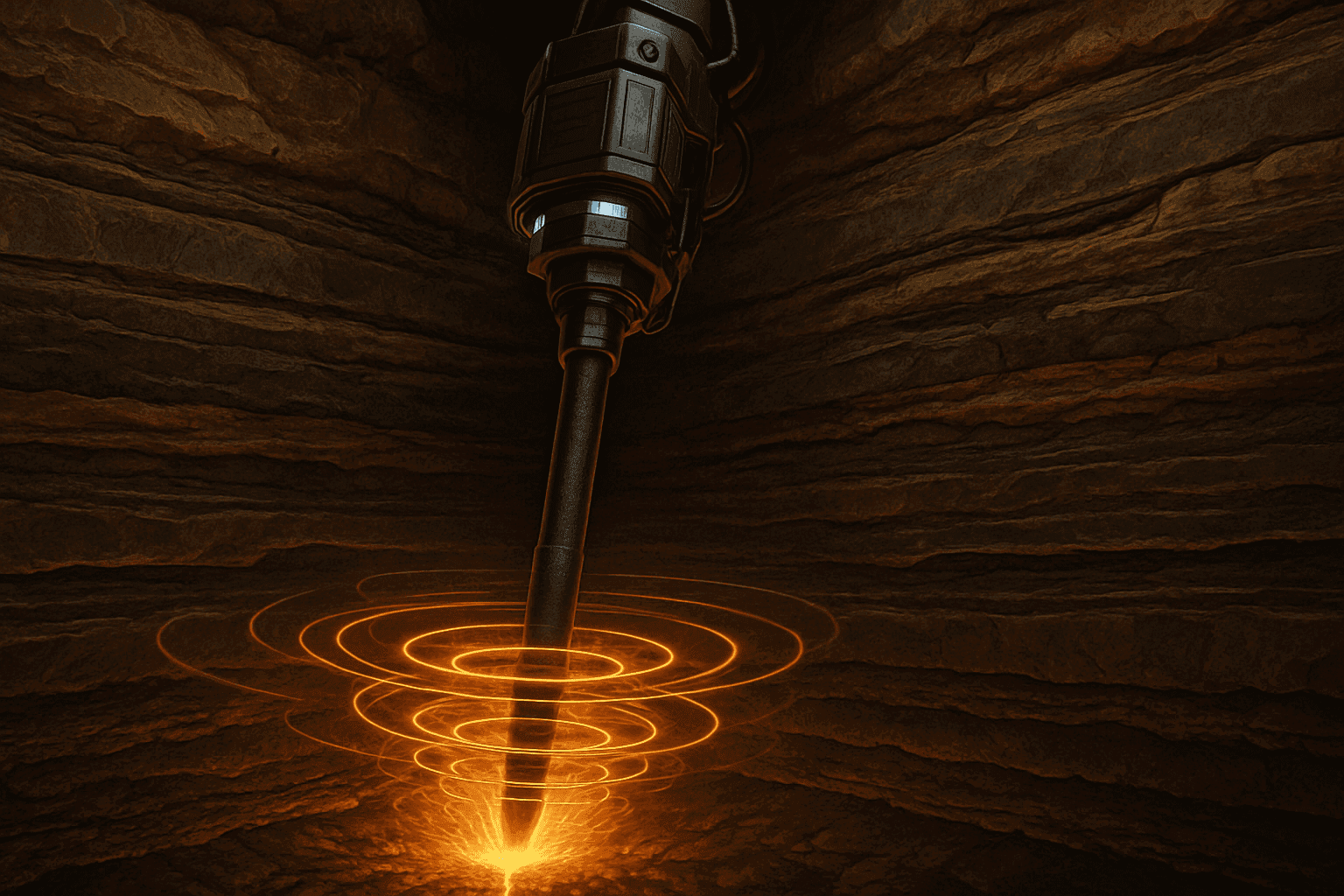
- Millimetre-Wave Drilling: Once basement rock is reached, Quaise replaces the drill bit with its millimetre-wave drill. This system uses a gyrotron, a device that generates high-frequency millimetre waves, to vapourise the rock.
- Vapourisation Process: The millimetre-wave beam heats the rock to the point of melting or vapourisation, creating a crater-like hole.
- Waste Removal: Nitrogen gas is pumped into the hole to flush out dust and vapourised rock particles as the drill moves deeper.
A gyrotron is the key power source in the system. It converts electrical energy into a tightly directed electromagnetic beam at millimetre-wave frequencies. That beam travels down the well through an articulated waveguide, rather than through a rotating mechanical drill string alone. The waveguide must continue transmitting energy as the borehole deepens while keeping the beam aligned with the rock face.
The intended advantage is that the hottest part of the operation is concentrated at the bottom of the well. Conventional drilling components do not need to grind continuously through the deepest hard rock, where abrasive wear and high downhole temperatures can rapidly limit ordinary bits and electronics. Removing the resulting dust and vapour is equally important: a clear borehole helps the beam reach fresh rock rather than losing energy in debris.
Quaise is targeting wells as deep as 20 kilometres, where rock temperatures could approach 500°C in suitable geological settings. At temperatures and pressures above water’s critical point, water becomes supercritical. Its high energy content could allow a smaller volume of produced fluid to carry more useful heat to the surface, but actual generation depends on the well’s pressure, flow rate, chemistry and turbine design.
Reaching that resource safely requires a complete well system: stable borehole walls, suitable casing and cementing, pressure control, and surface equipment capable of handling very hot geothermal fluids.
A Demonstration of Groundbreaking Tech
During the May 2025 demonstration, Quaise used a 100-kW gyrotron powered by 50,000 volts DC, connected to a Nabors F rig with a custom top drive. The drill, operating at roughly 48 kW, melted a hole into a granite/basalt rock mix at a rate of approximately 0.8 inches (2 cm) per minute. The demonstration showed that the millimetre-wave beam could remain precisely focused as the drill moved deeper, a significant development hurdle.
Drilling performance is not defined by raw power alone. A commercial system must repeatedly direct energy downhole, maintain a usable borehole geometry, remove debris and work alongside conventional rig operations. Demonstrating those elements together helps establish whether millimetre-wave drilling can move from controlled rock tests to a practical geothermal well-construction method.
Overcoming Challenges and Future Plans
Quaise Energy's journey has involved several engineering challenges, including maintaining the millimetre-wave beam's focus as the drill descends. The company's articulated waveguide has produced a consistent borehole shape, at least over short distances.
For deep wells, the system must also address the transition between conventional drilling and wave drilling. That includes delivering power reliably at the rig, advancing and protecting the waveguide, managing nitrogen circulation and retaining sufficient control over the well path. Each stage must operate reliably enough to avoid losing the economic benefit gained by faster penetration through basement rock.
Quaise has ambitious plans:
- Near-Term Testing: Quaise has continued field testing at its Marble Falls, Texas, site, where it has reported drilling more than 100 metres using millimetre-wave technology.
- Commercial Development: The company’s commercial plans depend on demonstrating that its drilling system can be scaled from field tests to a completed geothermal well with sustained production.
- Repowering Existing Infrastructure: Quaise envisages adapting existing fossil-fuelled power-plant infrastructure for geothermal heat where turbine equipment, transmission connections and site conditions are suitable.
The Kola Superdeep Borehole Inspiration
Quaise's ambition to drill the world's deepest hole draws inspiration from the Kola Superdeep Borehole, a Soviet project begun in the 1970s. The project aimed to reach 15 kilometres but reached 12.26 km, where temperatures of about 180°C challenged the equipment.
The comparison highlights why drilling method matters. Kola exposed the limits of tools built to mechanically cut rock under escalating temperature and pressure. Quaise's millimetre-wave concept seeks to move the rock-breaking work from a physical cutting surface to a directed energy beam, though it must still prove that the associated well, waveguide and surface systems can operate dependably at scale.
Benefits of Quaise's Approach
Quaise Energy's technology offers several potential benefits:
- Broader Site Options: Deep drilling could expand the range of viable geothermal locations where measured temperature gradients, reservoir design and well economics support a project; it does not make every site suitable.
- Potentially Higher Power Density: Superhot or supercritical geothermal fluids may increase heat carried per well, provided the reservoir can sustain the required pressure, flow rate and chemistry without excessive scaling or corrosion.
- Repowering Existing Infrastructure: Existing fossil-fuelled power plants may be candidates for geothermal repowering where their turbines and balance-of-plant equipment can be adapted and the geothermal resource can provide compatible steam conditions.
- Constant and Reliable Energy: A geothermal plant can provide continuous generation when its wells and reservoir maintain production; availability remains dependent on maintenance, well integrity and reservoir management.
- Potentially Compact Surface Development: Geothermal projects can require less surface area than some wind or solar projects for a comparable annual electricity output, but the comparison depends on well spacing, cooling technology, transmission and the specific project design.
- No Hydraulic Fracturing in the Drilling Step: Millimetre-wave rock vapourisation does not itself use hydraulic fracturing. However, seismic risk must still be assessed for the complete geothermal project, particularly if reservoir stimulation or fluid injection is required.
These are potential system-level benefits, not guarantees from drilling speed alone. They depend on whether a deep well can be completed safely, whether sufficient heat and fluid can be produced over time, and whether the cost per unit of electricity compares favourably with alternatives in a particular market.
Challenges and Considerations
The technology must meet defined engineering acceptance criteria before it can be considered a commercial well-construction method:
- Beam Delivery and Borehole Geometry: A field-scale run must document the electrical power supplied to the gyrotron, power delivered at the launcher, penetration rate, borehole diameter and directional survey results. Acceptance requires a continuous section that remains within the pre-defined diameter and trajectory tolerances for the well design.
- Debris Removal: Nitrogen circulation must remove the expected rock mass without obstructing the beam path or damaging surface equipment. This can be assessed through a mass balance of removed solids, pressure-loss measurements and continuous monitoring for blockage or recirculation.
- Waveguide Reliability: The articulated waveguide must retain alignment and transmission efficiency while being advanced through the planned drilling interval. Acceptance requires logged operating time, power losses, alignment data and inspection results showing no failure that prevents continued drilling.
- Well Integrity at High Temperature and Pressure: Casing, cement, seals and borehole-wall treatment must withstand the project’s specified temperature and pressure envelope. Pressure tests, temperature cycling and post-test caliper or integrity logs should confirm that the well remains fit for injection and production.
- Reservoir Performance: A completed well must demonstrate measured injectivity, productivity and thermal output over a defined test period. Tracer tests, pressure-interference data and temperature monitoring are needed to show that circulation can be sustained without unacceptable thermal decline or fluid loss.
- Drilling Economics: Commercial viability must be tested against measured drilling days, energy consumption, equipment availability and total well cost, compared with a pre-defined cost and generation model for the intended site.
The Future of Geothermal Energy
Quaise Energy's drilling technology could widen the range of geothermal resources that can be assessed for power generation. Its potential contribution to the clean-energy transition depends on proving safe, repeatable deep-well construction, sustained reservoir performance and competitive project economics.
If millimetre-wave drilling can meet those tests in full-scale wells, it could provide another route to dependable, low-carbon geothermal heat and make selected deeper resources practical to develop.
