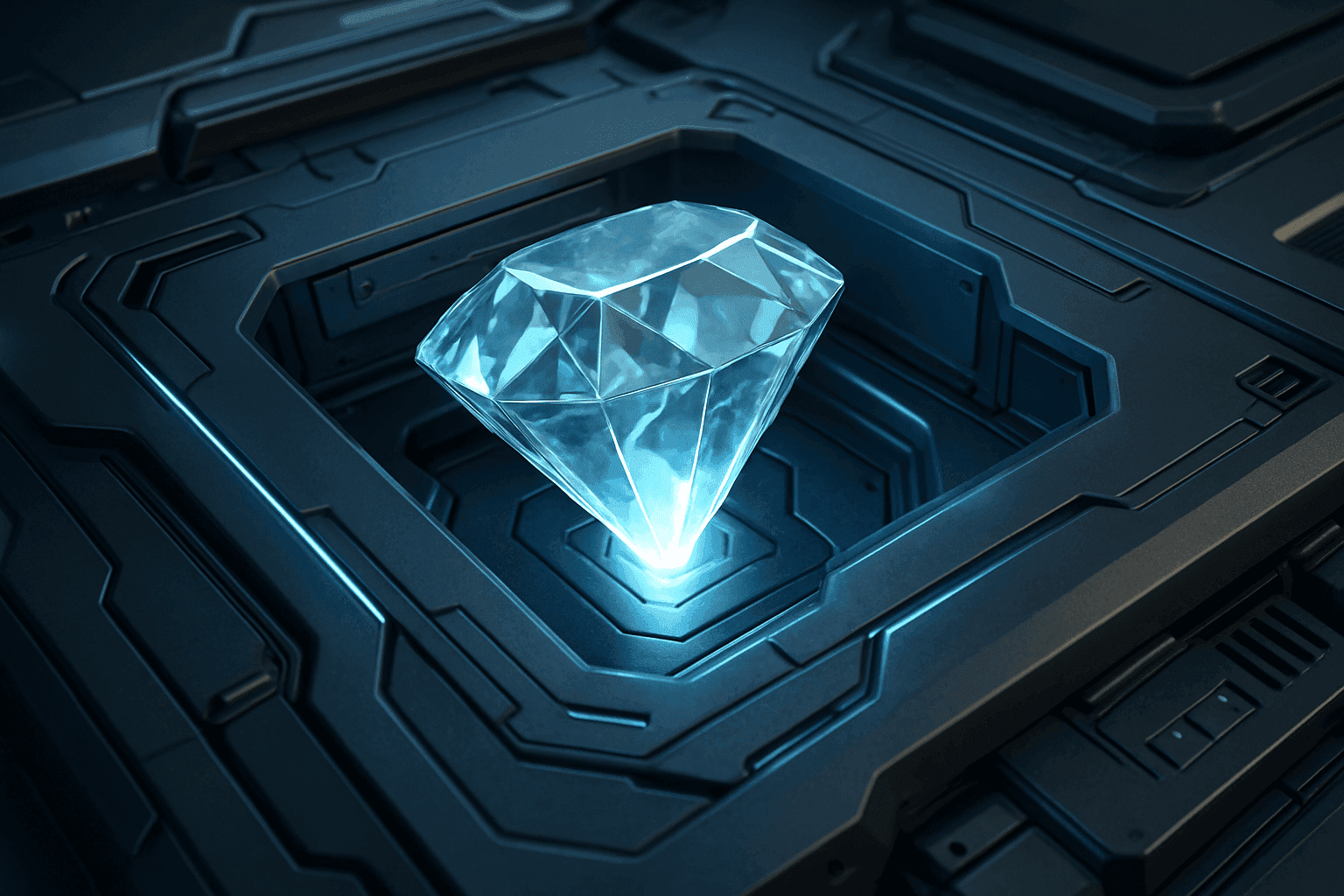
Eternal Spark: How Diamond Batteries are Revolutionizing Power
Imagine a battery that could power devices for thousands of years, offering a sustainable solution to energy needs across various industries. This vision is becoming a reality with the development of diamond batteries, a revolutionary technology that harnesses the power of radioactive isotopes encased in synthetic diamonds. These batteries, particularly those using carbon-14, promise ultra-long lifespans, minimal maintenance, and enhanced safety, opening doors to applications previously limited by conventional chemical power sources.
What are Diamond Batteries?
Diamond batteries, also known as nuclear batteries, betavoltaic cells, or radioisotope batteries, are devices that generate electricity directly from the radioactive decay of isotopes. Unlike conventional chemical batteries (such as lithium-ion or alkaline cells) that rely on finite chemical reactions and degrade over time, diamond batteries utilise the steady energy released during beta decay to create a continuous electric current.
The Betavoltaic Effect
The core principle behind diamond batteries is the betavoltaic effect, a process physically similar to the photovoltaic effect used in solar panels. However, instead of using photons from sunlight to knock electrons free, betavoltaic cells use high-energy beta particles (electrons) emitted during the decay of a radioactive isotope.
When these beta particles are embedded within a semiconductor material, they generate electron-hole pairs. In a diamond battery, synthetic diamond serves as the semiconductor. Diamond is an exceptional choice because it is a wide-bandgap semiconductor with an energy gap of 5.5 eV. This wide bandgap gives it extraordinary radiation hardness, meaning it can withstand constant bombardment by beta particles for millennia without suffering significant crystal lattice damage.
Key Components
- Radioactive Isotope: A beta-emitting isotope (such as Carbon-14, Nickel-63, or Tritium) that undergoes steady radioactive decay, serving as the continuous energy source.
- Synthetic Diamond: A lab-grown crystalline matrix that acts as a solid-state semiconductor, absorbing the kinetic energy of emitted beta particles to generate electricity.
How They Work
The conversion of nuclear decay into electrical energy follows a highly efficient, direct three-step process:
- Radioactive Decay: The radioactive isotope inside the crystal lattice undergoes beta decay. For carbon-14, a neutron decays into a proton, emitting a low-energy beta particle (a fast-moving electron) and an electron antineutrino. This nuclear reaction is represented by the following equation:
- Electron Generation: The emitted beta particle (e−) travels through the surrounding diamond semiconductor matrix, colliding with stable carbon atoms. These collisions ionise the carbon atoms, exciting electrons from the valence band to the conduction band, leaving behind positively charged "holes". This generates thousands of electron-hole pairs for every single beta particle emitted.
- Electric Current: An internal electric field, created by doping different layers of the diamond semiconductor to form a p-n junction, forces the free electrons and holes to flow in opposite directions. This charge separation creates a potential difference, directing a continuous, reliable electric current through external metal contacts to power connected low-energy devices.
The Carbon-14 Diamond Battery Breakthrough
Scientists and engineers from the UK Atomic Energy Authority (UKAEA) and the University of Bristol have achieved a significant milestone by creating the world's first carbon-14 diamond battery. This development leverages the unique properties of carbon-14 and synthetic diamonds to create an incredibly long-lasting and safe power source.
Carbon-14: A Sustainable Choice
Carbon-14 is a radioactive isotope of carbon with a half-life of approximately 5,730 years. This means it takes 5,730 years for half of the carbon-14 atoms in a sample to decay into stable nitrogen-14. The strategic selection of carbon-14 offers several profound advantages:
- Ultra-Long Lifespan: The extended half-life ensures that the battery can provide a continuous source of power for thousands of years. Even after 5,000 years, the battery will still operate at nearly 50% of its initial power capacity.
- Nuclear Waste Utilisation: Carbon-14 can be extracted from irradiated graphite blocks, which are a major byproduct of legacy nuclear power generation (such as the UK's decommissioned Magnox and Advanced Gas-cooled Reactors). Extracting the isotope from the outer layers of these blocks turns a costly nuclear waste liability into a valuable raw material for clean energy, promoting a circular nuclear economy.
- Inherent Safety: Carbon-14 emits low-energy beta radiation that can only travel a few centimetres in air and is completely blocked by just a fraction of a millimetre of any solid material. This makes containment incredibly simple and reliable.
Manufacturing Process
The synthesis of carbon-14 diamond batteries requires extreme precision and advanced industrial laboratory equipment:
- Carbon-14 Extraction: Radioactive carbon-14 is safely extracted from the surface of spent nuclear graphite blocks. The carbon is typically gasified into radioactive methane (14CH4) to isolate the isotope.
- Diamond Synthesis: Using Chemical Vapour Deposition (CVD), scientists grow synthetic diamonds layer by layer inside a vacuum chamber.
- Isotope Incorporation: The radioactive methane gas is introduced into the CVD chamber. As the diamond grows, the carbon-14 atoms are directly incorporated into the crystal lattice, forming an active, radioactive diamond core.
- Encapsulation: To guarantee absolute safety, the radioactive diamond core is encased in an outer layer of non-radioactive synthetic diamond (carbon-12). This outer diamond shell acts as an impenetrable barrier, completely absorbing any stray beta radiation and preventing any physical or chemical leakage of the isotope.
Advantages of Carbon-14 Diamond Batteries
- Unparalleled Lifespan: With a functional lifespan measured in thousands of years, these batteries outlast the operational lifetime of almost any device they power, rendering battery replacements obsolete.
- Uncompromised Safety: Diamond is one of the hardest and most chemically inert materials known to science. It is virtually impossible to break open under normal environmental conditions, resists acidic corrosion, does not catch fire, and can withstand extreme temperatures, ensuring the radioactive isotope remains permanently locked inside.
- High Thermal Conductivity: Diamond is an exceptional thermal conductor. This property allows any heat generated within the cell to dissipate instantly, preventing thermal runaway or degradation.
- Environmental Sustainability: By utilising carbon-14 extracted from legacy nuclear reactors, the technology actively reduces the volume of hazardous graphite waste stored in long-term repositories.
- Zero Maintenance: Because there are no liquid electrolytes to leak, dry out, or corrode, these solid-state batteries require zero upkeep or environmental protection, functioning flawlessly in absolute vacuums or high-pressure deep-sea environments.
Applications Across Industries
The unique characteristics of diamond batteries make them highly suited for niche, critical applications where conventional power source replacement is either physically impossible, highly dangerous, or prohibitively expensive.
Medical Implants
One of the most life-altering applications is in the field of implantable medical devices. Today, pacemakers, neurostimulators, and cochlear implants rely on lithium-ion batteries that last between 5 to 15 years, requiring patients to undergo periodic surgical procedures to replace the power source.
Biocompatible, diamond-encased batteries could power these devices indefinitely. Because the outer casing is pure carbon-12 diamond, it is entirely non-toxic and hypoallergenic, eliminating the risk of tissue rejection and reducing the physical and psychological toll of repeated surgeries on patients.
Space Exploration
In deep space, solar energy becomes ineffective due to the immense distance from the Sun. Spacecraft must rely on nuclear power. While traditional Radioisotope Thermoelectric Generators (RTGs) use heavy plutonium-238 to generate heat and electricity, they are large and emit high levels of gamma radiation, requiring heavy shielding.
Diamond batteries offer a lightweight, solid-state alternative for low-power spacecraft systems. They can power deep-space probes, planetary landers, and orbital satellites for decades. For example, they are ideal for maintaining active radio frequency (RF) tracking tags, keeping internal clocks synchronised, and keeping primary computer memories alive during long periods of hibernation on interplanetary transits.
Remote and Extreme Sensors
Monitoring hazardous environments requires sensors that can operate autonomously for decades without human intervention. Diamond batteries are ideal for powering:
- Seismic Sensors: Placed deep inside active volcanoes or tectonic fault lines to detect early warning signs of eruptions and earthquakes.
- Oceanic Monitors: Anchored to the deep ocean floor to track pressure changes, acoustic signals, or marine ecosystems.
- Infrastructure Monitors: Embedded directly into the structural concrete of bridges, tunnels, dams, and skyscraper foundations to monitor structural integrity and strain over centuries.
- Defence and Security: Powering remote border surveillance equipment, acoustic arrays on the seabed, and unattended ground sensors in polar regions.
Consumer Electronics
While diamond batteries currently produce minimal power, they could eventually play a supportive role in consumer electronics. Instead of replacing lithium-ion batteries entirely, a micro-diamond battery could be paired with a traditional battery or a supercapacitor.
In this hybrid setup, the diamond battery would slowly and continuously trickle-charge the device during periods of inactivity. This could keep real-time clocks, security chips, or emergency transmitters functioning indefinitely, even if the primary battery is completely dead.
Challenges and Future Directions
Despite their immense potential, several technical and commercial hurdles must be overcome before diamond batteries see widespread, mainstream adoption.
Low Power Output
The most significant constraint of betavoltaics is their exceptionally low power density. Currently, diamond batteries produce only microwatts (μW) of power. For perspective:
- One gram of carbon-14 yields approximately 15 Joules of energy per day.
- This translates to a continuous power output of only a few microwatts—far too low to power a modern smartphone, which requires several watts of power during operation.
To overcome this, researchers are developing complex three-dimensional p-n junctions within the diamond structure to maximise the surface area contact between the carbon-14 and the semiconductor interface. Additionally, combining these batteries with integrated supercapacitors allows the continuous, low-power energy to be harvested and stored over time, discharging in high-power bursts when needed.
High Production Costs
Growing synthetic diamond via Chemical Vapour Deposition is an energy-intensive, highly technical process. Furthermore, separating and purifying carbon-14 from radioactive graphite blocks requires specialised nuclear processing facilities. Consequently, the initial prototype manufacturing costs are extremely high.
However, commercial spin-outs, such as Arkenlight (established by the researchers at the University of Bristol) and other global startups like NDB (Nano Diamond Battery), are actively working to scale up the manufacturing processes. The UKAEA estimates that utilising 45 kilograms (around 100 pounds) of carbon-14 could produce millions of long-duration, diamond-based batteries, dramatically lowering the unit cost through automated, high-volume production.
Public Perception and Regulatory Support
The word "nuclear" often triggers public anxiety, and diamond batteries are occasionally misunderstood as miniature nuclear reactors. Educating the public about the nature of beta radiation—and demonstrating that the battery's outer diamond shell is completely non-radioactive and safely blocks all radiation—is vital for gaining widespread societal acceptance.
Furthermore, strict international regulations govern the transport, distribution, and commercial use of radioactive materials. Regulatory bodies will need to establish new frameworks to certify that these consumer-grade betavoltaic devices pose absolutely zero health or environmental risks throughout their life cycle.
The Path Forward
The future of diamond batteries looks promising, with ongoing academic and commercial research focused on overcoming current limitations and expanding their applications. Key areas of focus include:
- Improving Energy Conversion Efficiency: Optimising the internal geometry of the diamond p-n junctions to convert a higher percentage of beta particle kinetic energy into electricity.
- Exploring Alternative Isotopes: Investigating isotopes with higher energy densities or shorter half-lives (such as tritium or nickel-63) to build batteries for devices that require milliwatt-level power over shorter, decade-long spans.
- Hybrid Energy Systems: Integrating diamond batteries directly onto silicon microchips alongside supercapacitors to create self-charging, perpetual-power microchips for the Internet of Things (IoT).
The Promise of a Sustainable Future
Diamond batteries represent a significant step towards sustainable and long-lasting energy solutions. By harvesting the power of nuclear waste and encasing it in one of the hardest, most resilient materials on Earth, this technology offers a unique combination of longevity, safety, and circular utility.
As manufacturing technologies advance and production costs decrease, diamond batteries have the potential to revolutionise medicine, space exploration, structural engineering, and environmental monitoring. They embody a future where power is not only infinitely more reliable but also deeply responsible, turning the radioactive waste of our past into the clean, everlasting energy of our future.
