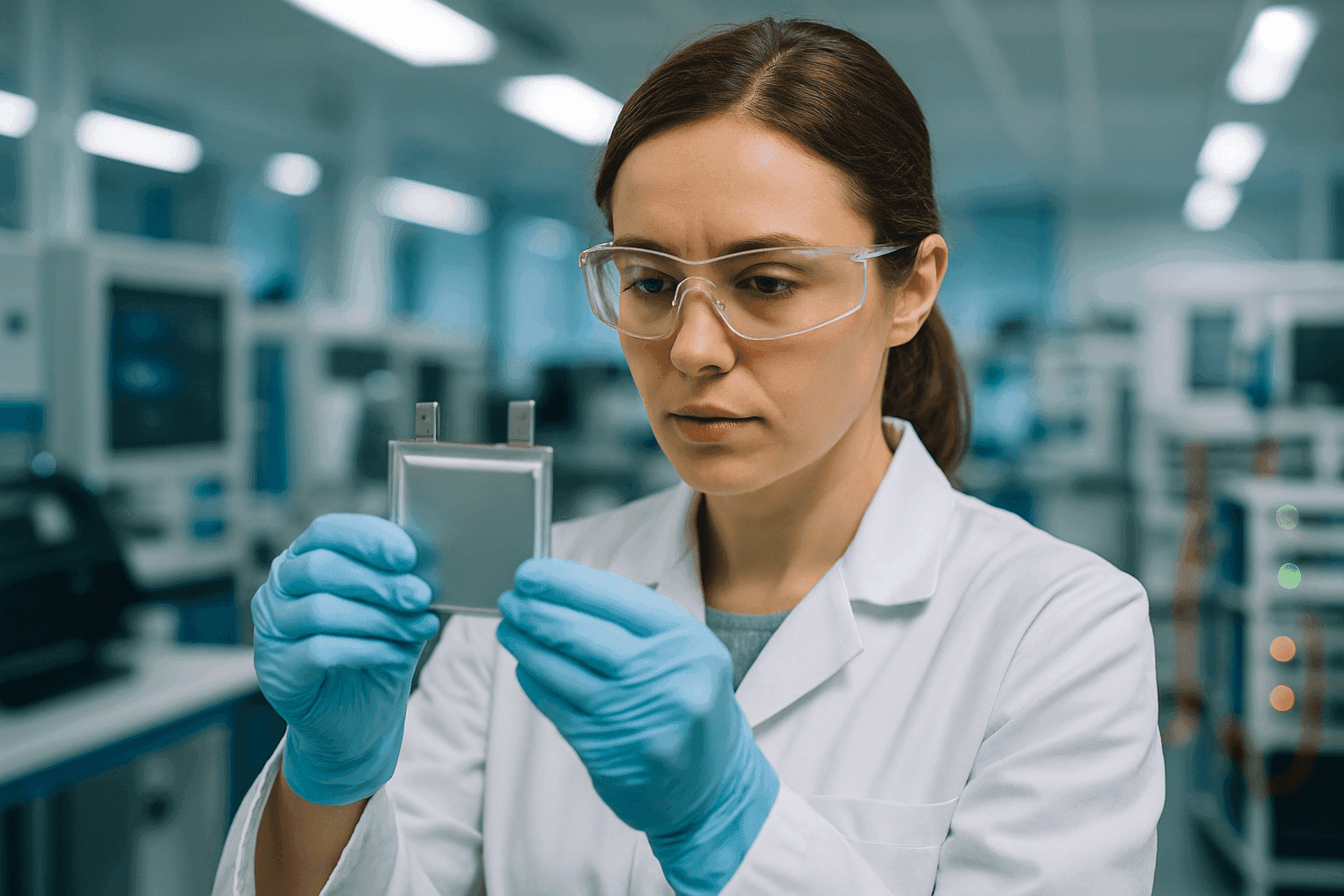
Factorial Energy’s Solid-State Battery Breakthrough Promises to Revolutionize EV Lifespan and Performance
A U.S. firm, Factorial Energy, is developing electric-vehicle (EV) solid-state cells intended to improve energy density, charging performance and durability. Factorial has said that smaller prototype cells in its Solstice™ all-solid-state programme have exceeded 2,000 cycles in lifecycle testing. However, its public materials do not specify the prototype capacity, test temperature, charge/discharge C-rate, depth of discharge or end-of-life capacity-retention criterion. The result should therefore not be used to calculate vehicle battery life or compared directly with automotive-cell cycle-life figures.
The work centres on Factorial's proprietary Factorial Electrolyte System Technology (FEST®) and Solstice™ cells. FEST® uses a quasi-solid electrolyte, while Solstice™ is an all-solid-state platform. Both aim to address long-standing challenges in battery performance, safety and scalability.
The Core Technology: Solid-State and Dry Cathode Innovation
Factorial Energy, based in Massachusetts, is developing solid-state battery technology for EVs. Unlike conventional lithium-ion batteries, which use liquid electrolytes, solid-state batteries use solid or quasi-solid electrolytes. These can support higher-energy electrode materials and reduce reliance on flammable liquid electrolyte.
A Factorial solid-state battery is not simply a conventional cell with different packaging. Its electrolyte system replaces or substantially reduces the flammable liquid electrolyte used in mainstream lithium-ion cells, while its architecture is intended to support high-energy electrode materials. The practical challenge is maintaining stable contact between electrodes and electrolyte over thousands of charge-discharge cycles, across changing temperatures and in large-format automotive cells rather than only laboratory samples.
Solstice™ uses a dry cathode-coating process. It removes conventional solvent-based electrode mixing and drying, avoiding solvent evaporation and associated volatile-organic-compound handling. It does not eliminate formation, which is a separate cell-conditioning process after assembly. Factorial says it is engineering Solstice™ to simplify and reduce formation requirements rather than remove formation altogether. FEST® is intended to retain substantial compatibility with established lithium-ion production equipment, while Solstice™ changes cathode manufacturing through dry coating.
Manufacturing compatibility matters because battery breakthroughs must be reproducible at high volume. A cell chemistry that performs well in a small prototype must still meet automotive requirements for yield, consistency, quality control, safety, cost and long-term reliability before deployment in customer vehicles.
Unprecedented Cycle Life and Energy Density
Factorial has reported performance metrics for its solid-state cells. Smaller Solstice™ prototypes have reportedly exceeded 2,000 charge cycles in lifecycle testing, but the company has not publicly disclosed the prototype capacity, temperature, C-rate, depth of discharge or end-of-life criterion. The result applies to Solstice™, not to the 77 Ah FEST® cell discussed below.
The company’s 77 Ah FEST® cells, validated with Stellantis, have shown more than 600 cycles while progressing towards automotive qualification, alongside a cell-level energy density of 375 Wh/kg. Stellantis and Factorial have not published the cells’ cycle-test protocol or end-of-life criterion, so the figure should not be compared directly with manufacturer cycle-life ratings that use different test conditions.
Energy density, measured in Wh/kg, describes how much energy a battery can store for a given mass. Higher cell-level energy density can support more driving range without proportionally increasing battery weight. Finished-vehicle range also depends on pack design, thermal management, vehicle efficiency, usable battery capacity, charging strategy and the protective hardware around the cells.
Impact on EV Lifespan
A cycle-life result can inform battery durability only when the test conditions and end-of-life threshold are known. If a future EV battery completed 2,000 full equivalent cycles while retaining sufficient usable capacity, its mileage would depend on the vehicle’s usable range per cycle. This cannot be inferred from Factorial’s undisclosed Solstice™ prototype test conditions.
Battery ageing is also affected by calendar time, rapid charging, high temperatures, deep discharge and charging habits. Fleet and consumer results will be as important as laboratory lifecycle figures.
Faster Charging and Wider Operating Temperatures
Factorial's technology is intended to improve charging time. The 77 Ah FEST® cells validated with Stellantis charged from 15% to over 90% in 18 minutes at room temperature. This is a reported cell result, not a specified vehicle charging time.
Charging performance should be assessed alongside charging conditions, battery state of charge, charger power, temperature and repeated-use effects. The 15% to 90% result is relevant because charging generally slows as a battery approaches full capacity.
Stellantis and Factorial report that the 77 Ah FEST® cells can operate from -30 °C to 45 °C (-22 °F to 113 °F), with discharge rates of up to 4C. The announcement does not provide equivalent range, efficiency or cycle-life results across that full temperature range.
Strategic Partnerships and Future Outlook
Factorial Energy has joint development agreements with Mercedes-Benz, Stellantis, Hyundai Motor Company and Kia Corporation. Stellantis, which invested $75 million in Factorial in 2021, has integrated Factorial solid-state cells into a Dodge Charger Daytona development vehicle in 2026 and begun road testing. Mercedes-Benz has reported that a lightly modified EQS test vehicle using Factorial FEST® lithium-metal cells travelled 1,205 kilometres without recharging, arriving with 137 kilometres of indicated remaining range.
These partnerships allow Factorial’s solid-state battery technology to be tested against automotive engineering requirements. Automakers must integrate cells into modules and packs, validate cooling and crash protection, develop charging controls and demonstrate reliable operation over the vehicle’s life. The reported 1,205-kilometre Mercedes demonstration is a vehicle-and-pack result, not a cell-level energy-density or cycle-life measurement; Mercedes-Benz has not supplied all pack specifications and operating conditions needed to compare it directly with the 77 Ah FEST® cell data.
FEST® is intended to be compatible with much existing lithium-ion production equipment, while Solstice™ replaces solvent-based cathode coating and drying with dry coating. Whether this lowers production cost or improves throughput at automotive scale remains to be demonstrated in production.
Factorial opened its Methuen, Massachusetts facility with space for an assembly line of up to 200 MWh. In its 2023 announcement, the company said the line was expected to be the largest solid-state battery assembly line in the United States; this was a company expectation for the planned line, not an independently verified ranking.
