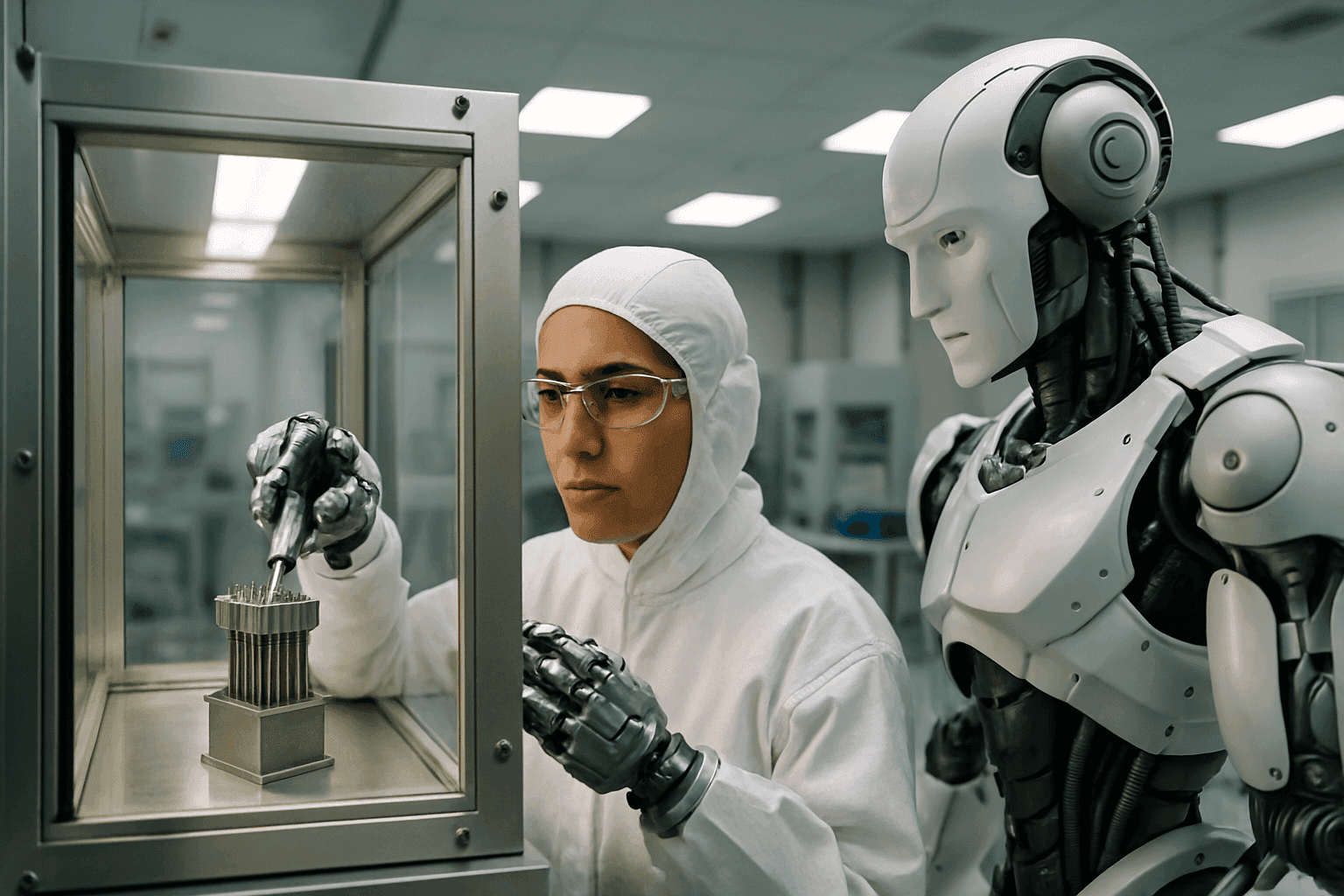
France’s Next-Gen Nuclear Waste Burning Efforts Bolstered by Robotic Innovation
In a significant stride for its advanced nuclear program, France is increasingly integrating cutting-edge robotics into its nuclear material management, with the recent deployment of an intelligent humanoid robot marking a pivotal moment. This development underscores France's long-standing commitment to a closed nuclear fuel cycle and the ambitious pursuit of next-generation reactors capable of significantly reducing nuclear waste.
On November 4, 2025, Orano, a global leader in nuclear materials, in collaboration with Capgemini, announced the deployment of “Hoxo,” the first intelligent humanoid robot in the nuclear sector, at the Orano Melox Ecole des Métiers in France. This groundbreaking initiative leverages embedded artificial intelligence (AI) and advanced sensors to enable Hoxo to replicate human movements, navigate autonomously, execute technical tasks, and interact within complex nuclear environments. The robot's introduction is expected to enhance industrial performance and provide crucial robotic assistance to human operators, particularly in challenging intervention scenarios.
The Stellarium Reactor: A Glimpse into Future Waste Burning
While Hoxo begins its work in existing facilities, France is also making notable progress on advanced reactor designs explicitly aimed at nuclear waste reduction. A prominent example is the Stellarium reactor, a fourth-generation fast neutron molten salt reactor currently under development by French startup Stellaria.
This innovative reactor is designed to operate within a closed fuel cycle, offering exceptional autonomy by generating 250 megawatts for up to 60 years without refueling. Crucially, the Stellarium boasts the unique ability to utilize various fuels, including uranium, plutonium, and thorium, and can even burn long-lived nuclear waste, drastically shortening its hazardous lifetime. Stellaria's vision is to develop a reactor that eliminates more long-lived nuclear waste than it produces, addressing one of the nuclear industry's most persistent challenges.
In July 2025, Stellaria secured a substantial €23 million in funding, bringing its total investment to €33 million, to accelerate the development of the Stellarium. The company aims to finalize a functional demonstrator by 2029, with commercial deployment anticipated by 2035. Strategic partnerships with industry giants like Schneider Electric, Technip Energies, and Orano are bolstering Stellaria's efforts, providing immediate market credibility and expertise in various facets of reactor development and fuel management.
Robotics Revolutionizing Nuclear Operations and Safety
The integration of robots like Hoxo at facilities such as Orano Melox highlights a broader trend in France's nuclear sector: the increasing reliance on advanced robotics and automation to improve safety, efficiency, and enable complex operations in hazardous environments. Orano, a key player in the recovery and transformation of nuclear materials, plays a central role in France's strategy to reprocess used nuclear fuel, recovering uranium and plutonium for reuse. Robotic assistance in these critical facilities can significantly reduce human exposure to radiation and streamline processes.
Beyond humanoid robots, specialized robotic systems are becoming indispensable across the nuclear lifecycle. Companies like Framatome leverage robotic arms for strenuous tasks, laser robots for dismantling operations (such as the Eloise robot used at the Superphénix reactor), and other remote-operated vehicles for inspections and foreign material extraction. These technologies are particularly vital in decommissioning projects, where remote-controlled robots can perform tasks like sorting and segregating radioactive waste, mapping contamination, and even cutting highly contaminated pipework, as exemplified by Framatome’s Charli robot at Superphénix.
Furthermore, the development of “digital twins” of nuclear facilities, as undertaken by Andra (France's National Agency for Radioactive Waste Management) through the CA2AN project, is enhancing safety and efficiency in waste management. These digital replicas allow operators to optimize workflows, test implementation layouts, and train in virtual reality, thereby reducing risks and saving resources.
France's Strategic Vision for a Sustainable Nuclear Future
France has long championed a “closed fuel cycle,” reprocessing used nuclear fuel to recover reusable materials and minimize waste volume and toxicity. In March 2024, Minister for the Economy, Finance, Industrial and Digital Sovereignty, Bruno Le Maire, reaffirmed this strategy, announcing plans to extend the life of existing recycling plants and initiate studies for new mixed-oxide (MOX) fuel fabrication and reprocessing facilities beyond 2040. This long-term commitment aims to reduce the volume of nuclear waste by up to 75%.
The strategic relaunch of fast reactor technology in March 2025, with plans for a demonstrator possibly around 2038 and operation between 2045-2050, further solidifies France's vision. This renewed emphasis, coupled with significant government investment—including a €1 billion boost through the France 2030 plan for innovative nuclear technology startups—underscores the nation's resolve to achieve energy independence and decarbonization goals through advanced nuclear solutions.
The convergence of cutting-edge fast reactor development, like the Stellarium, with the operational enhancements provided by advanced robotics, such as the humanoid Hoxo, positions France at the forefront of tackling the complex challenges of nuclear waste management and ushering in a more sustainable nuclear energy future.
