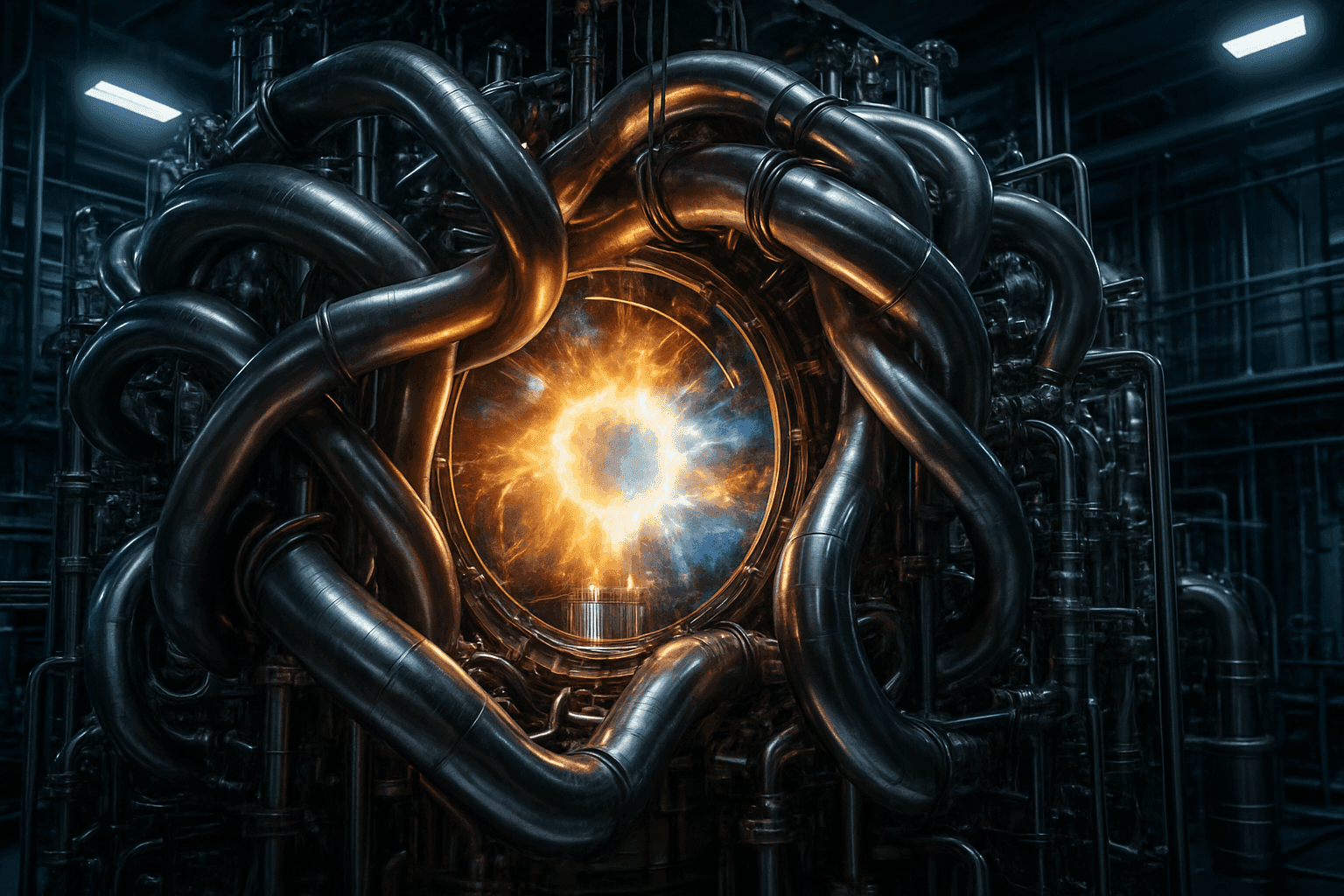
Fusion Breakthrough! Stellarator Creates Helium-3 Milestone
In Wendelstein 7-X (W7-X), the world’s largest stellarator, researchers in Greifswald, Germany, have generated high-energy helium-3 ions using ion cyclotron resonance heating (ICRH). The experiment provides a way to investigate energetic-particle confinement and radio-frequency heating in a stellarator.
What is Wendelstein 7-X?
Wendelstein 7-X is an experimental stellarator built by the Max Planck Institute for Plasma Physics (IPP). Its primary goal is to advance stellarator technology and evaluate the components needed for a future fusion power plant. Unlike tokamaks, stellarators are designed for continuous operation, which is essential for a practical energy source. W7-X is the world’s largest stellarator-type fusion device and tests whether this approach is suitable for power generation.
Stellarator vs. Tokamak: Key Differences
Stellarators and tokamaks both use magnetic fields to confine plasma, but their designs differ. Tokamaks rely on a strong electrical current flowing through the plasma to create part of the magnetic field needed for confinement. Stellarators use a complex arrangement of external magnetic coils. This allows them to operate in a steady state without a net plasma current.
That steady-state potential is relevant to helium-3 fusion research. A commercial fusion plant would need to control a very hot, energetic plasma reliably for long periods, rather than produce brief pulses. W7-X tests the confinement, heating and energetic-particle physics that such concepts require.
Key Features of Wendelstein 7-X:
- Optimised Magnetic Field: W7-X uses 50 non-planar superconducting magnet coils to create an optimised magnetic field for plasma confinement.
- Continuous Operation: W7-X is designed to sustain plasma discharges for up to 30 minutes, demonstrating the stellarator’s potential for continuous operation.
- Helias Configuration: The device uses a five-field-period Helias configuration, optimising plasma confinement and stability.
Historic Helium-3 Generation
For the first time in a stellarator, researchers at W7-X generated high-energy helium-3 ions using ICRH. A radio-frequency antenna fed electromagnetic waves into a plasma containing hydrogen, helium-4 and helium-3. The waves were tuned so helium-3 ions absorbed energy and reached high energies.
W7-X created and heated helium-3 ions for plasma-physics experiments; it did not demonstrate net energy production from a helium-3 fusion reaction. The controlled population of energetic helium-3 ions allows researchers to investigate confinement, energy transfer to the surrounding plasma and radio-frequency heating in a stellarator.
Why Helium-3?
Helium-3 is a light isotope of helium with two protons and one neutron. It is of interest for fusion because it offers the potential for reactions with much lower neutron production. Fusing helium-3 with deuterium, an isotope of hydrogen, produces primarily protons and helium-4, with significantly fewer neutrons than deuterium-tritium fusion. This could reduce neutron damage and radioactive material in a future reactor.
The most discussed helium-3 fusion reaction combines deuterium and helium-3:
2H+3He→4He+p+18.3 MeVHere, 2H is deuterium, 3He is helium-3, 4He is helium-4, p is a proton, and MeV means million electron volts of released energy. The charged proton carries most of the reaction energy, while the helium-4 nucleus is also charged. In principle, charged products are easier to contain electromagnetically than neutrons and may offer routes to more direct energy conversion.
Helium-3 fusion is often described as “aneutronic”, but the term needs qualification. The main deuterium–helium-3 reaction produces no neutron directly. In a real plasma, however, deuterium can react with deuterium, producing some neutrons and tritium. Helium-3 fusion could greatly reduce neutron production compared with deuterium–tritium fusion, rather than eliminate it entirely.
Why Helium-3 Fusion Is Difficult
The reduced neutron output comes with a demanding trade-off: deuterium–helium-3 fusion requires substantially higher temperatures and more stringent plasma confinement than the deuterium–tritium reaction pursued by most current fusion programmes. At those conditions, radiation losses, impurities, fuel dilution and the loss of fast charged particles become more significant engineering and physics challenges.
Fuel availability is another constraint. Helium-3 is rare on Earth and has important scientific and industrial uses. For these reasons, helium-3 fusion remains a long-term research prospect rather than a replacement for present-day energy systems.
Ion Cyclotron Resonance Heating (ICRH)
Ion cyclotron resonance heating uses radio-frequency waves to heat plasma in fusion devices.
- Electromagnetic Waves: Electromagnetic waves are introduced into the plasma through a specialised antenna.
- Resonance: Their frequency is tuned to match the ion cyclotron frequency of the target ion species, in this case helium-3.
- Energy Absorption: The ions absorb energy efficiently at resonance.
- Heating: The ions accelerate and heat up, increasing the plasma temperature.
In the W7-X experiment, helium-3 is a minority species in a hydrogen and helium-4 plasma mixture. This allows scientists to deposit radio-frequency power selectively into helium-3 ions, then study the resulting energetic particles. A power-producing plasma would need to heat fuel efficiently while avoiding particle losses that could reduce performance or damage internal components.
TEC Cluster Collaboration
The ICRH system used in W7-X was developed under the Trilateral Euregio Cluster (TEC) through collaboration between the Plasma Physics Laboratory of the Royal Military Academy in Brussels and the Jülich institutes IFN-1 and ITE.
Implications for Fusion Energy
The experiment gives W7-X a controlled fast-ion source for testing a central prediction of its magnetic configuration: that it can confine energetic particles effectively. The ICRH system operates between 25 and 38 MHz and can deliver up to about 1.5 MW of radio-frequency power in pulses of up to 10 seconds. In the hydrogen–helium-4–helium-3 scenario, it is intended to create helium-3 ions in the roughly 50–100 keV range, comparable to the energetic alpha particles expected in a future fusion reactor.
These energetic ions can compare measured confinement and losses with models of W7-X’s three-dimensional magnetic field. The results can also test whether fast-ion confinement improves at the high plasma densities for which W7-X was optimised. This is an energetic-particle experiment, not evidence that helium-3 is a practical reactor fuel or that W7-X has established commercial stellarator performance.
For helium-3 fusion, the experiment strengthens the scientific foundation rather than proving reactor feasibility. Researchers need to establish that energetic helium-3 ions can be heated predictably, remain confined and interact with the bulk plasma as models predict. The results can improve future heating-system design and help assess whether stellarator configurations can manage the demanding conditions required by advanced fusion fuels.
The Future of Wendelstein 7-X
The next steps for W7-X involve increasing heating power and plasma-discharge duration to achieve higher energy values. The goal is to increase energy turnover to 18 gigajoules while maintaining stable plasma for half an hour.
Future campaigns can compare energetic-particle behaviour across plasma compositions and operating conditions. Reliable long-duration operation, robust wall cooling and effective heating are essential prerequisites for any eventual fusion power plant, whether it uses deuterium–tritium or an advanced fuel cycle such as deuterium–helium-3.
Conclusion
Generating high-energy helium-3 ions in Wendelstein 7-X provides a controlled way to study radio-frequency heating and fast-particle confinement in a stellarator. The experiment supplies data to test W7-X’s magnetic-confinement design and supports research into the physics required for advanced fusion fuels.
