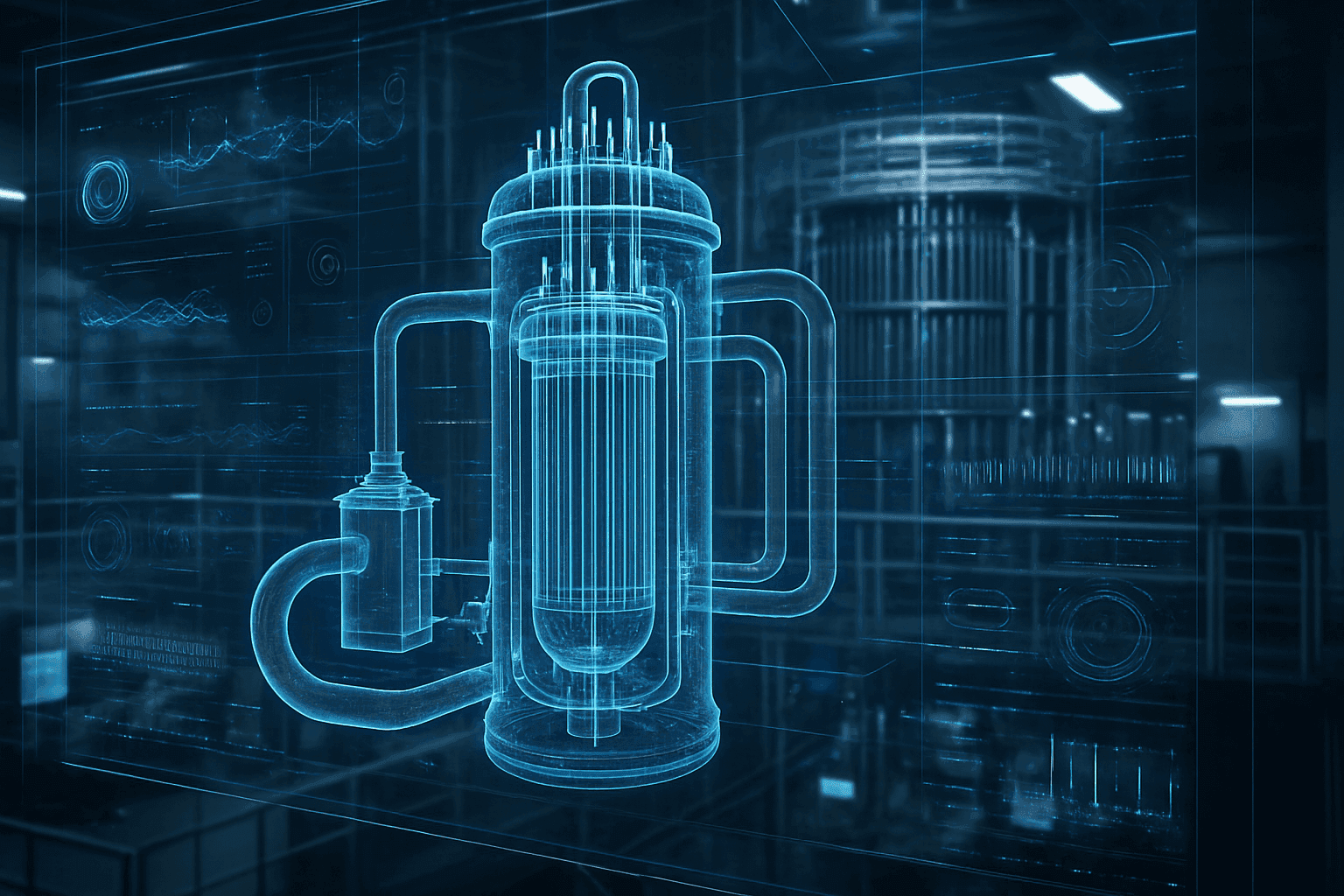
Nuclear Breakthrough: Digital Twin Achieves 99% Accuracy, Revolutionizing Reactor Management
The nuclear energy sector is undergoing a significant transformation with the advent of digital twin technology. A recent milestone has been achieved in the United States, where the first digital twin of a nuclear reactor has reached an accuracy level of 99%. This breakthrough promises to revolutionize how nuclear reactors are managed, operated, and secured, paving the way for enhanced safety, efficiency, and cost-effectiveness.
What is a Digital Twin?
A digital twin is a virtual representation of a physical asset or system. It leverages real-time data, simulation, and machine learning to mirror the behavior and characteristics of its physical counterpart. In the context of nuclear reactors, a digital twin can replicate the reactor's components, processes, and operational environment, providing a dynamic and comprehensive understanding of its performance.
Digital twins in the nuclear industry can be categorized into three main types:
- Static: Primarily focused on data centralization, representation, and consultation, often linked to 3D digital models.
- Dynamic: Couples the digital model with real-time data collected from sensors installed on the physical installation.
- Simulation: Models the operation and physical constraints applied to an environment.
The First US Nuclear Reactor Digital Twin
Researchers at Purdue University, in collaboration with Argonne National Laboratory, have achieved a groundbreaking feat by developing a digital twin of the Purdue University Reactor Number One (PUR-1). PUR-1 is the first and only reactor in the U.S. licensed with a fully digital instrumentation and control system. This digital twin is a fully integrated physics and data-driven simulation that receives real-time measurements from PUR-1's sensors. It utilizes AI-driven algorithms to make predictions and provide insights that can inform reactor operations.
The PUR-1 digital twin has demonstrated the ability to predict changes in the reactor's power production with an accuracy of 99%. This level of precision opens up new possibilities for monitoring and optimizing the performance of small modular reactors (SMRs).
Benefits of Digital Twins in Nuclear Energy
The implementation of digital twin technology in the nuclear industry offers a multitude of benefits, impacting various aspects of reactor design, operation, and safety:
Enhanced Safety and Security
- Real-time Monitoring: Digital twins enable continuous monitoring of reactor conditions, allowing for proactive identification of potential issues and anomalies.
- Anomaly Detection: By leveraging machine learning algorithms, digital twins can detect deviations from normal operating parameters, providing an additional layer of safety and security.
- Cybersecurity: Digital twins can be used to assess and mitigate cyber threats, ensuring the resilience of nuclear power plants against malicious attacks.
- Safeguards: Digital twins can improve the effectiveness of international safeguards by providing tools for accurate diversion pathway analysis, identification of pathway indicators, and real-time monitoring of facilities.
Improved Efficiency and Performance
- Optimization: Digital twins allow for the simulation of different operating scenarios, enabling the optimization of plant performance and the reduction of unplanned outages.
- Predictive Maintenance: By monitoring the condition of machinery and equipment in real-time, digital twins can predict when maintenance is needed, preventing downtime and reducing costs.
- Remote Monitoring: Digital twins enable remote monitoring and control of reactors, reducing the need for on-site personnel and minimizing operation and maintenance costs.
- Faster Design Cycles: Digital twins can accelerate nuclear technology design cycles by up to 50% while dramatically reducing testing and licensing costs.
Cost Reduction
- Reduced Downtime: Predictive maintenance and optimized operations can significantly reduce downtime, leading to increased energy production and revenue.
- Lower Maintenance Costs: By predicting maintenance needs and optimizing maintenance schedules, digital twins can lower maintenance costs.
- Optimized Resource Allocation: Digital twins improve simulation accuracy and operational efficiency by adapting to process variations in real-time, resulting in optimized resource allocation.
- Reduced Capital Expenditures: Rapidly deployable small modular reactor (SMR) and microreactor designs compatible with modular construction techniques and advanced manufacturing will be the new normal, reducing the need for large capital expenditures and compressing construction schedules.
Training and Knowledge Management
- Virtual Training: Digital twins can be used for virtual training, providing a safe and realistic environment for operators to learn and practice different scenarios.
- Knowledge Retention: Digital twins can capture and structure information in a way that engineers and operators can understand, ensuring knowledge retention and transfer.
- Improved Decision-Making: By providing a comprehensive model of the plant, digital twins support faster and smarter decision-making.
Applications of Digital Twins in the Nuclear Industry
Digital twin technology has diverse applications across the nuclear energy sector, including:
- Reactor Design and Operation: Simulating different reactor scenarios to optimize performance and safety, predicting and preventing component failures.
- Waste Management: Simulating waste storage and transport scenarios, identifying potential safety hazards, and optimizing waste management practices.
- Decommissioning: Simulating the dismantling process, identifying potential risks, and optimizing decommissioning strategies.
- Nuclear Safeguards and Security: Performing accurate diversion pathway analysis, identifying pathway indicators, developing required sensors, and monitoring facilities in real time.
- Small Modular Reactors (SMRs) and Microreactors: Improving monitoring and control of SMRs, cutting costs of operation and maintenance.
Challenges and Considerations
While digital twin technology offers numerous benefits, there are also challenges and considerations that need to be addressed for successful implementation in the nuclear industry:
- Data Management: Digital twins require accurate and up-to-date data to ensure the accuracy of simulations. The nuclear energy industry is highly regulated, and data sharing can be restricted because of security concerns.
- Cybersecurity: Protecting digital twins from cyber threats is crucial to ensure the integrity and reliability of the system.
- Expertise: The creation and management of digital twins demand a profound understanding of nuclear energy systems and the intricacies of digital twin technology.
- Uncertainty Quantification (UQ): Incorporating uncertainty quantification is essential to propagate uncertainty from the digital representations to predict the behavior of the physical asset.
- Regulatory Framework: The NRC is exploring the regulatory viability of digital twins for nuclear power plants, focusing on advanced sensors, security integration, and regulatory considerations.
- Computational Efficiency: Balancing the need for high-fidelity models with computational efficiency is crucial for real-time monitoring and control.
The Future of Nuclear Energy with Digital Twins
The achievement of 99% accuracy in the first US nuclear reactor digital twin marks a significant step forward in the application of this technology to the nuclear industry. As digital twin technology continues to evolve, it is expected to play an increasingly important role in:
- Advanced Reactors: Digital twins are being used to design for passive safety and built-in security-by-design in advanced fission and fusion reactors.
- Autonomous Operations: Digital twins enable autonomous control capabilities within nuclear power plants, ensuring optimal operational setpoints while upholding safety standards and resilience against cyber threats.
- Remote Monitoring and Control: With a digital twin, it's possible to develop the capability to monitor a reactor remotely, which could minimize the operation and maintenance costs.
- Proliferation Detection: Digital twins combined with machine learning technologies, can lead to new innovations in process-monitoring detection, specifically in event classification, real-time notification, and data tampering.
By addressing the challenges and leveraging the benefits of digital twin technology, the nuclear industry can move towards a future of safer, more efficient, and more sustainable energy production. The digital twin is not just a virtual replica; it is a powerful tool that can unlock new possibilities for the nuclear energy sector.
