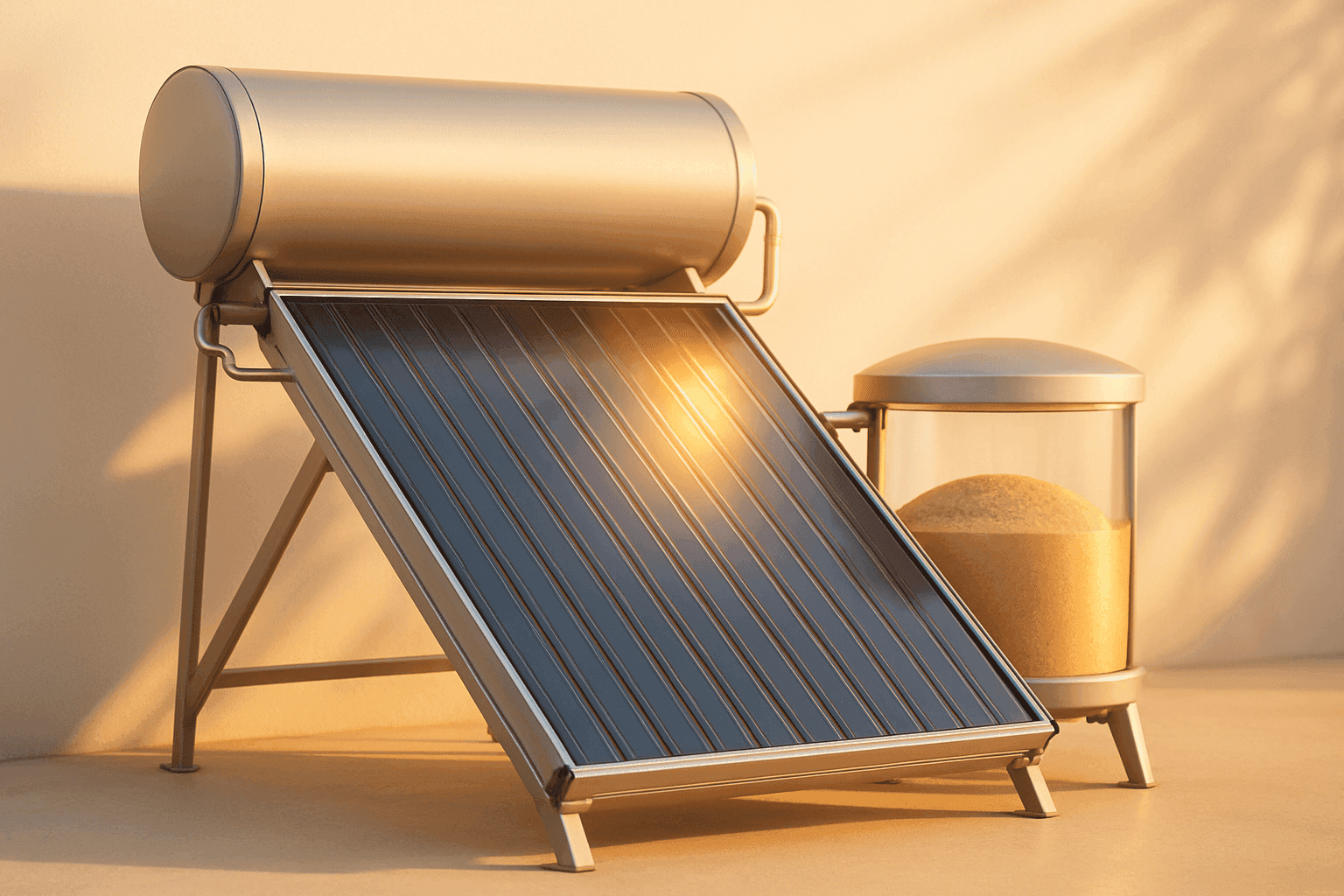
Transform Your Water Heater: How Solar Geysers Use Sand for Ultra-Cheap Hot Water
Tired of high energy bills for hot water? What if the solution was as simple and abundant as sand? A new innovation in thermal storage — the solar sand heater — is turning heads by using sand as a thermal energy storage system, dramatically cutting domestic hot water costs. This technology provides an exceptionally cheap, reliable, and sustainable way to heat water by storing solar energy as high-grade heat for use on demand.
The Hot Water Problem and Renewable Solutions
Heating water is a significant energy consumer in most households, typically accounting for up to 30 per cent of domestic energy usage. Traditional electric or gas water heaters contribute to fossil fuel dependence and rising utility bills.
Solar water heaters offer a renewable alternative, but their effectiveness is limited by the intermittency of sunlight. What happens on cloudy days, during winter, or at night? Standard battery systems (like lithium-ion) remain far too expensive for heating applications. This is where the innovative combination of solar energy and a sand-based thermal storage system — collectively known as a solar sand heater — comes into play.
What is a Solar Sand Heater?
A solar sand heater is a thermal energy storage (TES) system that converts solar energy (either direct thermal energy or electricity generated from solar photovoltaic panels) into heat, storing it within a highly insulated bed of sand.
Sand is an exceptional medium for high-temperature heat storage. Unlike water, which boils at 100 °C under standard atmospheric pressure, dry sand can easily be heated to temperatures exceeding 500 °C without undergoing phase changes or requiring pressurised storage vessels.
Enter the Sand Battery: Thermal Energy Storage Explained
The core of this innovation lies in thermal energy storage (TES), specifically utilising dry, fine-grain sand as the storage medium. Sand batteries leverage the physical properties of silica to absorb, store, and release heat efficiently over extended periods.
How Does a Sand Battery Work?
- Charging: Excess energy, typically from renewable sources like solar PV panels or wind turbines, heats the sand. This is achieved using electric resistance heating elements, such as a nichrome wire, deeply embedded within the sand reservoir.
- Storage: The sand stores the heat for extended periods. Thanks to its high thermal stability and the heavy insulation of the containing vessel, thermal losses are kept to an absolute minimum. Some advanced systems report losing as little as 1 per cent of their stored heat per day.
- Discharging: When hot water is needed, cold water is circulated through a heat exchanger (typically a network of metal pipes) embedded within the hot sand. The heat transfers from the sand to the water, delivering hot water instantly to the household.
Why Sand? The Advantages of This Storage Medium
- Abundance and Low Cost: Sand is one of the most abundant and easily sourced resources on Earth, making it a virtually free storage medium compared to lithium-ion or chemical batteries.
- High Thermal Capacity and Stability: Sand can withstand extremely high temperatures (upwards of 1000 °C) without degrading, melting, or releasing toxic off-gases. This high temperature ceiling allows for high-density energy storage.
- Excellent Heat Retention: Dry sand has low thermal conductivity when static, meaning it acts as its own insulator. This property allows it to retain a hot core for weeks.
- Environmentally Friendly: Sand is non-toxic, non-corrosive, non-flammable, and 100 per cent recyclable, representing a completely safe and sustainable domestic technology.
The Physics of Sand Thermal Storage
To understand how a solar sand heater stores energy, we can calculate its thermal storage capacity using the standard thermodynamic heat transfer equation:
Q=m⋅cp⋅ΔTwhere:
- Q is the stored thermal energy in Joules (J).
- m is the mass of the sand in kilograms (kg).
- cp is the specific heat capacity of dry sand (typically around 830 J⋅kg−1⋅K−1).
- ΔT is the temperature difference between the charged sand and the ambient or target temperature in Kelvin (K) or degrees Celsius (°C).
For example, if a domestic solar sand heater contains 120 kg of fine sand, and is heated from an ambient temperature of 20 °C to a peak temperature of 350 °C (ΔT=330 K):
Q=120×830×330=32,868,000 JConverting Joules to kilowatt-hours (1 kWh=3.6×10⁶ J):
Q≈9.13 kWhThis means a small, 120 kg sand reservoir can store over 9 kWh of thermal energy. This is more than enough thermal capacity to supply a typical household's daily hot water requirements without drawing any energy from the utility grid.
Fine Sand Solar Geyser (FSG): A Practical Application
Researchers are actively developing and testing sand-based solar geyser systems specifically optimised for domestic hot water. One promising design is the Fine Sand Solar Geyser (FSG), developed by researchers in India to address rural energy access and urban cost reduction.
How the FSG System Works
- Solar Panels: The system uses photovoltaic (PV) panels to generate direct current (DC) electricity from sunlight. This bypasses the need for complex, leak-prone solar thermal collectors on the roof.
- Nichrome Wire Heating: The generated DC electricity directly powers a nichrome wire heating rod located inside the sand container, converting electrical energy into heat with nearly 100 per cent efficiency.
- Fine Sand Storage: This heat is stored in a heavily insulated container filled with fine sand (approximately 120 kg in the prototype). Fine-grain sand is specifically selected for its high thermal mass, excellent heat retention, uniform heat distribution, and low cost.
- Heat Exchanger: An integrated heat exchanger equipped with high-conductivity aluminium fins transfers the stored heat to cold domestic water as it passes through the embedded copper pipes.
Performance and Cost-Effectiveness
The FSG system has demonstrated impressive real-world metrics:
- High Thermal Storage Efficiency: Charging efficiencies of over 90 per cent have been achieved under optimal operating conditions.
- Cost-Effective: The system is projected to have a remarkably low energy cost of around $0.0233 per kWh, which is significantly cheaper than standard grid-tied electric water heaters.
- Short Payback Period: With low material costs (sand, copper pipes, and insulation), the payback period is calculated at approximately 4.45 years.
- Resilience: The system overcomes the intermittent nature of solar radiation, ensuring hot water is available 24 hours a day, even during consecutive cloudy days.
Real-World Examples and Projects
While domestic solar sand heaters are expanding in residential markets, the concept of sand-based thermal storage is being validated by large-scale projects worldwide:
- Polar Night Energy (Finland): This company built the world's first commercial sand battery. Using a large, insulated steel cylinder filled with 100 tonnes of low-grade sand, they store excess wind and solar power as heat at temperatures up to 600 °C, which is then discharged into the local district heating network.
- National Renewable Energy Laboratory (NREL – USA): NREL is working on a project called "ENDURING" (Economic Long-Duration Electricity Storage Using Low-Cost Regolith). This project uses gravity-fed heated sand to store energy for grid-scale electricity generation and industrial process heat.
- Drake Landing Solar Community (Canada): This master-planned solar community in Alberta utilises borehole thermal energy storage (BTES) in underground soil and sand to store summer solar energy, providing over 90 per cent of the community's space heating needs throughout the freezing Canadian winter.
Benefits of Solar Geysers with Sand Energy Storage
- Dramatically Reduced Energy Costs: By utilising free solar energy combined with an ultra-cheap storage medium, these systems can lower hot water utility bills by up to 80 per cent.
- Renewable Energy Integration: Solar sand heaters help to overcome the intermittency of solar power, making renewable heating a viable alternative to gas or coal-fired grids.
- True Energy Independence: Generating, storing, and utilising your own thermal energy reduces reliance on municipal grids and insulates households from volatile energy pricing.
- Lower Carbon Footprint: Replacing fossil fuel-based electricity with direct solar-to-thermal sand storage significantly reduces greenhouse gas emissions.
- Grid Stabilisation: On a macro-scale, sand-based thermal storage can help stabilise regional electricity grids by acting as a demand-response sink during times of peak solar generation.
- Extreme Longevity and Low Maintenance: Unlike chemical batteries that degrade after 3,000 to 5,000 cycles, sand does not degrade. A solar sand heater can cycle indefinitely for decades with virtually zero maintenance.
Potential Drawbacks and Challenges
While highly promising, solar sand heater technology does present a few challenges:
Round-Trip Efficiency for Electricity: If the stored heat in a sand battery is converted back into electricity, the conversion efficiency is relatively low (typically 30 to 40 per cent). However, when the heat is used directly* as thermal energy for hot water or space heating, the efficiency is exceptional (often exceeding 90 per cent).
- Thermal Loss: Over extended periods, even well-insulated sand containers lose heat. Minimising these losses requires high-performance insulation materials, which can increase the footprint and initial cost of the unit.
- Space and Weight Requirements: Sand is dense. A system storing enough energy for several days of domestic hot water requires a heavy, robust containment vessel, which must be safely positioned on a stable concrete slab or ground floor.
- Early Stages of Commercialisation: While the physics is well-established, standardised, out-of-the-box domestic solar sand heaters are still transitioning from academic prototypes to widespread commercial retail markets.
The Future of Hot Water: Sand as a Key Ingredient
The solar sand heater represents a massive step forward in the search for simple, low-cost, and sustainable energy storage. By combining the natural abundance of silica with high-temperature electrical resistance or solar thermal collectors, this technology turns a common resource into a highly effective thermal battery. As commercial kits and DIY designs mature, the solar sand heater is set to become a core technology in the transition toward net-zero homes and ultra-cheap domestic energy.
