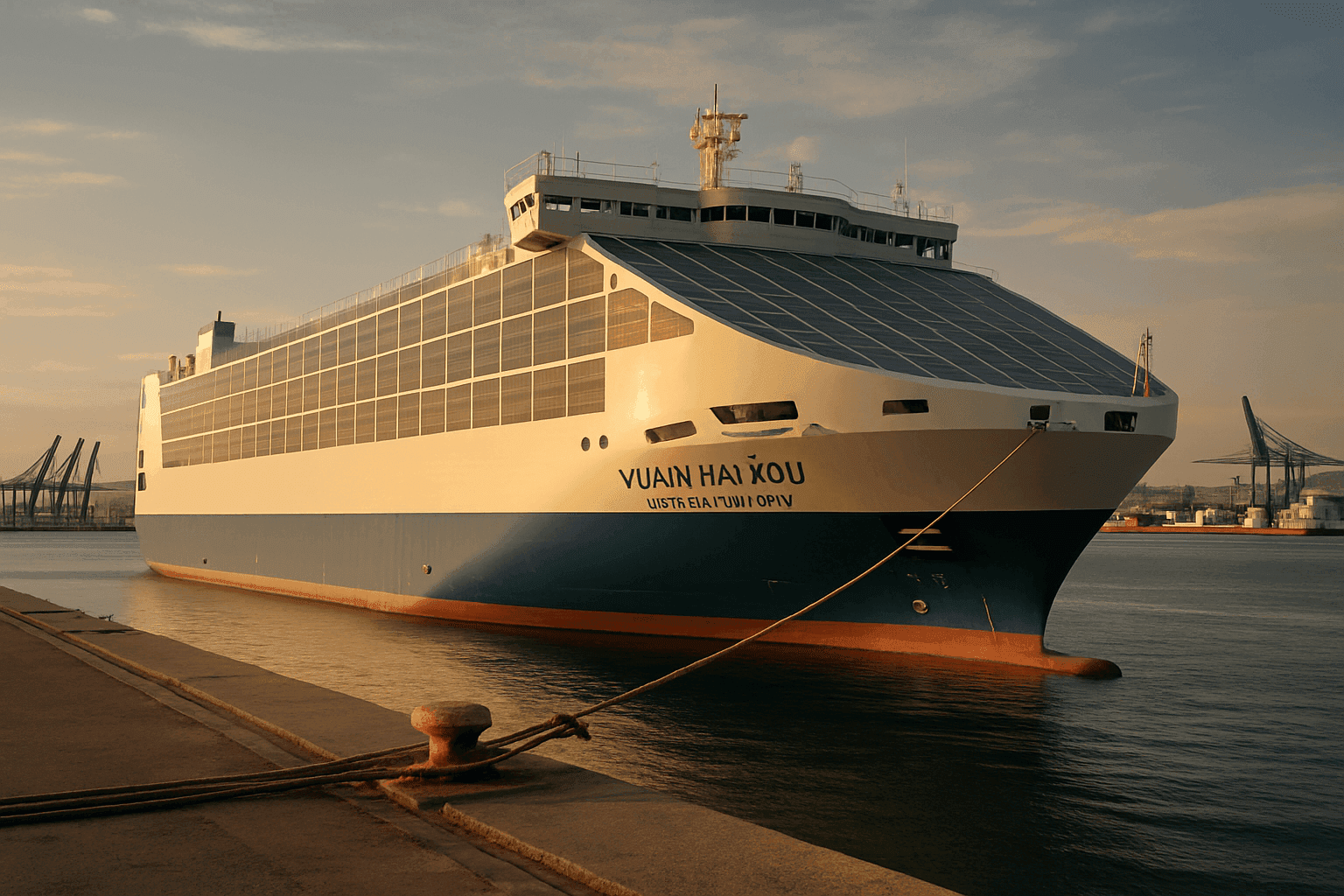
Yuan Hai Kou: World’s Largest Solar-Powered Car Carrier Completes Maiden Voyage
The successful maiden voyage of the Yuan Hai Kou, the world's largest solar-powered car carrier, represents a shift toward lower-emission operations in the global maritime industry. Operated by Guangzhou Yuanhai Car Carrier Transportation (a joint venture involving China COSCO Shipping Corporation Limited), this vessel recently arrived at Greece's Piraeus Port, carrying 4,000 Chinese-made vehicles, predominantly new energy vehicles (NEVs). This inaugural journey demonstrates key progress in green shipping technologies and sustainable international logistics.
As international shipping faces tighter regulatory frameworks under the International Maritime Organisation (IMO) decarbonisation targets, the Yuan Hai Kou provides a technical model for roll-on/roll-off (RoRo) transport operations.
Pioneering Green Technology at Sea
The Yuan Hai Kou represents a fusion of marine engineering and environmental design. Central to its operations is a 302.8-kilowatt solar power system, the largest of its kind integrated into a car carrier. This extensive photovoltaic array is designed to generate approximately 410,000 kilowatt-hours of electricity annually, reducing the ship's reliance on auxiliary fossil fuels.
Beyond its solar capabilities, the vessel is equipped with a dual-fuel engine that runs on both liquefied natural gas (LNG) and conventional fuel oil. This hybrid propulsion system is engineered to cut energy consumption by 20% and reduce carbon emissions by over 24%.
A single round trip from China to Europe is estimated to lower emissions by 2,100 tonnes of CO₂. The reduction in carbon intensity over the vessel's lifecycle is projected to be 35% compared to conventional ships.
The ship's 500-plus LONGi Sea-Shield solar modules are specifically designed for marine environments, offering resistance to salt-spray corrosion, Potential Induced Degradation (PID), and wind load stresses while powering onboard systems such as lighting, communication, and auxiliary functions. Annually, these modules save an estimated 111 tonnes of fuel and 346 tonnes of CO₂.
Technical Specifications of the Yuan Hai Kou Vessel
Measuring 199.9 metres in length, the Yuan Hai Kou has a gross tonnage of 68,252 tonnes and a displacement of 39,069 tonnes. It is designed with 12 vehicle decks—eight fixed and four adjustable—providing flexibility for cargo. While its maiden voyage carried 4,000 vehicles, the vessel has a carrying capacity of up to 7,000 standard cars (CEUs), enabling it to transport passenger cars, engineering trucks, and buses.
Below is a detailed technical profile of the Yuan Hai Kou vessel:
| Parameter | Specification Details |
|---|---|
| Vessel Name | Yuan Hai Kou (远海口) |
| Vessel Type | Pure Car and Truck Carrier (PCTC) / Ro-Ro |
| IMO Number | 9999589 |
| MMSI / Call Sign | 414999000 / BPZH4 |
| Flag / Registry | China |
| Length Overall (LOA) | 199.9 metres |
| Beam (Width) | 38.0 metres |
| Gross Tonnage | 68,252 tonnes |
| Deadweight (DWT) | 19,133 tonnes |
| Cargo Capacity | Up to 7,000 CEU (Car Equivalent Units) |
| Decks | 12 levels (8 fixed, 4 hoistable/adjustable) |
| Primary Propulsion | Dual-fuel LNG / conventional marine gas oil (MGO) |
| Solar Power Array | 302.8 kW (utilising over 500 LONGi Sea-Shield PV panels) |
| Shipyard / Builder | Guangzhou Shipyard International Co. Ltd. (GSI) |
| Operator | Guangzhou Yuanhai Car Carrier Transportation Co., Ltd. |
The ship also integrates proprietary software developed by COSCO Shipping. This system facilitates real-time vehicle tracking and offers instant fire warnings—a safety protocol designed to mitigate hazards when transporting new energy vehicles carrying lithium-ion batteries.
Strategic Importance of the Maiden Voyage
The successful maiden voyage of the Yuan Hai Kou with 4,000 Chinese vehicles, departing from Nansha Auto Port in Guangzhou, marks a significant step in COSCO Shipping's global channel strategy. This initiative aims to integrate shipping, ports, and logistics, establishing a model for low-carbon operations. The vessel's route along the “China-Mediterranean” maritime corridor connects directly to markets in the Belt and Road regions, including Greece, Turkey, Italy, and Tunisia.
Utilising Piraeus Port as a central hub, the service network of the Yuan Hai Kou extends across European nations such as France and Spain, as well as North African countries and Black Sea region ports. While conventional car carrier routes from Asia to Europe currently bypass the Red Sea to travel around the Cape of Good Hope—a detour extending transit times to 40–45 days—the Yuan Hai Kou maintained direct passage through the Suez Canal. By operating at an average transit speed of 16–17 knots and utilising streamlined roll-on/roll-off handling protocols at Piraeus, the vessel completed the journey in approximately 30 days, cutting transit times by nearly one-third.
The vessel's compliance with China Classification Society's (CCS) “Safety Technical Guidelines for Roll-on/Roll-off Transportation of New Energy Vehicles” highlights its commitment to safety standards, intelligent features, and digital innovation.
The introduction of such advanced car carriers is designed to support Chinese automakers like BYD, Chery, Geely, and SAIC as they expand their presence in international markets. This strategic asset allows for greater control over the supply chain, reducing reliance on third-party logistics, cutting transport costs, and ensuring faster delivery of new energy vehicles globally.
