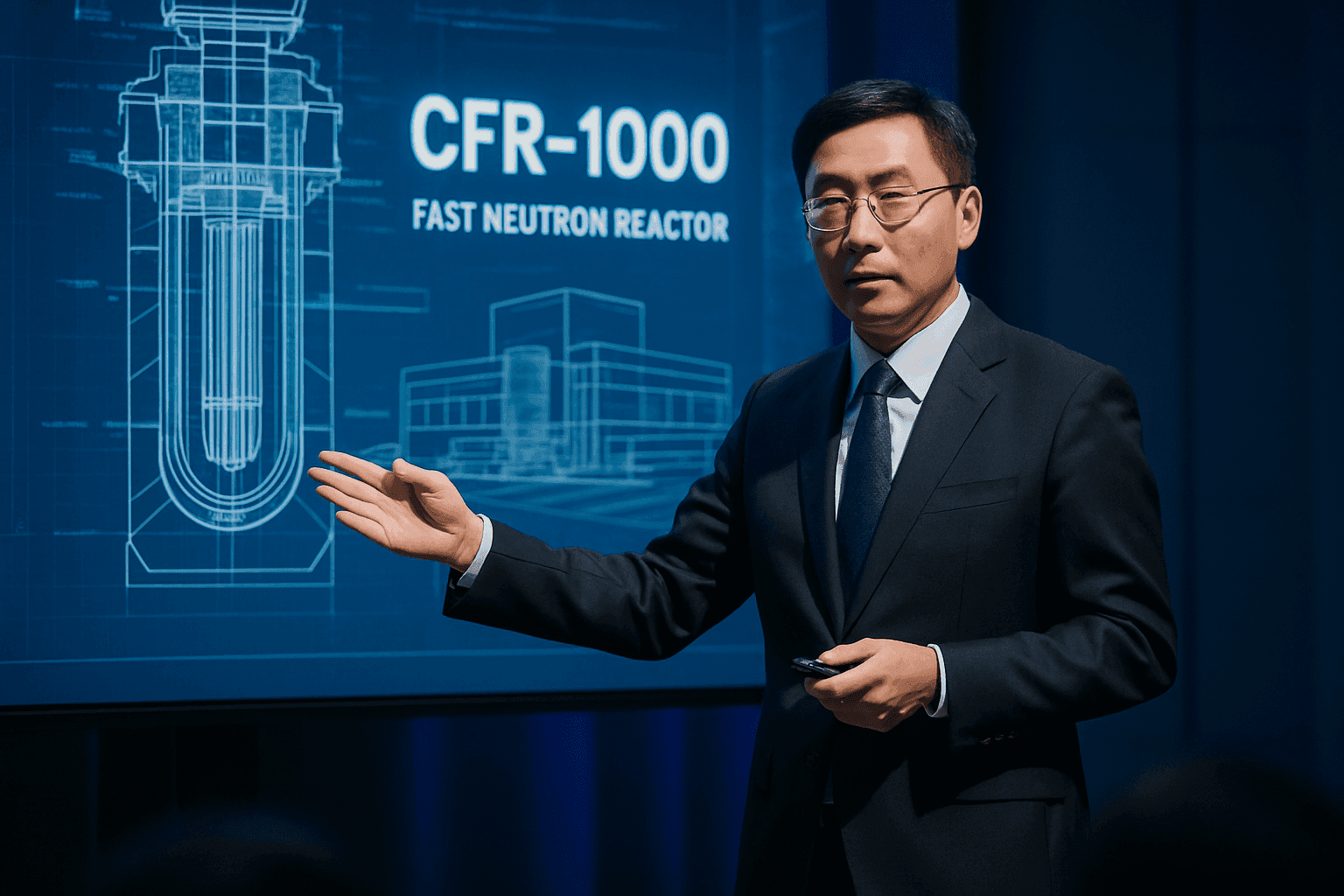
China Unveils Design for Gigawatt-Level Fast Neutron Reactor, CFR-1000
FUZHOU – China has announced the completion of the preliminary design for its first fourth-generation, gigawatt-level commercial fast neutron reactor, the CFR-1000. This significant development was unveiled by the China National Nuclear Corporation (CNNC) at a symposium on advanced nuclear energy development held in Fuzhou, Fujian province, on Tuesday. The CFR-1000, with an installed capacity of up to 1.2 gigawatts (GW) of electricity, represents a crucial step in China's long-term nuclear energy strategy, aiming for enhanced safety, sustainability, and economic performance.
What Is the CFR-1000?
The CFR-1000 is China’s proposed large commercial sodium-cooled fast reactor. Its name refers to the China Fast Reactor programme and its gigawatt-scale class, although the announced design has an installed electrical capacity of up to 1.2 GW. It is intended to follow China’s experimental CEFR reactor and the CFR-600 demonstration units, taking fast-reactor technology from research and demonstration towards commercial-scale deployment.
As a pool-type fast neutron reactor, the CFR-1000 would use liquid sodium as coolant rather than water and would operate with fast neutrons rather than the slowed, or thermal, neutrons used in most conventional nuclear power stations. CNNC has completed a preliminary design; the project remains subject to approval, a confirmed site, detailed engineering, construction and commissioning before commercial operation.
A Leap in Nuclear Energy Strategy
The unveiling of the CFR-1000's design signifies major progress in China's “three-step” technology roadmap for sustainable nuclear energy development: thermal reactors, fast reactors, and controlled nuclear fusion reactors. Fast neutron reactors are internationally recognized as a preferred type among fourth-generation advanced nuclear energy systems due to their advantages in fuel utilisation, waste reduction, and safety. This move is also part of China's broader efforts to improve its energy mix, ensure energy security, and meet its dual carbon targets by promoting green and low-carbon development.
Understanding Fast Neutron Reactors
Unlike conventional thermal reactors that use slowed neutrons, fast neutron reactors utilise fast neutrons to sustain nuclear fission and generate heat for power production. This distinction allows them to extract significantly more energy from uranium—potentially up to 60 times more than traditional reactors—by efficiently using uranium-238 in addition to the fissile U-235 isotope. This process, known as breeding, can produce new fissile material, such as plutonium-239, from uranium-238, thereby extending nuclear power programmes for thousands of years and improving nuclear waste management.
In a fast reactor, the chain reaction does not rely on a neutron moderator such as ordinary water. Liquid sodium is attractive as a coolant because it transfers heat efficiently while slowing relatively few neutrons. The heat produced in the reactor is transferred through the plant’s heat-transport systems to generate steam and drive a turbine, as in other electricity-generating nuclear stations, but the reactor physics and fuel cycle are materially different.
Advantages of the CFR-1000 Design
The CFR-1000 is a sodium-cooled pool-type fast neutron reactor, a technology considered the most mature and promising among fourth-generation concepts due to its high breeding ratio, strong capacity to transmute long-lived radioactive waste, and inherent safety features. With over 400 reactor-years of operational experience worldwide with sodium-cooled fast reactors, this technology offers a robust foundation for commercial application. The ability of fast reactors to transmute long-lived isotopes into shorter-lived ones further reduces the radiotoxic inventory and eases long-term storage challenges, enhancing the environmental sustainability of nuclear energy.
The pool-type arrangement places major primary-system components within a common sodium pool. This can reduce some external primary piping and is designed to provide substantial thermal inertia, but sodium technology also requires specialised engineering and operating controls. Sodium reacts chemically with water and air, so containment, leak detection, intermediate heat-transfer systems and fire protection are central considerations for any commercial CFR-1000 plant.
China's Journey in Fast Reactor Development
China has been actively developing fast reactor technology for over a decade. Its first experimental fast reactor, CEFR (China Experimental Fast Reactor), was connected to the grid in 2011. Building on this experience, China then initiated the construction of the CFR-600, a demonstration fast reactor, in Xiapu, Fujian province, with its first unit starting operation at a reduced capacity in 2023. The second unit of the CFR-600 is currently under construction.
This progression is significant for the CFR-1000 because a commercial-scale reactor depends on more than the reactor vessel alone. It requires proven fuel handling, sodium systems, instrumentation and control, component manufacturing, construction capability, operating experience and a regulatory basis that can support a larger plant. The CFR-600 programme is therefore an important technical and operational bridge between CEFR and the proposed CFR-1000.
Domestic Mastery and Global Standing
According to Zheng Yanguo, CNNC's deputy chief engineer, China has independently mastered all core and supporting technologies for large-scale fast reactors, establishing a comprehensive industrial chain. This puts China's fast neutron reactor technology among the global leaders. Other major nuclear powers, including Russia and the United States, are also pursuing advanced reactor designs with similar goals of fuel efficiency and cleaner power. Russia currently operates the world's largest capacity fast reactor, the BN-800.
For China, a domestic supply chain for large fast reactors would be important to the CFR-1000’s eventual economics and delivery timetable. Commercialisation will still depend on demonstrated reliability, construction performance, fuel-cycle arrangements, regulatory approval and the cost of electricity compared with other low-carbon generation technologies.
Future Outlook and Global Implications
The CFR-1000 is currently awaiting approval, with commercial operation anticipated to begin after 2030, possibly around 2034-2036. While the exact location for its construction has not been announced, its development is poised to redefine nuclear power's role in China's clean energy transition and cement the nation's status as a nuclear powerhouse. The long-term vision includes achieving 200 GW of nuclear capacity by 2035 and 400-500 GW by 2050, significantly offsetting CO₂ emissions.
If approved and built, the CFR-1000 would be an important test of whether China can deploy sodium-cooled fast reactors at gigawatt scale. Its performance would be measured not only by output, but also by availability, safety, fuel utilisation, waste-management outcomes, construction cost and the ability to replicate the design as part of a wider fleet.
The advancement of fast breeder reactors, however, also raises international discussions regarding non-proliferation, as these reactors produce plutonium, which can be used in nuclear weapons. While fast reactor development has seen declines or suspensions in many Western countries due to high costs and technical challenges, China and Russia are currently leading in this field. The continued progress of the CFR-1000 underscores China's commitment to this advanced nuclear technology.
