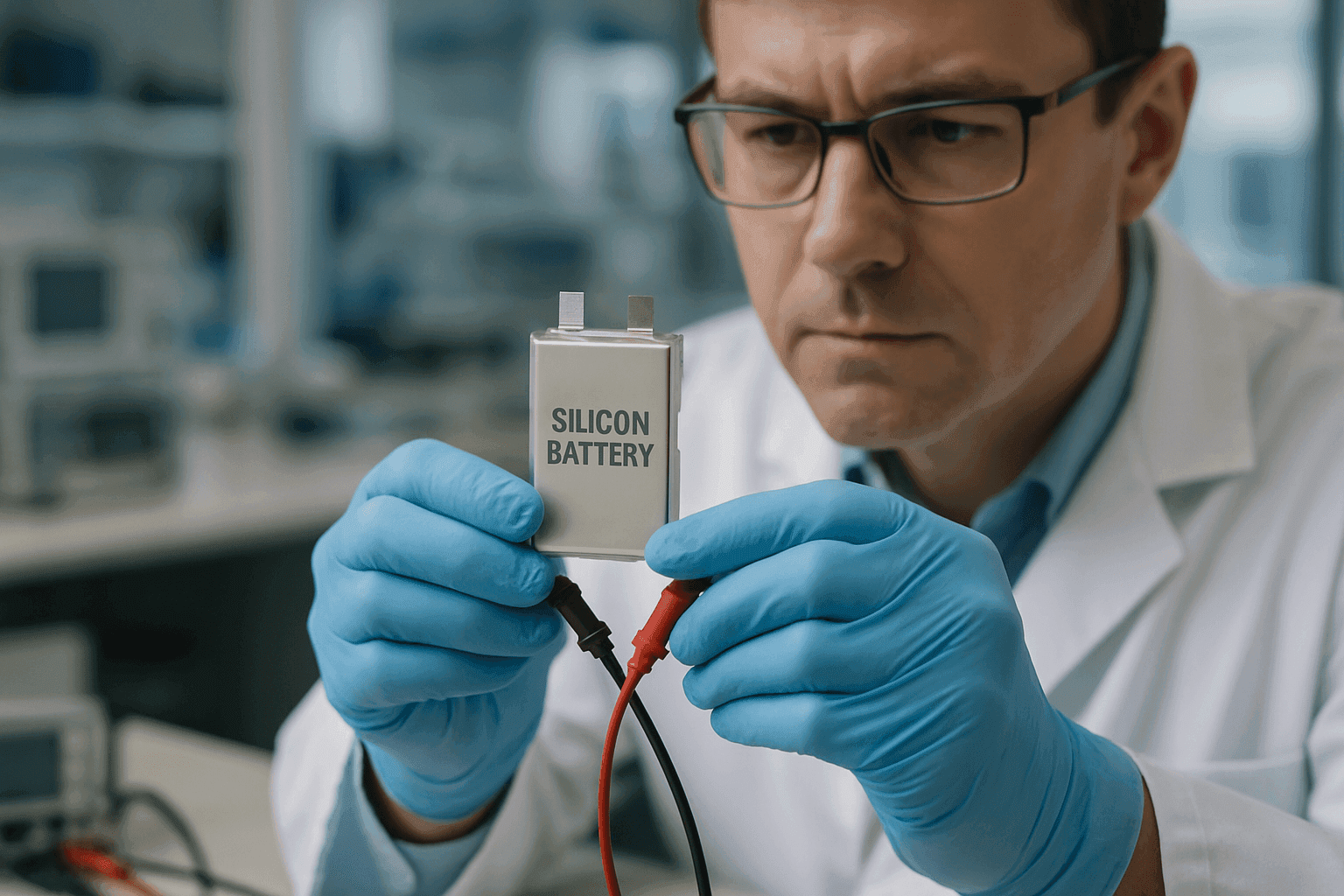
Silicon Battery Longevity Redefined: A 3,000-Cycle Leap
A significant advancement in battery technology has emerged with the announcement that next-generation silicon carbon batteries, powered by innovative composite materials, can consistently achieve over 1,500 charge cycles, and in some cases, surpass 3,000 cycles. This breakthrough fundamentally redefines durability standards for high-capacity rechargeable batteries, which have long aimed for a benchmark of 1,000 cycles for high-performance lithium-ion counterparts. This massive leap in silicon carbon battery lifespan signals a pivotal moment for energy storage across diverse applications, from electric vehicles to consumer electronics and large-scale grid systems.
The Untapped Potential of Silicon and Silicon-Carbon Anodes
For decades, graphite has served as the primary anode material in conventional lithium-ion batteries, a role it performs adequately but with inherent limitations in energy density. The theoretical maximum specific capacity of a pure graphite anode is structurally capped at:
Cgraphite=372 mAh/gSilicon, however, has long been recognised as a “holy grail” anode material due to its phenomenal theoretical capacity to store lithium ions. At room temperature, the theoretical specific capacity of silicon is approximately:
Csilicon=3,579 mAh/gThis is nearly ten times that of graphite on a per-mass basis. This exceptional capacity translates directly into higher volumetric and gravimetric energy density, meaning a silicon carbon battery can hold more charge in a smaller, lighter package. This offers the potential for significantly extended device runtimes and increased range for electric vehicles (EVs). Beyond superior energy storage, silicon anodes also promise faster lithiation kinetics, enabling rapid charging speeds—a crucial factor for modern consumer demands and the widespread adoption of electric transport.
The appeal of silicon also extends to its environmental footprint. Silicon is highly abundant and less reliant on rare and hazardous materials like cobalt, commonly found in traditional lithium-ion battery cathodes. Furthermore, the potential for recycling silicon-based anode materials is high, contributing to more sustainable lifecycle energy storage solutions.
Overcoming the Degradation Challenges: Do Silicon Carbon Batteries Degrade Faster?
A common question asked by automotive and electronics engineers is: do silicon carbon batteries degrade faster than traditional graphite batteries? Historically, the answer was yes. While silicon offers outstanding initial energy capacity, early-generation silicon anodes suffered from rapid, severe degradation that made them commercially unviable, often failing in fewer than 100 cycles.
This rapid silicon carbon battery degradation stems from three distinct physical and chemical phenomena:
- Extreme Volumetric Expansion: When lithium ions insert themselves into silicon (lithiation), the silicon host crystal expands by up to 300% to 400% of its original volume. During extraction (delithiation), it contracts back. This extreme physical breathing puts massive mechanical stress on the anode structure.
- Particle Pulverisation: Under repeated expansion and contraction cycles, pure silicon particles crack and break apart (pulverise). This causes a total loss of electrical contact between the active silicon material and the current collector, leading to immediate capacity loss.
- Solid Electrolyte Interphase (SEI) Instability: The protective SEI layer forms on the anode surface during the initial charge-discharge cycles. Because the underlying silicon continually expands and contracts, this SEI layer repeatedly cracks open, exposing fresh silicon to the liquid electrolyte. This triggers continuous SEI reformation, which consumes active lithium ions and depletes the battery's electrolyte.
The chemical degradation and capacity retention R(n) of an unmitigated silicon anode over cycle number n can be modelled using a simplified exponential decay function:
R(n)=R0⋅(1−α)nWhere R0 is the initial capacity and α represents the fractional capacity loss per cycle (the degradation coefficient). For raw silicon anodes, α is exceptionally high due to continuous SEI reconstruction and lithium inventory depletion. In contrast, modern engineered silicon-carbon battery lifespan solutions successfully minimise α to levels comparable to graphite.
For years, the industry benchmark for high-performance lithium-ion batteries has been 1,000 charge cycles. Overcoming these fundamental materials science challenges to enable a silicon-carbon composite anode to meet, and now vastly exceed, this benchmark represents a monumental engineering feat.
Group14's SCC55: A Catalyst for Silicon Carbon Battery Longevity
The recent breakthrough in silicon carbon battery cycle life is largely attributed to advanced silicon-carbon composite materials developed by Group14 Technologies, specifically their product known as SCC55®. This engineered material is enabling battery manufacturers to consistently achieve over 1,500 charge cycles across a range of applications, with some test instances demonstrating performance beyond 3,000 cycles.
Rick Luebbe, CEO and Co-Founder of Group14 Technologies, emphasised this shift, stating that “1,500 cycles is the new 1,000” for silicon-containing batteries, marking a new era of durability combined with higher energy density and ultra-fast charging.
Group14's technology relies on a highly sophisticated silicon-carbon composite structure. Instead of using pure silicon particles, SCC55 embeds amorphous nano-silicon within a rigid, highly conductive porous carbon scaffold. This carbon framework acts as an internal elastic buffer. It provides designed void space that internally accommodates the silicon’s volume changes during lithiation without fracturing the outer shell of the anode particle.
This elegant mechanochemical solution ensures that:
- The outer particle boundary remains stable, preventing SEI layer disruption and continuous electrolyte consumption.
- Excellent electrical conductivity is maintained throughout the anode's structural network.
- Active lithium is not prematurely trapped or depleted, directly improving overall silicon carbon battery longevity.
The SCC55 material is highly compatible with various conventional and next-generation battery chemistries, including Lithium Iron Phosphate (LFP), Lithium Manganese Iron Phosphate (LMFP), and high-nickel formulations (such as NMC). This drop-in compatibility makes it highly versatile for integration into existing gigafactory manufacturing lines. Millions of consumer and industrial products worldwide are already utilising Group14's silicon battery material technology.
Comparing Anode Material Metrics
To understand where the modern silicon carbon battery life cycle stands in relation to traditional materials, the table below highlights key performance differences across different anode configurations:
| Anode Material Chemistry | Specific Capacity (mAh/g) | Typical Volumetric Expansion | Practical Cycle Life (Unmitigated) | Commercial Cycle Life (With Advanced Composites) |
|---|---|---|---|---|
| Traditional Graphite | 372 | ~10% | 1,000 to 3,000+ | 1,000 to 3,000+ |
| Pure Silicon (Unstructured) | ~3,579 | 300% to 400% | < 100 | N/A (unviable) |
| Silicon-Carbon Composite (Si-C) | 500 to 1,500 | 20% to 150% | < 300 | 1,500 to 3,000+ (e.g. SCC55) |
Implications Across Key Sectors
Achieving stable 3,000-cycle performance in silicon carbon batteries has profound implications for a multitude of battery-reliant industries:
Electric Vehicles (EVs)
For the automotive industry, increased battery longevity directly translates to a lower total cost of ownership and enhanced reliability for EVs. Longer-lasting batteries reduce the need for costly pack replacements over the vehicle's operational lifespan, addressing a key consumer concern and potentially accelerating global EV adoption. Furthermore, the higher energy density of silicon carbon batteries could extend EV range by up to 30%, and their fast-charging capabilities—potentially enabling full charges in as little as 10 minutes or even 90 seconds—could alleviate “range anxiety” and completely transform charging infrastructure requirements.
Consumer Electronics
Smartphones, laptops, and wearables stand to benefit immensely from more durable, higher-capacity silicon carbon batteries. Users can expect devices with longer daily runtimes between charges, faster charging times, and slimmer physical designs due to silicon's higher volumetric density. Additionally, because the silicon carbon battery cycle life is so high, the frequency of device upgrades driven by degraded battery health will fall sharply, resulting in less electronic waste.
Electric Vertical Take-off and Landing (eVTOL) Aircraft
The nascent eVTOL and urban air mobility industry, which relies heavily on ultra-powerful yet lightweight energy sources, will find silicon carbon batteries particularly advantageous. The combination of high power output, high gravimetric energy density, and robust cycle life is critical for achieving viable flight durations, maintaining safe power margins, and ensuring the economic feasibility of air taxi and drone delivery services.
Energy Storage Systems (ESS) for AI Data Centres and Grids
As data centres increasingly power intensive artificial intelligence workloads, their energy demands are escalating exponentially. High-performance, long-duration battery storage systems are becoming essential for ensuring uninterrupted power supply (UPS) and managing peak demand. Similarly, for renewable energy grids, robust energy storage solutions are paramount for balancing intermittent energy sources like solar and wind. The enhanced durability and cycle life of silicon carbon batteries make them an incredibly attractive option for these critical infrastructure applications, improving overall system reliability and lowering capital expenditure over time.
The Future of Energy Storage
This milestone by Group14 Technologies, validated by rigorous performance data from over 20 global customers across various applications, underscores a massive paradigm shift in electrochemical energy storage. While early silicon-based batteries struggled to reach even 100 cycles, and the legacy industry standard for high-performance lithium-ion batteries sat at 1,000 cycles, the consistent attainment of 1,500+ cycles, with peak performance exceeding 3,000, establishes a brand new baseline for all rechargeable batteries.
The rapid progress in silicon anode technology, driven by innovations in advanced porous carbon composites and polymer binders, signifies that the long-standing challenges of volume expansion and SEI instability are finally being solved. This not only positions the silicon carbon battery as a highly viable alternative to graphite, but potentially as the new global standard for high-performance rechargeable batteries. As research and manufacturing scale-up continue to advance, further improvements in cost, yield, and integration efficiency are anticipated, paving the way for silicon-carbon chemistries to power our electrified future.
