
Process Modelling for Efficient Scale-Up in Chemical Manufacturing
Scaling up a chemical process from laboratory bench to industrial production is a complex endeavour, with challenges that can jeopardise efficiency, safety and profitability. Differences in heat transfer, mixing and reaction kinetics at varying scales can produce unexpected behaviour, making direct, linear scale-up nearly impossible. Process modelling turns trial and error into predictive engineering, saving time, reducing costs and accelerating chemical-manufacturing innovation.
Understanding Process Modelling in Chemical Engineering
Process modelling develops mathematical representations of chemical processes. These models allow engineers to simulate, analyse and predict performance under different conditions, informing design, optimisation and control. A model is effectively a digital twin of a physical process, enabling virtual experiments and a clearer understanding of underlying mechanisms.
A useful model has a defined purpose and boundary. It may represent an individual reactor, a separation train, a utility system or an entire plant. The required detail depends on the decision: a flowsheet model may be sufficient for mass and energy balances, while reactor scale-up may require dynamic kinetics, heat removal, mixing and mass-transfer effects.
Types of Process Models
Chemical engineers primarily use three types of process model:
- Mechanistic Models (First Principles Models): Built on physical and chemical laws, including conservation of mass and energy, these models describe process phenomena from first principles. They can be extrapolated beyond the initial experimental-data range.
- Empirical Models: Developed from experimental data, these models establish relationships between input and output variables without necessarily describing the underlying physics. They are often simpler to develop but may be less reliable outside the data range used to create them.
- Hybrid Models: These combine mechanistic and empirical approaches, using fundamental principles for well-understood aspects and empirical correlations for phenomena that are difficult to model mechanistically. They can provide robust predictions with less complexity than fully mechanistic models.
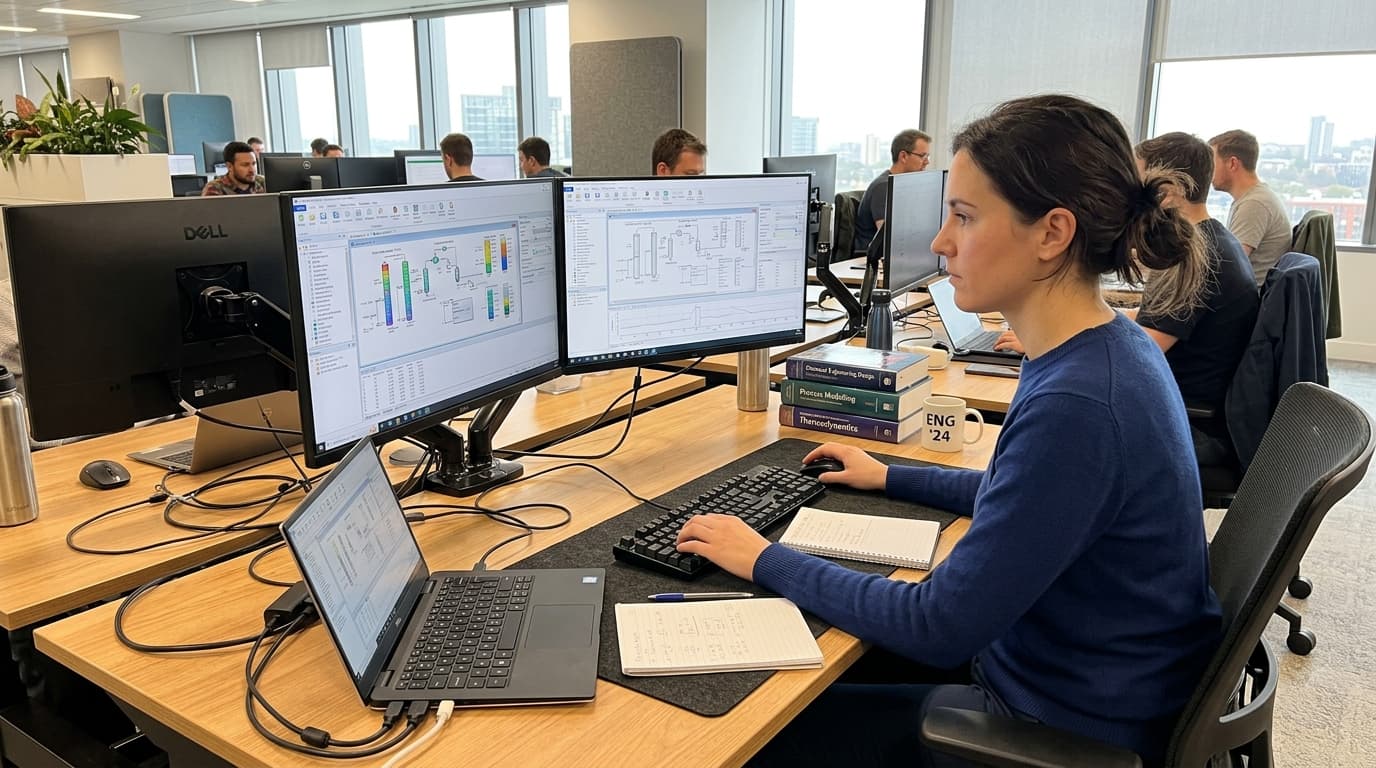
Build a digital twin of your process — from steady-state simulation to dynamic modelling — to test scenarios, optimise control, and predict plant behaviour.
The Critical Role of Process Modelling in Chemical Scale-Up
Chemical process scale-up is the disciplined transfer of a process from laboratory or pilot equipment to commercial manufacture while maintaining product quality, throughput, safety and economic performance. It is not simply a matter of increasing vessel volume or flow rate. A larger vessel has a different surface-area-to-volume ratio, circulation pattern, residence-time distribution, heat-removal capacity and mixing time. These differences can change conversion, selectivity, crystallisation behaviour, impurity profiles and the response to disturbances.
The transition from laboratory equipment to an industrial plant is rarely straightforward. Factors negligible at small scale can become dominant at larger scale, changing process dynamics and kinetics. Process modelling addresses these challenges by:
- Predicting Performance: Models can predict large-scale behaviour while accounting for changes in heat transfer, mixing and mass-transfer rates. Heat-transfer rate depends on the surface-area-to-volume ratio, which decreases during scale-up and can affect exothermic and endothermic reactions and impurity generation.
- Reducing Experimental Costs and Time: Virtual testing of process designs and operating parameters reduces the need for expensive physical experiments, including pilot-plant trials.
- Improving Process Safety: Modelling identifies potential hazards, uncontrolled reactions and undesirable behaviour before construction, allowing design changes and mitigation strategies to be developed.
- Optimising Operating Conditions: Simulations identify operating conditions that improve yields and reduce energy consumption.
- Accelerating Innovation and Time-to-Market: Streamlined development and scale-up can speed commercialisation of products and technologies.
Scale-Up Criteria That Require Explicit Modelling
For chemical process scale-up, engineers identify the dimensionless groups and operating criteria that govern the process rather than attempting to preserve every laboratory condition. Depending on the unit operation, these may include power input per unit volume, impeller tip speed, Reynolds number, heat-transfer coefficient, gas superficial velocity, residence time and pressure drop. The appropriate criterion differs between a reaction, a gas-liquid system, a crystalliser, a filter and a distillation column.
An exothermic batch reaction may be limited by the rate at which heat can be removed through the vessel jacket or coil. A model should compare the reaction heat-release profile with available cooling capacity, account for the effect of viscosity on mixing, and test credible deviations such as delayed feed, loss of cooling or an incorrect charging sequence. In gas-liquid reactions, the model must also consider whether gas dispersion and mass transfer remain adequate as vessel geometry and agitation change.
3D Modelling in the Chemical Industry
3D modelling complements process simulation by creating a spatial representation of equipment, pipework, structures, access routes and utilities. While a process model determines what must happen thermodynamically and hydraulically, a 3D plant model tests whether the design can be built, operated, maintained and safely isolated within the available space.
For a scale-up project, 3D modelling becomes particularly valuable once major equipment duties and preliminary sizes are available. Engineers can position reactors, columns, heat exchangers, pumps, tanks, instruments and pipe racks; assess line routing and elevation changes; and identify constructability issues before fabrication. It also bridges process engineers, mechanical engineers, piping designers, operations teams and contractors.
- Equipment layout and maintainability: A 3D model verifies lifting space, access to valves and instruments, removal paths for pumps and heat-exchanger bundles, platform locations and safe operator access.
- Piping and hydraulic design: Pipe routing affects pressure losses, pump duty, drainage, venting, dead legs and the ability to clean or sterilise a system. These details can be checked against the process model and piping specifications.
- Clash detection: Coordinated 3D models reveal conflicts between pipes, steelwork, cable trays, ducting and equipment before site work begins, reducing rework and schedule risk.
- Safety and operability reviews: The model supports reviews of hazardous-area layouts, escape routes, access to emergency equipment, segregation of incompatible materials and safe chemical handling.
- Existing-facility integration: Laser scans and point clouds can be incorporated when expanding a live plant, allowing new equipment and tie-ins to be designed around verified conditions.
3D modelling does not replace process modelling or detailed engineering calculations. Its value is greatest when data remains connected: equipment tags, design pressures, temperatures, line sizes, material specifications and process conditions should be consistent across the process flowsheet, piping and instrumentation diagrams, and the 3D model. This reduces discrepancies during design reviews, procurement, construction and commissioning.

Build a digital twin of your process — from steady-state simulation to dynamic modelling — to test scenarios, optimise control, and predict plant behaviour.
The Process Modelling Workflow for Scale-Up
A structured approach to process modelling for scale-up typically follows several stages:
- Laboratory-Scale Experimentation and Data Collection: Initial experiments establish process chemistry, kinetics and thermodynamics. Data should cover the expected operating range, including feed composition, temperature, concentration, agitation, and relevant impurity or particle-size measurements.
- Problem Definition and Model Formulation: The team defines the problem, modelling goals, success criteria, model boundaries, critical quality attributes, critical process parameters and the decisions the model must support. Physical and chemical phenomena are then translated into mathematical equations.
- Model Development and Solution: Based on collected data and fundamental principles, the appropriate mechanistic, empirical or hybrid model is developed and solved using numerical methods. Thermodynamic-property methods, reaction kinetics, transport correlations, equipment geometry and control logic should match the process and available evidence.
- Model Validation: The model is validated against experimental data, ideally from different scales such as laboratory and pilot plant, to assess its accuracy and predictive capability. Validation should compare predicted and observed conversion, temperature, composition, yield, pressure and product quality, rather than relying on a single favourable run.
- Process Design and Simulation: The validated model simulates scale-up scenarios, allowing engineers to predict large-scale performance, identify bottlenecks and optimise conditions. Sensitivity analysis shows which uncertain inputs most affect safety, capacity, yield and energy demand.
- Pilot-Scale Testing (and Validation): For complex processes, pilot-scale testing remains important for validating model predictions and gathering data under conditions closer to industrial scale. Model-based approaches transfer insights from smaller scales while minimising large-scale experiments.
- Industrial-Scale Design and Construction: The validated model informs commercial-plant design, helping ensure that equipment sizing and process parameters support efficient, safe operation. Process information should be coordinated with 3D modelling, piping design, control-system design and operability reviews.
- Continuous Monitoring and Improvement: After commissioning, models can support monitoring, troubleshooting and further optimisation as part of a digital-twin strategy. Comparing plant data with model predictions can identify fouling, changing raw-material quality, control issues and capacity constraints.
Essential Tools and Software for Process Modelling
The complexity of chemical processes requires advanced simulation software to implement and solve process models. Common tools include:
- Aspen Plus: Commercial simulation software for rigorous modelling of chemical processes, supporting batch and continuous operations, including applications such as carbon capture and hydrogen electrolysis.
- Aspen HYSYS: AspenTech software widely used for process simulation, design and optimisation, particularly in oil, gas and petrochemical industries.
- COMSOL Multiphysics: Commercial software using finite-element methods for multiphysics problems, including fluid flow, heat transfer and mixing through computational fluid dynamics (CFD).
- CHEMCAD: An integrated chemical process simulation suite with an intuitive interface.
- gPROMS: Process Systems Enterprise software with advanced capabilities for dynamic simulation and optimisation.
- Ansys: A suite of simulation tools, including CFD, for materials and chemical processing.
- DWSIM: An open-source, CAPE-OPEN-compliant chemical process simulator with steady-state and dynamic simulation capabilities.
- Dynochem: Software designed for process development and scale-up, including reaction kinetics, mixing and process-safety assessments, particularly in pharmaceutical manufacturing.
These tools support mass and energy balances, thermodynamic modelling, transport-property modelling, equipment sizing and economic analysis. They are often used alongside CFD tools for local effects and 3D design platforms for plant layout. Software selection should follow the decision required: a plant-wide flowsheet, dynamic batch model, reactor mixing study and 3D layout review each require different capabilities and levels of detail.
Challenges and Future Trends in Process Modelling
Process modelling for scale-up still presents challenges. Accurate mechanistic models require deep understanding and high-quality experimental data. Uncertainty can be significant when modelling novel chemical processes, especially at low technology readiness levels (TRL), because historical data may be scarce and transfer mechanisms may differ at scale. Models are not fully accurate and require engineering judgement.
Model risk should be managed explicitly. Assumptions, property-method choices, uncertain parameters, validation evidence and the intended operating range should be documented. A model suitable for preliminary equipment sizing may not be reliable enough for relief-system design, product-release decisions or a major capital commitment without further validation.
Key trends include:
- Integration of AI and Machine Learning (ML): AI and ML algorithms are being integrated into simulation software to improve predictive modelling, optimise processes and accelerate development.
- Digital Twins: Digital-twin models of existing facilities can support continuous optimisation, predictive maintenance and real-time decision-making.
- Cloud-Based Solutions: Cloud platforms provide flexibility, scalability and accessibility for process simulation, enabling collaborative work and faster computations.
- Process Intensification (PI): Process modelling supports the development and scale-up of intensified chemical processes, which increase driving forces for transport phenomena, separations and reactions.
- Enhanced Interoperability: Development is likely to focus on better integration between simulation tools, 3D plant models and experimental-data platforms.
